Payment Gateway vs Processor vs Switch: What's the Difference?

Content authorBy EGSPublished onReading time10 min read
A modern workspace with a glowing smartphone, a card reader, server block, and switchboard, all softly lit on a wood grain surface.

A gateway captures and secures payment data at the point of entry. A processor carries authorization messages between the acquirer and the issuer, then handles clearing and settlement. A switch decides where each message goes. Three separate responsibilities, frequently sold together under one contract, which is where the confusion starts.

What does each payment component do?

Each of the three owns a different job, from data security to route selection. That separation is architectural. One vendor can sell you all three under a single brand and a single application programming interface (API), so the label on the proposal does not tell you which functions you're actually buying.

The reason the boundaries matter is regulatory and operational. Card data handling sits under the Payment Card Industry Data Security Standard (PCI DSS), while settlement ownership sits with a licensed acquirer. Routing control sits wherever the switch physically lives.

Three questions cut through most vendor decks:

  • Which system is the first to touch a raw Primary Account Number (PAN), and where is it stored?

  • Who holds the acquiring license and pays out to your merchant account?

  • Who can change a routing rule, and how long does that change take?

If a single provider answers all three with itself, you have an integrated stack. That's a fine choice, and you should know you made it deliberately.

A gateway secures payment data

The gateway is the entry point that takes payment details and converts them into something safe to move. It captures card data from a checkout page or a terminal and encrypts or tokenizes it, then hands a clean transaction request forward after early validation like Luhn checks and address verification.

Tokenization is what makes the gateway worth isolating. Replace the PAN with a surrogate value and most of your infrastructure falls out of the cardholder data environment. According to guidance from the PCI Security Standards Council, properly implemented tokenization substantially reduces the number of systems subject to PCI DSS controls, while encrypted PANs stay in scope because encryption is reversible.

So the gateway decision is a compliance-scope decision disguised as an integration decision. Whoever holds your token vault holds your audit boundary, and moving vaults later means re-tokenizing your entire card-on-file base. Ask about token portability before you sign.

A processor executes transaction messaging

The processor is the component that builds and interprets the actual transaction messages. It formats the authorization request and transmits it toward the network and issuer, then assembles captured transactions into clearing files that trigger settlement.

Those messages follow a defined grammar. In ISO 8583, the four-digit Message Type Indicator classifies everything, where 0100 is an authorization request from the acquirer and 0110 is the issuer's response carrying an approval code in data element 38 or a decline code in data element 39.

Here's what that structure implies for your roadmap. Because response codes are standardized but issuer decline reasons are not, two processors handling identical traffic will surface different diagnostic detail, and that difference decides whether your retry logic is intelligent or blind. Ask any processor for its raw decline-code mapping documentation. If they won't share it, you're building recovery logic on guesswork.

A switch selects the transaction route

The switch is the decision layer that picks a destination for every message. It reads attributes on the transaction and matches them against rules you configure before forwarding the message to the chosen endpoint. Bank Identification Number (BIN) and transaction cost are the usual inputs.

Routing rights are sometimes law. The Federal Reserve confirmed in 2022 that under Regulation II, the merchant or a processor acting on the merchant's behalf picks the debit network, and a processor can't opt the merchant out of that right.

That legal detail exposes something worth checking in your own stack. If your switch is owned by a party that earns margin on the route it selects, its default configuration won't be tuned for your cost, and stale BIN tables quietly cost you basis points on every debit transaction. Request the routing table in writing. A refusal is itself the answer.

Start building your financial platform?

Speak with EGS engineers about open banking, payment infrastructure, cloud systems, and enterprise software.

Get in Touch

The components differ by responsibility

The cleanest way to separate them is by looking at what each component is accountable for:

  • Gateway: Captures and secures payment data from checkout, POS, or wallets. It uses encryption or tokenization and typically has the main PCI DSS capture scope. Routing is minimal or handled elsewhere.

  • Processor: Executes authorization and clearing messages between acquirers, card networks, and issuers. It handles structured transaction requests and returns response codes and clearing files.

  • Switch: Decides where each transaction message should go. It uses transaction attributes and configurable rules to route messages between processors, acquirers, and networks.

In practice, the distinction is simple: the gateway secures the data, the processor executes the transaction, and the switch chooses the route. One provider may perform all three functions, which is why these terms are often used interchangeably.

How do they work together?

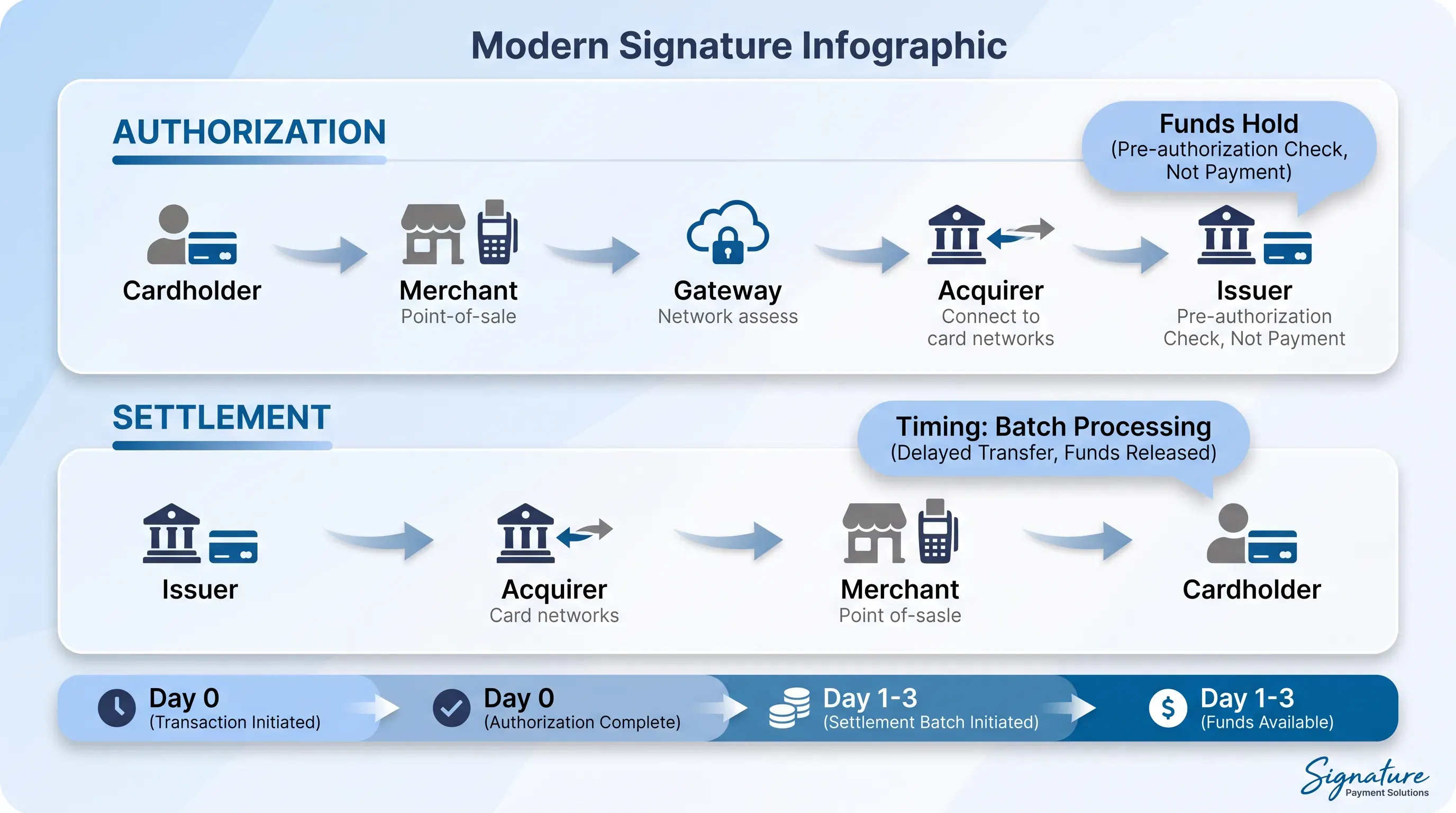
Modern infographic illustrating payment processing with a flow diagram separating Authorization and Settlement, featuring soft gradients and flat icons.

They work in sequence, and the sequence is shorter than most architecture diagrams suggest. Data flows from checkout through securing and routing, then out to the network and issuer, and the response returns along the same path. Real deployments compress this constantly, because a switch is frequently a module inside a processor or a gateway.

That compression is why vendor conversations go sideways. You're comparing a four-box diagram against a provider who does three of those boxes in one service and calls the whole thing a gateway.

Authorization moves data both ways

Authorization is a round trip that completes in about two seconds. Checkout hands card data to the gateway, which tokenizes it and passes a request onward. The switch selects a route and the network delivers it to the issuer.

Visa's stated average authorization response time is under two seconds, against network availability the company claims at six nines. Notice where the time actually goes. Network transit is a small fraction of that budget, so when your checkout feels slow, the culprit is almost always your own gateway hops or fraud-screening calls.

An approval at this stage places a hold. No money has moved yet, and confusing the two breaks reconciliation.

Settlement moves money later

Authorization confirms funds are available. Settlement actually moves them, on a separate timeline, through different systems. The acquirer batches captured transactions and submits them to the network for clearing, where positions net across issuers and acquirers. Settlement banks then pull funds from issuers and push them to acquirers.

Card networks settle most currencies on a T+0 to T+2 basis that excludes weekends and local bank holidays, and a single acquirer can run several settlement services at once so timelines vary across one portfolio.

For product teams, this has a direct consequence: any dashboard built on authorization timestamps will disagree with your bank statements forever. You need the settlement or funding date as a distinct field from your processor, because reconciliation against authorization data produces permanent phantom discrepancies that engineering will chase for quarters.

Start building your financial platform?

Speak with EGS engineers about open banking, payment infrastructure, cloud systems, and enterprise software.

Get in Touch

Why do vendor labels overlap?

Labels overlap because bundling is a commercial strategy. Gateways add acquiring. Acquirers build gateways. Payment service providers (PSPs) resell processing under their own brand. Orchestration platforms sit above everything and route across the lot. The word on the contract reflects positioning.

Licensing is the hard boundary underneath the marketing. An acquirer must hold an acquiring license in every region where it operates, which raises the barrier to entry considerably compared with a processor, and that requirement is the difference no rebrand can hide.

Verify five things instead of trusting the label:

  1. Which entity holds the license and appears on your merchant agreement

  2. Who receives settled funds and on what cycle

  3. Whether the token vault is theirs, yours, or a third party's

  4. Who can modify routing rules and how

  5. Which party you call at 3 a.m. during an outage

Work through that list and the pretty diagram in the sales deck reorganizes itself into an accountability map. That map is what you're actually procuring.

Which architecture fits your fintech?

Pick based on how much routing control your economics require, because everything else follows from that. Launch speed favors one provider. Multi-market expansion and outage resilience favor separation. Transaction volume determines when the second option starts paying for itself.

Payment method mix pushes hard in one direction. Digital wallets reached 56% of global e-commerce value in 2025 according to the Worldpay Global Payments Report 2026, and local rails dominate specific markets, with iDEAL taking two-thirds of Dutch shoppers.

Which means the architecture question is downstream of your market plan. If you sell into one country on cards, you'll never feel the constraint of an integrated stack. If you sell into six countries where each needs a different local method and probably a different local acquirer, you'll hit the ceiling within a year of launch, and rebuilding under revenue pressure costs more than building it right while you're small.

Integrated stacks simplify early launches

One provider covering gateway and processing gets you live fastest with a single integration and one contract. Fewer moving parts means fewer reconciliation feeds and fewer certifications.

Outsourcing the payment path is also the most effective scope-reduction move available. Tokenized architectures can remove the majority of systems from assessment, with providers reporting up to 90% scope reduction for comprehensive implementations, though the vault and any detokenizing system stay fully in scope.

The trade you're making is leverage. A single provider sets your pricing without competitive pressure and gives you one point of failure at checkout. All of it hurts at scale, so build with an exit in mind even while you're choosing convenience.

Modular stacks provide greater control

Separating the gateway from processing lets you route across providers and fail over when one path degrades. The gain is measurable and specific to routing quality.

ACI Worldwide found that 85% of merchants moving to a multi-acquirer setup saw conversion increase, and Ahmed Tadele of ACI reported 12 to 16% conversion gains where smart dynamic routing was in place across the company's database. Solidgate's merchant Zeely recorded an 8 percentage point approval lift by cascading across JPMorgan Chase and Adyen.

Those numbers come with a staffing bill nobody puts in the proposal. Multiple settlement files and per-provider decline taxonomies need owners. Below roughly a few million dollars in annual volume, the approval-rate gain won't cover the engineering hours, which is the calculation to run before you commit.

Need help designing your payment stack?

Start by mapping which component owns each responsibility in your current or planned setup, then decide where you need control and where you're comfortable outsourcing.

EGS is a payment technology partner that builds and integrates the layers described here. The team works on card processing software and payment infrastructure, which means the same conversation covers your gateway choice and your routing logic.

If you need to define an architecture from scratch or modernize a stack that has quietly grown past what it was designed for, book a call with EGS. Bring your current integration diagram and your market roadmap for the next 18 months. Those two documents are enough to tell whether an integrated provider or a modular stack fits what you're building.

Start building your financial platform?

Speak with EGS engineers about open banking, payment infrastructure, cloud systems, and enterprise software.

Get in Touch

A merchant identification number, or MID, is the identifier an acquirer assigns to a merchant account. It links transactions, fees, chargebacks, and deposits to that account. Keep MIDs documented by legal entity and country, since one business can use different MIDs across acquirers or payment methods.

A refund returns money after a captured transaction has entered the settlement process. An authorization reversal releases an unused or cancelled authorization hold before settlement. Send the correct message promptly, because a refund doesn't remove the original debit and can take time to appear on the cardholder's statement.

Test an approval and a decline, then confirm that your system records the processor's transaction ID. Test duplicate submissions in a separate case. A sandbox checks integration behavior, but it doesn't reproduce every issuer response, so validate the live configuration through the provider's required certification process.

Document who owns incident response and how your checkout behaves when authorization times out. Don't automatically retry every failed request, because an issuer can approve the original transaction after the timeout. Use idempotency keys and reconcile uncertain transactions against processor records before charging a customer again.

Yes, if the gateway supports each processor and exposes routing controls for your account. Confirm whether it can send tokens to every chosen processor, since gateway-specific tokens often aren't usable elsewhere. You also need separate merchant accounts and reconciliation processes for each acquiring relationship.

Schedule a Meeting

Book a time that works best for you

You Might Also Like

Discover more insights and articles

A modern banking operations center featuring a central dashboard with transaction flow stages, bank engineers monitoring the system.

How Financial Institutions Process Transactions in Real Time

A financial institution processes a transaction in real time through an always-available system that validates and posts it in seconds, with decision and confirmation built into the flow. An incoming request passes through synchronous APIs for immediate checks and asynchronous events for parallel work. Authorization and fraud screening finish inside the same tight, continuous window as ledger posting and customer notification.

A close-up of a hand inserting a payment card into a POS terminal, with a laptop nearby and soft daylight illuminating the scene.

What Happens Behind the Scenes of a Card Payment

A card payment runs in two separate acts. Authorization takes about two seconds and only reserves money: the terminal sends a message through the acquirer to the issuer, which replies approve or decline. Clearing then batches that sale and settlement moves the actual funds, so the merchant is paid one to three business days later.

A modern office desk displays six realistic payment devices connected by blue and white arrows, emphasizing a card payment ecosystem.

How Payment Transactions Are Routed Between Banks, Switches, and Processors

A card payment travels from the terminal through the acquirer's processor and a switch that picks the path before crossing the card scheme to the issuing bank and returning along the same chain with an approve or decline. Six participants move the payment in two directions on a round trip that finishes in under two seconds.

A collaborative fintech team discusses around a central table, with a hand-drawn workflow diagram on a whiteboard in a modern office.

Top Security Mistakes in Fintech Infrastructure (and How to Avoid Them)

The most damaging fintech security mistakes are architectural rather than tactical. Weak identity controls and secrets stored in code are common examples. Flat networks can also cause damage. Incomplete logging and fraud detection that never talks to the security stack create further risks. Each one lets a single compromise reach money movement and customer data at once, which is why they must be designed out before launch.