Automated top-ups prevent avoidable shortfalls
Automated top-ups are rules that fire a liquidity transfer when your balance crosses a defined threshold, without waiting for a person to notice. The rule set needs a trigger level and a fallback if the transfer fails.
Controls belong in the same rule set. Per-transfer caps and daily aggregate limits keep an automation bug from moving your entire master account balance, and every action needs a timestamped audit record. The liquidity management transfer window on FedNow constrains when funds can move between accounts, so automation has to know the calendar as well as the balance.
Here's the part that trips up new implementations. An automated top-up that can't execute because the funding rail is closed is an alert with extra steps. Design the rules so a failed transfer escalates to a human with a pre-authorized alternative, and test that path during a weekend before you rely on it.
What happens when liquidity runs short?
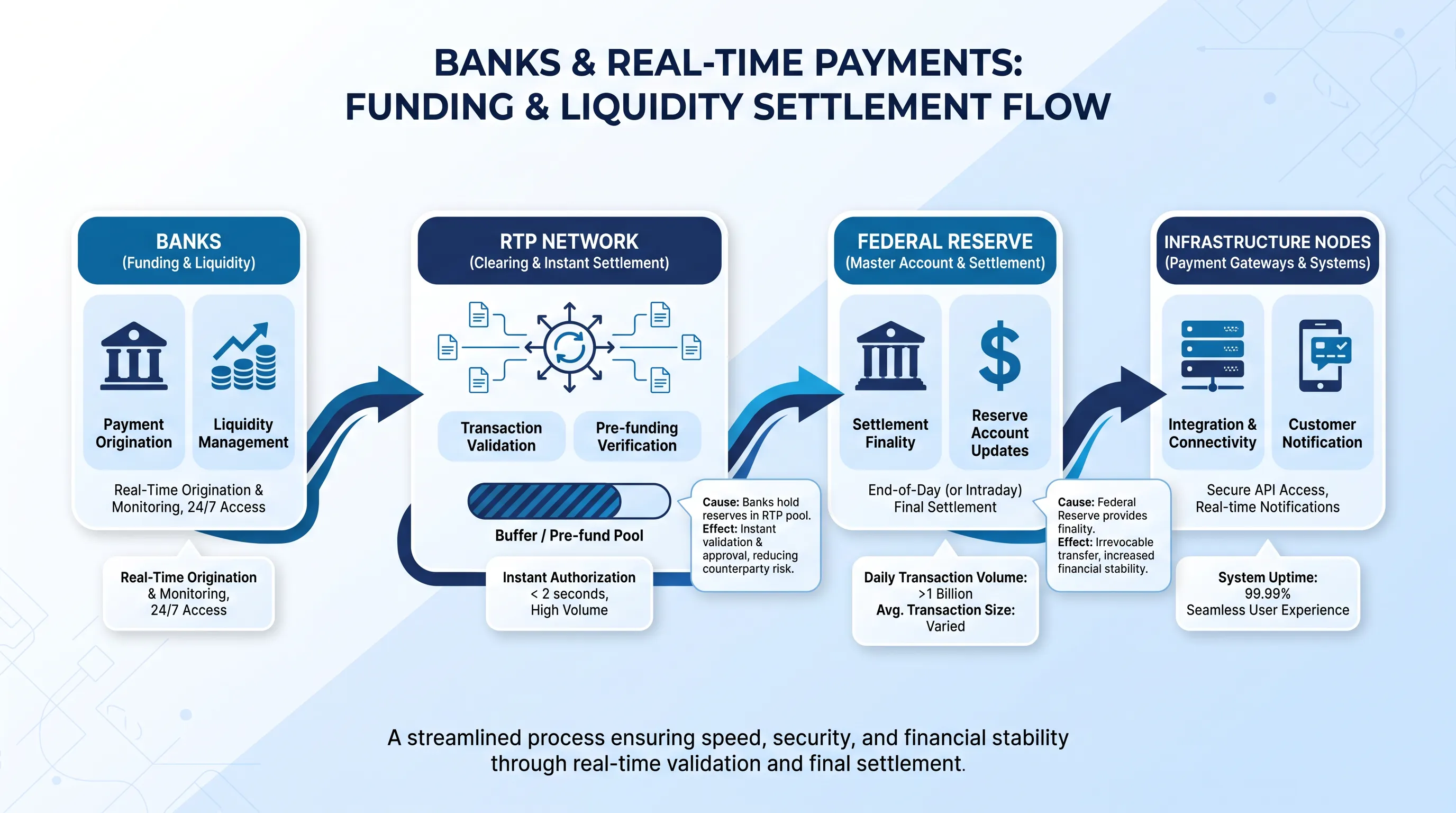
When liquidity runs short, the outcome depends entirely on the scheme, and on the RTP network it's outright rejection. There's no queue and no partial settlement. Other schemes handle shortfalls differently, with queueing or an intraday overdraft against the master account.
The Federal Reserve flagged the overdraft scenario explicitly when designing FedNow, because a participant with unexpectedly high outgoing volume during hours when Fedwire isn't operating may incur an overnight overdraft it can't cure through a transfer from another participant.
The damage compounds beyond the failed transaction:
-
A rejected payment reaches the customer as a failure with no explanation they'll accept, since the money was in their account
-
Overnight overdrafts carry cost and supervisory attention, and repeated ones invite questions about your liquidity risk framework
-
Emergency funding on a weekend prices worse than planned funding on a Tuesday
The reputational piece is the one that lingers. Instant payment failures are visible to the customer in seconds, which is a different exposure than a delayed ACH file nobody sees.
Integration makes automation possible
None of the automation described above works unless your systems exchange balance and transaction data fast enough to act on. The RTP gateway knows what's been sent, and the treasury platform holds the funding logic. If any of those talk in batch files, your control loop runs at the speed of the slowest hop.
APIs replacing batch processing give instant access to balances and transaction status, according to HSBC's research on real-time treasury, which is the difference between an event-driven position and a periodic snapshot.
What that means practically is that integration architecture determines your minimum viable buffer. A bank whose treasury system learns about settlement drawdown ninety minutes late has to hold ninety minutes of peak outflow as extra cushion, permanently. Cutting that lag to seconds releases real money from the joint account, which is how an integration project pays for itself on the balance sheet.
How should banks design liquidity controls?
Design liquidity controls as a written policy with named owners before you write any code, because the technical build implements decisions that treasury has already made. Every item below needs a specific number and a person accountable for it.
-
Minimum balance floor and target balance, sized on peak outflow across your longest non-funding window rather than daily averages
-
Named owner for the forecast model, with a defined retraining cadence and a rule for onboarding new high-volume senders
-
Top-up authority thresholds, showing what the system executes alone and what needs sign-off
-
Weekend and holiday coverage roster with escalation contacts who can actually authorize a transfer
-
Stress scenarios and documented failover for gateway, treasury platform, and funding rail outages
The Basel Committee left stress scenario design to institutions themselves, which has produced no direct methodology for intraday stress testing despite supervisors regularly requiring it during review.
That absence is an opening. Since no standard method exists, a bank that documents its own scenario logic clearly defines the terms of the supervisory conversation.
Build always-on payment infrastructure with EGS
If your liquidity controls depend on systems that were designed for a business day, the fix is an integration and architecture project. Energize Global Services (EGS) is a technology company founded in 2007 and headquartered in Yerevan, Armenia, with offices in the United States and Bulgaria. It builds software for banking and fintech clients.
EGS engineers work on core banking systems and payment platforms. Their work includes the company's own remote banking product, Doocat. That's the same set of components a real-time payments liquidity framework runs on.
Book a call with the EGS engineering team to walk through your current settlement architecture and where the data lags sit.