Payment Authorization Engine: Designing Low-Latency Decision Systems

Content authorBy EGSPublished onReading time10 min read
A candid business meeting in a modern office with professionals discussing reports around a table, surrounded by natural light and greenery.

This article explains what a payment authorization engine is and how teams can use it to approve more good transactions without inviting fraud or operational overhead. It grounds the basics in familiar credit card authorization, then shows how the engine fits inside a wider payment orchestration setup.

Why approvals quietly leak revenue

A payment authorization engine is the part of your stack that decides how each transaction reaches the issuer, and it is the lever most teams never touch. The cost of ignoring it shows up quietly. Across e-commerce, the average false decline rate is 1.51% of annual sales, which Datos Insights estimates as nearly $175 billion in lost sales in 2024. Those are good customers, turned away at the door.

The number gets worse when you look at who is doing the declining. Signifyd data shows banks falsely decline about 15% of good e-commerce orders, because issuers lack the behavioral context to tell a real shopper from a fraudster. So if you run meaningful card volume, a few points of recoverable approval rate are sitting in your decline column right now.

Here is the part worth sitting with. Most teams treat the approve-or-decline verdict as something that happens to them, owned by acquirers and issuers, beyond reach. The decisions that shape that verdict have a name, and you can configure them.

How credit card authorization works

Before the payment authorization engine makes sense, the underlying flow has to be clear. A standard credit card authorization moves through a handful of parties in well under a second. The cardholder enters their details at checkout, and the request leaves the merchant's environment from there.

The path looks like this:

  • The gateway passes the request to the acquirer, which routes it through the relevant card network to the issuing bank.

  • The issuer checks whether the card is valid with available funds under its own risk rules, then returns an approval code or a decline code.

What the customer sees as "approved" is only the authorization. The money hasn't moved yet. Capture and settlement happen later, hours afterward, when the merchant tells the acquirer to pull the authorized funds. The split matters because the revenue decision is made at authorization, long before settlement.

Authentication can sit inside this flow too. With 3D Secure, the merchant's provider sends transaction data to the issuer for a cardholder check before authorization, and the issuer runs either a challenge or a frictionless flow. When authentication succeeds, liability for fraudulent chargebacks shifts from the merchant to the issuer. So the question of who decides what, and when, has a clean answer. The issuer decides the final verdict, but everything that reaches the issuer was shaped on the merchant side first.

What a payment authorization engine is

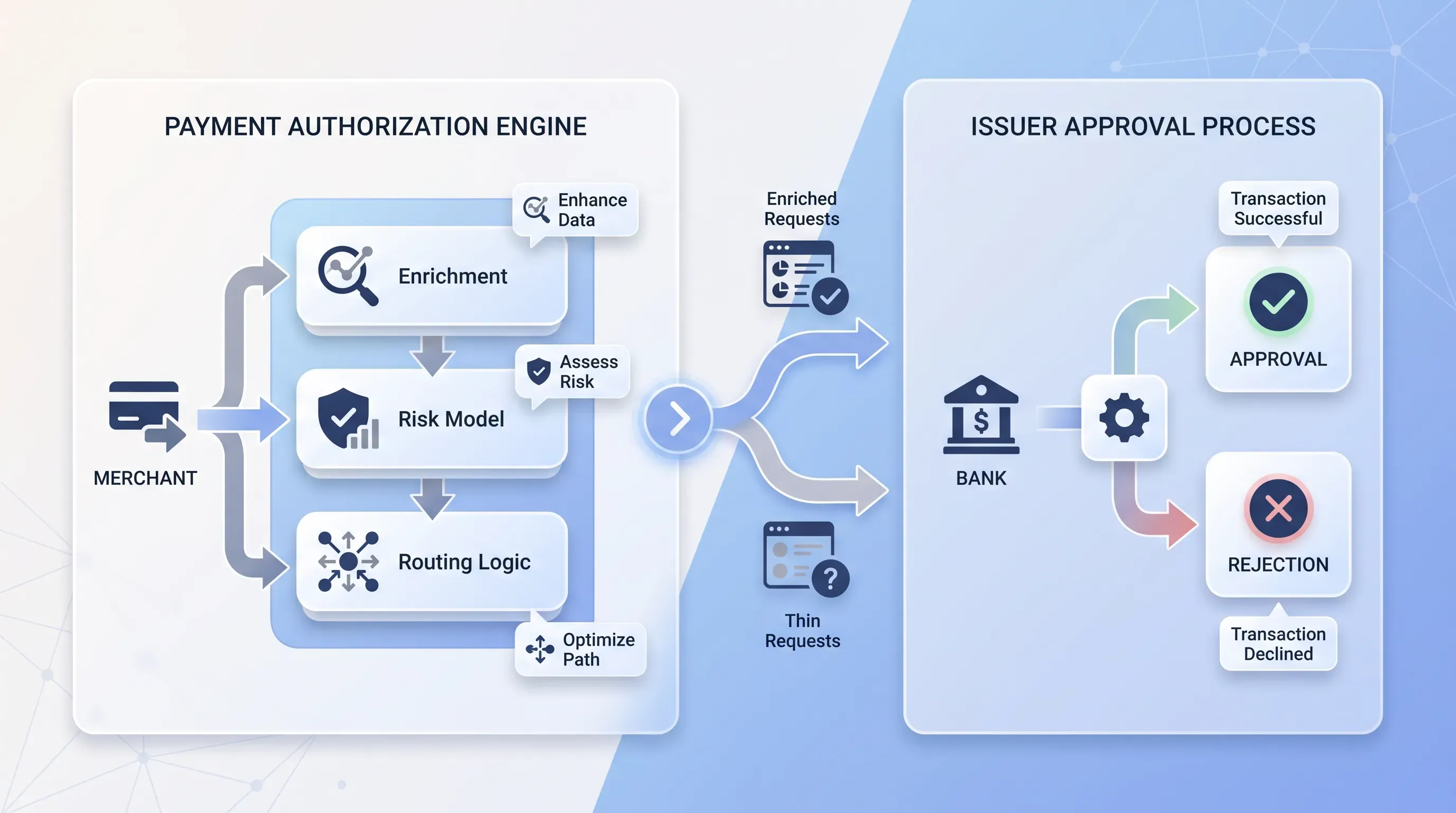
Modern infographic comparing a payment authorization engine and issuer approval process, featuring clean gradients and flat navy icons.

A payment authorization engine is the merchant-side decisioning layer that evaluates each transaction against rules and signals before and around the authorization request. It is not the issuer's approval. That distinction trips up a lot of otherwise sharp payments teams, so it's worth stating plainly.

The issuer still makes the final approve or decline. What the engine controls is everything leading up to that moment. It decides whether the request gets sent at all, then manages the data and acquirer path the issuer sees. If the attempt fails, the same logic decides whether to retry. The issuer's verdict is a reaction to the package you hand it. A clean request with strong enrichment and routing earns a different answer than a thin one.

That's why the engine is the piece you can own. You can't reach into an issuer's risk model, but you can change what that model sees. When people say a merchant "improved approval rates," the engine is almost always where the work happened, because it's the layer between your checkout and the issuer's decision that you're allowed to configure.

Start building your financial platform?

Speak with EGS engineers about open banking, payment infrastructure, cloud systems, and enterprise software.

Get in Touch

Where the engine sits in payment orchestration

The payment authorization engine sits inside a wider stack, and the coordinating layer above it is payment orchestration. Orchestration is the control layer that connects providers under one integration, then decides how traffic flows across them. The market is moving toward this model fast; Mordor Intelligence puts it at USD 2.65 billion in 2025 and forecasts USD 7.27 billion by 2031, at an 18.31% CAGR.

The division of labor is clean once you see it. Payment orchestration handles provider routing with failover and reconciliation. The authorization engine handles the per-transaction decision logic. They aren't competitors. Orchestration gives the engine the options to choose from, and the engine decides which option each transaction takes.

Picture the request path. A payment leaves your checkout and reaches the authorization engine, where it's screened and enriched; after fraud tooling, the orchestration layer selects which acquirer carries it to the network and issuer. If you're assembling or evaluating your own architecture, that's the map. The engine is the brain on each transaction, and payment orchestration is the switchboard that gives the brain somewhere to send things.

What the engine actually decides

The payment authorization engine makes distinct decisions on every transaction, and each one is a lever you control. Treating authorization rate as a single issuer verdict misses the point. The verdict reflects the quality of every decision below.

Whether to send the request

The first decision is whether a request should reach the issuer at all. Pre-authorization screening filters out obvious fraud and low-quality traffic before it touches the network. This is the opposite of what most people assume fraud filtering is for. You're protecting the issuer's view of your brand.

Issuers watch the quality of traffic coming from each merchant. Feed them a stream polluted with junk attempts, and they grow cautious, which makes them decline more of your legitimate volume to be safe. Keep the stream clean, and your traffic earns trust over time. This is a decision you configure, not something the issuer does for you, and where you place the check changes everything downstream.

How to enrich the signals

The second decision is what data rides along with the request. Issuers decline what they can't recognize, so the engine's job is to make a real cardholder look like one. That means richer transaction data and consistent cross-border signals. It also means network tokenization, which replaces the raw card number with a merchant-specific credential the networks vouch for.

The payoff here is documented. Visa reports a 4.6% global lift in card-not-present authorization rates for tokenized transactions versus raw card numbers, alongside a roughly 26% drop in fraud. For a merchant doing USD 100M in annual volume at a 90% baseline, recovering even two points is around $2 million in captured revenue a year. Weak or inconsistent data causes the avoidable declines, because the issuer can't tell a returning customer from a stranger. For an engineer, the work is attaching the right data and tokenized credentials. For a risk lead, the reassurance is that stronger signals cut fraud at the same time they lift approvals.

Start building your financial platform?

Speak with EGS engineers about open banking, payment infrastructure, cloud systems, and enterprise software.

Get in Touch

How to route and retry

The third decision is the path and the second chance. Smart routing sends each transaction down the acquirer most likely to approve it, based on the issuer relationship and how that card's BIN range maps to geography. The gains are concrete. Solidgate reports that Zeely combined acquirer migration with routing and cascading for a +8pp approval rate lift, with risk metrics down 40% in three months.

Retry logic is where teams hurt themselves most. The discipline is telling a soft decline from a hard one. Soft declines account for 70 to 90% of card-not-present failures, things like insufficient funds or an issuer timeout, and they're worth another attempt. Hard declines, like a stolen card or closed account, are permanent. Retry the wrong ones and you irritate issuers, trigger scheme fines that damage your standing. Retry the right ones with proper timing, and published recovery rates run from 30% to 70% of soft-declined transactions. Orchestration is what makes routing and cascading possible in the first place, since it gives the engine more than one path to try.

Lifting approvals without adding risk

Here's the tension the article has been building toward. The same payment authorization engine that raises approvals can raise fraud and operational drag if you tune it carelessly. The goal is to win approvals without trading away control.

The good news is that these aren't opposing goals as often as people fear. Filtering junk before authorization lifts approval rates and cuts fraud in the same move, because cleaner traffic earns issuer trust while bad attempts never land. Network tokenization does the same double duty. And applying authentication selectively, rather than challenging every shopper, holds conversion while shifting liability on the transactions that warrant it.

The operational side matters as much as the fraud side. Manual review is expensive and slow; it costs an average of $3.47 per transaction according to Signifyd, and as many as 23% of e-commerce orders were manually reviewed in 2025 per MRC data. When the engine makes cleaner decisions on more transactions, fewer orders sit stuck in a queue, and your team stops doing low-value triage. That's how the engine reduces drag while it lifts revenue.

Tradeoffs and what to watch

None of this is free, and pretending otherwise would do you no favors.

The honest costs are worth naming before you commit:

  • Migration and integration take real effort, especially if you're moving from a single-provider setup to a coordinated one.

  • More moving parts mean more architectural complexity to monitor and reason about.

  • Over-tuned rules block good customers, and the cost shows up months later in retention data that rarely gets traced back to the fraud layer.

Approval rate is a metric you watch continuously, because issuer behavior and your own traffic mix shift underneath you. A setup tuned last year drifts. The decision to build versus buy changes the math here. Building an authorization or payment orchestration layer in-house gives you control but loads the ongoing maintenance onto your team, while buying shifts the per-acquirer complexity to a provider at the cost of some flexibility. Neither answer is universal, and the right call depends on your volume and how much of this you want to own.

Where to start

Start by measuring what you have. Pull your current credit card authorization rate, then look at where declines cluster by issuer, geography, and card type. Those patterns reveal where revenue is leaking. From there, review your payment authorization engine's decisioning logic and identify which controls you actively manage versus which still rely on default settings.

A focused audit often uncovers quick wins, whether that's network tokenization, intelligent retry strategies, or routing optimizations. The key is treating payments as a revenue growth lever rather than a back-office function.

At EGS, we help merchants identify hidden authorization losses and implement strategies that increase approval rates without increasing acquisition spend. Our payment experts work with businesses to optimize authorization performance, reduce unnecessary declines, and recover revenue that would otherwise be lost.

If you'd like to understand where your authorization rates can improve, book a call with the EGS team for a tailored assessment of your payment setup.

Start building your financial platform?

Speak with EGS engineers about open banking, payment infrastructure, cloud systems, and enterprise software.

Get in Touch

Review authorization rules at least monthly, and after major traffic changes. Issuer behavior, fraud patterns, and card mix shift over time, so rules that worked six months ago can start blocking good orders. Track approval rate, false declines, fraud rate, and manual review volume together.

Track declines by issuer, acquirer, card type, BIN range, country, and decline code before changing routing. This gives you a baseline and helps separate routing problems from fraud-screening or data-quality issues. Change one routing rule at a time so you can measure its effect.

A Payment authorization engine can reduce chargebacks when it screens risky traffic before authorization and applies authentication to higher-risk transactions. It doesn’t replace fraud tools or issuer checks. It coordinates their signals so fewer suspicious orders reach approval while legitimate shoppers face less unnecessary friction.

Yes, subscriptions need separate retry rules because recurring payments fail for reasons like expired cards, issuer timeouts, or temporary lack of funds. Retry soft declines on a planned schedule, but stop after hard declines. Account updater services and network tokens also help keep stored cards current.

Buying is safer when the client wants faster coverage across acquirers and fewer maintenance tasks. Building fits teams with high payment volume, in-house payment engineers, and a need for exact control over rules. The right choice depends on transaction volume, provider mix, and internal ownership.

Schedule a Meeting

Book a time that works best for you

You Might Also Like

Discover more insights and articles

A realistic workbench scene with a disassembled POS terminal, engineers' hands, certification documents, and a laptop in a professional workshop.

Embedded POS Software: Engineering Payment Systems at Device Level

This article explains what changes when you engineer embedded POS software by moving the payment stack into the device itself instead of building an app on someone else's certified terminal. It walks through the engineering layers involved, with the constraints behind each decision folded into how certification reshapes the entire project from day one.

Close-up of hands making a contactless payment at a POS terminal in a retail store, with a blurred background and natural lighting.

Real-Time POS Terminal Software Development: Engineering Fast and Secure Payments

This article explains how real-time POS terminal software development shapes the software inside a payment terminal to move a card payment through the device quickly and securely. It follows the layered architecture and traces one transaction from tap to response under the latency budgets and certification rules that shape every choice you make, with offline behavior treated as part of that constraint.

Fraud operations analyst at a multi-monitor workstation in a modern fintech office, focused on investigating suspicious transactions.

Anti-fraud architecture for layered digital fraud defense

This article explains anti-fraud architecture as one connected stack of coordinated controls. It walks through the layered model end to end: each layer's job at its place in the customer journey, plus the way the layers feed one another so decisions sharpen over time.

An IT professional reviews a network architecture diagram on a large monitor in a naturally lit office, with realistic desk clutter.

Payment security architecture for PCI DSS-aware payment flows

This article shows how payment security architecture decides your compliance scope before you write a single control. It walks through where data substitution sits in the flow and what each placement does to the cardholder data environment. The artifacts a QSA will demand during a PCI DSS compliance assessment come later.