ATM Monitoring for African Banks: Improve Service Availability

Content authorBy EGSPublished onReading time9 min read
Banking staff collaborate around a conference table in a modern meeting room, discussing ATM monitoring strategies with laptops and screens.

This article is a buyer's guide to evaluating monitoring tools and integration support for a mixed-vendor ATM estate. It explains why a device that reports "online" can still fail customers, and how to score vendors against your own incident workflow and service commitments.

When online still fails

Most ATM monitoring dashboards answer one question well: is the machine powered and responding? That's useful, and it's also the reason so many failures reach the customer before they reach the service desk. A terminal can sit green on the console while the cash dispenser refuses notes or the authorization request times out at the switch.

The gap between device health and service health is where complaints come from. Someone stands at a machine in Lagos or Nairobi and walks away with nothing. The branch logs a call. The vendor finds no fault. The incident closes and repeats next week because nobody owns it.

Account ownership in Sub-Saharan Africa reached 55% of adults in the 2021 Global Findex, and cash access still anchors trust in those accounts. ATM monitoring that stops at device status can't protect that trust.

Map ATM monitoring layers

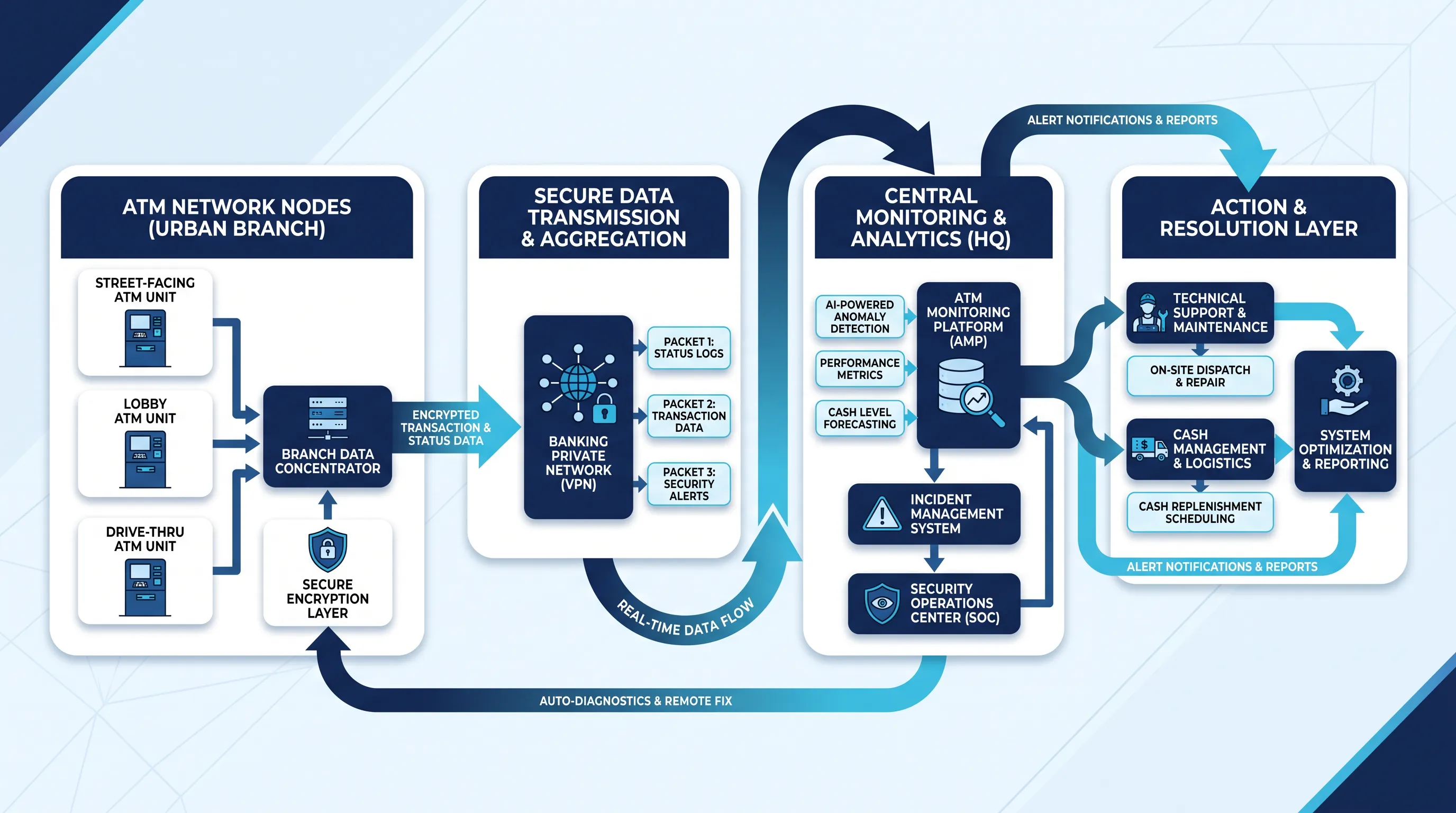
Flowchart depicting the ATM monitoring process in an urban bank, featuring interconnected cards, arrows, and a pale-blue gradient background.

A typical estate is rarely uniform. A bank with 400 terminals runs NCR Atleos machines in urban branches and Diebold Nixdorf units at older sites, and those machines talk to one switch and two or three processors. Each vendor ships its own console. Each console sees its own hardware.

That's the structural problem. When monitoring is organized by device vendor instead of by service, every alert arrives as an isolated hardware event, and nobody is looking at the chain the customer actually depends on. Good ATM monitoring separates failures by layer, then reassembles them into a single view of what a cardholder can and can't do right now.

Device and application failures

The device layer is the one most banks already watch. Cassette states and dispenser faults surface through the vendor platform or through standards-based interfaces like the CEN XFS specification for peripheral access.

Above that sits the ATM application. It fails differently. A terminal stuck in a service menu after a technician visit looks healthy to a network ping and takes no transactions at all. Electronic journals catch what status codes don't, because the journal records what the customer attempted and what the application decided. Reading journals in near real time is what turns ATM management software from a status board into a diagnostic tool.

One boundary matters here and stays fixed throughout this guide: detecting a dispenser fault is a software responsibility, while repairing it is the hardware vendor's. Monitoring shortens the time to a correct dispatch without replacing the engineer.

Communications and processing failures

An ATM with a working dispenser and a clean journal still fails if the path behind it breaks. Links over VSAT or 4G routers degrade before they drop, and intermittent packet loss produces timeouts that look like random customer errors. The terminal never goes offline, so nothing alerts.

Then there's the transaction chain. Requests move from the ATM to the switch and out through national infrastructure such as NIBSS in Nigeria for off-us traffic. A processor that slows down under batch load or a host cutover window will empty a machine of usable service while its status stays green. Message-level standards from EMVCo chip specifications govern part of this exchange, which means failures can be protocol issues.

Start building your financial platform?

Speak with EGS engineers about open banking, payment infrastructure, cloud systems, and enterprise software.

Get in Touch →

ATM monitoring software context

What changes the picture is correlation. ATM monitoring software that ingests transaction outcomes from the switch and network metrics in one place can tell you that twelve terminals on the same regional link all stopped completing withdrawals at 14:06, and that none of them have a hardware fault.

Three inputs do most of the work in practice:

  • Transaction outcome data, because a sudden rise in a single response code across a region names the failing component faster than any device alert.

  • Electronic journal content, which shows the customer's actual experience of abandoned sessions and repeated retries.

  • Correlated infrastructure signals from the switch, host, and network layer, so a single root cause produces one enriched event rather than forty device tickets.

Most monitoring platforms expose metrics through SNMP as defined in RFC 1157 or through modern collectors like Prometheus exporters. The protocol matters less than whether the tool can join those streams to a service definition.

Build an availability matrix

Before scoring any product, write down what each customer service depends on. An availability matrix helps turn a problem like “the ATM is down” into something the team can act on. It also shows which alerts and monitoring capabilities are currently missing.

  • Cash withdrawal: Requires a dispenser, card reader and PIN pad, as well as an ATM application that is in service and writing journals. Communications depend on the network link, switch team, host or NIBSS routing. Key telemetry includes cassette levels, response codes and journal entries. The main owners are ATM operations and the switch team.

  • Balance inquiry: Requires a card reader, PIN pad and printer or screen. The ATM application and screen flow support the service, while the host provides the authorization path. Teams should monitor response codes and host latency. The core banking team owns this service.

  • Cash or cheque deposit: Requires a deposit module and bill validator, together with the deposit application and reconciliation file. Processing depends on host posting and the back-office batch. Bin status and posting confirmations provide the necessary telemetry. Ownership sits with branch operations and finance.

  • Card-based transfers: Requires a card reader and PIN pad, plus the ATM application and beneficiary lookup. Processing runs through the switch and interbank processor. Processor response times should be monitored, with the payments team responsible for the service.

Fix incident handoffs

Detection without a clean handoff just moves the delay. An enriched event arriving at the service desk should already carry the probable failing layer and the evidence behind that conclusion. The service desk shouldn't be the place where diagnosis starts.

Build the handoff around the way ITIL incident management separates detection from resolution ownership. Each event type gets a runbook with the first three checks and the escalation path if those checks fail. Named ownership beats group mailboxes every time, because a queue can't be held accountable for a missed restoration target.

Repeat incidents deserve separate treatment. When the same site fails monthly and each ticket closes as "no fault found," the problem is almost always a boundary: the hardware vendor sees a clean device and the network provider sees a healthy link. Track those as problem records tied to the availability matrix rather than closing them individually, and ATM monitoring becomes evidence you can take into a supplier review.

Start building your financial platform?

Speak with EGS engineers about open banking, payment infrastructure, cloud systems, and enterprise software.

Get in Touch →

Score ATM monitoring options

Scorecards fail when they copy a generic feature list. Yours should reflect your vendor mix and the service levels you've committed to your regulator. The Central Bank of Nigeria's payment guidelines and comparable requirements from the Bank of Ghana set expectations for dispute handling and uptime reporting that your tooling has to feed.

Score each candidate across three areas, weighted by what hurts you most today.

Coverage and correlation

  • Supported data sources: which ATM vendors, which switch, which host interfaces, and what happens when you add a terminal brand next year.

  • Electronic journal access: real-time ingestion and search, or overnight file collection only.

  • Service-level visibility: can the product report availability per customer service.

  • Alert correlation and enrichment: does one root cause produce one event with context attached.

ATM monitoring software that only speaks to one manufacturer's fleet will leave part of your estate dark, and the dark part is where your unexplained incidents will concentrate.

Workflow and accountability

Ask how events reach your service desk tool and whether runbooks live inside the platform or in your knowledge base. Ownership tracking should survive a handoff to an external provider, which means the ticket records who holds the incident at every point rather than just who opened it.

Reporting matters as much as alerting. Your ATM management software should produce the availability numbers you present to the board and to the regulator without someone rebuilding them in a spreadsheet each month.

Improvement measures

  • Mean time to detect, measured from the first failed customer transaction rather than from the first alert.

  • Mean time to restore, split by failing layer so you can see whether delays sit with hardware dispatch, network providers, or internal teams.

  • Repeat incident rate per terminal and per service.

  • Total service downtime expressed in lost transaction opportunity, which is the figure that connects ATM monitoring to revenue.

Google's guidance on defining service level objectives applies directly here, because an availability target means nothing until you've agreed what counts as a successful transaction.

Where EGS fits

EGS works on software integration and production monitoring. In an ATM estate, that's the layer between the vendor consoles you already own and the operational picture you don't have yet. We don't sell a packaged terminal product, and the engineering work starts with what's already installed.

The practical scope is connecting existing tools so telemetry and journals land in one correlated stream, then shaping events so they arrive at the service desk with cause and evidence attached. Alongside that sits the unglamorous part: writing runbooks per failure type and defining escalation paths. Where your ATM monitoring software has integration gaps, we build the adapters.

Set clear service boundaries

Being explicit about scope protects both sides. Monitoring and software support cover detection and the reporting behind your service levels. They don't cover ATM hardware repair or cash-in-transit logistics, which stay with your device vendors and your cash management partners.

Clear boundaries make those partners faster. When a dispatch request carries the fault code and the journal extract, the engineer arrives with the right part. When replenishment teams receive cassette trends from your ATM management software, routes get planned. ATM monitoring earns its cost at the handoff.

Prepare for an assessment

Before a technical conversation, pull together a short picture of your environment: the ATM vendors and models in service and your switch and host platforms. Add your support ownership map, which covers external contracts, and a list of the incident patterns that keep returning.

With that in hand, a scoping session can go straight to the gaps instead of discovery. Talk to EGS about the monitoring and operational gaps affecting your ATM services, and we'll show you where integration work will change your ATM monitoring results fastest.

Start building your financial platform?

Speak with EGS engineers about open banking, payment infrastructure, cloud systems, and enterprise software.

Get in Touch →

Review them at least quarterly, then revisit them after a switch change, processor migration, or new ATM model. Check alert thresholds, escalation contacts, runbook steps, and service definitions. A review should also compare false positives and missed incidents, because both indicate that the monitoring design needs adjustment.

Retention should follow the bank’s legal, regulatory, dispute, and privacy requirements. Keep recent journals searchable for investigations, then move older records to controlled archive storage when policy permits. Define access roles, encryption, deletion dates, and an audit trail before collecting the data at scale.

Yes, but the integration method depends on the terminal and its vendor interface. Options include vendor APIs, XFS data, SNMP, journal files, or an adapter at the management layer. Test read-only collection first, then verify timestamps, error mapping, and transaction correlation before using the data for automated alerts.

Protect it as operational and customer-related data. Encrypt connections and stored records, restrict access by role, mask card and account details, and log administrative activity. Separate monitoring credentials from payment credentials, and define a process for reviewing access after staff or supplier changes.

Ask EGS which existing consoles, switches, hosts, journals, and service desk tools it can connect, and what remains outside scope. EGS can assess the client’s ATM monitoring integration gaps, ownership model, and reporting needs. Book a call after gathering those details so the discussion can focus on feasible interfaces and handoffs.

Schedule a Meeting

Book a time that works best for you

You Might Also Like

Discover more insights and articles

A project manager in business casual attire discusses a document intake process with a team in a modern office, focusing on a large monitor.

Bank document intake workflow: A readiness checklist

This article gives you a checkpoint-by-checkpoint method for testing a document intake process before you turn it on. It includes a worksheet structure you can copy into a spreadsheet and the evidence each control needs to produce.

Two business partners collaborate on configuring a POS terminal in a modern office, surrounded by payment devices and colleagues.

EthioPay for Ethiopian Banks: Turn Readiness into a Delivery Plan

This article explains how an Ethiopian bank moves from "we want to participate" to a dated, costed integration plan for the country's domestic card scheme and instant payment rails. It covers service selection and a phased release sequence.

A modern smartphone displaying a mobile banking app lies on a wooden desk, surrounded by abstract payment cards and a notebook.

AfriGO Card Readiness: Plan Your Nigerian Bank’s Rollout

This article is a readiness guide for moving from "we're considering it" to a controlled pilot on Nigeria's domestic card rails. It covers role definition and launch scope, then maps the transaction flow so you can assess systems and assign requirement ownership through the workstream matrix that holds the whole program together.

A professional seated at a desk uses a smartphone and payment card, engaged in online banking in a bright, modern office.

G2P Payments in Africa: Build Reliable Social Payment Infrastructure

This article traces the full lifecycle of a government social payment in Africa, from eligibility approval through to reconciliation and investigation evidence. It assigns operational ownership at each system boundary and sets out how to control exceptions and assisted access.