Bank document intake workflow: A readiness checklist

Content authorBy EGSPublished onReading time10 min read
A project manager in business casual attire discusses a document intake process with a team in a modern office, focusing on a large monitor.

This article gives you a checkpoint-by-checkpoint method for testing a document intake process before you turn it on. It includes a worksheet structure you can copy into a spreadsheet and the evidence each control needs to produce.

Bank document intake workflow

A bank document intake workflow is ready when every required document can be securely requested and transferred, with evidence at each step. Evidence is the operative word. If a control exists but produces nothing an examiner or an internal auditor can inspect later, it hasn't passed.

Optical character recognition (OCR) sits inside that chain. It reads characters off an image and hands text to the next step. On handwriting, the honest benchmark is still a 3 to 5% character error rate, which means extraction alone decides nothing. The workflow runs from the request through the handoff. Test that, and you're testing the thing that actually carries risk.

Confirm the workflow scope

Scope first, because every later checkpoint inherits it. Write down the jurisdiction and the banking process. Then add the retention policy and the approval rules that govern who can say yes.

Consent is where scope quietly breaks. The Electronic Signatures in Global and National Commerce Act requires affirmative consumer consent before an electronic record substitutes for a required writing, and the FDIC examination manual notes that consent must be given in a way that reasonably demonstrates the consumer can access the format you intend to use. A customer emailing a PDF is not the same as a customer consenting to electronic delivery.

Record your assumptions in writing and get them confirmed by name. Legal and compliance should each sign off on the slice they own. Unconfirmed assumptions are the most common source of late-stage rework in a bank document intake workflow, because they surface during the pilot instead of before it.

Build the worksheet

One row per process and document class. A mortgage application and a business account opening both collect bank statements, but the required fields and the retention clock differ, so they're separate rows. Keep it editable, because you'll revise it as the mapping exposes gaps.

Each row needs these columns:

  • Channel, requester, and the named owner of the document class

  • Required fields and the validation rule applied to each

  • Status values the row can hold, plus the exception trigger that moves it out of the happy path

  • Notification sent to the customer, and the reviewer assigned when a human has to look

  • Access role permitted to view the file, and the audit event written at every state change

  • Retention rule, disposal date, and the destination system the record transfers to

  • Acceptance evidence from that destination, and the recorded outcome

The worksheet is the artifact you take into the go/no-go meeting. When a column is blank, that's the finding. A bank document intake workflow with twelve rows and three empty validation cells is not 75% ready, because the gaps cluster in the document classes nobody wanted to own.

Map every checkpoint

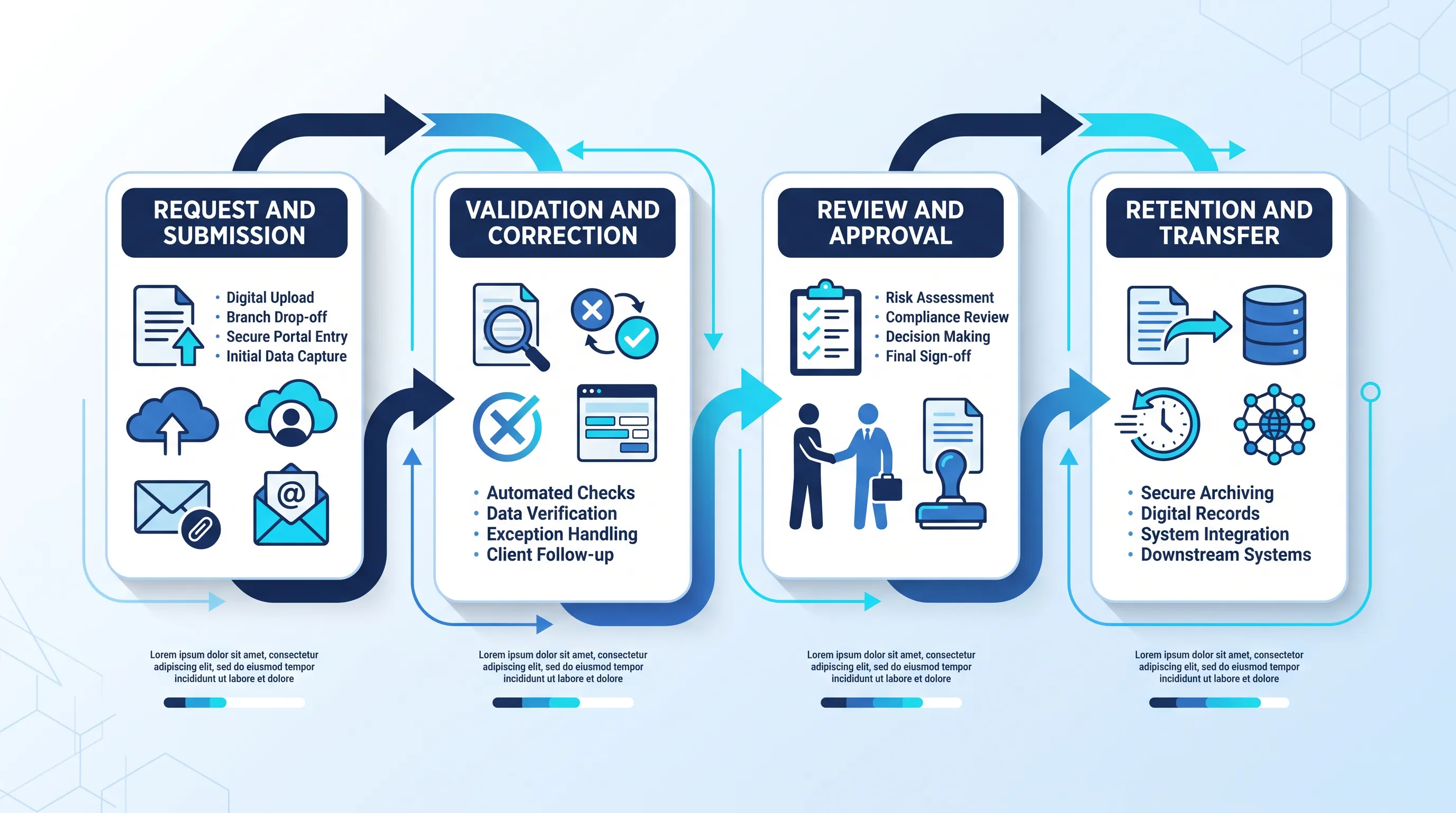
Flowchart depicting a bank document intake workflow with modular blocks for each stage, connected by curved arrows in navy and cyan tones.

Now walk the workflow in sequence and fill the worksheet as you go. For each checkpoint, write the control and the evidence it produces. I've found it's worth doing this against a real file, because diagrams rarely show where the evidence stops.

The sequence below follows a document from the moment you ask for it to the moment it lands in a system of record. Treat each stage as a gate on the bank document intake workflow. A file that can't clear one stage shouldn't advance to the next.

Start building your financial platform?

Speak with EGS engineers about open banking, payment infrastructure, cloud systems, and enterprise software.

Get in Touch →

Request and submission

Start with the request itself. Who sends it and whether the customer's consent to receive it electronically was captured and stored before the request went out. Then check the delivery channel against encryption requirements, since the FTC Safeguards Rule at 16 CFR 314.4(c)(3) requires customer information to be encrypted in transit and at rest, with any exception documented and approved.

Submission confirmation matters more than it looks. The customer needs proof you received the file, and you need a system record tying that file to the application and a timestamp. Without that identification step, a bank document intake workflow can't tell a resubmitted statement from a new one.

Then run the mechanical checks: required fields present and duplicate detection against what's already on file. Entrust's verification data across 195 countries found digital forgeries made up 35% of document fraud in 2025, up from a 29% average over the prior three years. Intake is where that pressure lands first.

Validation and correction

Every required field needs a rule, and every rule needs a defined failure behavior. Write both. The exception trigger should name what happens and who gets told.

Customer notifications carry regulatory weight here. Under § 1002.9(c) of Regulation B, a creditor that receives an incomplete application has 30 days to either act on it or send a notice of incompleteness specifying the information needed and a reasonable deadline. Your reminder logic and your adverse action logic have to be the same clock.

Correction instructions should tell the customer exactly which document failed and why, then route the replacement through the same controls as the original. Version history is the checkpoint most pilots miss. The original submission event and the replacement stay in the record, because overwriting a bad file erases the evidence that the bank document intake workflow caught the problem.

Review and approval

Define the triggers that pull a human in: low extraction confidence or a flagged identity document. Name the reviewer role for each trigger, and bind that role to an access permission so the person who reviews the file is the only category of person who can open it.

Approval rules need the same precision. Who approves and what happens when they decline. Escalation paths should resolve to a named individual. In payments and banking, account takeover accounts for 82% of fraudulent activity, which is why permission scoping at the review stage is a fraud control and not just hygiene.

Decision evidence is what makes the review defensible. The CFPB's Circular 2023-03 made clear that a creditor using complex algorithmic models still owes applicants specific and accurate principal reasons, and vague substitutes don't satisfy the law. So the audit event has to capture what the reviewer decided and which factor drove it. If you can't reconstruct the action from the log, the control didn't exist.

Start building your financial platform?

Speak with EGS engineers about open banking, payment infrastructure, cloud systems, and enterprise software.

Get in Touch →

Retention and transfer

Confirm the retention clock per document class, then confirm the disposal job that enforces it. Records required under the Bank Secrecy Act must be kept for five years and stored so they're retrievable in a reasonable period, and the FFIEC's Appendix P breaks the periods down by record type. Banks operating in New York carry a parallel obligation under 23 NYCRR Part 500, whose audit trail section requires systems designed to reconstruct material financial transactions.

Transfer is the last gate and the weakest one in most designs. Map each document class to its destination system and require the destination to return acceptance evidence. Reconciliation then compares what you sent against what the system confirmed it holds.

Failure handling deserves its own row. When a transfer fails, the file should hold in a named state with an owner and a retry rule, and the downstream process should stay blocked. A bank document intake workflow that marks a loan file complete while the statement sits in a failed queue has created a reconciliation problem that surfaces weeks later.

Add a lending example

Here is a single hypothetical worksheet row, written the way a filled one should look. The process is consumer mortgage origination and the document class is a two-month personal bank statement submitted through the secure portal.

  • Validation rule: page count matches stated period, account holder name matches application, image legibility score above threshold. Result on intake: fail, pages 3 and 4 unreadable.

  • Exception trigger: legibility failure. Status moves to "resubmission required" and the original file is retained with its submission event intact.

  • Notification: portal message plus email naming the specific pages and the deadline, with the compliance clock started on the same timestamp.

  • Review assignment: credit operations analyst, read access to the statement only, with the escalation path going to the underwriting team lead after 48 hours.

  • Transfer rule: handoff to the loan origination system blocked until the replacement passes validation and the analyst records an approval.

  • Acceptance evidence: confirmation identifier returned by the loan origination system, written to the audit log against the original request.

Two things make this row pass. The original unreadable file stays in the record as evidence of what was received, and the block on downstream transfer is enforced by the system. That pairing is what separates a tested bank document intake workflow from a documented one.

Record readiness status

Mark every checkpoint as pass or exception, with missing evidence as a third status. Those three states are not interchangeable. An exception is a known gap with a decision behind it, while missing evidence means you don't yet know whether the control works.

Every exception gets a named owner and a due date in the same row. Unassigned exceptions migrate into production and become findings. Then list the dependencies that cross team or system boundaries, since those are the items no single owner can close alone and the ones that slip past the pilot date.

Be honest about what the tally tells you. The cost spread in lending is wide enough to make operational discipline measurable: Freddie Mac's analysis put the top quartile of originators at roughly $6,900 per loan against about $16,500 for the bottom quartile, and independent mortgage banks averaged a thin $443 profit per loan in 2024. Rework in intake eats margin that small quickly.

Make the rollout decision

The rule is simple and worth holding to. If security or handoff evidence is still unresolved, pause. Those two generate regulatory exposure, and neither of them gets easier to fix once volume is flowing through the bank document intake workflow.

A controlled pilot is justified when every checkpoint passes or carries an exception with an owner and a date. Remediation with deadlines is the right call when the gaps are concentrated in one stage and the owners are identified. Stop the rollout when the worksheet shows missing evidence across multiple stages, because that pattern means the design hasn't been tested, not that it's nearly done.

Fraud pressure argues for the strict reading. "As detection improves, fraud rings evolve, becoming faster, more organized and commercially driven," said Simon Horswell, Senior Fraud Specialist Manager at Entrust, whose team tracked a 244% year-over-year rise in digital document forgeries. A workflow that can't prove what it received and who approved it will not hold up against that.

Conclusion

Work the checklist against real files and let the blanks decide the date. A pilot built on evidence costs less than a rollout rebuilt under examination pressure.

EGS works with banking operations and compliance teams on exactly this kind of pre-implementation assessment, from scope confirmation through remediation planning. If you want an experienced second read on your bank document intake workflow before you commit to a rollout date, book a call with our team.

Start building your financial platform?

Speak with EGS engineers about open banking, payment infrastructure, cloud systems, and enterprise software.

Get in Touch →

Use an immutable event record for each action. Capture the timestamp, actor or service identity, document identifier, outcome, failure reason, and a link to the related file or notification. Store records where authorized reviewers can search them without changing the original evidence.

Retest it after any material change and on a schedule set by your risk program. Changes to the intake channel, validation rules, permissions, retention settings, or destination system should trigger a focused review. Keep the test file, result, reviewer, and remediation record together.

The person who owns the control shouldn't approve its unresolved risk alone. Assign operational exceptions to a named process owner, then obtain review from compliance, legal, security, or another independent authority when the issue affects that function. Record the decision, expiry date, and required remediation.

Yes. A vendor change can alter encryption, extraction accuracy, access roles, retention, or transfer behavior. Compare the old and new configurations, identify affected worksheet rows, and rerun those gates before production use. Preserve the change record and approval with the original readiness evidence.

Yes. The client should see a plain-language status for each requested document, including whether action is needed and the deadline. Internal records should retain the full control evidence and reviewer details. EGS can provide an independent review of the worksheet and remediation plan, and clients can book a call for that assessment.

Schedule a Meeting

Book a time that works best for you

You Might Also Like

Discover more insights and articles

Two business partners collaborate on configuring a POS terminal in a modern office, surrounded by payment devices and colleagues.

EthioPay for Ethiopian Banks: Turn Readiness into a Delivery Plan

This article explains how an Ethiopian bank moves from "we want to participate" to a dated, costed integration plan for the country's domestic card scheme and instant payment rails. It covers service selection and a phased release sequence.

A modern smartphone displaying a mobile banking app lies on a wooden desk, surrounded by abstract payment cards and a notebook.

AfriGO Card Readiness: Plan Your Nigerian Bank’s Rollout

This article is a readiness guide for moving from "we're considering it" to a controlled pilot on Nigeria's domestic card rails. It covers role definition and launch scope, then maps the transaction flow so you can assess systems and assign requirement ownership through the workstream matrix that holds the whole program together.

A professional seated at a desk uses a smartphone and payment card, engaged in online banking in a bright, modern office.

G2P Payments in Africa: Build Reliable Social Payment Infrastructure

This article traces the full lifecycle of a government social payment in Africa, from eligibility approval through to reconciliation and investigation evidence. It assigns operational ownership at each system boundary and sets out how to control exceptions and assisted access.

A woman interacts with her smartphone at a casual desk, navigating a banking app, with a blurred laptop and plant in the background.

Card Testing Fraud: Protect African Payment Platforms

This article explains how to investigate and contain automated authorization abuse across a merchant portfolio without shutting out paying customers. It covers the signals worth correlating and a control matrix you can hand to the team on shift.