AfriGO Card Readiness: Plan Your Nigerian Bank’s Rollout

Content authorBy EGSPublished onReading time11 min read
A modern smartphone displaying a mobile banking app lies on a wooden desk, surrounded by abstract payment cards and a notebook.

This article is a readiness guide for moving from "we're considering it" to a controlled pilot on Nigeria's domestic card rails. It covers role definition and launch scope, then maps the transaction flow so you can assess systems and assign requirement ownership through the workstream matrix that holds the whole program together.

Where the rollout work actually starts

Most AfriGO card programs stall for the same reason. The business decision gets made in a steering committee six weeks before the engineering reality is discovered, and nobody wrote down who owns the gap between them. A card rollout touches your terminal estate and your switch configuration. It also reaches key management, along with reconciliation files and the dispute desk. None of that is optional, and none of it is quick.

So this guide works in the order the work actually happens. You define the role you're playing and draw a boundary around the first release. Then you trace a single transaction end to end and check your systems against that trace. Every claim you make about readiness needs a named source and a named owner. That's the whole method.

Define your AfriGO role

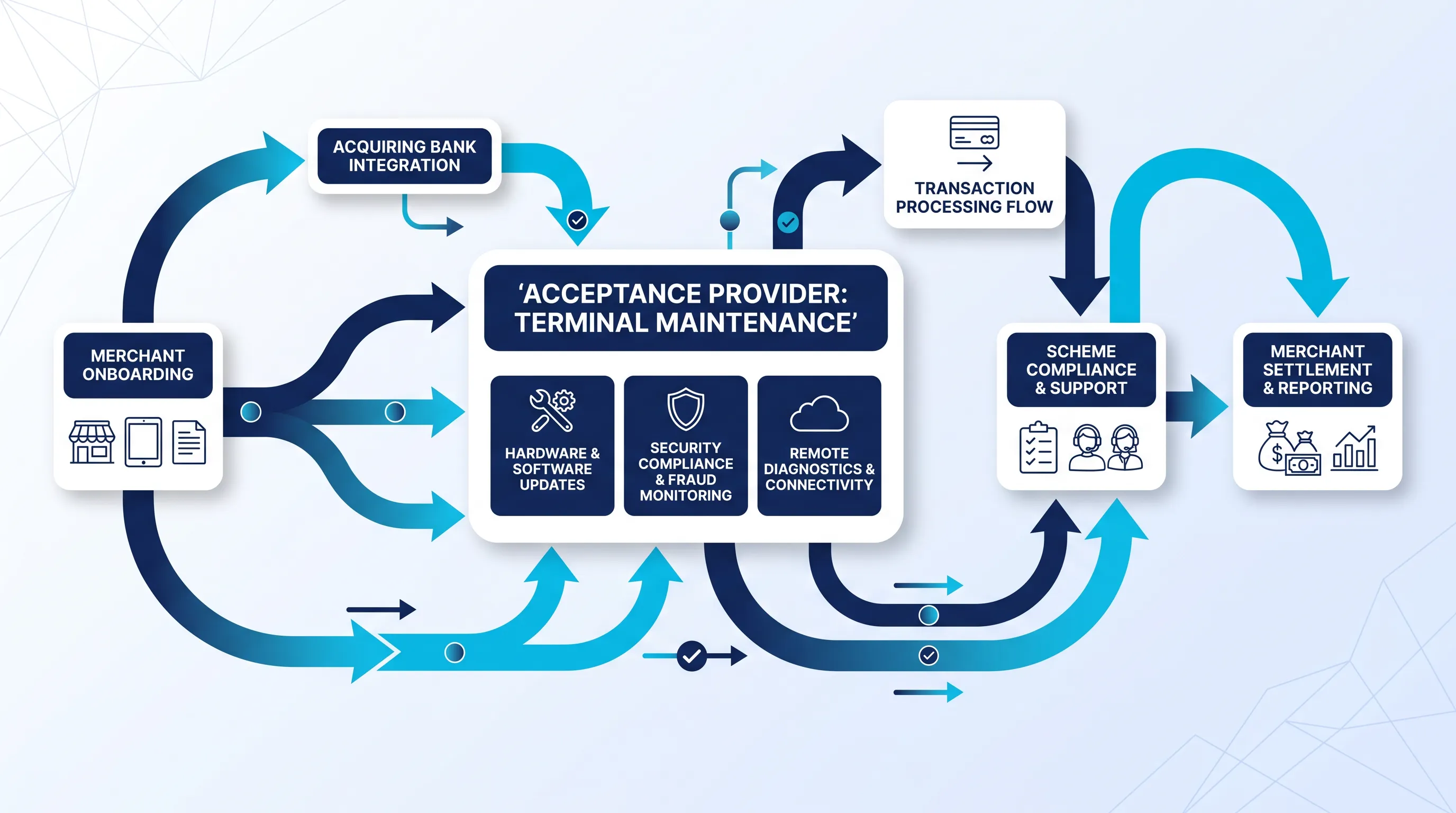
Flowchart depicting the role of an acceptance provider in the AfriGO card scheme, featuring a central maintenance block and onboarding arrows.

The AfriGO card scheme is Nigeria's domestic card network, launched on 26 January 2023 by the Central Bank of Nigeria (CBN) with the Nigeria Inter-Bank Settlement System (NIBSS). It processes domestically, which is the point. Godwin Emefiele, then CBN governor, said at launch that the scheme "is important to plug the gap that has remained in the economy since the introduction of the cashless policy, and will integrate the informal segment of our economy, reduce shadow banking, bring more Nigerians into the formal financial services."

Four roles exist, and your institution occupies at least one of them. An issuer produces and manages cards across the debit, credit, prepaid and virtual product set. It authorizes transactions against cardholder accounts. An acquirer signs merchants and takes settlement risk. A processor runs the switching and message handling. An acceptance provider deploys and maintains the terminals.

Those roles carry different work. Issuing pulls in card processing and data preparation for personalization, since the card is built to EMVCo standards with tokenization and contactless support. Acquiring pulls in merchant onboarding and settlement, with chargeback handling as part of the same work. Write down which one you are before anyone opens a requirements document, because the two programs share almost no tasks.

Set the launch scope

Take an acquiring bank with a live terminal estate already running Verve and international brands. Its first scope decision is how much of the estate the first release touches, and the honest answer is almost always less than the business wants.

A defensible pilot scope names the services supported and the transaction types for a defined set of acceptance channels and merchant segments, with a processor arrangement and a stop line attached. Purchase and balance inquiry at attended retail POS, routed through one processor, across fifty merchants in Lagos, is a scope. "AfriGO acceptance across the estate" is a wish. The difference matters because 5.90 million POS terminals were deployed in Nigeria as of March 2025 out of 8.36 million registered, and estate-wide parameter pushes across that volume are a release event in themselves.

Scope also sets reliability. Every transaction type you add brings its own failure modes and its own reversal path. Refunds behave differently from purchases. ATM withdrawal behaves differently from both. Cut the first release down until you can describe every exception path in a single meeting, then add the rest in release two.

Start building your financial platform?

Speak with EGS engineers about open banking, payment infrastructure, cloud systems, and enterprise software.

Get in Touch →

Map the transaction path

Before you assess anything, trace one transaction. A card is presented at the terminal. The terminal application builds a message and sends it through the Payment Terminal Service Provider (PTSP) to a Payment Terminal Service Aggregator (PTSA). The acquirer's host receives it, routes to the nominated processor, and the processor presents it to the card scheme for authorization against the issuer. Then the response travels all the way back, and settlement happens on a separate clock.

The routing layer is regulated. In a circular dated September 11, 2024, the CBN directed acquirers to route all POS transactions through a licensed PTSA, either NIBSS or Unified Payment Services Limited, and required PTSAs to send transactions only to processors that the relevant scheme has certified and the CBN has licensed, as nominated by the acquirer. A later circular of 11 December 2025 went further and mandated dual connectivity to both aggregators, with automatic failover.

Settlement adds its own wrinkle. Premier Oiwoh, Managing Director and CEO of NIBSS, described the instant POS settlement service this way at a Lagos press conference: "This new service will significantly benefit merchants by offering timely access to funds, improved cash flow, and reduced risk of delayed or disputed transactions." Instant credit to the merchant changes your reconciliation design, because funds move before your end-of-day file arrives. Map that before you build it. The card path and your existing scheme paths are not interchangeable at the settlement layer.

Assess system readiness

Now compare the trace against what you own. The rule here is simple: assume nothing is compatible until a configuration file or a vendor letter says it is. An existing certified connector to another scheme proves nothing about this scheme.

Terminal and host compatibility

Start with the terminals, because that's where the longest lead times hide. Your POS devices need an application and kernel build that recognizes the scheme's Application Identifiers, plus parameter sets covering floor limits and contactless thresholds as well as offline behavior. NIBSS, as the PTSA, is responsible for certification and re-certification of all payment terminals and applications on behalf of the industry, and operates the Terminal Management System every terminal connects to.

Then the host. Check message format handling and field mappings against your BIN routing tables, then confirm whether your switch can distinguish this card transaction from an existing domestic one at the routing decision. ATM acceptance needs separate work from POS. Online acceptance needs a third path. Estate management is the quiet killer here, because pushing a new application version to thousands of deployed devices is an operational project with its own schedule.

AfriGO processing dependencies

Document every external dependency as a question with an owner. The card scheme publishes participation requirements, and your processor publishes its own. Where those two sets disagree, you find out during certification, which is the expensive place to find out.

The list you need confirmed in writing before design freeze:

  • Scheme participation approval, BIN allocation, and the certification test plan, confirmed by AfriGO directly

  • Processor support for the required message set and your intended transaction types, confirmed by the processor in writing

  • Connectivity to both licensed aggregators, including network paths, firewall rules, and failover behavior

  • Key ceremony scheduling, key exchange format, and who holds which component

  • Settlement and reconciliation file formats, cut-off times, and the clearing account structure

Flag each item with a date and a named person. An unconfirmed assumption on this list is a schedule risk, and it stays red until someone outside your institution answers it.

Security and operations

Security work splits cleanly between you and your processor, with your terminal vendor in the same written split. Key management and cryptographic hardware sit with named individuals under dual control, as does the custody of key components. Your PCI DSS position has to be current: 51 of the 64 new requirements introduced in version 4.0 became effective on 31 March 2025, so an assessment that treated them as future-dated is out of date.

Operations is where a card pilot gets judged. Fraud monitoring rules need tuning for a new BIN range with no transaction history behind it. Dispute handling has hard deadlines, since the CBN requires that disputed POS or web transactions be resolved within 72 hours, and the Federal Competition and Consumer Protection Commission has publicly backed draft rules forcing refunds within 48 hours on failed ATM transactions. Name the team that answers the merchant's call at 9pm on a Saturday. If you can't, you don't have an operations plan.

Start building your financial platform?

Speak with EGS engineers about open banking, payment infrastructure, cloud systems, and enterprise software.

Get in Touch →

Separate requirement ownership

Two kinds of requirements will land on your program, and conflating them is how banks end up building things nobody asked for. External requirements come from the card scheme and the CBN, as well as from your processor and the certification body. Internal requirements are everything you decide about architecture and configuration, along with controls and staffing for service management.

External requirements are verifiable. The Guidelines on Operations of Electronic Payment Channels set out stakeholder obligations in writing. The ₦100 million minimum share capital for a PTSP license is published. Where a requirement is external, cite the document and the clause. Where it's internal, say so and put a name next to it.

Then apply one rule across the whole program. Every readiness claim carries a source and an owner, or it doesn't go in the status report. "The terminals support it" leaves the owner and the source blank. "Build 4.2.1 passed sandbox certification on 14 March, evidence in ticket PAY-2291, owned by the terminal engineering lead" is a claim. The second kind survives an audit, and the first kind collapses the week before go-live.

Build the workstream matrix

Nine workstreams cover a card scheme rollout, and each one needs a lead and a deliverable, with a dependency list attached. Participation and approvals. Acceptance channels. Terminals and estate management. Host and processing. Security and keys. Testing and certification. Operations and disputes. Settlement and reconciliation. Merchant and cardholder support.

Run them in parallel, but connect them explicitly. Testing can't start before keys are exchanged. Settlement design can't close before the processor confirms file formats. Support can't be staffed before scope is frozen. Draw those arrows on one page and keep that page in front of the steering committee every week.

Owners and evidence

For each workstream, the matrix holds an accountable owner and required documentation. Architecture evidence and vendor confirmation sit with configuration proof, and open questions fill the last column. The last column is the one that matters. A workstream with no open questions three weeks before a pilot is either finished or not being examined honestly.

Evidence has to be artifacts. A signed scope letter from the processor. A screenshot of the routing table. A certification pass report with a reference number. Interface specifications with version numbers. Anything a new engineer could read in an hour and understand what state the program is in.

Pilot acceptance criteria

Define entry and exit criteria as numbers before the pilot starts, because defining them afterward turns into negotiation. Entry means approvals granted and connectivity proven on both aggregator paths, with certification passed and keys loaded, then monitoring live and the support escalation path tested with a real call.

Exit criteria are measured:

  1. Authorization success rate at or above your existing scheme baseline on the same merchant set

  2. Every reversal and timeout completed within the agreed window, with zero unexplained exceptions

  3. Settlement files reconciled to the last naira across the full pilot period

  4. Dispute cases resolved inside the 72-hour regulatory window

  5. Production volume held at the agreed cap until all four above hold for a defined number of consecutive days

Hit them and you expand. Miss one and you fix it before adding merchants.

Scope engineering support

The engineering work described above is specialized and time-boxed, which makes it badly suited to being squeezed around a core banking upgrade. Energize Global Services (EGS) has built banking and payment systems since 2007 from delivery centers in Yerevan and Sofia as well as Tbilisi, and the work covers core banking platforms and payment infrastructure along with fraud and anti-money-laundering systems for financial institutions.

What that means for a card program is concrete. Architecture assessment against your intended scope. Card processing and switch-side development. POS application and estate changes. Security and key management design. Test planning and execution support through certification. Production monitoring and hypercare once the pilot opens.

Worth stating plainly: EGS is not a scheme member and does not sell a ready-made certified connector. Scheme participation and BIN allocation come from the scheme and the CBN, as does certification. The engineering that gets your systems to the point where certification is winnable is where an external team adds capacity.

Plan the next step

Four answers determine the shape of your program. Which role you're taking. Which acceptance channels are in the first release. What your current processor and switch environment actually looks like. And where you're drawing the pilot boundary. Write them down in a page, and the engineering scope for your card rollout becomes a planning conversation instead of a discovery exercise. Discuss your AfriGO rollout with EGS and map the engineering work from current systems to pilot readiness.

Start building your financial platform?

Speak with EGS engineers about open banking, payment infrastructure, cloud systems, and enterprise software.

Get in Touch →

Run a scheduled test on both aggregator paths before production traffic begins. Disable the active path under controlled conditions, confirm automatic rerouting, check that transactions aren’t duplicated, and compare logs with settlement records. Keep the test script, timestamps, alerts, and results as evidence for the accountable owner.

No. A terminal build must support the scheme’s approved application identifiers, kernel behavior, contactless settings, floor limits, and offline rules. Obtain written confirmation from the terminal provider, then complete scheme-specific certification. Existing approval for another network doesn’t establish compatibility with an afrigo card transaction.

Record each proposed change with its reason, affected systems, accountable owner, test evidence, approval, and rollback steps. The process should also state whether the change affects pilot scope, transaction limits, routing, keys, or settlement. Freeze production changes during agreed test windows unless the incident lead approves an exception.

Set limits from the approved merchant population, transaction types, operational support capacity, and fraud monitoring coverage. Define caps by value, count, channel, or merchant group, then document who can raise them. Increase a cap only after the agreed authorization, reversal, reconciliation, and dispute measures remain within tolerance.

The client should involve EGS before design freeze if internal teams need help assessing architecture, switch changes, terminal updates, security design, or certification testing. EGS can support engineering readiness, but scheme participation, BIN allocation, and formal certification remain responsibilities of the relevant scheme, regulator, and approved participants.

Schedule a Meeting

Book a time that works best for you

You Might Also Like

Discover more insights and articles

A project manager in business casual attire discusses a document intake process with a team in a modern office, focusing on a large monitor.

Bank document intake workflow: A readiness checklist

This article gives you a checkpoint-by-checkpoint method for testing a document intake process before you turn it on. It includes a worksheet structure you can copy into a spreadsheet and the evidence each control needs to produce.

Two business partners collaborate on configuring a POS terminal in a modern office, surrounded by payment devices and colleagues.

EthioPay for Ethiopian Banks: Turn Readiness into a Delivery Plan

This article explains how an Ethiopian bank moves from "we want to participate" to a dated, costed integration plan for the country's domestic card scheme and instant payment rails. It covers service selection and a phased release sequence.

A professional seated at a desk uses a smartphone and payment card, engaged in online banking in a bright, modern office.

G2P Payments in Africa: Build Reliable Social Payment Infrastructure

This article traces the full lifecycle of a government social payment in Africa, from eligibility approval through to reconciliation and investigation evidence. It assigns operational ownership at each system boundary and sets out how to control exceptions and assisted access.

A woman interacts with her smartphone at a casual desk, navigating a banking app, with a blurred laptop and plant in the background.

Card Testing Fraud: Protect African Payment Platforms

This article explains how to investigate and contain automated authorization abuse across a merchant portfolio without shutting out paying customers. It covers the signals worth correlating and a control matrix you can hand to the team on shift.