EthioPay for Ethiopian Banks: Turn Readiness into a Delivery Plan

Content authorBy EGSPublished onReading time8 min read
Two business partners collaborate on configuring a POS terminal in a modern office, surrounded by payment devices and colleagues.

This article explains how an Ethiopian bank moves from "we want to participate" to a dated, costed integration plan for the country's domestic card scheme and instant payment rails. It covers service selection and a phased release sequence.

EthioPay in context

EthioPay is the name Ethiopia's national switch now puts on its domestic card scheme and its instant transfer rails. The brand was unveiled in December 2025 at Friendship Park in Addis Ababa, and the underlying platform already links 32 banks, 12 MFIs.

Participation is no longer a strategy question for most institutions. The hard part is the distance between a board decision and a working integration, and that distance is where budgets get wrecked. What follows is a way to close it: pick the customer outcome and sequence the work so each release has a decision point behind it.

EthSwitch and EthioPay

The national switch is a share company owned by the banks together with the central bank, and it operates the scheme. The National Bank of Ethiopia sets the rules. Directive No. ONPS/02/2020 defines the five operator categories and reserves the national switch licence, priced at ETB 300 million in minimum capital, for a single entity formed between financial institutions and the regulator.

What stays with you is everything customer-facing. Issuing decisions and acquiring contracts. Solomon Desta, Vice Governor of the National Bank of Ethiopia and chairperson of the switch's board, described the brand as a national asset built on collaboration, and said it integrates banks and mobile money services.

EthioPay card scheme

The domestic card scheme is a four-party model, which means the issuer and acquirer are different entities and any payment institution meeting the requirements can join and issue its own cards. It sets routing rules for authorizations and settlement across point-of-sale and e-commerce traffic, plus ATM withdrawals.

Not every capability lands on every participant at the same time. If you only issue, personalization vendors and BIN setup matter to you, and merchant onboarding does not. Card traffic in Ethiopia still skews heavily to cash-out: the country had 13,313 ATMs in June 2025 against 19,638 POS devices, and ATM transaction volume runs far ahead of POS. Check the published card specification and the certified vendor list on the operator's resources page before you scope anything. A bank planning its issuing stack can also review card issuing infrastructure before committing to vendors.

Start building your financial platform?

Speak with EGS engineers about open banking, payment infrastructure, cloud systems, and enterprise software.

Get in Touch →

EthioPay IPS

EthioPay IPS is the instant side: real-time account-to-account and wallet-to-wallet transfers. It went live nationally in February 2026 on BPC's SmartVista platform, and by its first full fiscal year the switch had cleared a single-day peak of 1,029,761 transactions worth ETB 5.1 billion.

Integration runs on ISO 20022 messaging through a standardized application programming interface (API) set, with 33 direct participants and nine indirect ones at last count. The switch also built a middleware layer that translates ISO 8583 and proprietary bank files into ISO 20022 structures. Confirm your onboarding route and approval path with the operator directly, because what's documented publicly lags what's live. Teams mapping this work can use the ISO 20022 standard as a reference point for message design.

Mobile and merchant payments

Your mobile app is a channel that sits on top of a payment rail, and the customer who taps "send money" doesn't care whether the instruction clears over the card switch or the instant rails. That separation matters for scoping, since a single app screen can touch three different back-end integrations.

On the acceptance side, merchant payments arrive through interoperable POS and QR. Ethiopia's QR standard follows the EMVCo specification and reserves tag IDs 28 to 30 for the domestic instant payment scheme, so one merchant-presented code works across participating providers.

Choose the customer service

Start with the outcome. A bank that says "we need to integrate" has no scope. A bank that says "we want our SME merchants to accept QR payments from any wallet in Ethiopia, settled same day, by Q3" has a scope and a deadline that will expose every gap in its stack.

Define who the user is and what you will measure. Transaction success rate and time-to-settle are the two numbers that will tell you whether the launch worked. Regulatory decisions sit on top: the amended issuer directive ONPS/10/2025 requires two-factor authentication and makes participation in the instant payment system mandatory for institutions offering digital services.

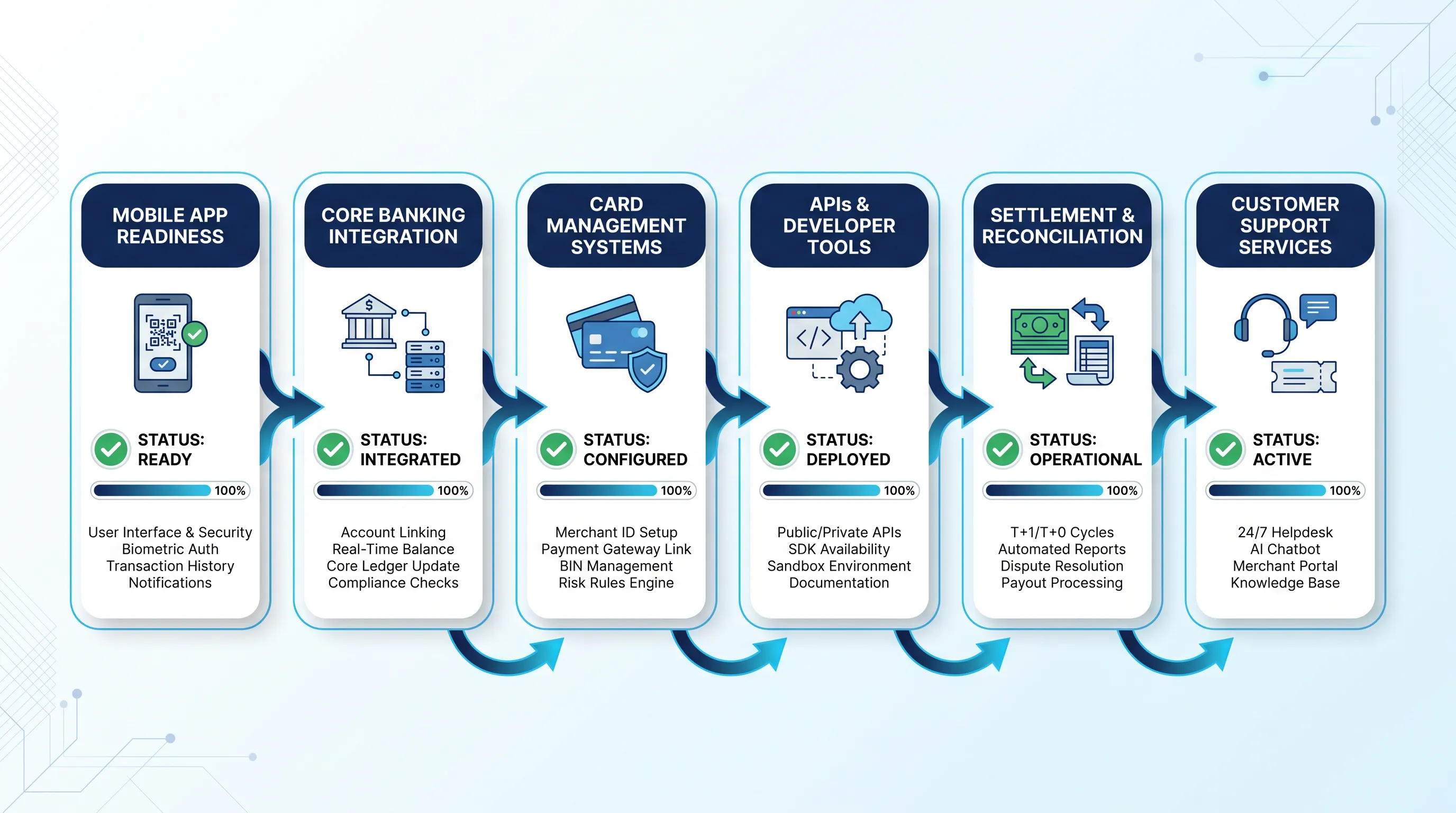
Build the readiness matrix

Flowchart depicting a financial readiness matrix for merchant QR acceptance services, featuring rounded cards, arrows, and a pale-blue gradient background.

Take each service you picked and run it down a fixed set of columns. A mid-sized commercial bank launching merchant QR acceptance, for example, will find that the customer app is ready and the core banking posting logic is not. The matrix exists to surface that before procurement.

Score every row as ready or gap, and treat unknown as the most expensive category:

  • Channels: mobile app, internet banking, agent and branch flows

  • Core banking: real-time balance checks, posting, and 24/7 availability during end-of-day

  • Card management and switching: BIN ranges, authorization routing, stand-in processing

  • APIs and security: message translation, certificate management, hardware security module capacity, including security module capacity

  • Settlement and reconciliation: intraday positions, break handling, exception queues

  • Fraud, disputes, and customer support: monitoring rules, chargeback workflows, first-line scripts

The unknowns are where delivery estimates go wrong. A bank that can't say whether its core posts in real time at 2am has scoped a daytime service.

Start building your financial platform?

Speak with EGS engineers about open banking, payment infrastructure, cloud systems, and enterprise software.

Get in Touch →

Identify delivery dependencies

Some of what determines your timeline sits outside your building. Certification windows and regulatory approvals move at their own pace, and no amount of internal effort compresses them. The switch itself has acknowledged uneven readiness across institutions, which is why it started building its connectivity middleware in March 2025, with full end-to-end testing and coordinated onboarding waves planned for its third phase.

Inside your building, the constraints are familiar. Legacy cores that batch-process and an integration team already committed to three other programs. Vendor capability deserves a hard look too, because EthioPay IPS runs on ISO 20022 and plenty of local implementations still speak ISO 8583 natively. Each of these changes scope and cost, and pretending otherwise just moves the overrun later. A dedicated integration team can help address the gap between those systems and the scheme.

Assign delivery ownership

Every unowned item becomes a blocker two weeks before go-live. Write names against the list:

  • Requirements and acceptance criteria, owned by the business sponsor for the service

  • Architecture and integration design, including message mapping and environment topology

  • Security, key management, and data protection sign-off

  • Test execution across unit, integration, certification, and operational-readiness stages

  • Production operations, incident response, and the escalation path to the operator

  • Partner and vendor coordination, with one person holding the relationship

Participation decisions and certification outcomes stay with the institutions that hold them. Your bank owns its licence position and its submissions. The operator owns the scheme rules and the certification verdict. An engineering partner owns the build and the evidence that it passed.

Plan phased delivery

Turn the gap list into workstreams, then sequence them so the foundational work lands first. Core availability and reconciliation come before any channel rollout, because a customer-facing launch on an unready back end produces exactly the kind of outage that the switch spent capital on data center relocation and disaster recovery to avoid.

Give each phase written acceptance criteria and a go-live decision point where someone can say no. Phase one proves connectivity and a single use case in a controlled environment. Phase two adds certification and a limited production pilot, which is how the national rollout itself began, with two participating banks on person-to-person transfers in February 2024. Phase three scales channels and volume, and only then do you expand the EthioPay IPS use-case set into merchant and bulk flows.

Define EGS support

Energize Global Services (EGS) is a fintech engineering company founded in 2007, with 500+ subject matter experts working on core banking platforms and payment infrastructure. The company holds ISO 27001 and PCI DSS certification and lists Ethiopia among its countries of operation.

What that buys you here is engineering capacity and judgment. EGS assesses your current architecture against the service you want to launch and builds the phased plan with dependencies named. Certification and scheme approvals remain yours and the operator's, and EthioPay IPS onboarding runs through the national switch on its terms.

Set the next step

Bring the customer service you intend to launch with a date attached and your honest readiness assessment including the unknowns. Those decisions determine the engineering scope more than any technology choice does.

The banks that ship on time are the ones that scoped the gaps before signing the contract. Talk to EGS directly about your EthioPay plans and define the engineering scope for your bank.

Start building your financial platform?

Speak with EGS engineers about open banking, payment infrastructure, cloud systems, and enterprise software.

Get in Touch →

Prepare the proposed service scope, target launch date, architecture diagram, licence details, expected transaction volumes, delivery owners, and known system gaps. Keep test evidence and vendor information available. EthSwitch should confirm the current submission list, required formats, fees, and approval sequence because public guidance can change.

Separate costs for software changes, certificates and security hardware, testing, certification, vendor support, operations, and staff training. Estimate each workstream against the readiness matrix, then add time for unknowns and external approval windows. A cost plan should also include recurring reconciliation, monitoring, support, and infrastructure expenses after launch.

Choose after comparing the required control, transaction volume, internal integration skills, operational coverage, and approval requirements. Direct participation gives the bank a direct technical relationship with the switch, while indirect participation may fit a bank that lacks the connectivity or support capacity. EthSwitch must confirm which route the bank can use.

Test successful transfers, timeouts, duplicate messages, rejected transactions, reversals, balance posting, reconciliation, fraud alerts, and customer notifications. Run these tests during overnight and weekend conditions because instant payments require continuous operational support. Include disaster recovery and incident escalation tests before approving a production pilot.

Yes. EGS can assess the client bank’s architecture, map gaps to the chosen service, define dependencies, and produce a phased engineering plan with acceptance criteria. The bank and EthSwitch still control regulatory submissions and certification decisions. A bank can book a call with EGS to review its readiness evidence and target date.

Schedule a Meeting

Book a time that works best for you

You Might Also Like

Discover more insights and articles

A project manager in business casual attire discusses a document intake process with a team in a modern office, focusing on a large monitor.

Bank document intake workflow: A readiness checklist

This article gives you a checkpoint-by-checkpoint method for testing a document intake process before you turn it on. It includes a worksheet structure you can copy into a spreadsheet and the evidence each control needs to produce.

A modern smartphone displaying a mobile banking app lies on a wooden desk, surrounded by abstract payment cards and a notebook.

AfriGO Card Readiness: Plan Your Nigerian Bank’s Rollout

This article is a readiness guide for moving from "we're considering it" to a controlled pilot on Nigeria's domestic card rails. It covers role definition and launch scope, then maps the transaction flow so you can assess systems and assign requirement ownership through the workstream matrix that holds the whole program together.

A professional seated at a desk uses a smartphone and payment card, engaged in online banking in a bright, modern office.

G2P Payments in Africa: Build Reliable Social Payment Infrastructure

This article traces the full lifecycle of a government social payment in Africa, from eligibility approval through to reconciliation and investigation evidence. It assigns operational ownership at each system boundary and sets out how to control exceptions and assisted access.

A woman interacts with her smartphone at a casual desk, navigating a banking app, with a blurred laptop and plant in the background.

Card Testing Fraud: Protect African Payment Platforms

This article explains how to investigate and contain automated authorization abuse across a merchant portfolio without shutting out paying customers. It covers the signals worth correlating and a control matrix you can hand to the team on shift.