How European Instant Payments Infrastructure Operates

Content authorBy EGSPublished onReading time13 min read
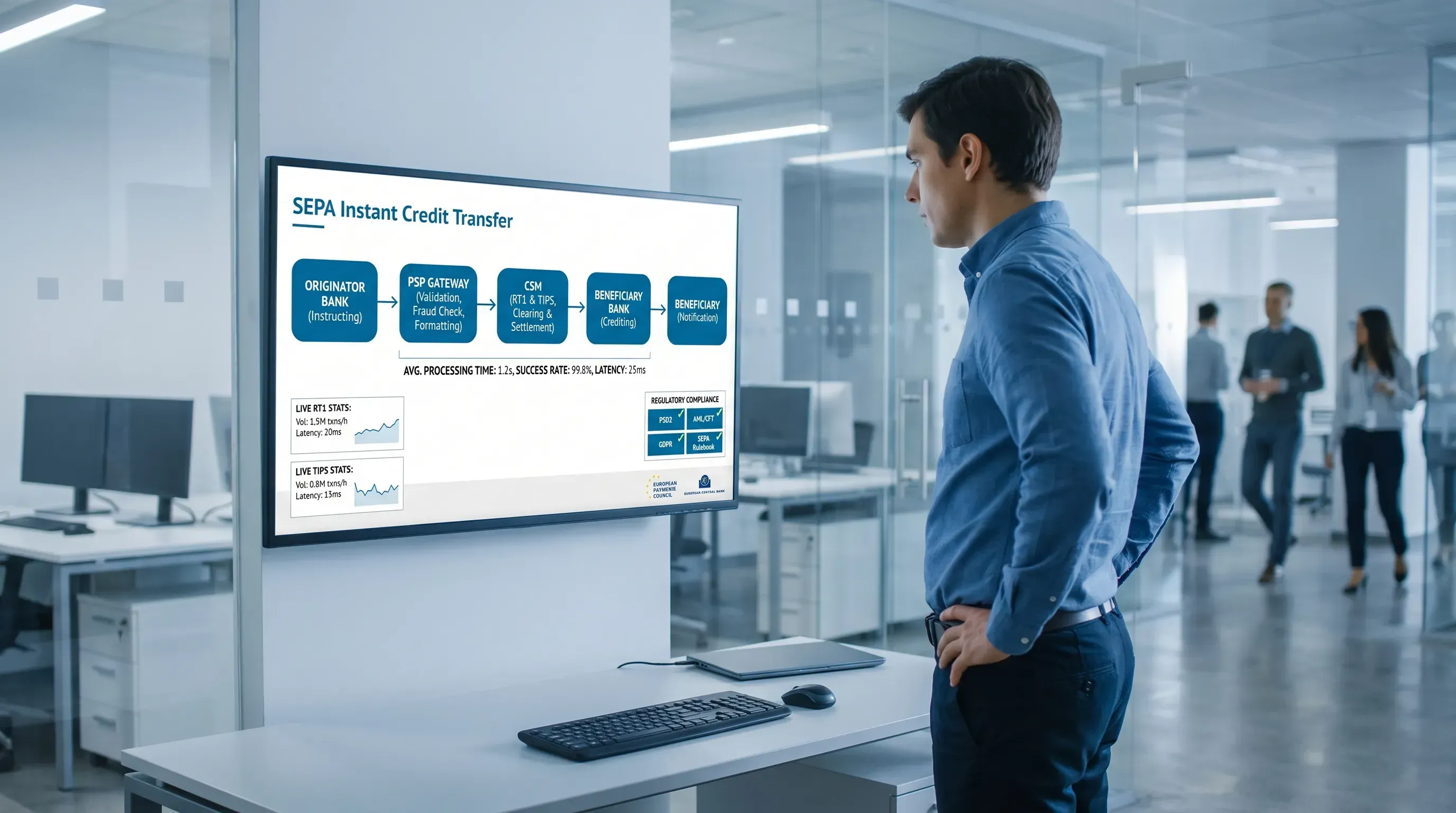
A professional reviews a SEPA Instant Credit Transfer flow diagram on a large monitor in a modern corporate engineering office.

European instant payments run on SEPA Instant Credit Transfer (SCT Inst), the European Payments Council scheme for euro credit transfers cleared and settled continuously in seconds. Payer banks send ISO 20022 instructions through either RT1 or TIPS, and the beneficiary bank credits the account and returns a status inside ten seconds every day of the year.

What is SEPA Instant?

SEPA Instant is the common name for SCT Inst, the European Payments Council (EPC) scheme rulebook that defines how euro credit transfers are exchanged and confirmed within seconds at any hour. The scheme is a rulebook. It specifies message content and timing obligations.

Three layers sit under that name and they're worth keeping apart. The rulebook sets the rules. Clearing and settlement mechanisms, RT1 and TIPS among them, move the messages and settle the money. Participating payment service providers (PSPs) then build the customer-facing services, from mobile banking screens to corporate APIs, on top of both.

The scale is no longer marginal. RT1 alone had 94 participants in its SCT Inst service and handles around 5 million transactions on peak days, with average processing between participants of just over one second. That gap between the one-second reality and the ten-second obligation is where design freedom lives. Everything you spend on validation and fraud scoring comes out of that margin.

How does an SCT Inst payment flow?

An SCT Inst payment moves through stages from customer initiation through settlement in RT1 or TIPS, and a status message then travels back to the payer. If you know how a standard SEPA transfer works, the difference is that none of these stages queue. Every one runs synchronously, in a single request-response cycle.

The message chain is what makes the difference visible. Where batch SEPA files carry thousands of transactions in one pain.001, instant payments produce a distinct set of messages per transfer. A single SCT Inst generates at minimum five distinct ISO 20022 messages, which carry a unique end-to-end identification that lets any participant trace the transaction across the chain.

That per-transaction message overhead reshapes your capacity math. Batch systems scale on file size, and instant systems scale on concurrent request volume, which means a bank sizing its gateway on daily payment counts alone will under-provision for peak-second load. Model the peak minute instead.

How does the payer bank validate it?

The payer bank runs its checks before the money leaves, and it runs them all inside a few hundred milliseconds. Account status and available balance resolve before a pacs.008 is built and timestamped. Strong customer authentication under the Payment Services Directive 2 (PSD2) and the Verification of Payee result finish in the same window, along with fraud scoring and the sanctions position.

Sanctions handling changed shape here. The Instant Payments Regulation requires PSPs to screen their full customer base at least daily and immediately after any new designation takes effect.

Front-loading screening onto the customer record removes the slowest step from the payment path, but it moves your compliance risk into data freshness. If your daily refresh runs at midnight and a designation publishes at 09:00, every payment you clear until the next cycle carries that gap. Refresh more often than the rule demands.

How do RT1 and TIPS route it?

RT1 and TIPS are two different routes to the same reach. RT1, operated by EBA CLEARING, is a pan-European real-time gross settlement system that settles in its own books backed by funds held in a technical account at T2. TIPS, run by the Eurosystem, settles directly in central bank money on dedicated cash accounts.

Both require funds positioned in advance, and both are open every calendar day. The practical distinction sits in the funding account. TIPS achieved 99.99% technical availability across 2025 as it more than doubled its traffic for a second consecutive year, and it settled 99.99% of instant payments within five seconds.

Reachability decides which route you need, and most institutions end up on both because their counterparties are split across them. EBA CLEARING has issued specifications for instructing-party functionality that lets RT1 participants manage traffic and liquidity across RT1 and TIPS from a single access point, which tells you the industry has accepted dual connectivity as the normal end state.

How does the beneficiary bank respond?

The beneficiary bank validates the incoming pacs.008 and returns a pacs.002 carrying either acceptance or a rejection reason code. Funds become available to the payee at the moment of crediting, before the confirmation completes its journey back to the payer. That ordering matters, because the payee sees money in the account while the payer is still watching a spinner.

Checks on the receiving side are narrow by design. Account existence and whether the message arrived inside the timeout window. Oracle's SEPA Instant processing documentation notes that inbound payments received after the timeout seconds configured in network preferences are rejected upfront, with a pacs.002 returned carrying the reason code.

So your inbound path has a harder latency budget than your outbound one. A payment your core banking system takes four seconds to post is a payment you'll reject through no fault of the sender, and the sender's customer will blame the sender. Inbound crediting deserves its own performance target.

Start building your financial platform?

Speak with EGS engineers about open banking, payment infrastructure, cloud systems, and enterprise software.

Get in Touch →

Which operating rules constrain processing?

Four scheme and legal constraints shape almost every design decision, from the execution deadline and continuous availability to the treatment of amount limits and irrevocability once settlement completes. Two of these come from EU law and two from the current EPC rulebook, and confusing the sources is how banks end up defending internal controls as if a scheme required them.

The Instant Payments Regulation (IPR) amended the SEPA Regulation and set the outer legal boundaries. The rulebook then tightens the internal choreography. On the pricing side, Article 5b of the IPR prohibits charging more for sending or receiving an instant credit transfer than for other credit transfers of corresponding type, a rule that has applied in euro area member states since 9 January 2025.

Price parity has an architectural consequence people underestimate. Once instant costs the customer nothing extra, instant becomes the default channel, and your volume forecasts based on the old opt-in behavior stop being useful. Build capacity for the payment mix you'll have.

How quickly must payments complete?

The legal ceiling is ten seconds end to end, and the current SCT Inst rulebook divides that ceiling into tighter internal milestones. The clock starts at the time of receipt of the payment order, which equals the moment the payer authorizes it, recorded in the rulebook attribute for the transaction timestamp.

Since October 2025, the old 10-20-25 second sub-timeline became a 5-7-9 seconds timeline. A response reaches the originator PSP within 5 seconds, and a timeout triggers at 7. After 9 the sender can raise a status update request.

There's already evidence of what compressing those milestones costs. Analysis of German PSP activity in TIPS published by SUERF found that the shorter processing times produced an increased share of timeouts and offline agent errors, even as volumes grew. Read that as a warning about tail latency. Your p50 can sit at one second while your p99 breaches seven, and only the p99 generates customer complaints.

Are SCT Inst transfers capped?

No scheme-level maximum applies to SCT Inst any more. The EPC removed the €100,000 per-transaction cap, and the rulebook now states that a maximum amount at scheme level is no longer applied beyond what the amended SEPA Regulation itself sets. Any limit your customers hit above that comes from a PSP.

PSPs retain the ability to apply risk-based limits per customer or per account where law permits and where the limit is disclosed clearly. Fraud exposure is the usual justification, and it's a legitimate one given that a settled instant payment can't be pulled back unilaterally.

The removal changed behavior fast. The SUERF analysis of the German TIPS community attributes a marked increase in transaction volumes and values in the second half of 2025 specifically to the lifting of price discrimination and transaction limits. What that implies for anyone still running a legacy internal cap: your limit is now a competitive decision, and corporate treasurers comparing providers will notice which banks kept theirs at €100,000 out of inertia.

Must systems operate continuously?

Sending and receiving capability has to work 24 hours a day on every calendar day, which rules out maintenance windows that take the service offline. The IPR defines an instant credit transfer as one executed immediately around the clock, and requires that all payment accounts a PSP maintains stay reachable at any moment.

That obligation extends past the payment engine to everything the engine depends on, from fraud scoring to the people who answer the phone at 03:00 on a Sunday. The ECB reported that TIPS experienced one incident affecting instant payment settlement during 2024, caused by unresponsiveness in a connected T2 component.

The lesson in that single incident is about blast radius. A dependency you don't own and can't patch took latency with it, and the settlement engine stayed up. Design your own chain so that a slow downstream service degrades into a clean rejection, because a timeout you cause is worse than a rejection you control.

Start building your financial platform?

Speak with EGS engineers about open banking, payment infrastructure, cloud systems, and enterprise software.

Get in Touch →

How do banks integrate SCT Inst?

Integration centers on an instant-payment gateway that sits between customer channels and the clearing infrastructure, and connects outward to every system that has to answer within the execution window. The gateway owns message construction and timeout enforcement. Everything else answers its calls.

The connections you'll build, roughly in order of latency sensitivity:

  • Digital and API channels for initiation, plus core banking for balance checks and posting

  • Fraud scoring and the daily sanctions position, both of which have to respond in milliseconds

  • ISO 20022 message handling with RT1 or TIPS connectivity and treasury systems for settlement position monitoring

A practical implementation note: transaction logging has to capture schema validation results and retry attempts against a unique transaction ID so that any transaction path can be reconstructed within seconds for audits or disputes. That requirement pushes back on a tempting shortcut. Teams under deadline pressure log at the gateway edge, then discover during their first dispute that they can't prove where the four lost seconds went.

Which regulations govern instant payments?

Two instruments carry the central obligations, and PSD2 governs everything around the authorization itself. The Instant Payments Regulation, Regulation (EU) 2024/886, sets the mandate to send and receive along with price parity. The SCT Inst rulebook translates those into message-level requirements. PSD2 continues to govern strong customer authentication and liability allocation.

Verification of Payee became mandatory for euro area PSPs on 9 October 2025, offered free of charge, and it applies to standard credit transfers as well as instant ones. PSPs outside the euro area have until 9 July 2027.

One consequence deserves attention because it shifts liability. Where a payer authorizes a transfer after being warned that the payee name and account identifier don't match, that payer carries the loss for a misdirected payment. The quality of your warning message therefore becomes a liability control. A vague "details could not be verified" prompt invites a customer to click through, and a court will read it that way too.

Which technical risks threaten reliable delivery?

Rejections and timeouts account for most instant-payment failures in production. Funding gaps and downtime also trace back to a specific implementation weakness. The ECB's supervisory priorities for 2026 to 2028 name operational risk management frameworks and ICT capabilities as a prioritized vulnerability, with explicit expectations around the Digital Operational Resilience Act (DORA) implementation and third-party risk.

Supervisory attention on those areas has a direct read-across to instant payments. An instant-payment service touches more third-party dependencies than any batch service you run, and it fails in public within seconds. So the same controls a supervisor asks about generically become the controls that keep your success rate above 99%.

The three failure domains below cover most of what goes wrong after go-live. Each has become harder since October 2025, when tighter timelines and unlimited amounts arrived together.

Liquidity must remain available continuously

Settlement positions are prefunded, which means an instant payment fails when the position runs dry regardless of the customer's account balance. TIPS runs around the clock, but T2, where banks hold their central bank accounts, does not. It's open 07:00 to 18:00 CET on weekdays and closed for six bank holidays a year, which is less than a third of TIPS business hours.

Run low on a weekend and you wait until Monday. That asymmetry forces Friday afternoon funding decisions that have to survive an entire weekend of unpredictable volume, and it explains why threshold alerts and automated liquidity transfers within TIPS hours belong in the first release.

Since the €100,000 cap disappeared, a single large corporate payment can now consume a position sized for retail traffic. Calibrate your weekend buffer against your largest plausible transaction.

Reconciliation must happen in real time

Reconciliation in an instant environment means correlating an asynchronous status response back to a reserved or posted debit, within seconds, without ever double-crediting. Confirmed acceptance and confirmed rejection have to be handled distinctly from no answer at all. The third one is the dangerous state, because a timeout doesn't tell you whether the beneficiary was credited.

The recall process exists for exactly these situations. Under earlier rulebook versions, originator PSPs sent multiple recall requests for the same transaction, which created confusion between PSPs during resolution, and the current rulebook clarified the handling of recalls and related status update requests.

Duplicate protection is the control that pays for itself. If your retry logic can reissue a pacs.008 after a timeout without a scheme-level idempotency key, you will eventually pay twice and spend weeks recovering the second payment through recall channels that were designed for error correction.

Resilience must cover every dependency

Resilience for instant payments means active-active architecture across the whole chain, because a single-site design can't meet a 24/7 obligation during any upgrade. TIPS itself was built to restart within 15 minutes in a site disaster scenario and to sustain a doubling of payment volume within a year, according to specifications described by Piero Cipollone, then Deputy Director General for Markets and Payment Systems at Banca d'Italia and later an ECB Executive Board member.

Those figures set a useful benchmark for your own targets. If the infrastructure you connect to recovers in 15 minutes and your gateway needs four hours, your customers experience your recovery time.

Practical implications for how you build:

  1. Deploy across two active sites with traffic served from both, so failover is a routing change

  2. Instrument per-hop latency and rejection reason codes, because aggregate success rates hide the specific dependency that's degrading

Capacity planning has to assume the doubling pattern TIPS has now seen twice, which means your headroom needs to be a year of growth.

Build your SCT Inst capability with EGS

The fastest way to find the weak point in an instant-payment design is to have someone walk the whole chain with you, from channel initiation through to the settlement position and back. EGS builds and operates that chain, from banking platforms to 24/7 production operations for services that can't take a maintenance window.

Whether you're standing up SCT Inst for the first time or validating a live implementation against the 5-7-9 timeline and continuous availability obligations, the work starts with an honest assessment of what your current architecture does under peak-second load. Book a call with EGS and bring your current message flow and latency numbers. We'll tell you where the ten seconds go.

Start building your financial platform?

Speak with EGS engineers about open banking, payment infrastructure, cloud systems, and enterprise software.

Get in Touch →

Test the complete path under peak concurrent load, including a slow or unavailable dependency. Verify that accepted payments post once, rejected payments release reserved funds, and uncertain outcomes enter reconciliation. Run failover tests while traffic continues, because a successful message test doesn't prove the service can meet its timing obligations during an incident.

Yes, a bank can use a technical provider for gateway operation or clearing connectivity. The bank remains accountable for compliance, customer outcomes, and operational control. Its contract should set response-time targets, incident duties, and access to the records needed to investigate a failed or disputed payment.

Keep an end-to-end transaction ID, the payment instruction, and every status message. Record timestamps for authorization, gateway processing, clearing submission, and account posting. Store the verification result and the decision behind any rejection. These records let operations staff establish whether the payment settled, failed, or needs a recall request.

A payment that needs a human decision shouldn't enter the SCT Inst execution path until that decision is complete. Use rules before acceptance to identify cases requiring review, then reject or defer the customer's instruction under the bank's disclosed process. Waiting for an analyst after submission risks a timeout and an uncertain payment outcome.

Use a standard SEPA transfer when the recipient account isn't reachable for SCT Inst or when the payment does not require immediate delivery. A standard transfer also fits batch-based corporate processes that have been designed around scheduled approval cycles. The sender should still check the recipient details before authorizing either transfer type.

Schedule a Meeting

Book a time that works best for you

You Might Also Like

Discover more insights and articles

A single hand holds a credit card partially inserted into a sleek payment device, set against a minimal background.

What Systems Decide Whether a Payment Is Approved or Declined

Four systems can stop a card payment, from the merchant's gateway and fraud tools through the acquirer and the card network to the issuing bank. The issuer makes the final authorization call after checking the account balance and the fraud score, then applying scheme rules. Any earlier system can block the transaction before the issuer ever sees it.

Close-up of two hands interacting with a payment terminal at a supermarket checkout, with a blurred retail background.

How Payment Authorization Decisions Are Made in Milliseconds

A card authorization is a synchronous request-response round trip. The terminal builds a message that the acquirer and card network route to the issuer, and the issuer combines account and cryptographic checks into a single approval or decline code that travels back the same path. Money moves later, during clearing and settlement.

A bank analyst monitors transaction flow on multiple screens in a modern office, showcasing a high-tech, professional environment.

Liquidity Management in Real-Time Payments Systems

Liquidity management in real-time payments is the practice of keeping enough funds or credit immediately available in settlement accounts to clear every outbound payment instantly, around the clock. Because instant payments settle transaction by transaction with no netting window, banks prefund or continuously replenish balances instead of squaring positions once a day.

A modern corporate meeting room with banking professionals discussing KPIs on a large dashboard display, surrounded by laptops and reports.

Key Challenges Banks Face When Adopting Instant Payments

Banks adopting instant payments face five connected gaps, from batch-based cores that can't post in seconds to liquidity management that stops at 5 p.m. Each gap has to close before launch.