What ISO 20022 actually is
The ISO 20022 payment system is a global standard for electronic data interchange between financial institutions across payments, securities, trade services, cards, and foreign exchange. It was launched in 2004 by the Geneva-based International Organization for Standardization, which describes it as a way to give the industry a single common "language" for moving money and information. The point is interoperability: one shared vocabulary that any participant can read and write, regardless of region or system.
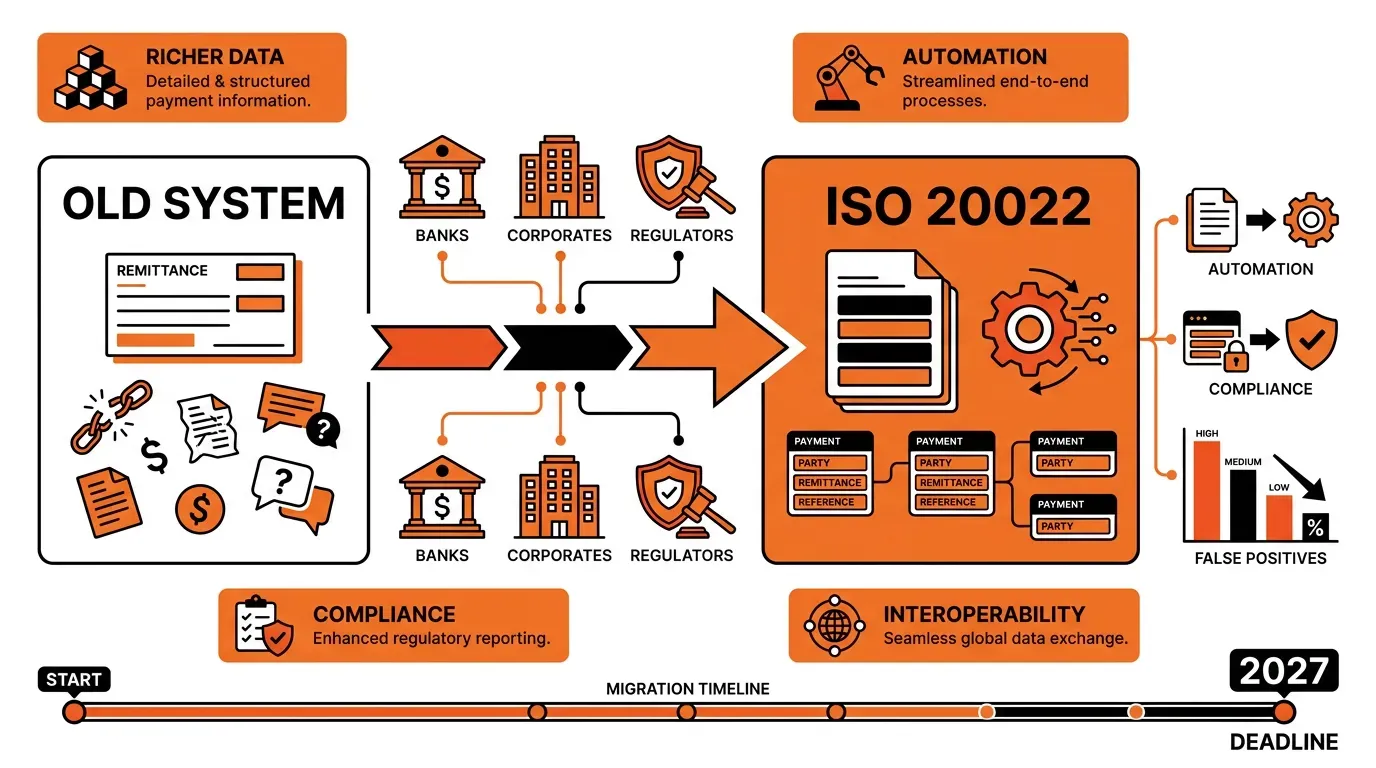
Unlike older formats that rely on rigid character strings, the ISO 20022 payment system uses structured messages built in Extensible Markup Language (XML), and each piece of information has its own clearly named field. That structure carries far richer data, from beneficiary identifiers to invoice references, and it does so in a way machines can parse without guessing. The result is a format designed for automation, with machine-readable fields in place of fixed-length text.
Why the old standards fell short
Legacy formats like SWIFT MT were built for a different era of banking. The MT 103 customer credit transfer, for instance, only supports up to 140 characters for remittance information, which forces corporates to truncate invoice details or push them outside the payment chain entirely. Free-text fields and inconsistent regional conventions made it hard to know what data belonged where.
Those gaps had real consequences. The Bank for International Settlements noted that translating between domestic formats and MT routinely caused data truncation and fragmentation, which undermined straight-through processing and made sanctions screening harder. Compliance teams ended up chasing false positives because names, addresses, and purpose codes lived in unstructured strings rather than discrete fields.
Reconciliation suffered too. When a corporate received a payment, it had to match it against an invoice using whatever fragment of reference survived the journey. Failed and repaired payments are expensive. According to Datos Insights, 45% of banks estimate that customer attrition from failed payments costs them between $1 million and $5 million a year. That's the bill the industry kept paying for a messaging layer that couldn't carry enough context.
How the ISO 20022 payment system works
At the core sits a shared data dictionary that defines every business element a financial message can carry, from a debtor's legal entity identifier to a purpose code. Messages are written in XML, which means each field has a defined name and type within a structured tree. Two systems built by different vendors in different countries can read the same message because they share the dictionary.
Messages are grouped into families that map to a business function. The four most relevant to payments are:
-
pacs (Payments Clearing and Settlement): interbank credit transfers, returns, and status reports. pacs.008 carries a customer credit transfer between banks, equivalent to MT103.
-
pain (Payments Initiation): instructions sent from a corporate or end customer to its bank, such as pain.001 for a credit transfer initiation.
-
camt (Cash Management): account reports, statements, and exception messages like camt.056 for a payment cancellation request.
-
admi (Administration): system acknowledgements and event notifications.
Because the dictionary is shared, the same message logic flows across different rails. SWIFT uses the ISO 20022 payment system for cross-border payments under its Cross-Border Payments and Reporting Plus (CBPR+) guidelines. The Eurosystem runs it on T2, the successor to TARGET2 that processes roughly €2.2 trillion a day. The Bank of England's Clearing House Automated Payment System (CHAPS) runs on it. Fedwire runs on it. That common base is what makes interoperability more than a slogan.
Key benefits of the new standard

The advantages of the modern payment messaging standard differ for banks and for the corporate or regulatory teams that depend on payment data. The themes are consistent: richer data and fewer manual touches, with a foundation that supports new products without another round of format wars.
Richer remittance data
ISO 20022 lets a single payment carry structured invoice references that the old 140-character free-text line couldn't hold. It can also preserve party identifiers and purpose codes in dedicated fields. For corporates, that means a payment arrives with enough context to be matched to an open receivable automatically, without an operations analyst stitching together emails and bank statements. Straight-through processing rates improve because the data the receiving system needs is already there, in the field where it belongs.
The Bank of England designed its CHAPS implementation around exactly this idea and went beyond the minimum technical implementation to mandate purpose codes and Legal Entity Identifiers for certain payment types. That's a deliberate bet on richer data as the actual prize.
Better compliance and screening
When names, addresses, and country codes sit in dedicated fields, sanctions screening tools stop tripping over ambiguous free text. A structured address with a country code is easier to match against a watchlist than a string that crams the same information into a single line. Anti-money-laundering (AML) and fraud detection benefit from the same clarity, because pattern detection works better on clean, typed data.
This matters for any bank operating across jurisdictions where regulators want consistent, auditable evidence that screening is working. The ISO 20022 payment system gives compliance teams a richer dataset and fewer false positives to chase, which translates to lower per-transaction screening costs.
Global interoperability
A single modern payment messaging standard reduces the need to translate between regional formats every time a payment crosses a border. The G20 cross-border payments programme identified fragmented messaging as a major friction, and the Committee on Payments and Market Infrastructures has set an end-2027 timeline for global adoption of harmonised data requirements. Fewer translations means fewer repair queues because less data gets lost, so settlement moves faster.
For corporates with treasury operations in many currencies, the practical effect is that the data you send in one corridor looks like the data you send in another. That consistency is what makes multi-currency cash management workable at scale.
Future-ready infrastructure
The ISO 20022 payment system was built to extend. Instant payment schemes and open banking APIs need a flexible data model, and ISO 20022 already provides one for embedded finance products too. The Federal Reserve's FedNow Service uses ISO 20022 from day one, which means new use cases like request for payment (pain.013) plug into the same dictionary that handles wires.
A flexible data model matters most for products that don't exist yet. If a central bank digital currency or a tokenised deposit needs a settlement message in five years, the schema can be extended rather than rebuilt.
The global migration timeline
The ISO 20022 migration has been a phased global program. The big milestones are easy to track once you know where to look.
The Eurosystem went first among the major hubs. On 20 March 2023, T2 replaced TARGET2 as the real-time gross settlement system for the euro area, with EBA Clearing's EURO1 cutting over the same weekend. SWIFT began its cross-border coexistence period on the same date through CBPR+, so MT and ISO 20022 messages could flow side by side.
The UK followed quickly. On 19 June 2023, CHAPS and the Bank of England's Real Time Gross Settlement System migrated. The United States took longer. Fedwire originally planned a March 2025 cutover, but the Federal Reserve pushed the date to 14 July 2025, when the legacy Fedwire Application Interface Manual (FAIM) format was retired in a single-day implementation with no coexistence phase.
The big one for cross-border traffic was 22 November 2025, when SWIFT ended the MT/ISO 20022 coexistence period. Key MT messages such as MT103 and MT202 were retired as the mandatory format for payment instructions across the SWIFT network, which connects more than 11,000 financial institutions worldwide. SWIFT has left a narrow fallback window until November 2026 with additional validations and charges, but the message is clear: the ISO 20022 payment system is now the default for cross-border traffic. In Asia-Pacific, schemes like Japan's Zengin and Australia's New Payments Platform adopted the standard earlier, while several markets continue their own ISO 20022 migration on regional timelines.
Challenges banks and businesses face
The benefits are real, but the work behind them is heavy. Legacy core banking systems were not designed for XML payloads or structured addresses, and rewriting them is expensive. Many banks have responded by bolting translation layers in front of older platforms, which gets them compliant without fixing the underlying data model.
That approach has limits. SAP Fioneer cited a survey finding that 48% of U.S. financial institutions plan to implement only the minimum requirements for Fedwire and SWIFT, with no broader modernisation plans. The risk is that the rich data that justified the whole exercise gets stripped on the way into a legacy ledger, so the bank ships ISO 20022 messages but doesn't gain the operational benefit.
The practical headaches show up in several places:
-
Data truncation when MX messages get mapped to internal MT-shaped tables, with the industry convention of appending a "+" character to signal dropped data.
-
Vendor coordination across core banking, payment hubs, screening engines, and reporting tools, each on its own release cycle.
-
Staff training, because operations teams who spent twenty years reading MT tags now have to think in XML schemas and structured address rules.
Smaller institutions and corporates feel the pressure more sharply than tier-one banks. A community bank that relies on a correspondent for cross-border payments still has to understand what's changing, because the ISO 20022 payment system changes customer-facing fields and the statement layouts that feed reconciliation files. The cost of getting it wrong is paid in failed payments and unhappy clients.
How to prepare for adoption
Preparation starts with a data audit. Map every payment field your systems produce and consume, then compare them against the ISO 20022 message types you'll actually exchange. The goal is to identify where information will be lost or misrouted, including cases where duplicate data would create production issues.
From there, the work follows a familiar path. In a note on the Bank of England's CHAPS approach, Akhil Rao noted that the UK rollout sequenced enhanced data requirements over years; purpose codes and LEIs were introduced gradually before they became mandatory. That phased pattern is worth copying.
A grounded preparation plan covers a few priorities. Run a gap analysis against the message types your business depends on; start with pacs.008, pacs.009, pain.001, and camt.053. Select payment service providers and SWIFT-accredited partners whose roadmaps match your modernisation strategy rather than fighting it. Build a test plan that exercises edge cases such as structured addresses and long remittance strings, with exception flows like camt.056 cancellations included in the same plan. Train operations and compliance staff on the new field names and codes before go-live, not after.
The ISO 20022 migration also gives finance and treasury teams a reason to revisit reconciliation processes. If your accounts receivable system can finally consume structured invoice references end-to-end, that's an automation project waiting to happen. The modern payment messaging standard rewards organisations that treat the transition as a chance to redesign workflows.
What comes next
The ISO 20022 migration is the beginning of a longer arc. The same modern payment messaging standard that now carries cross-border wires is the foundation for instant payments and request-for-payment flows, with open banking relying on the same data layer. As central bank digital currencies move from pilots to production, they'll need a messaging substrate that supports rich identity and purpose data, which is exactly what ISO 20022 already offers.
The next wave will focus on what banks do with the data. Centralised payment data stores and canonical data models are where the strategic value sits, especially when analytics use structured payment flows. Maharaja Subramanian of Volante Technologies described the Fedwire cutover as a moment to accelerate broader payment transformation, and that framing applies to every institution that has now crossed the line.
The ISO 20022 payment system is now the working layer of global finance, and assessing your readiness against it is no longer optional. If your team is mapping out the next phase of your ISO 20022 migration, treat this as the start of a multi-year investment in the modern payment messaging standard and the products it will support. Reach out to our payments team to review your current architecture against the ISO 20022 payment system roadmap and identify where data quality and automation can improve customer experience next.