Modern data center server racks with glowing cybersecurity lock icons representing secure cloud infrastructure and data protection

HSM Development Company: Engineering Secure Payment Infrastructure for Regulated Systems

Every card tap, every ATM withdrawal, every online checkout depends on cryptographic keys that must never be exposed. When those keys leak, the entire payment chain collapses. So how do you build infrastructure that keeps secrets secret at massive scale?

Content authorBy EGSPublished onReading time9 min read

What This Article Covers

This guide breaks down how a capable HSM development company architects secure payment systems from the ground up. You'll learn the role of hardware security modules as the root of trust, how real-world payment flows work (ATM, POS, card issuing), what PCI DSS compliance demands, and why key ceremonies, clustering, and failover matter. We'll also walk through the full architecture: HSM plus payment switch, authorization engine, and key vault. If you're a CTO or Head of Payments evaluating HSM integration services, this is your starting point.

Why Hardware Security Modules Are the Root of Trust in Payments

A hardware security module is a tamper-resistant physical device that generates, stores, and manages cryptographic keys. In payment systems, it's the one component that everything else trusts. Without it, PIN translation, card verification, and key exchange all become vulnerable. Think of the HSM as a vault inside a vault. The device itself resists physical intrusion, and its firmware enforces strict access policies.

That combination makes it the foundation for:

  • PIN block translation between acquirer and issuer networks

  • EMV cryptogram generation and validation during chip card transactions

  • Master key storage for derived key hierarchies (DUKPT, MK/SK)

  • Digital signature operations for card personalization and issuance

Hardware security module engineering isn't just about plugging in a box. It's about designing the trust boundary that protects every transaction flowing through your system. According to Verizon’s Data Breach Investigations Report, over 70% of breaches involve a human element such as credential misuse or errors, reinforcing the need for tightly controlled key management systems.

The distinction matters because a misconfigured HSM environment can pass certification yet still expose keys during runtime. Getting this right requires deep expertise in both cryptographic protocols and payment network rules. For more on enterprise-grade security infrastructure and real-world payment architecture, see Energize Global Services.

Full Architecture: HSM, Payment Switch, Auth Engine, and Vault

Building a payment platform means connecting several interdependent components. The HSM sits at the center, but it doesn't work alone.

The Payment Switch

The payment switch routes authorization messages (ISO 8583 or ISO 20022) between merchants, acquirers, card networks, and issuers. It calls the HSM for every cryptographic operation: PIN verification, MAC generation, and key translation.

A well-designed switch handles thousands of transactions per second while maintaining sub-100ms latency to the HSM. The connection between switch and HSM typically uses a dedicated, encrypted channel with mutual authentication. At global scale, networks like Mastercard process tens of thousands of transactions per second, placing strict performance and latency requirements on HSM-backed systems.

The Authorization Engine

This layer applies business rules: fraud scoring, velocity checks, balance lookups, and approval logic. It sits between the switch and the core banking system.

The auth engine never touches raw keys. It passes encrypted PIN blocks and cryptograms to the HSM, receives a yes/no response, and makes its decision. That separation of duties is critical for PCI DSS compliance. This becomes even more important as global card fraud losses are projected to exceed $40 billion annually, making secure cryptographic validation a core requirement for every transaction.

The Key Vault and Management Layer

Beyond the HSM hardware, you need a logical key management system that tracks the following core elements. To ensure secure key handling, full visibility, and compliance across the entire infrastructure, this system must cover several critical components.

Those are:

  • Key hierarchies (zone master keys, terminal master keys, session keys)

  • Key lifecycle states (active, suspended, destroyed)

  • Audit trails for every key operation

  • Distribution records for remote key injection

This vault layer often runs as software that orchestrates HSM commands. It's where HSM integration services prove their value, connecting key management policies to operational reality.

Together, these four components form the backbone of any regulated payment system. Getting one wrong compromises the others.

Real-World Payment Flows

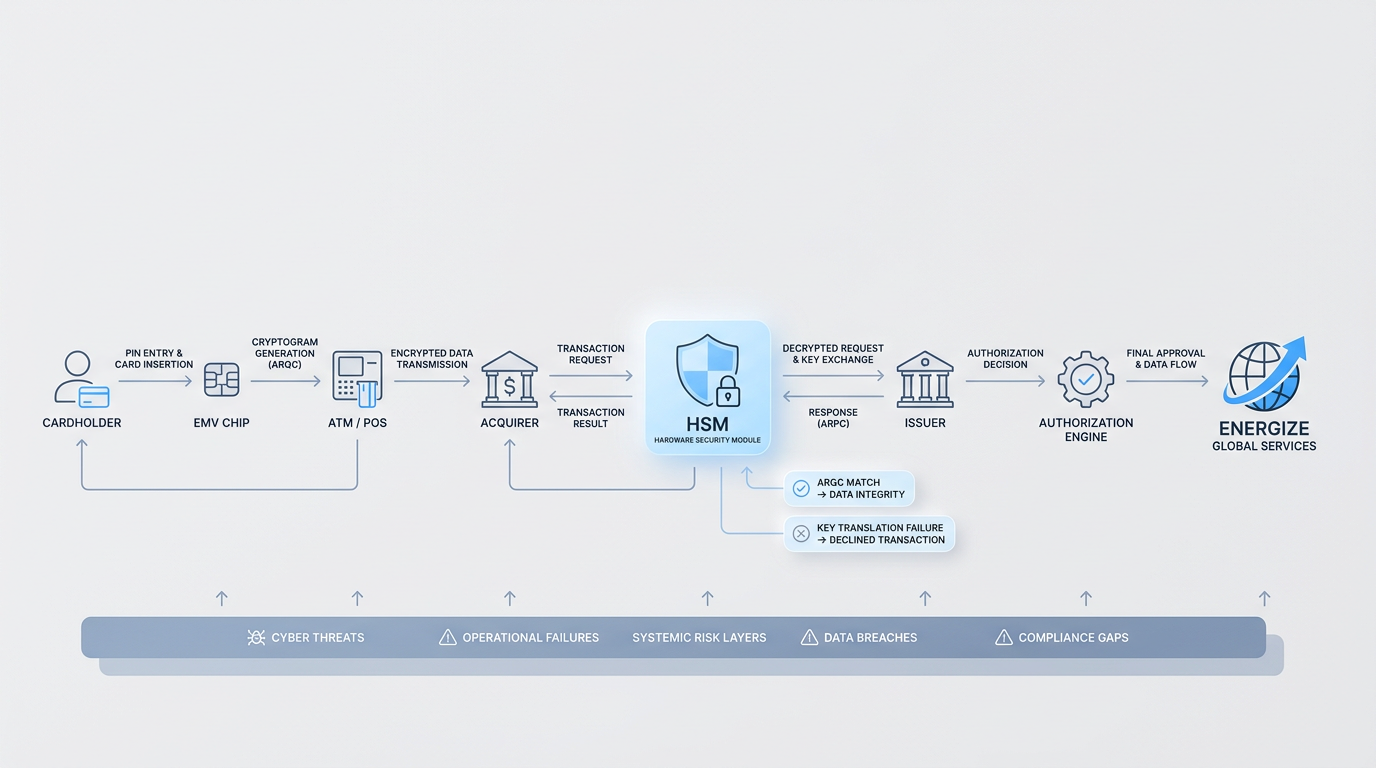
Flow-based infographic illustrating the payment transaction journey with muted blue icons, soft lighting, and a central highlighted HSM.

Understanding architecture in theory is useful. Seeing it in action is better.

ATM Cash Withdrawal

When a cardholder enters a PIN at an ATM, the terminal encrypts the PIN using a terminal key stored via remote key injection. The encrypted PIN block travels through the acquirer's switch to the issuer's HSM. The HSM translates the PIN block from the acquirer's zone key to the issuer's zone key, then verifies the PIN against the card's stored offset. If it matches, the auth engine approves the withdrawal.

Every step relies on the HSM. If the key translation fails or uses a stale key, the transaction is declined or, worse, insecure.

POS Chip Transaction

At a point-of-sale terminal, the EMV chip generates an Application Request Cryptogram (ARQC). The terminal sends this cryptogram, along with transaction data, to the issuer.

The issuer's HSM:

  • Derives the card's unique key from the issuer master key

  • Recalculates the ARQC using the same transaction data

  • Compares the two values

A match confirms the card is genuine and the data hasn't been tampered with. The HSM then generates an Authorization Response Cryptogram (ARPC) sent back to the card.

Card Issuance and Personalization

Before a card ever reaches a cardholder, the issuer's HSM generates and injects keys during personalization.

This includes:

  • ICC master keys for EMV applications

  • CVV/CVC values derived from card data and issuer keys

  • PIN offset or PVV values

Energize Global Services, a multinational development center specializing in software for hardware security modules and POS terminals, has built HSM-backed card issuance pipelines that handle millions of cards across multiple issuing programs. Their work spans open banking and core banking platforms as well.

For more on resilient financial platforms, secure infrastructure, and digital transformation, visit the Energize Global Services homepage.

These flows show why hardware security module engineering must account for every message hop, every key derivation, and every failure scenario. With global digital payment transaction value expected to exceed $14 trillion annually, even minor weaknesses in cryptographic workflows can scale into systemic risk across millions of transactions.

PCI DSS Compliance and Key Ceremonies

PCI DSS (specifically PCI PIN Security and PCI P2PE) sets strict rules for how keys are managed. Compliance isn't optional if you process card payments.

What PCI DSS Requires for HSM Environments

PCI DSS requires strict operational controls around HSM environments to ensure that cryptographic keys remain protected at all times. These controls include dual control, where no single individual can access or reconstruct a key, and split knowledge, which ensures that key components are distributed across separate custodians. Secure key loading must be performed in controlled environments using tamper-evident processes and witnessed ceremonies. In addition, organizations must enforce regular key rotation based on defined schedules and maintain comprehensive audit logs that record every HSM-related command and activity.

Key Ceremonies in Practice

A key ceremony is a formal, witnessed event where cryptographic keys are generated, loaded, or exchanged.

It typically involves:

  • A secure room with no electronic devices

  • Two or three key custodians, each holding one key component

  • A ceremony script reviewed and approved by compliance

  • Video recording and signed attestation documents

These ceremonies happen during initial HSM deployment, annual key rotations, and whenever a key is suspected of compromise. They're labor-intensive but non-negotiable.

Any serious HSM development company builds key ceremony procedures into the project plan from day one, not as an afterthought.

High Availability, Clustering, and Failover

A single HSM is a single point of failure. In production payment environments, downtime means declined transactions and lost revenue. According to Gartner, the average cost of IT downtime can reach $5,600 per minute, making high availability a direct financial requirement.

Clustering Models

Most payment HSMs support active-active clustering, where two or more devices share the same key material and process requests in parallel. This provides both performance scaling and redundancy.

Common configurations include:

  • Two-node clusters in a single data center for local HA

  • Geographically distributed clusters across two or more data centers

  • N+1 configurations where a standby HSM takes over if any active node fails

Failover Design

Failover isn't just about hardware. The payment switch and key management layer must detect HSM unavailability within milliseconds and reroute requests.

This means:

  • Health-check polling on short intervals (every 1 to 2 seconds)

  • Connection pooling with automatic rebalancing

  • Synchronized key material across all nodes before any go-live

  • Tested disaster recovery runbooks, not just documented ones

HSM integration services should include failover testing under realistic load. A cluster that works in a lab may behave differently under 10,000 transactions per second with network jitter.

Getting HA right is what separates a proof-of-concept from a production-grade payment system.

What Defines a Strong HSM Development Company

A strong HSM development company designs, integrates, and operates tamper-resistant cryptographic environments that serve as the root of trust for payment systems, covering key management, compliance architecture, clustering, and real-world transaction flows. Not every vendor has the depth to handle the full lifecycle.

Look for these capabilities:

  • Custom firmware and command development for payment-specific HSM operations

  • Full architecture design, not just rack-and-stack integration

  • PCI DSS and PCI PIN gap analysis and remediation

  • Key ceremony planning and execution

  • Ongoing operational support, including 24/7 monitoring and incident response

For more detail on how a multinational company approaches these challenges—including open banking, core banking, PCI certification, and best practices—learn more at Energize Global Services.

The difference between a company that "connects an HSM" and one that engineers the entire trust layer around it is enormous.

Wrapping Up

Secure payment infrastructure starts with the HSM and extends through every layer: the switch, the auth engine, the key vault, the failover design, and the compliance framework holding it all together. Choosing the right HSM development company means finding a partner that can architect the full trust boundary, not just install hardware. For CTOs and Heads of Payments building or upgrading regulated systems, the architecture decisions you make around hardware security module engineering will define your platform's security posture for years to come. Consider a strategic partnership with Energize Global Services for end-to-end secure payment solutions and industry-leading expertise.

An HSM generates, stores, and protects cryptographic keys used for PIN translation, EMV cryptogram validation, key exchange, and card personalization. It acts as the root of trust, ensuring that sensitive operations happen inside a tamper-resistant boundary where keys are never exposed in plaintext.

Software encryption runs on general-purpose servers where keys can be extracted from memory. An HSM is purpose-built hardware with physical tamper protection, dedicated cryptographic processors, and strict access controls. For PCI-regulated payment environments, HSMs are required for PIN processing and key management.

A key ceremony is a formal, witnessed procedure for generating or loading cryptographic keys into an HSM. It enforces dual control and split knowledge so that no single person can access a complete key. Key ceremonies are mandatory under PCI PIN Security standards and are essential for maintaining audit compliance.

HSM clusters synchronize key material across multiple devices. If one node fails, the payment switch detects the outage (typically within 1 to 2 seconds) and reroutes traffic to healthy nodes. Active-active clusters also distribute load during normal operations, improving both performance and resilience.

Yes. A capable HSM development company handles gap analysis, architecture design, key management policy creation, ceremony planning, and audit preparation. They ensure the HSM environment meets PCI DSS, PCI PIN, and PCI P2PE requirements from initial deployment through ongoing operations.

Schedule a Meeting

Book a time that works best for you

You Might Also Like

Discover more insights and articles

Title:
Instant Debit Cards: Enabling Immediate Payment Access

Meta description:
Learn how instant debit cards let you spend funds moments after account approval. Read this guide to understand the dig

Instant Debit Cards: Enabling Immediate Payment Access

In this article, we explain what instant debit cards are and how the technology lets customers spend within seconds of opening an account. We walk through the customer flow, the benefits for both sides of the transaction, the security behind it, and where the technology is heading.

Title:
Virtual Card Issuing: Secure Digital Payments for Modern Fintechs

Meta description:
Learn how virtual card issuing works so you can select the best provider and launch secure payment features.

Virtual Card Issuing: Secure Digital Payments for Modern Fintechs

This article explains how virtual card issuing works under the hood and why it has become a core building block for fintech products. It walks through the infrastructure, common use cases, security obligations, and the criteria that matter when picking a provider.

Title:
White Label Card Issuing: When to Use It and When to Build Your Own

Meta description:
Decide if white label card issuing fits your business or if you should build your own stack. Learn the tra

White Label Card Issuing: When to Use It and When to Build Your Own

This article explains how white label card issuing works and helps fintech founders and product leaders decide whether to license a ready-made platform or build their own stack. It covers the trade-offs and what to verify before signing anything.

Title:
Card Issuing Platform: Architecture for Scalable and Secure Card Programs

Meta description:
With a modern card issuing platform, you can scale your program safely. Learn to design a secure arc

Card Issuing Platform: Architecture for Scalable and Secure Card Programs

This article walks fintech leaders and product-engineering teams through the architectural layers behind a modern card issuing platform. We break down the stack from the issuing processor to the API gateway, then show how the pieces cooperate during a live authorization before the article closes with a checklist for evaluating any vendor or in-house build.