Payment Systems Development: End-to-End Guide for Banks and Fintechs

Content authorBy EGSPublished onReading time10 min read
A diverse team of fintech engineers collaborates around a large table, discussing a hand-drawn workflow diagram in a bright, modern office.

This article walks through payment systems development as one connected transaction flow, from the customer tap to final settlement. It covers each layer of the stack before turning to integration risk and the build-or-outsource decision.

Why payment architecture is hard

If you are about to commit budget and roadmap to payment systems development, you are making a bet you cannot easily unwind. Payments are not ordinary software. A checkout that stalls for two seconds loses the sale. Money still has to reconcile to the cent across parties that never see each other's databases, while a single misconfigured control can trigger a compliance failure that regulators notice. The margin for error is thin, and the blast radius is wide.

The cost of getting it wrong is documented. When a defective datacenter switch took down Visa Europe on June 1, 2018, 5.2 million Visa transactions failed to process, and at peak the failure rate hit 35% of attempts. Downtime is expensive even at smaller scale. More than 90% of large enterprises report hourly downtime costs above $300,000. The harder problem is that modernization has to happen while the business keeps running, because you cannot ask customers to stop paying you for a quarter.

So this guide treats the full stack as one connected flow. That framing matters because a weakness anywhere breaks the whole chain.

How a transaction actually flows

Before the layers make sense, you need one mental model of a payment moving end to end. Start at the moment a customer taps a card or clicks pay. The capture point hands the payment data to a gateway, which passes it to the acquirer, the bank that represents the merchant. The acquirer routes the request through the card network to the customer's bank, which checks funds and returns an approval or decline.

The whole authorization round trip runs on a tight clock. A point-of-sale terminal has 2-3 seconds to return a result, and most of that is consumed in network transit, which leaves the authorization system under a second to run validation and fraud checks. Mastercard has reported an average network response time of 130 milliseconds across its network. The issuer's decision and the network hops around it eat most of the budget, which is why the parts you control have almost no slack.

Authorization is only the promise, though. Settlement is when the money actually moves, and reconciliation is when your records and the network's records are proven to agree. Latency and reversibility concentrate in different places along this path. Every layer discussed next exists to serve this flow, and each one can break it.

The four layers of payment systems development

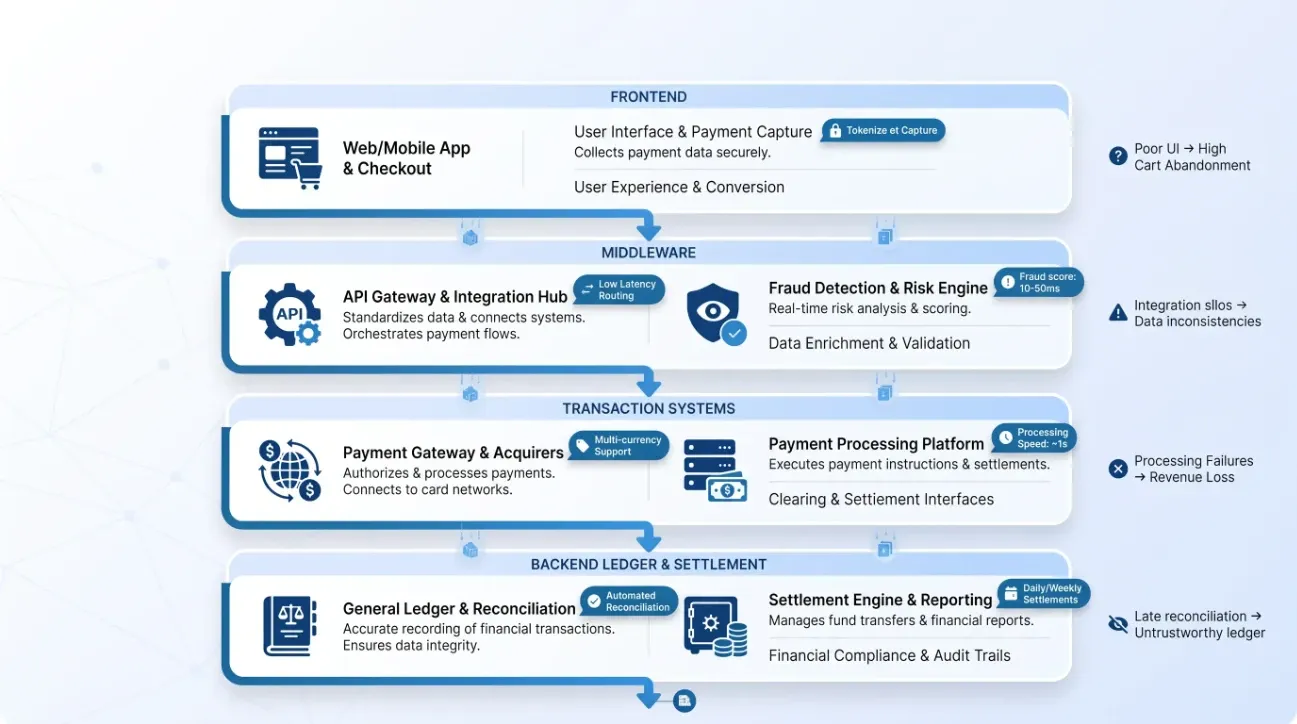
Modern SaaS infographic with four sections: Frontend, Middleware, Transaction Systems, and Backend, featuring soft gradients and navy icons.

Most teams divide payment systems development into the four layers covered below. The layers are a useful way to divide payment systems development work, but treating them as four separate projects is the fastest way to build something fragile. In payment platform engineering, what separates a working platform from one that limps is whether these layers were designed as a single system, because the boundaries between them are where most integration pain lives.

For each layer below, the questions worth asking are the same. Which decisions do you own and cannot delegate to a vendor? What fails here under real load? And which choices are cheap to make now but expensive to reverse two years in? This is the core of the work, so the subsections focus on trade-offs.

Start building your financial platform?

Speak with EGS engineers about open banking, payment infrastructure, cloud systems, and enterprise software.

Get in Touch

Frontend layer

The frontend covers the customer-facing entry points where payment starts, from a POS terminal on a counter to digital checkout flows. Its job is narrow but unforgiving. Its job is to capture payment data securely and hand it off cleanly. In payment platform engineering, the architectural decisions here are about which payment data touches your systems.

The hardest constraints show up at the edges. Device fragmentation means your capture logic has to behave identically across terminals and the digital environments you do not control. POS terminals need a sane offline story, because a checkout lane cannot stop when the network blinks. And the decision that shapes your whole compliance posture is whether sensitive card data ever enters your environment at all. Tokenization pushes that decision toward no.

  • Keep the real primary account number out of your systems by tokenizing at capture. Since PCI DSS scope follows cardholder data, systems that hold only tokens fall outside the cardholder data environment.

  • Design the offline path for POS before launch, not after the first outage, because retrofitting store-and-forward logic into a live terminal fleet is painful.

Middleware and transaction systems development

Middleware is the brain of the operation. In transaction systems development, the payment switch and its authorization logic decide where each transaction goes and whether it clears, all inside the millisecond budget the flow allows. This is where transaction systems development gets genuinely hard, because the logic has to be correct and available within a narrow time budget.

Consider what happens inside that window. High-performance fraud systems score risk in the 10-50ms range inside authorization thresholds of roughly 100ms, and one major card network evaluates up to 500 risk attributes in about 1ms. As Akshay Ghalme wrote in his breakdown of Stripe's fraud pipeline, "every millisecond Radar spends is a millisecond Stripe cannot spend on the actual card network handshake." Routing and orchestration are the parts most teams underestimate. Deciding which acquirer to send a transaction to and how to fail over without double-processing is the layer where transaction systems development complexity peaks. This is also where deep integration experience pays off most, because the failure modes are subtle and only show up at volume.

Backend ledger and settlement

The ledger is the single source of truth for balances and transaction state. Everything else can be rebuilt from logs. The ledger cannot be wrong, which is why this layer demands a kind of correctness that ordinary application databases rarely need. Settlement work with banks and networks reads from and writes to this backbone, and reconciliation depends on it.

The ledger has to be idempotent, with accuracy and auditability built into the recordkeeping. If a client retries a request that already succeeded, the ledger must record one payment only. Idempotency is a core architectural concern. As one engineer put it in a study of payment idempotency, it is "a deliberate architectural decision" that requires durable persistence and database-level concurrency control so downstream ledger writes stay idempotent. Reconciliation is the ultimate defense, a periodic process that compares your internal ledger against the settlement files from banks and PSPs to catch discrepancies before they compound. Bolt these on late and you inherit a ledger you cannot trust, which is the one thing a payment system cannot survive.

Start building your financial platform?

Speak with EGS engineers about open banking, payment infrastructure, cloud systems, and enterprise software.

Get in Touch

Security layer

Security in payments wraps the whole stack. Hardware security modules protect cryptographic keys and PINs. Identity and access management controls who can touch what, while encryption and tokenization guard the data as it moves. Fraud detection guards against misuse in the same flow. A payment HSM is a tamper-resistant hardware device that protects the keys and customer PINs used across card issuance and transaction processing, certified under schemes like FIPS 140-2 and PCI HSM.

These controls touch every other layer, which is why they have to be designed in from the start. Tokenization sits in the frontend, while key management supports the middleware and ledger under access control. All of it maps to PCI DSS and broader regulatory obligations. Since April 1, 2025, the formerly best-practice requirements in PCI DSS 4.0 are mandatory for every entity that handles card data, including your third-party providers. In payment systems development, retrofitting security into a system that was not built for it is where budgets and timelines go to die.

Where integration breaks down

Here is the argument underneath everything above. Most real-world failures in payment systems development happen at the seams between components, where one system hands off to another and something is lost in translation. Even with strong components across the stack, payments can stall when payment platform engineering is handled by people who understood each box but missed the wiring between them.

The failure modes are concrete and repeat across builds:

  • Data format mismatches during legacy migration, where a modern service and a decades-old core disagree on how a field is encoded and quietly corrupt a transaction.

  • Reconciliation drift, where the ledger and the settlement file diverge by cents that grow into an audit problem no one can explain.

  • Latency injected by middleware that was correct in a test harness but collapses under production concurrency.

  • Security gaps that open at handoffs, where data is protected inside each system but exposed in the moment it passes between them.

This is the reality of modernization. New components have to coexist with a black-box legacy core while live payments continue. 92 of the top 100 banks still run COBOL mainframe cores, and the developers who wrote that code are retiring. Major changes to core applications carry the risk of outages and compliance failures; performance drops follow the same changes, which is exactly why the integration work is the hard part.

Build, buy, or partner

This is the decision you actually came for, and you have to defend it to a board. The paths trade off against control and risk, with time to market and cost shaping the same decision.

  1. Build in-house. You get full control and a system shaped exactly to your business. You also need scarce specialist expertise across four layers, and you are competing with every other bank for the same handful of engineers who understand legacy cores and real-time money movement. Time to market is the longest of the three.

  2. Buy a platform. You trade control for speed. For payment platform engineering, a packaged platform gets you live faster and offloads part of the compliance burden, but its assumptions and integration constraints set the limits of customization.

  3. Partner with a specialist. You keep more control than buying while borrowing the integration experience that in-house teams rarely have on staff.

The deciding factor is the integration risk from the previous section. The market is not slowing down to let you catch up, with instant payments forecast to reach 22% of global transaction volume within three years, up from 16% in 2023. A generalist internal team can build any single layer. In payment systems development, wiring four layers into a regulated, real-time system that reconciles to the cent is specialist work, and that is the capability worth optimizing for when you defend the choice.

Getting your payment build right

Payment systems development succeeds or fails as one integrated whole. The risk concentrates at the boundaries, especially during migration and in the security gaps that open when data moves between systems. Ledger drift and middleware latency belong to the same boundary problem. Get the layers right individually and you still have not solved the hard problem, which is making them work as a single flow.

EGS builds and modernizes payment systems for banks and fintechs facing exactly this decision, with the integration experience that keeps live payments running while the architecture changes underneath. If you are weighing a build-or-modernize move in payment systems development, book a call to pressure-test your architecture and roadmap before you commit the budget.

Start building your financial platform?

Speak with EGS engineers about open banking, payment infrastructure, cloud systems, and enterprise software.

Get in Touch

Track authorization success rate and end-to-end latency first. These numbers show whether customers can complete payments within the expected time window. Add reconciliation exceptions after settlement closes, because unresolved breaks point to ledger, file, or routing errors that need review before the next cycle.

Test failover with production-like traffic before the first live transaction. Route test payments through the backup acquirer, force timeouts, and verify that retry logic uses idempotency keys. The test should prove that one customer action creates one financial record, even when the first route fails.

Yes, payment systems development can reduce PCI scope when sensitive card data stays outside your environment. Tokenization at capture and hosted payment fields limit which systems touch the primary account number. Your team still needs access controls and vendor checks, because PCI obligations don’t disappear when scope shrinks.

Replace a legacy payment core when change risk exceeds replacement risk. Warning signs include release freezes, unexplained reconciliation breaks, and transaction delays after small configuration changes. A phased migration lowers operational risk because live payments keep moving while specific flows shift to the new system.

A client should prepare transaction volumes, current system diagrams, and settlement file examples before choosing a build partner. These materials let technical teams assess latency limits, ledger design, and integration gaps. The decision is more accurate when it starts from live constraints instead of high-level requirements.

Schedule a Meeting

Book a time that works best for you

You Might Also Like

Discover more insights and articles

A diverse team of professionals in business attire collaborates at a conference table, discussing payment analytics data displayed on a monitor.

Payment Analytics Platform: Turning Transaction Data into Business Intelligence

This article explains how a payment analytics platform turns raw transaction data into intelligence your teams can act on. It walks through the payment analytics platform pipeline from ingestion to warehousing and the trade-off between real-time and batch processing before it turns to the use cases that pay for the whole thing.

An enterprise security engineer analyzes identity and access management software on multiple monitors in a modern fintech office.

Bank-Grade IAM Systems: Architecture for Secure Financial Platforms

This article breaks down what separates bank-grade IAM systems, in the genuine sense, from ordinary enterprise identity and access management. It explains the architectural pillars that define the tier and connects them to the regulations you answer to, so you can judge the right delivery path.

A busy fintech operations room with employees engaged in identity verification, featuring a large touchscreen and various tech devices.

Identity and Access Management in Fintech: Securing Payment Platforms

This article explains why, in identity and access management fintech, identity is the security foundation every payment platform depends on, and how authentication and access governance work as one system. It walks through modern login methods and permission design under the compliance rules that follow, so you can judge the maturity of your own setup.

A modern office workspace featuring a laptop with a financial dashboard, a hand typing, and various desk items in natural light.

Regulated Wallet Infrastructure: Designing Secure Multi-Rail Wallets

This article is a design guide for building a wallet that holds and moves real customer money across more than one payment rail. It walks through the ledger and the transaction engine, then connects those layers to KYC-gated accounts and rail integrations, with the deepest focus on reconciliation, because that is where most builds quietly break.