Passwordless and passkeys
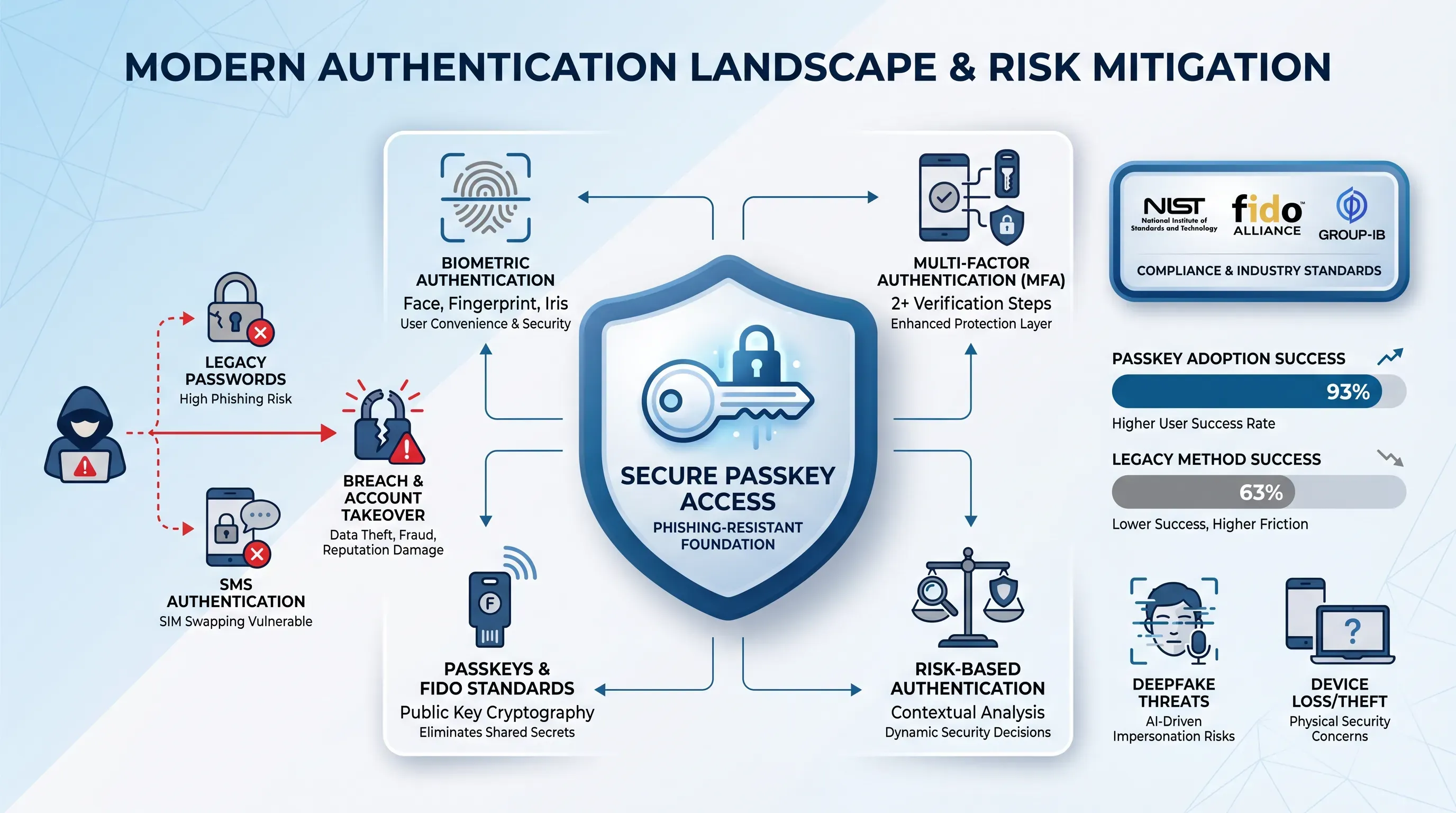
Passwordless authentication removes the reusable secret entirely. FIDO-based passkeys use a cryptographic key pair, where the private key stays on the user's device and only a public key sits on your server. According to the FIDO Alliance's own analysis, passkeys are resistant to phishing and credential stuffing because there's no shared secret to steal and no password database worth breaching.
This matters for payment logins because reused breached passwords are a primary route into customer accounts. A passkey is bound to your domain at the protocol level, so a cloned login page can't harvest anything usable. That binding is why platforms report sharp cuts in phishing-related takeovers, and passkey logins succeed at a 93% average rate against 63% for passwords.
The honest tradeoff is recovery. A credential tied to a device raises the question of what happens when the device is lost, and account recovery becomes the weak link if you fall back to a phishable method to reset it. Design the recovery path with the same rigor as the login, or attackers will simply target it instead.
Biometrics and inherence
Biometric factors like a fingerprint or a face scan prove something the user is, which is why they fit naturally into a payment approval on a phone. They're fast, and they pair well with a possession factor already sitting in the user's hand. But biometrics work best as one factor inside a stronger scheme.
The reason is that a biometric check confirms a responsive face or finger, and attackers have learned to feed it fakes. In February 2024, Group-IB documented an iOS trojan called GoldPickaxe that prompted victims to record their own liveness responses, then fed that footage through face-swap tools to pass a bank's facial recognition, and one victim lost $40,000. Liveness detection defends against this because it confirms live human input and blocks replayed or synthetic images. It's now essential because the number of deepfakes detected worldwide quadrupled between 2023 and 2024 and reached 7% of all fraud attempts.
Multi factor authentication
Multi-factor authentication (MFA) combines independent factor types so that breaking one doesn't break the login. The category split is the point. A stolen password is useless without the device, and a stolen device is useless without the biometric. Not all MFA is equal. SMS one-time passwords are now treated as weak, and NIST SP 800-63-4, finalized in 2024, treats SMS as inadequate for the assurance level most regulated workloads need, because SIM-swap and real-time phishing proxies defeat it.
Enforce phishing-resistant MFA, built on FIDO2 or WebAuthn, for two groups in particular:
-
Customers, especially before money-movement actions
-
Privileged employees who can move funds or export customer data
That privileged-employee point connects straight to compliance. The two-of-three factor requirement covered later is MFA written into law for payments.
Authorization and least privilege
Proving who someone is only gets you halfway. Authorization decides what that verified identity is allowed to do, and in identity and access management fintech this is where a large share of fintech breaches actually happen. Broken access control sits at number one on the OWASP Top 10, found in 94% of tested applications. A valid identity gives an attacker access to unauthorized resources while the login remains intact.
Role-based access control assigns permissions to roles, so a support agent and a payments engineer see different things. In IAM fintech systems, fine-grained permissions go further because they scope access down to specific resources and actions. In identity and access management fintech, the principle tying them together is least privilege: give every identity the minimum it needs and nothing more. Apply it to human and non-human identities alike, because a compromised identity with narrow permissions has a small blast radius, and a compromised admin has the run of the platform.
Broken access control looks mundane in practice. An authenticated user changes an ID in a URL and reads another customer's account, or an internal endpoint skips the permission check and lets a low-privilege identity trigger a payout. Lateral movement is the same problem playing out across systems, where one foothold reaches the next because nothing re-checked authorization at each step. The identity security infrastructure defense is to enforce authorization on every request after login. If you can't say, for each endpoint, which identities are allowed and why, that's the first place to look.