Infographic showing how AI adoption drives operational changes and improves business outcomes including cost reduction and efficiency gains

HSM Software Development: Designing Secure Key Management for Payment Systems

Every payment transaction you process depends on cryptographic keys that must never be exposed. If the software layer between your application and the hardware security module (HSM) is poorly designed, even the best tamper-resistant hardware won't save you from breaches, failed audits, or crippling downtime.

Content authorBy EGSPublished onReading time9 min read

What This Article Covers

This article walks through the core components of HSM software development for payment systems. You'll learn how APIs, key lifecycle automation, encryption services, and integration patterns come together to form production-grade cryptographic key management systems. We'll cover performance constraints, high availability, DevOps practices, and real-world lessons from teams that build these systems at scale. Whether you're an architect, a developer, or a security engineer, you'll walk away with a clear picture of what it takes to ship secure, reliable HSM software.

What Is HSM Software Development?

HSM software development is the practice of building the API layer, key lifecycle automation, integration middleware, and operational tooling that sits between business applications and hardware security modules. It covers encryption services, PIN translation, tokenization, digital signing, and multitenancy, all designed to meet the throughput, latency, and compliance demands of payment systems. According to IBM, the global average cost of a data breach reached $4.45 million in 2023, underscoring the financial impact of weak cryptographic controls

The Software Layer That Makes HSMs Useful

An HSM is essentially a hardened cryptographic processor. It signs, encrypts, and stores keys inside a tamper-resistant boundary. But without a well-designed software layer on top, it's just an expensive black box.

The software layer handles everything the hardware can't: routing requests, managing the key lifecycle, enforcing access policies, logging operations, and integrating with the broader payment ecosystem. This is where HSM software development gets interesting and where most complexity lives.

A typical HSM device can perform about 1 to 10,000 1024-bit RSA operations per second, depending on model and key size. That throughput ceiling means the software must be smart about batching, caching session keys, and distributing load across multiple HSM nodes.

Secure Key Lifecycle Automation

Managing cryptographic keys manually is a recipe for outages and compliance violations. Secure key lifecycle automation covers generation, distribution, rotation, revocation, and destruction, all without human hands touching plaintext key material. Industry research shows that over 80% of data breaches involve compromised or stolen credentials, reinforcing the need for automated key management and strict access controls.

Key Generation and Injection

Keys should be generated inside the HSM itself, never imported from an external source unless absolutely required (and even then, wrapped under a key-encrypting key).

For payment systems, this typically means:

  • AES-256 or 3DES keys for PIN encryption and MAC generation

  • RSA or ECC key pairs for TLS termination and code signing

  • Zone master keys (ZMKs) for key exchange between acquirers and processors

The software layer exposes APIs that let upstream services request key generation without knowing anything about the underlying HSM commands.

Rotation and Revocation

Key rotation is where many teams stumble.

A solid rotation engine should:

  • Track key expiry dates and trigger rotation automatically

  • Support "grace periods" where both old and new keys are active

  • Handle rollback if the new key fails validation downstream

  • Log every rotation event with timestamps and actor identity

Revocation is equally critical. When a key is compromised, the software must propagate revocation across every system that holds a reference to that key, including partner gateways, payment switches, and fraud engines.

Building this level of automation into your cryptographic key management systems eliminates entire categories of human error and keeps you audit-ready year-round.

APIs: The Contract Between Applications and the HSM

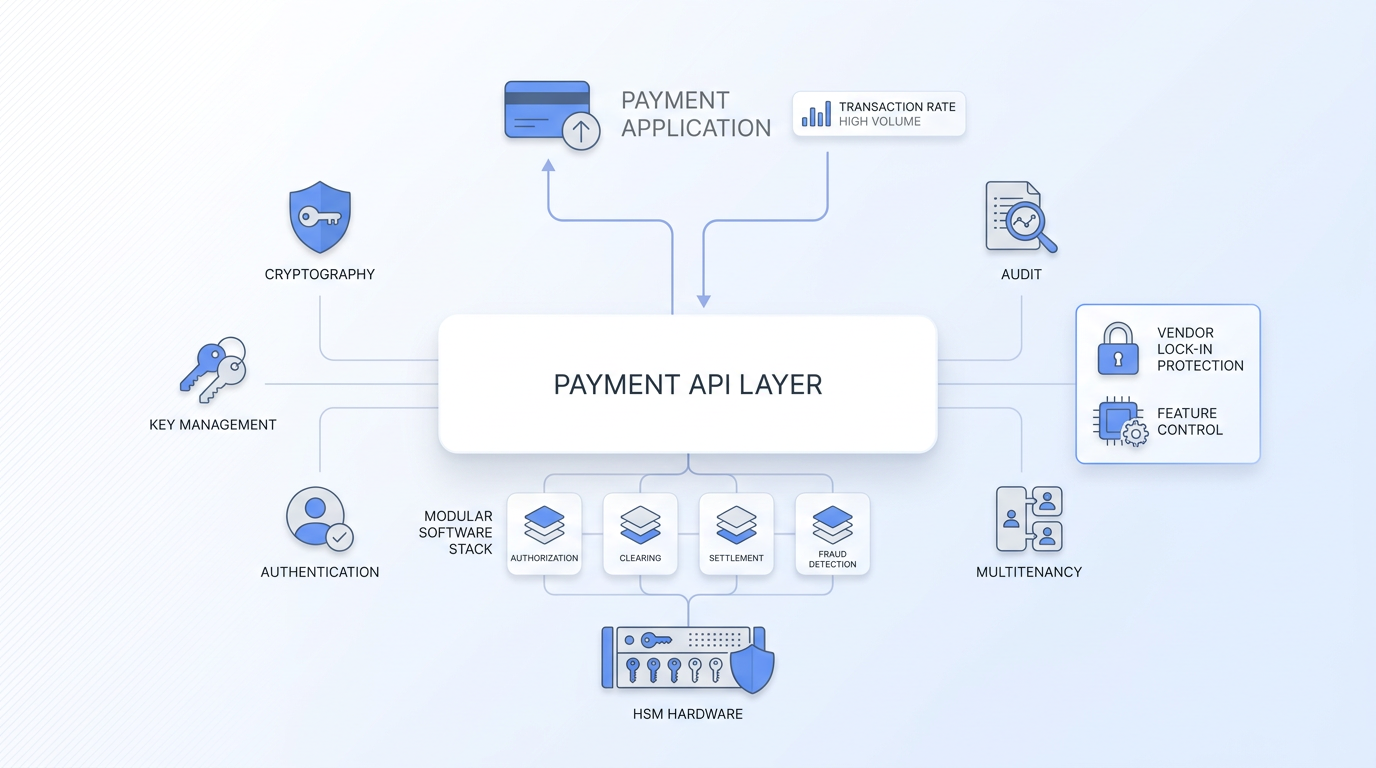
Flow diagram of a layered payment API architecture with central API Layer, icons for applications, hardware, and cryptography, on a light gradient background.

Clean, well-documented APIs are the backbone of any HSM software stack. Your payment application should never speak raw HSM vendor commands. Instead, it calls a normalized API layer that abstracts vendor-specific protocols. At scale, this abstraction becomes critical—networks like Visa can process over 65,000 transaction messages per second, meaning inefficient API layers quickly become bottlenecks.

Core API Functions

At minimum, an HSM API layer exposes a comprehensive set of core cryptographic and key management functions that enable secure, compliant, and high-performance transaction processing across payment infrastructures.

It exposes:

  • Encrypt / Decrypt: Symmetric and asymmetric operations with algorithm selection

  • Sign / Verify: Digital signatures for transaction authorization and code integrity

  • PIN Translation: Converting PIN blocks between formats (ISO 0, ISO 3, ISO 4) as transactions move between networks

  • Tokenization: Replacing PANs with non-reversible tokens for storage and analytics

  • Key Management: CRUD operations for keys, plus rotation and status queries

Each call must include authentication, authorization checks, and detailed audit logging. Multitenancy support is essential if you serve multiple issuers or merchants from a shared platform.

Firmware and Version Management

On the HSM side, firmware awareness matters. For instance, some embedded HSM implementations return firmware version details via major, minor, and patch numbers, which your software layer should query on startup to verify compatibility and enable or disable features accordingly.

A disciplined API layer protects you from vendor lock-in and makes it far easier to swap or upgrade HSM hardware without rewriting business logic.

Integration With Switches, IAM, Wallets, and Fraud Systems

HSM software doesn't operate in isolation. It sits at the intersection of multiple critical systems.

Payment switches send thousands of authorization requests per second, each requiring PIN verification or MAC validation. The HSM software must handle concurrent connections, maintain persistent sessions, and recover gracefully from dropped links.

IAM (Identity and Access Management) systems control who and what can invoke cryptographic operations. Your HSM middleware should integrate with LDAP, OAuth 2.0, or mutual TLS certificate authentication to enforce least-privilege access.

Digital wallets rely on HSMs for token provisioning and transaction signing. The software layer must support real-time token generation with sub-50ms latency to avoid degrading the user experience.

Fraud detection engines consume signed transaction logs and cryptographic proofs. Feeding these systems requires:

  • Real-time event streaming (Kafka, gRPC)

  • Tamper-evident log chains

  • Correlation IDs that trace a transaction from terminal to HSM and back

In 2024, Futurex launched the industry's first unified HSM, CryptoHub, reflecting a broader trend toward consolidating cryptographic services under a single management plane. Your software architecture should anticipate this kind of convergence by keeping integration interfaces modular.

Performance Constraints: TPS, Latency, and High Availability

Payment systems don't get to be slow. Cardholders expect sub-second authorization, and your HSM layer is on the critical path. Large-scale payment infrastructures already operate at tens of thousands of transactions per second, with benchmarks exceeding 65,000 TPS at peak capacity.

Throughput and Latency

Key performance targets depend on your transaction volume, system architecture, peak load patterns, and required service-level agreements, but common benchmarks for scalable and reliable HSM environments typically include several critical performance indicators.

These are:

  • TPS (transactions per second): Large issuers need 5,000+ TPS sustained, with burst capacity beyond 10,000 TPS

  • P99 latency: Under 10ms for symmetric operations, under 50ms for asymmetric signing

  • Connection pooling: Maintain warm connections to HSM nodes to avoid TCP handshake overhead on every request

If your application exceeds the HSM's raw throughput, the software layer must distribute load across a cluster. Round-robin is a starting point, but smarter strategies (least-connections, key-affinity routing) reduce contention.

High Availability

Downtime in a payment HSM system directly impacts transaction approval rates, customer experience, and revenue continuity, making resilience and fault tolerance critical design priorities. Even short disruptions can cascade across dependent systems, so architectures must be built to handle failures without interrupting service.

HA design principles include:

  • Active-active HSM clusters with automated failover

  • Key replication across geographically separated data centers

  • Health-check daemons that pull degraded nodes out of rotation within seconds

  • Circuit breakers in the API layer that return cached results or degrade gracefully when all HSM nodes are overloaded

Every component, from the load balancer to the key sync daemon, needs to be tested under failure conditions, not just happy-path loads.

Logging, Monitoring, and Compliance

You can't secure what you can't see. HSM software must generate detailed, immutable audit logs for every cryptographic operation, ensuring full traceability, regulatory compliance, and rapid incident investigation when anomalies occur. In practice, this logging framework should clearly define what is captured, what is strictly excluded, and where the data is securely stored.

These requirements typically include:

  • What to log: Key ID, operation type, timestamp, caller identity, success/failure, HSM node used

  • What never to log: Plaintext keys, full PANs, PIN blocks

  • Where to send logs: A tamper-evident SIEM or dedicated compliance store with write-once semantics

Monitoring dashboards should track TPS, error rates, key inventory (how many active keys, how many pending rotation), and HSM hardware health (temperature, battery status, tamper alerts).

PCI DSS, PCI PIN Security, and SOC 2 audits all require evidence that key management follows documented procedures. Automated logging turns compliance from a quarterly fire drill into a continuous, low-effort process.

DevOps Practices for HSM Software

Deploying cryptographic software isn't the same as deploying a web app, but modern DevOps principles still apply—especially when consistency, repeatability, and secure automation are required across environments. To reduce risk and ensure controlled rollouts, teams should treat HSM infrastructure and workflows as code-driven, testable systems.

In practice, this approach includes the following core practices:

  • Infrastructure as code: Define HSM cluster topology, key policies, and access rules in version-controlled config files

  • CI/CD with HSM simulators: Run integration tests against software HSM emulators in your pipeline before touching real hardware

  • Blue-green deployments: Roll out new API versions alongside the old, shifting traffic gradually

  • Secret zero management: The credentials that authenticate your software to the HSM must themselves be securely bootstrapped, often using a Vault-like system or a hardware-rooted trust chain

Energize Global Services, a multinational development center specializing in HSM and payment terminal software, follows these patterns when building production-grade secure infrastructure for banks and processors. Their approach, highlighted in Energize Global Services, focuses on delivering resilient financial platforms and enterprise-grade security solutions.

Treating your HSM software with the same discipline as your payment application code is what separates hobby projects from production-grade systems. In high-risk industries like finance, breach costs regularly exceed $6 million per incident, making resilient cryptographic infrastructure a direct business priority.

Wrapping Up

HSM software development is where security engineering meets systems engineering. The hardware provides a trust anchor, but it's the software layer, your APIs, key lifecycle automation, integration middleware, logging, and operational tooling, that determines whether your payment system is truly secure or just theoretically secure. Get the software right, and your HSMs become a reliable foundation for every transaction you process. To learn more about building resilient financial platforms and secure payment ecosystems, explore Energize Global Services.

It involves building the middleware, APIs, and automation tools that manage cryptographic operations on hardware security modules. This includes key generation, rotation, revocation, encryption, signing, PIN translation, and integration with payment switches, fraud systems, and identity platforms.

Automating the key lifecycle removes manual steps where errors and exposure are most likely. Automated rotation, revocation propagation, and audit logging ensure keys are never stale, never orphaned, and always traceable, which directly supports PCI DSS and PCI PIN Security compliance.

Throughput varies by device and key type. Symmetric operations (AES, 3DES) are significantly faster than asymmetric ones (RSA, ECC). Large payment processors typically target 5,000+ TPS with P99 latency under 10ms for symmetric calls. Software-layer optimizations like connection pooling and load balancing across HSM clusters are essential to hit these numbers.

The HSM software layer streams signed transaction logs and cryptographic proofs to fraud engines via real-time pipelines (Kafka, gRPC). Correlation IDs let fraud systems trace each transaction from the point-of-sale terminal through the HSM and back, enabling faster anomaly detection without exposing sensitive key material.

Yes. Teams use infrastructure as code for cluster configuration, CI/CD pipelines with HSM simulators for testing, and blue-green deployments for zero-downtime releases. The key difference from standard DevOps is that secret bootstrapping and access policies require extra care, often involving hardware-rooted trust chains.

Schedule a Meeting

Book a time that works best for you

You Might Also Like

Discover more insights and articles

Title:
Instant Debit Cards: Enabling Immediate Payment Access

Meta description:
Learn how instant debit cards let you spend funds moments after account approval. Read this guide to understand the dig

Instant Debit Cards: Enabling Immediate Payment Access

In this article, we explain what instant debit cards are and how the technology lets customers spend within seconds of opening an account. We walk through the customer flow, the benefits for both sides of the transaction, the security behind it, and where the technology is heading.

Title:
Virtual Card Issuing: Secure Digital Payments for Modern Fintechs

Meta description:
Learn how virtual card issuing works so you can select the best provider and launch secure payment features.

Virtual Card Issuing: Secure Digital Payments for Modern Fintechs

This article explains how virtual card issuing works under the hood and why it has become a core building block for fintech products. It walks through the infrastructure, common use cases, security obligations, and the criteria that matter when picking a provider.

Title:
White Label Card Issuing: When to Use It and When to Build Your Own

Meta description:
Decide if white label card issuing fits your business or if you should build your own stack. Learn the tra

White Label Card Issuing: When to Use It and When to Build Your Own

This article explains how white label card issuing works and helps fintech founders and product leaders decide whether to license a ready-made platform or build their own stack. It covers the trade-offs and what to verify before signing anything.

Title:
Card Issuing Platform: Architecture for Scalable and Secure Card Programs

Meta description:
With a modern card issuing platform, you can scale your program safely. Learn to design a secure arc

Card Issuing Platform: Architecture for Scalable and Secure Card Programs

This article walks fintech leaders and product-engineering teams through the architectural layers behind a modern card issuing platform. We break down the stack from the issuing processor to the API gateway, then show how the pieces cooperate during a live authorization before the article closes with a checklist for evaluating any vendor or in-house build.