Which failures permit route switching?
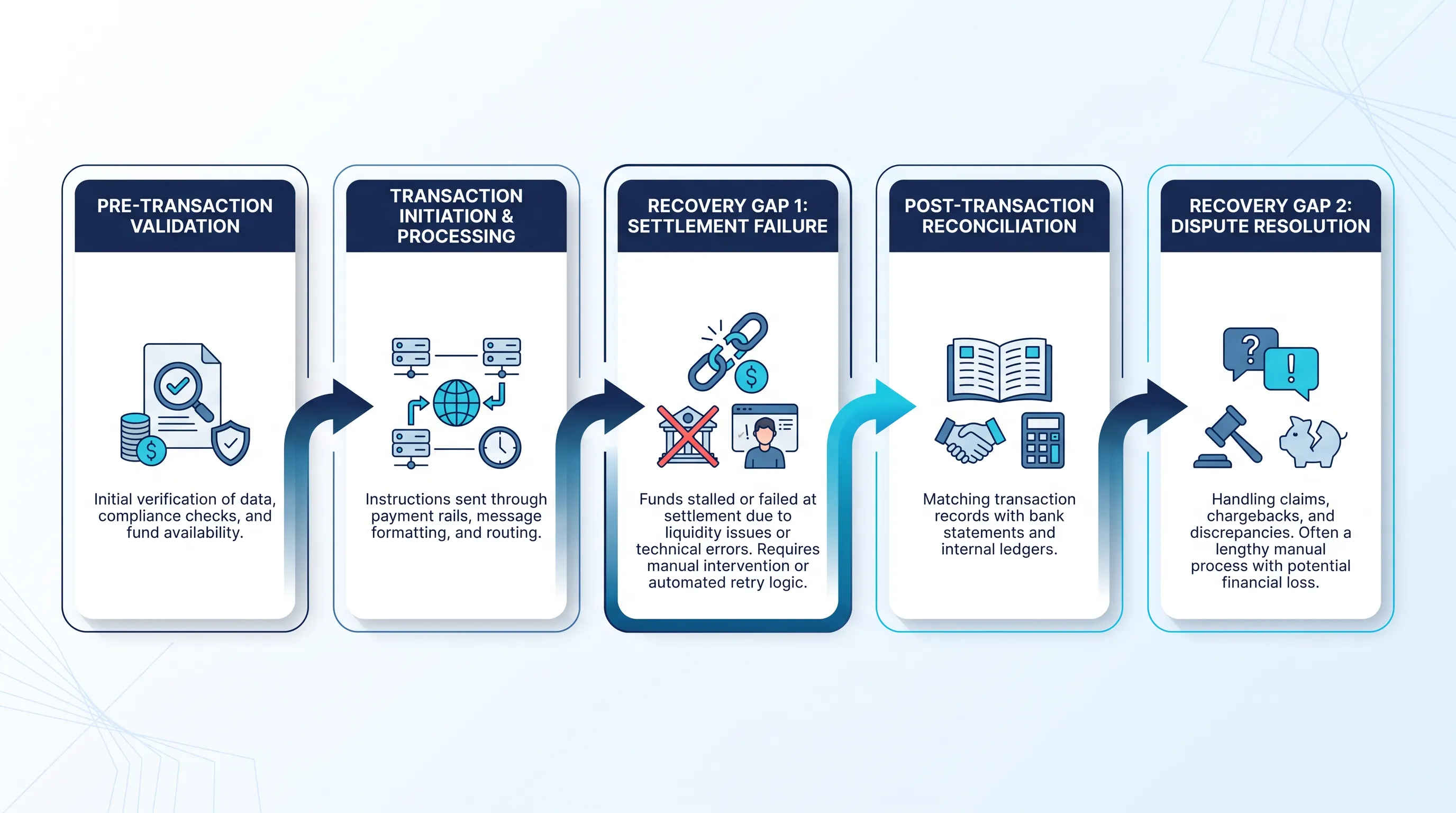
Switch routes only in the cases where transport failed before the financial request was accepted. Build the matrix around transaction state, not link state, and give every row an owner and an evidence requirement:
-
Connection refused or gateway unreachable before transmission, owned by the terminal and PTSP, evidenced by connection logs showing no bytes sent.
-
Request transmitted with no response inside the timeout, owned by the processor, evidenced by the journal entry and the reversal advice raised against it.
-
Response received late, after the terminal gave up, owned by the processor and the acquirer together, evidenced by correlated timestamps across both route logs.
The Uptime Institute's Annual Outage Analysis 2025 found that IT and networking issues accounted for 23% of impactful outages in 2024, a rise the report attributes to complexity and misconfiguration. Adding a second aggregator adds exactly that kind of complexity, so your matrix has to be narrower than your instinct.
No request crossed the connection
Reroute freely here, and only here. The condition is that connection and gateway evidence shows no financial message was ever accepted by the first PTSA, which means a refused TCP connection or a failed handshake.
Timeouts are the trap. The Worldpay ISO 8583 reference guide recommends a client timeout value of at least 25 seconds and adds five seconds for each additional network hop between the device and the host.
Nigerian POS traffic runs through more hops than that baseline assumes once you insert a PTSA and a processor between terminal and issuer. If your terminal timeout was tuned for a shorter chain, it will declare "no request sent" on transactions that were in fact accepted, and your safest failover case quietly becomes your most dangerous one.
The response was lost
Treat this as unknown and resolve it, never resend it. Keep the original STAN and RRN and raise a reversal.
Timing matters more than most designs allow for. The Worldpay host specification warns that a timeout reversal not sent within 10 minutes of the original transaction may fail if the original was approved and already passed to settlement.
Ten minutes is shorter than most incident bridges take to assemble. So the reversal has to be automatic and queued by the platform during the outage, otherwise your recovery arrives after the settlement file has closed and the only remaining remedy is a manual refund.
Recovery remains delayed
Bound the retries, then escalate to people. Define a fixed retry count with a defined interval and hand the case to a named investigator.
The regulatory ceiling here is tight. Where an instant reversal fails because of a technical issue or system glitch, the CBN requires manual reversal within no more than 24 hours, and processors must deliver daily settlement reports by 8am on a T+1 basis.
Line those two up and the operational consequence is clear. Your investigators get one settlement cycle to find the transaction, so if route history and processor journals aren't joined in a single searchable view before the incident, the 24-hour clock expires while someone is exporting logs.
The failed route returns
Bring traffic back in stages, after you've checked health and reconciled what happened during the outage. Validate the link and then raise the traffic share gradually instead of flipping everything back at once.
A restored link also says nothing about the transactions stranded during the failure. The NIP case study published in AfricaNenda's SIIPS 2025 report notes a maximum processing time of 20 seconds per transaction, with most completing in under one second.
Against that baseline, anything still unresolved minutes after recovery is a state problem. Restoring the route returns capacity, so the reconciliation of the outage window has to run as a separate workstream with its own sign-off.
How should teams prove failover readiness?
Prove it by failing on purpose, in a test environment that mirrors production message flows. Pull the link mid-transaction. Delay a response past the timeout and then deliver it. Send the same reversal five times. Fail the reversal itself and reconcile the whole mess afterwards.
Idempotency is the pass criterion that catches most defects. As the engineering guidance on ISO 8583 reliability puts it, the same 0400 with the same STAN and RRN sent five times must result in one logical reversal, and the retry side is non-negotiable.
Your evidence pack needs to show the same discipline:
-
Correlated traces across terminal, PTSA, processor, and settlement for every test case, stored immutably.
-
Dashboards and alerts that distinguish route health from unresolved transaction count.
-
A runbook per failure row in your matrix, each with a named decision-maker and an escalation time.
Testing that only proves the link switched has proven the easy half. The regulator asked for failover, but your exposure sits in the transactions that were mid-flight when it happened.
How can EGS test your design?
Bring in an architecture review before your next scheduled failover test. Energize Global Services (EGS), founded in 2007 and headquartered in Yerevan with offices in Boston and Sofia, builds POS terminal software and card processing platforms for financial institutions, and holds ISO 27001 and AICPA SOC 2 certification.
An engagement at this level covers your POS and payment-processing message flows end to end and deliberate failure testing against the matrix described above. EGS does not certify you with NIBSS or UPSL, and nothing here substitutes for the testing those aggregators require of you directly.
Talk through your dual-PTSA failover design with EGS engineers and come away with the specific list of failure cases your team hasn't tested yet.