What a virtual card platform does
A virtual card issuing platform lets a business create payment cards through code instead of plastic. You call an Application Programming Interface (API), and a card number comes back in milliseconds, ready to spend within the limits you set. That is the whole point. The card exists as data that a system can issue without mailing a physical object to a cardholder.
The shift away from physical card programs happened because the old model was slow and rigid. Issuing a plastic card meant working through a bank and shipping cards to people who then had to activate them after production runs. API-driven issuing collapses that timeline. Businesses now spin up cards for vendors and employees. They can also create a card per transaction, then close it the moment it is no longer needed.
The market reflects how useful this turned out to be. The global virtual cards market is projected to reach $60.06 billion by 2030, with a 21.2% compound annual rate from 2025. Single-use cards already held 59.13% of the market in 2025, which tells you how much businesses value cards that expire after one purchase. The rest of this article explains what makes that possible: the architecture that connects your systems to the card networks and the security that keeps card data safe, with scaling decisions that hold performance steady as volume climbs.
Core architecture of a virtual card issuing platform

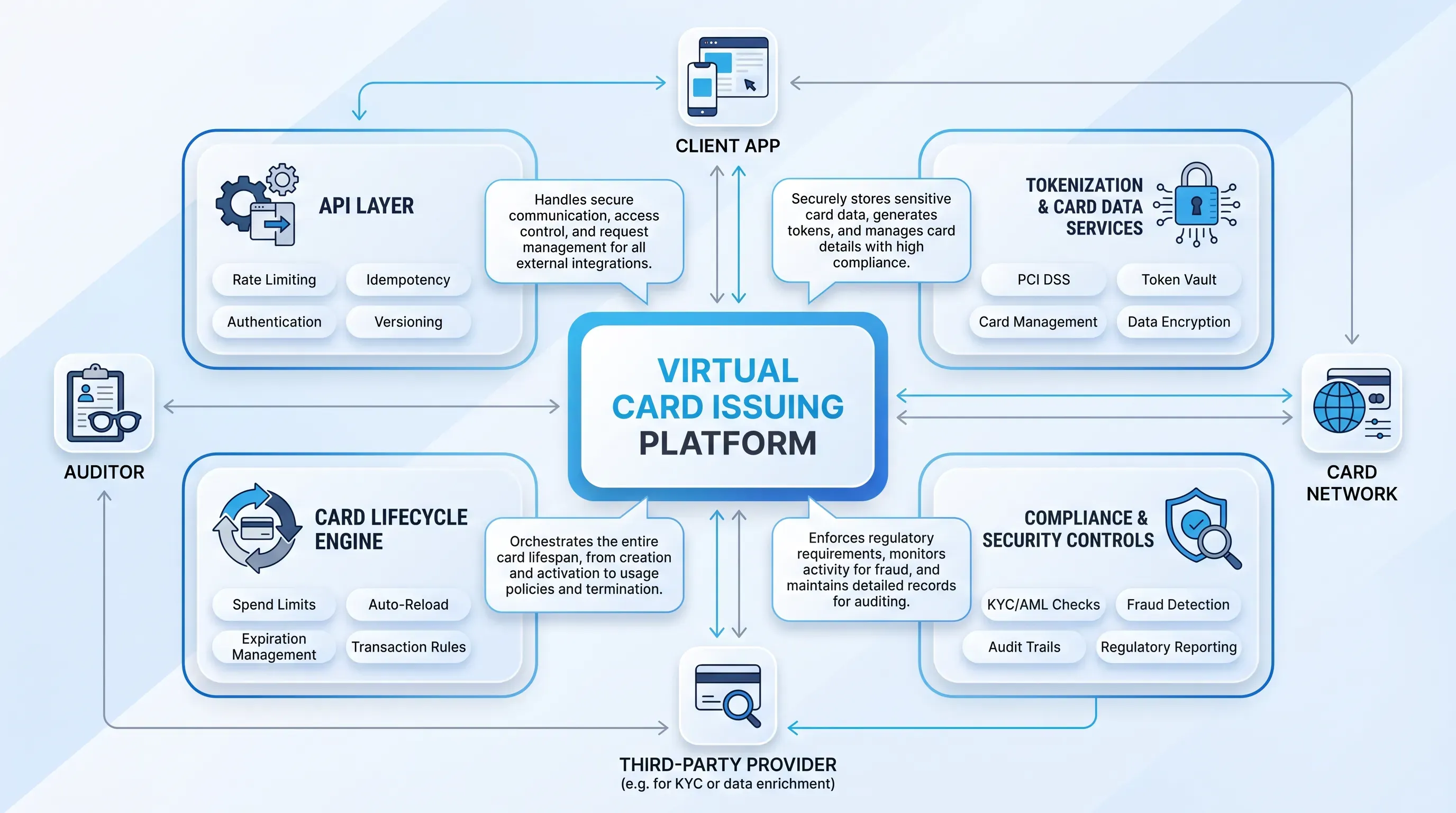
A virtual card issuing platform is built from a handful of components that each own one job and hand work to the next. A request starts in a client application, passes through the API layer, touches the tokenization and card data services, runs against the card lifecycle engine, and then either reaches the card networks or returns a decision. The whole round trip happens inside the latency budget of a card authorization.
What matters is how tightly these pieces depend on one another. The API layer can't authorize a transaction without the lifecycle engine confirming the card is active and within its limits. The lifecycle engine can't enforce anything without card tokenization systems that resolve a token back to real credentials inside a secure vault. None of it ships safely without the compliance controls wrapped around every step. Read the sections below as parts of one flow, with each component taken in turn.
API and integration layer
The API layer is the front door. It exposes endpoints for creating cards, authorizing transactions, querying balances, and updating card states, and it hides the machinery behind them so a client developer can integrate in days rather than months. Most platforms follow REST conventions because they map cleanly onto card operations, with authentication handled through scoped API keys or OAuth tokens so that each request proves who it belongs to.
Two design choices carry most of the reliability weight here. Webhooks push real-time events back to the client the instant a transaction is authorized or declined, so the client doesn't poll for updates. Idempotency protects against the unpredictable nature of distributed systems. Stripe's API implements idempotency keys on mutating endpoints by allowing clients to pass a unique value in a header, which means a retried request after a network timeout charges the customer only once. That guarantee is what lets a client safely retry without fear of issuing two cards or double-authorizing a payment.
Beyond correctness, the API layer handles the practical concerns that keep a public interface healthy:
-
Rate limiting that caps how many requests a client can send in a window, which protects the platform from runaway scripts and noisy neighbors
-
Versioning that lets the platform ship breaking changes on a new version while existing integrations keep running against the old one
Because this layer abstracts the underlying complexity, the developer integrating it never sees the vault or the network connections, while the partitioning scheme stays behind the interface. They see a card object and a set of verbs.
Virtual card infrastructure and tokenization
Underneath the API sits the virtual card infrastructure that generates valid card numbers within the Bank Identification Number (BIN) ranges assigned by the card networks. This is where a Primary Account Number (PAN) is created and where the platform decides whether a card is single-use or reloadable. The virtual card infrastructure has to produce numbers that pass network validation while staying tied to the account that owns them.
The sensitive part of that virtual card infrastructure is the PAN itself, and this is where card tokenization systems earn their place. Tokenization replaces a real PAN with a non-sensitive token that has no exploitable value outside the system that created it. According to the PCI DSS Tokenization Guidelines, a properly implemented tokenization solution can reduce or remove the need to retain PAN in an environment once a transaction is processed, which shrinks the number of systems that fall inside the cardholder data environment.
How card tokenization protects payment data
Card tokenization systems work by storing the real credentials in a secure vault and handing out tokens everywhere else. When an authorization arrives, the virtual card issuing platform resolves the token back to the PAN inside that vault and uses it to talk to the network, while the raw number stays hidden from the surrounding services. Both data at rest in the vault and data in transit between services stay protected because the only place the PAN lives in the clear is behind the vault's controls. That is why this layer is central to compliance. Bluefin notes that when tokenization is handled through a third-party provider, it shifts responsibility for protecting stored data away from the business, which lowers both cost and operational risk.
The design of card tokenization systems also decides how much of your stack auditors have to inspect. Systems that can de-tokenize a token back into a PAN stay in scope, which is why the vault and the card tokenization systems around it are isolated from everything else. Get this layer right and the rest of the virtual card infrastructure becomes far cheaper to secure.
Card lifecycle engine
The card lifecycle engine manages a card from the moment it is created through activation, spending, suspension, and expiry. Every card moves through a defined set of states, and the engine is the authority on which state a card is in and what transitions are allowed. A suspended card can't authorize. An expired card can't be reactivated. The engine enforces those rules so no other component has to guess. The controls that businesses care about are applied at authorization time, inside this engine.
When a transaction comes in, the engine checks it against the rules attached to the card before approving or declining:
-
Spend limits that cap a single transaction or a rolling total
-
Merchant category restrictions that block a card from being used outside approved categories
-
Single-use rules that close the card automatically after its first successful authorization
Every state change and every authorization decision is recorded, which gives businesses an audit trail and gives auditors the evidence they need. Corpay's description of virtual cards that lock to a specific supplier, amount, and date shows the kind of configured controls the lifecycle engine turns into enforced outcomes. This is the component that gives a business fine-grained control over every card it issues, one card at a time.
Security and compliance controls
Security on a virtual card issuing platform is layered, because no single control is enough on its own. Encryption protects data in transit and at rest, so even a captured packet or a stolen disk yields nothing usable. Access controls limit who and what can reach the cardholder data environment, and each service touches only the data it needs. The two work together, since encryption without tight access control still leaves keys exposed to anyone inside the perimeter.
The tokenization vault depends on secure key management, and this is where hardware earns its keep. A Hardware Security Module (HSM) is a tamper-resistant physical device that generates and stores cryptographic keys; it also manages key operations inside the device so the keys are never exposed externally. Futurex HSMs, for example, are FIPS 140-2 Level 3 and PCI HSM validated and handle key lifecycle management for payment systems. Keys that protect the vault rotate and expire, while certified hardware keeps them locked away from application memory.
All of this sits under the Payment Card Industry Data Security Standard (PCI DSS), which any organization has to meet when it processes cardholder data or handles its storage and transmission. Audit logging and continuous monitoring serve both security and the regulation at once, because the same records that let you investigate an incident also prove to an assessor that controls are working. Treat security as a one-time setup and it decays. The platforms that hold up treat it as a practice in which key rotation and access reviews are routine work, while log monitoring continues after launch.
Fraud detection and controls
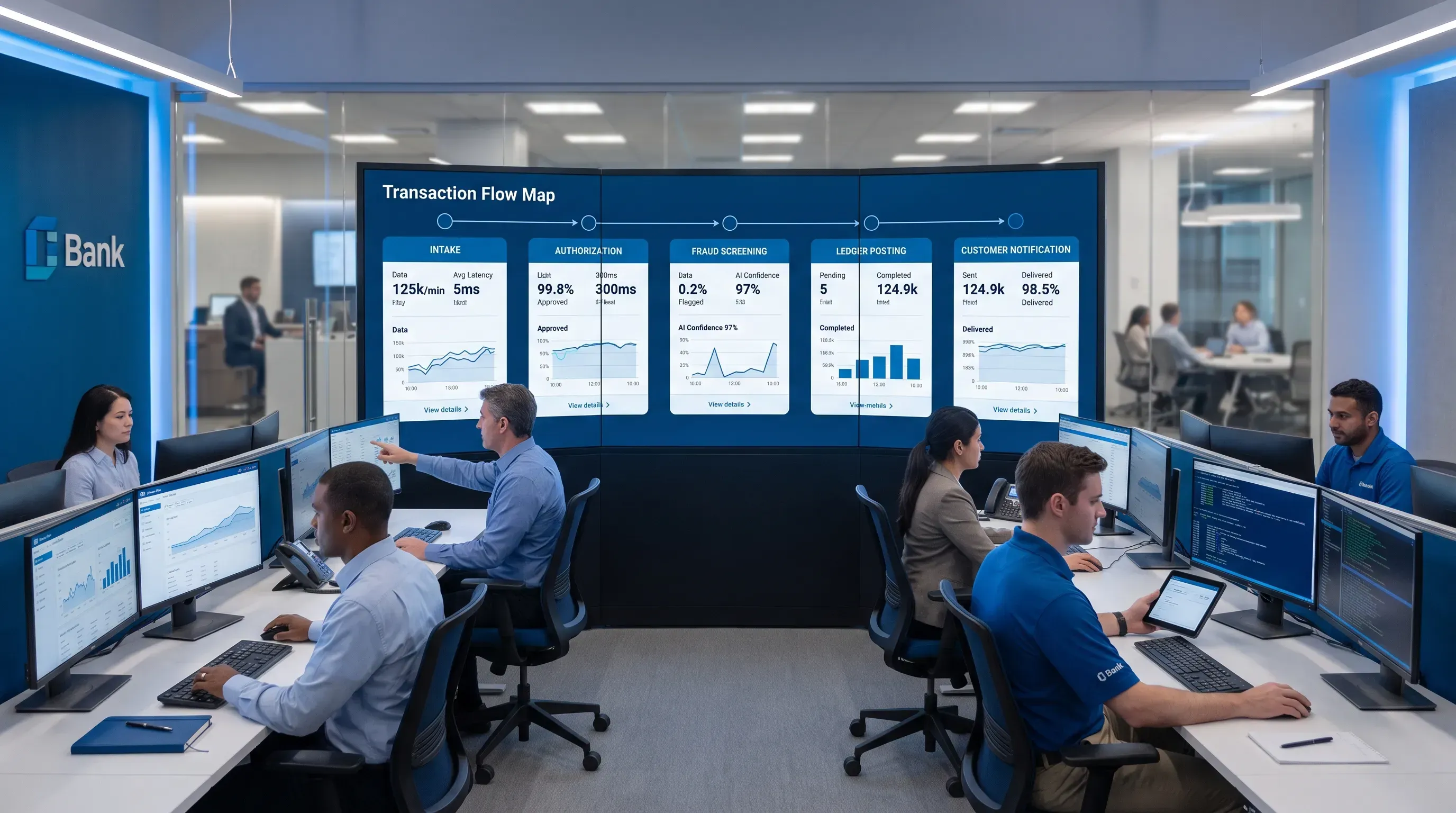
Fraud detection runs in real time because the decision has to be made before the authorization clears. Global card fraud losses reached $33.41 billion in 2024 according to the Nilson Report, which is the scale of the problem these systems exist to contain. The virtual card issuing platform scores each authorization request as it arrives and decides whether to approve or decline it, with flagged cases routed for review.
The scoring combines a few approaches that each catch different things. Rule-based controls handle the clear-cut cases, such as a card used outside its approved merchant category. Velocity checks watch for patterns over time, like a sudden burst of authorizations on a card that normally sees one a week. Machine learning models score the gray areas by assigning a risk number from many signals at once. Visa's Advanced Authorization, in production since 1993, scores every transaction against more than 500 risk attributes in under a millisecond, which shows how tight the latency budget is and how much can still be evaluated inside it.
That latency budget is the hard constraint. A card authorization on VisaNet routes to the issuer in roughly 150 milliseconds, and the fraud decision has to fit inside that window alongside everything else the platform is doing. So the models are tuned to score fast, and the rules execute first because they are cheap. Configurability is what makes the system usable. A business sets its own thresholds for how aggressively to decline borderline transactions, which lets it balance fraud prevention against the cost of blocking legitimate spending. Set the dial too tight and you decline good customers. Too loose and losses climb.
Scaling for high transaction volume
Scaling a virtual card issuing platform means handling more cards issued and more transactions processed without authorization times creeping up. The work splits into stateless and stateful parts, and they scale differently. The API and authorization services are largely stateless, so horizontal scaling handles them by placing more identical instances behind a load balancer as traffic grows. The database is harder.
Database partitioning, or sharding, divides a large dataset into smaller pieces stored across separate servers so that no single server becomes a bottleneck. The shard key matters enormously, because a poorly chosen key forces expensive re-sharding later. Caching sits in front of the hot reads and keeps frequently accessed card and balance data in memory so an authorization doesn't wait on disk. Authorization is the latency-critical path, so the architecture is shaped around keeping that path short even as the data behind it multiplies.
Staying online through failures is its own requirement. High availability on a virtual card issuing platform comes from redundancy across multiple instances and availability zones, so the loss of one node or one data center doesn't take the system down. CockroachDB, for instance, distributes and rebalances data automatically as payment volume grows while preserving transactional guarantees, which removes the manual sharding work that otherwise grows more painful with every scale-up.
None of this comes free, and the trade-offs are real:
-
Strong consistency across distributed nodes costs latency, while relaxing it improves speed at the risk of stale reads
-
Redundancy and extra capacity raise infrastructure cost, which has to be weighed against the cost of downtime during a peak season
The right balance depends on the program. A platform processing prepaid disbursements tolerates different trade-offs than one running corporate travel cards at month-end peaks.
Final thoughts
On a virtual card issuing platform, architecture and security belong to one system, with scalability changing how that system behaves under load. The API layer is only as trustworthy as the tokenization vault behind it, while fraud controls work inside the latency the scaling design preserves and compliance depends on disciplined key management and access controls as volume grows. Thoughtful component design pays off most when a program scales, because the weak link is the one that breaks first under load.
When you evaluate or build one of these platforms, look hard at how tokenization reduces PCI scope and how the lifecycle engine enforces controls at authorization time, then test how the system stays available during failures. EGS builds resilient fintech infrastructure for exactly these demands. To see how a virtual card issuing platform can fit your program, reach out to our team for a consultation.