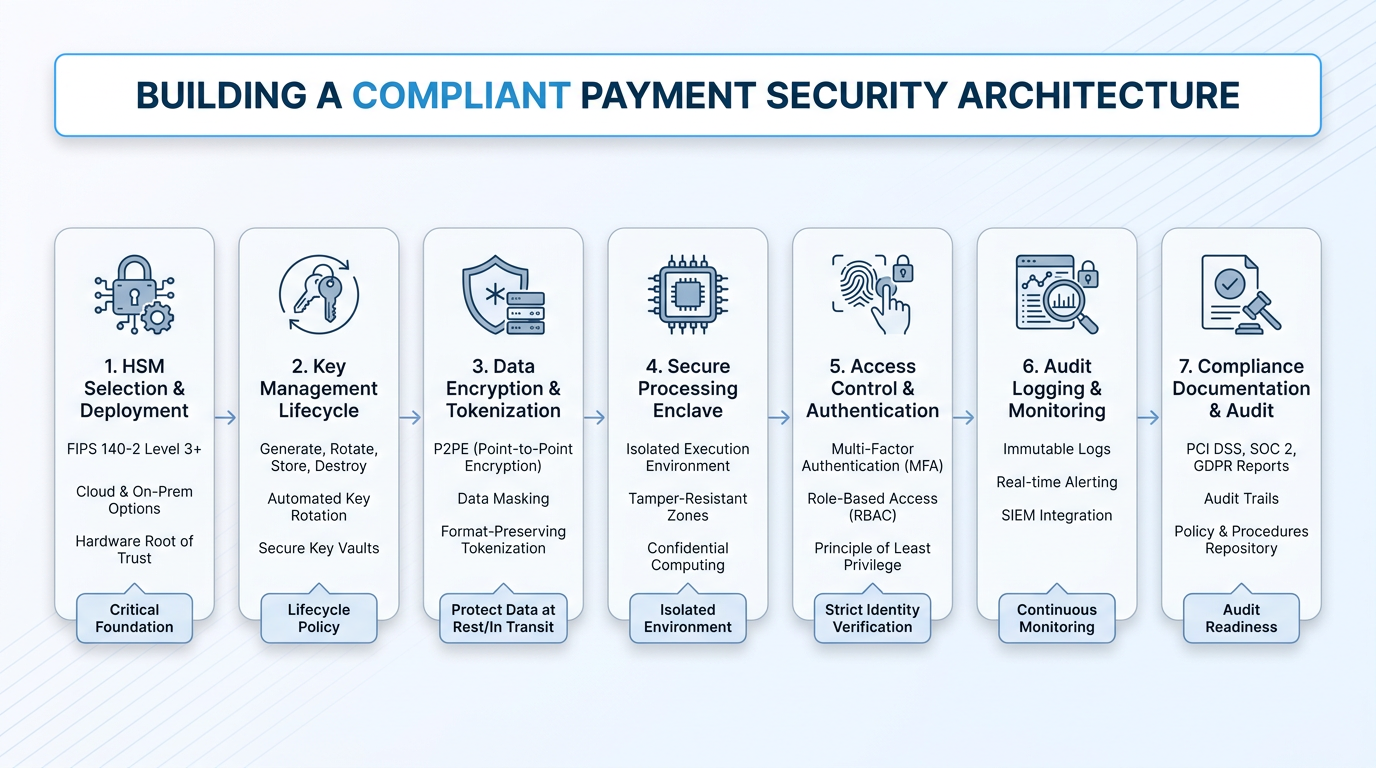
What This Guide Covers
This article maps PCI DSS controls directly to real infrastructure, showing exactly how hardware security modules support encryption, logging, and access control across Requirements 3, 4, and 10. You'll get a clear architecture breakdown, an audit readiness checklist, and a list of common pitfalls fintechs face when building payment cryptography infrastructure. Whether you're prepping for your first PCI assessment or tightening an existing setup, every section here is built to save you time and headaches.
HSM Requirements Across PCI Standards
An HSM certified to PCI PTS v4.0 or FIPS 140-2 Level 3+ is a tamper-resistant cryptographic device that generates, protects, and manages encryption keys used to secure payment card data throughout its lifecycle. It is required or strongly recommended across PCI DSS (Reqs 3, 4, 10), PCI PIN, PCI P2PE, PCI 3DS, and PCI Card Production (Logical) v2.0 at Requirements 8.5, 8.7, and 8.14.
What Is an HSM and Why PCI DSS Demands One
A hardware security module is a physical device (or cloud-based service) that generates, stores, and manages cryptographic keys inside a tamper-resistant boundary. In the context of PCI DSS encryption compliance, the HSM is the backbone of your key management lifecycle. PCI DSS doesn't explicitly say "you must use an HSM." But once you read Requirements 3, 4, and 10 closely, you realize that meeting them without an HSM is nearly impossible at scale.
Here's why:
-
Requirement 3 (Protect Stored Account Data): encryption keys must be stored separately from encrypted data, with strict access controls. HSMs enforce this by design.
-
Requirement 4 (Protect Cardholder Data in Transit): strong cryptography during transmission relies on keys that must be generated and managed securely.
-
Requirement 10 (Log and Monitor All Access): every key operation inside a certified HSM produces an audit trail, which assessors love.
HSMs compliant with FIPS 140-2 security level 3 and above meet PCI DSS HSM requirements, making FIPS certification your minimum bar for device selection.
Beyond PCI DSS itself, HSMs appear as explicit requirements across related PCI standards. PCI PIN v3.0 includes Requirement 1 specifying HSM system use, while PCI P2PE v3.0 includes Requirements 4A-1 and 5-1 for point-to-point encryption. Even PCI 3DS v1.0 includes Requirement P2-6.1.2 for 3-D Secure environments. The HSM isn't optional; it's woven into the entire PCI ecosystem.
For more on building resilient, compliant security and payment infrastructure, visit Energize Global Services.
7 Steps to Build Compliant Payment Security Architecture

1. Choose an HSM That Matches Your Deployment Model
Not every HSM fits every environment. On-premises appliances from vendors like Thales or Utimaco work well for large processors. Cloud-native HSMs (AWS CloudHSM, Azure Dedicated HSM) suit teams that need elasticity.
The PCI Security Standards Council recognized this shift. PCI PTS HSM Security Requirements v4.0 adds a new evaluation module and approval class for cloud-based HSMs used in HSM-as-a-service offerings. If you're evaluating a cloud HSM provider, confirm they hold this v4.0 approval.
Key selection criteria:
-
FIPS 140-2 Level 3 or FIPS 140-3 certification
-
PCI PTS HSM v4.0 listing (check the PCI SSC device list)
-
Support for your required algorithms: AES-256, RSA-2048+, DUKPT, TR-31
-
Throughput capacity for your transaction volume
Make sure you aren't running devices evaluated under older standards. Version 3.0 of PCI PTS HSM Security Requirements retired in December 2022 for new device evaluations, so any newly deployed HSM should carry v4.0 approval.
2. Map Your Architecture to PCI DSS Controls
Before writing a single line of integration code, draw your data flow. Auditors want to see exactly where cardholder data enters, how it gets encrypted, where keys live, and how logs are collected.
A typical compliant architecture looks like this:
-
POS terminal or payment gateway captures card data and immediately calls the HSM for encryption (Req 4).
-
Encrypted payload travels to the application server. The server never holds keys in memory.
-
HSM cluster handles decryption only when needed for authorization, then re-encrypts for storage (Req 3).
-
Key management layer within the HSM enforces dual control, split knowledge, and automatic key rotation.
-
SIEM integration pulls tamper logs, key access events, and admin actions from the HSM (Req 10).
This architecture keeps your cardholder data environment (CDE) as small as possible, which reduces your audit scope dramatically.
3. Enforce Key Management Lifecycle Rules
PCI DSS Requirement 3.6 spells out exactly what your key management procedures must include. The HSM handles most of this natively, but you still need documented policies.
These requirements break down into the following core controls:
-
Generation: keys must be created inside the HSM's secure boundary, never imported from a laptop or dev server.
-
Distribution: use TR-31 key blocks for key exchange between HSMs. Plain-text key components outside the device are a finding.
-
Storage: keys never leave the HSM in cleartext. Period.
-
Rotation: define crypto-periods. Most assessors expect rotation annually or after a suspected compromise.
-
Destruction: retired keys must be zeroized using the HSM's certified deletion function.
Fintechs building payment cryptography infrastructure often underestimate the documentation burden here. Your QSA will ask for written procedures, evidence of dual control ceremonies, and logs showing who participated. Energize Global Services provides deep expertise in secure key management policies and lifecycle controls for payment systems—see more at Energize Global Services.
4. Lock Down Access Controls
Requirement 7 (restrict access by business need) and Requirement 8 (identify users) apply directly to your HSM. This is where many teams get caught.
In practice, these requirements translate into the following access control measures:
-
Assign unique operator IDs for every admin. No shared accounts, ever.
-
Implement multi-factor authentication for HSM console access.
-
Use role-based permissions: separate key custodians from system administrators.
-
Require M-of-N authentication for sensitive operations (key generation, firmware updates).
A common pitfall: a single engineer has root access to the HSM and the application server. That's a segregation-of-duties failure, and auditors flag it immediately.
To empower your team with best-in-class access control structure, Energize Global Services offers certified expertise and implementation support for financial institutions.
5. Integrate Logging with Your SIEM
Requirement 10 demands that you log all access to cardholder data and all actions taken by anyone with admin privileges. Your HSM generates these events natively, but they're useless sitting on the device.
To make logging effective and audit-ready, you should implement the following practices:
-
Forward HSM audit logs to your SIEM in real time (syslog, SNMP, or API).
-
Set alerts for: failed authentication attempts, key deletion events, firmware changes, tamper alarms.
-
Retain logs for at least 12 months, with a minimum of 3 months immediately accessible.
This integration is where PCI DSS encryption compliance meets operational security. If your SIEM can correlate an HSM tamper alert with a physical access log from your data center, you've built real defense.
If you want to learn how to integrate HSM audit logging with state-of-the-art SIEM infrastructure, visit Energize Global Services.
6. Test and Validate Before the Audit
Don't wait for your QSA to find gaps. Run a proactive internal readiness assessment to identify compliance issues early, validate your operational controls, and ensure your HSM environment meets PCI requirements before any formal audit begins. This kind of pre-audit check helps avoid costly remediation cycles and last-minute surprises.
Run an internal readiness check using this checklist:
-
HSM firmware is current and matches a PCI PTS-listed version
-
All key components are stored under dual control with split knowledge
-
Crypto-period policies are documented and enforced
-
HSM logs are flowing to SIEM with correct timestamps
-
Network segmentation isolates the HSM from non-CDE systems
-
Physical security controls (locked rack, camera, access badge) are in place
-
Disaster recovery includes HSM key backup and restoration procedures
Organizations like Energize Global Services, which build secure payment infrastructure and specialize in software for hardware security modules and POS terminals, often embed these validation steps directly into CI/CD pipelines so compliance checks happen automatically with every deployment.
7. Avoid the Most Common Fintech Pitfalls
Fintechs move fast, but that speed often comes at the cost of overlooked security controls and incomplete documentation, creating specific risks during PCI HSM certification efforts—especially when teams prioritize delivery over audit readiness or assume that early-stage configurations will scale into compliant production environments.
Common pitfalls include:
-
Pitfall 1: Using a test HSM configuration in production. Dev keys and relaxed policies don't pass audit.
-
Pitfall 2: Ignoring cloud HSM shared responsibility. Your provider secures the hardware; you secure key policies, access, and logging.
-
Pitfall 3: No documented key ceremony. If you can't prove dual control happened, the assessor treats it as if it didn't.
-
Pitfall 4: Treating PCI compliance as a one-time project. Requirements change. The PCI Security Standards Council published PCI PTS HSM Security Requirements Version 4.0 on 17 December 2021, and teams that weren't tracking updates scrambled to adapt.
-
Pitfall 5: Skipping penetration testing on the HSM network segment. Assessors expect evidence that segmentation actually works.
Catching these issues early saves weeks of remediation during audit season.
Wrapping Up
PCI DSS HSM integration isn't just a checkbox exercise. It's an architecture decision that shapes your entire payment cryptography infrastructure. Map your controls to Requirements 3, 4, and 10 early. Pick an HSM with current PCI PTS v4.0 or FIPS 140-2 Level 3 certification. Lock down access, automate logging, and document every key ceremony. The teams that treat compliance as continuous engineering, not annual panic, are the ones that pass audits cleanly and sleep well afterward.
Learn more about resilient, PCI-compliant platforms at Energize Global Services.