Latency needs an end-to-end budget
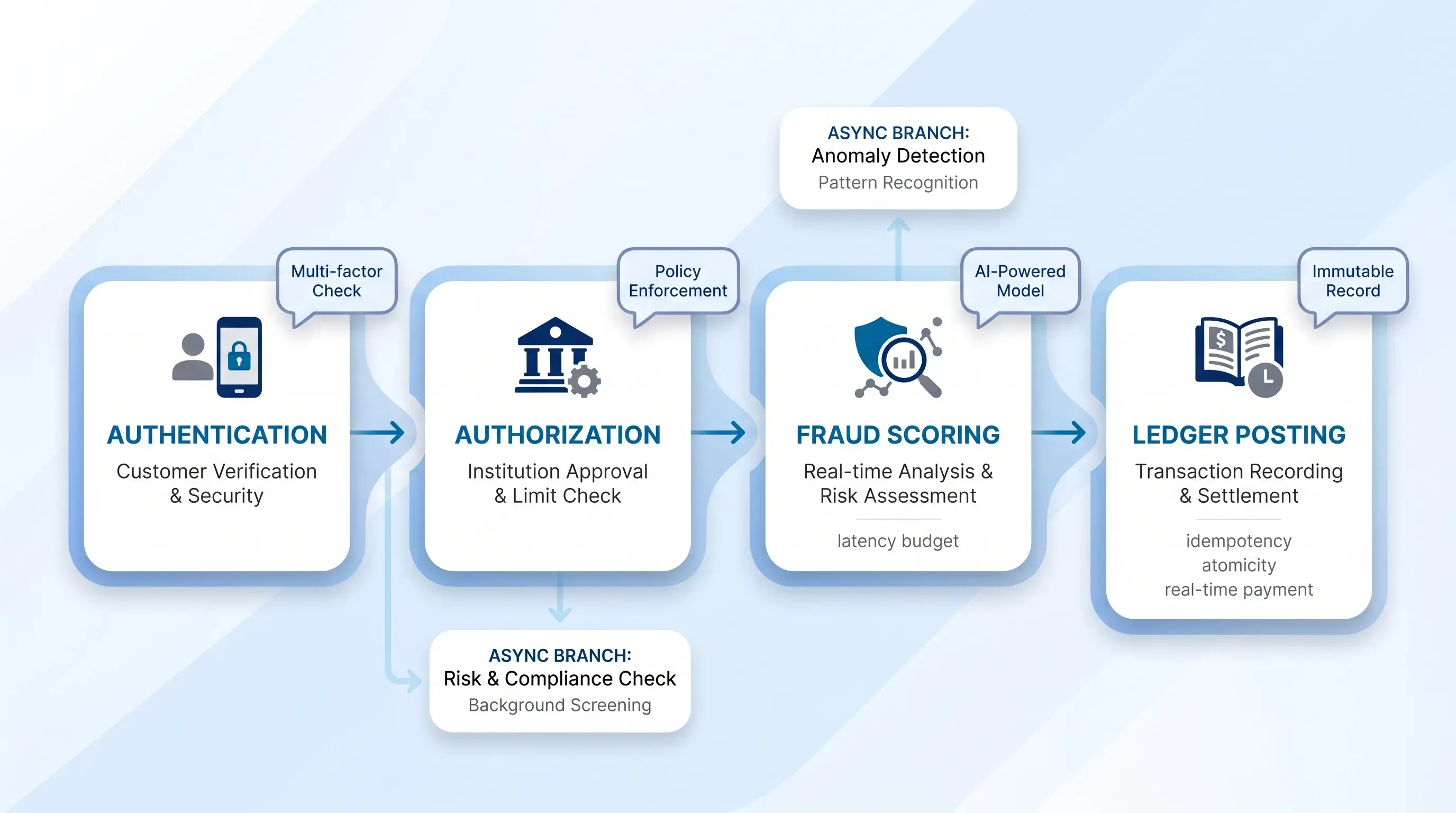
The response-time target has to be divided between network transit and authentication. Separate allocations cover fraud scoring and core or ledger access, with the remainder reserved for external rail calls. Each stage gets an allocation, and the sum can't exceed your ceiling.
The Software House offers a practical split inside a fraud decision: 20 ms for feature retrieval, followed by 30 to 80 ms for model inference. Rule evaluation gets 10 to 30 ms, and the rest goes to downstream calls and timeout headroom. Monitor percentile latency because averages hide the slow outliers that trip network timeouts. Your p99 is where transactions actually fail, so that's the number your service-level objective should protect.
Availability must cover every dependency
A 24/7 transaction service is only as available as its weakest dependency. Databases and identity services can become that dependency, as can the fraud engine or core connectors. The same risk applies to network links and recovery procedures. One of those going dark takes the whole flow with it.
As Volante Technologies puts it, real-time rails were built for continuous operation that inverts the batch assumptions of defined operating windows and predictable cycles. Design for redundancy and automated failover, with graceful degradation built in. Keep capacity headroom above your expected peak so a spike doesn't become an outage. Set recovery time and recovery point objectives per dependency as well as for the platform as a whole. The dependency without its own failover plan is the one that defines your true availability, whatever your headline number claims.
Consistency requires controlled retries
Timeouts create ambiguous outcomes, which makes blind retries dangerous even when every component is online. When a call times out, you don't know whether the transaction posted, so retrying could post it twice.
Unique transaction identifiers and idempotency keys safeguard against duplicate posting. The transactional outbox pattern supports reconciliation, while status queries help prevent inconsistent balances. As one payments engineer writing on DEV Community warns, idempotency keys only protect the request boundary, so if the same logical transaction arrives with a different key, the system isn't fully safe. Before retrying an ambiguous call, query the transaction's status and let that answer decide. Correctness under retries has to be deterministic because a best-effort duplicate check eventually fails.
Observability follows every transaction
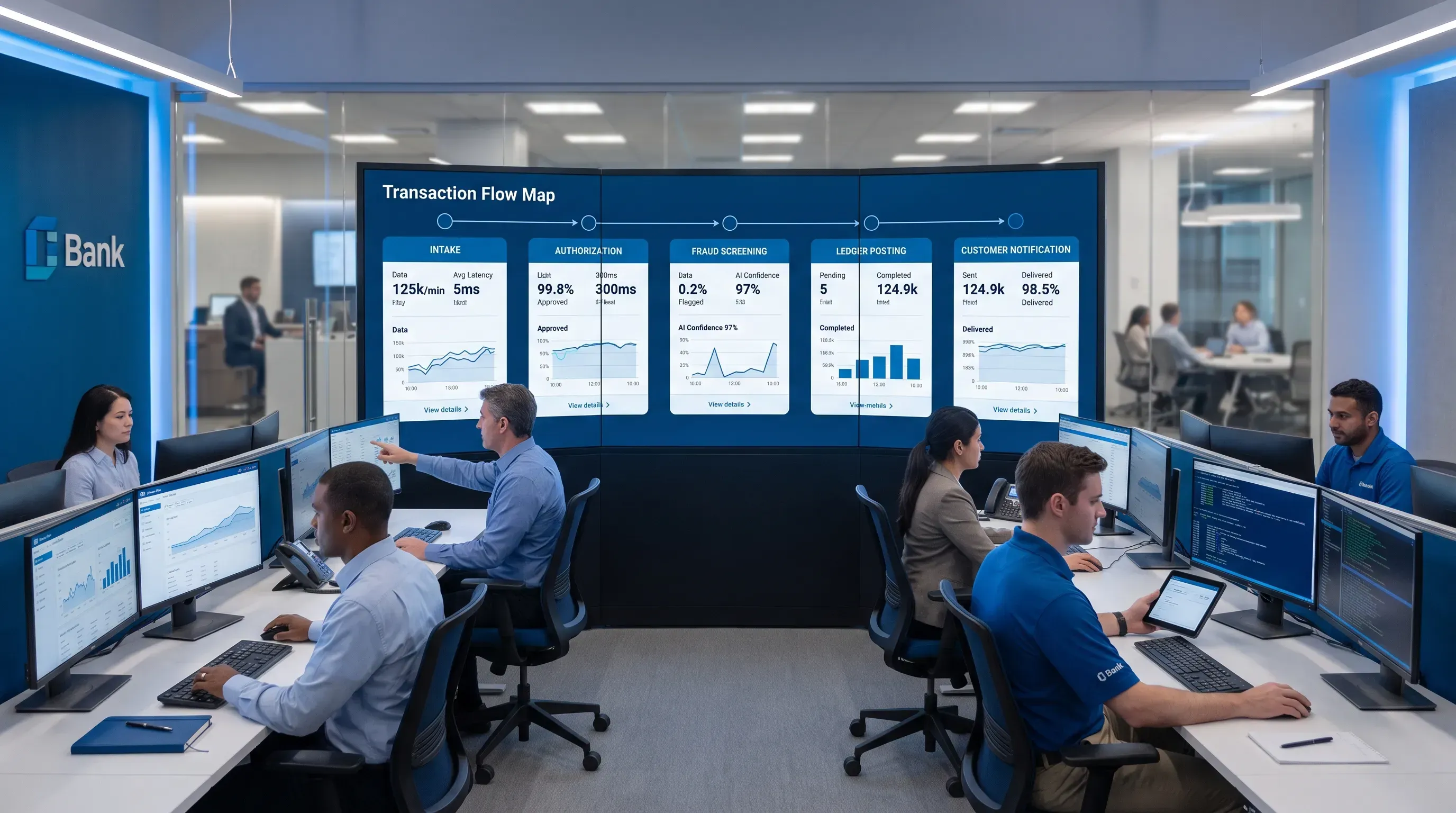
Correlation IDs and structured logs reveal exactly where a transaction slowed or failed. Distributed traces add to that visibility, as do metrics and business-level alerts. A single correlation ID threaded through every service lets you reconstruct one payment's entire journey across your platform.
OneUptime recommends instrumenting each stage from feature extraction through model inference so you can pinpoint where time is spent and react before latency hits your approval rates. Operational teams need both technical telemetry and an auditable transaction state, kept separate. You investigate with the traces and logs, and you never touch the financial record to do it. That separation is what lets you debug a live incident without corrupting the ledger you're trying to protect.
How can legacy cores support real time?
Institutions can defer immediate core replacement because an orchestration and integration layer can expose APIs and translate messages. It can also isolate channels from legacy constraints while moving suitable workloads to real-time services. The core keeps running while modern services front it.
Codingscape describes the appeal directly: your legacy core keeps running exactly as it does today, and nothing breaks because you haven't touched it, while new experiences launch through modern APIs instead of overnight batch files.
Here's the honest limit. An adapter can't fix a core that lacks authoritative balances or safe posting under concurrent load. It also can't make that core reachable 24/7. A core that fails those demands requires genuine core work beyond what a facade can provide.
Adapters contain legacy constraints
Anti-corruption layers and API facades connect modern services to older core interfaces. Message translators keep legacy formats contained within that boundary. The adapter absorbs the ugliness so the rest of your services speak clean, modern contracts.
This matters because legacy cores expose only file-based integration, and Vergent LMS notes that this integration uses nightly extracts in proprietary flat-file formats. An anti-corruption layer translates between those formats and your event stream at a single boundary. Contain the legacy format in one place and its constraints stop leaking outward, which is what makes staged modernization possible while existing payment operations keep running.
Shadow balances need strict controls
A separate real-time balance service improves responsiveness only when ownership and synchronization are defined explicitly, along with reconciliation and failure behavior. A shadow balance is a copy, and copies drift.
Legacy cores already juggle memo and available balances alongside a collected balance; all are updated across multiple batches as funds settle, per BillGo. This is exactly the ambiguity a shadow service inherits if you're careless. Loosely synchronized copies produce stale balances and overdrafts that can lead to double spending. Decide up front which system owns the authoritative number and what happens when the two disagree, because an undefined failure mode in a balance service is a customer overdraft waiting to happen.
Migration should follow transaction risk
Prioritize flows based on customer value and volume. Then account for latency need and fraud exposure, with dependency complexity guiding the sequence. This phased approach avoids a big-bang conversion. Move the flows that gain the most and threaten the least first, then work toward the harder ones.
Codingscape frames the low-risk path well: build new microservices around the core so new customer experiences launch in weeks instead of waiting years for a full replacement. Reduce cutover risk with parallel runs and replayable events. Add contract testing before you flip live traffic. Run the old and new paths side by side and compare results until you trust the new one. Changing live payment infrastructure is safest when you can prove the new flow matches the old before anyone depends on it.
EGS can modernize transaction processing
If you're mapping where your current stack blocks real-time processing, the next step is a design review that connects your architecture to the specific rails and cores you run, along with their controls. Energize Global Services (EGS) works with institutions that need to design or modernize secure, scalable real-time transaction infrastructure.
EGS reviews architecture and integration needs across core banking and payment systems, with APIs covered in the same assessment. Fraud and security components form another part of the review, and Hardware Security Modules (HSMs) receive specific attention. Cloud integrations and enterprise software complete the scope. The work starts from your constraints and builds the design from them.
Book a call with EGS to walk through your authorization flow and latency budget, along with the dependencies that decide your real availability. You'll leave with a clear read on which workloads are ready for real-time services now and what your modernization plan has to include before you connect to an instant rail.