Why architecture matters for card programs
Card programs rarely die from a missing feature. They die from architecture that cannot hold up once volume and geography-driven product variations stack on top of each other. A 50-millisecond authorization budget feels generous until hot ledger rows and a cross-region tokenization round trip have to fit inside the network's response window. At that point, the choices made on day one start showing up as declines and missed SLAs.
Poor design surfaces in predictable ways: downtime that erodes cardholder trust and compliance gaps that surface during PCI or SOC 2 audits. Product iteration speed also drops as the codebase fights itself. The way to evaluate any card issuing platform, whether you are buying it or building around inherited infrastructure, is layer by layer. That is what the rest of this article does.
Core layers of a card issuing platform

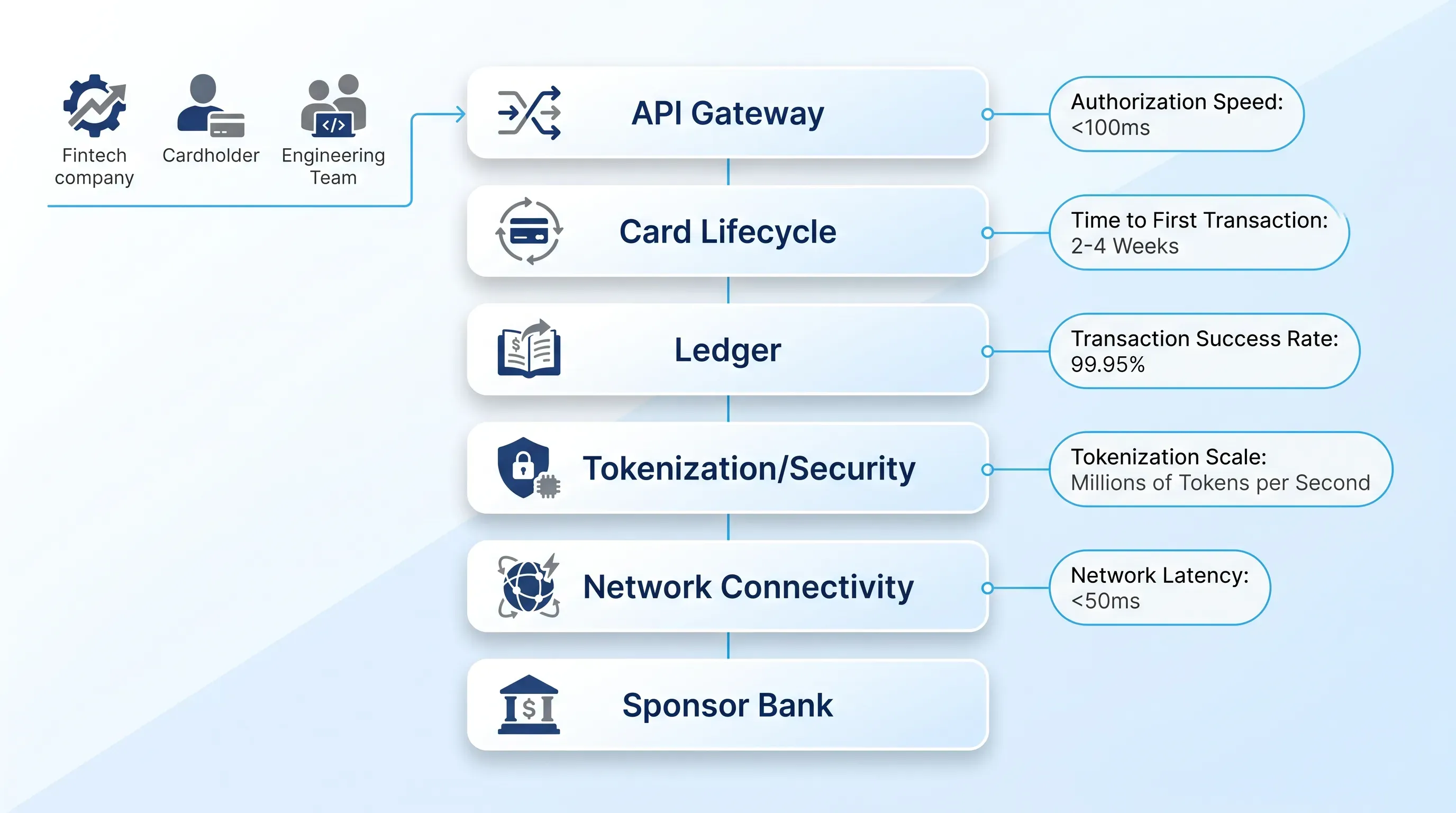
Every card issuing platform is a stack of specialized systems sitting between a cardholder and a network. Each layer has a narrow job and a defined latency budget, with trade-offs that ripple into the layers above and below. Walk through them in order and the architecture stops feeling like a black box.
Issuing processing platform
The issuing processing platform is the engine that talks to card networks such as Visa and Mastercard in real time. It receives authorization requests, applies issuer rules, decides whether to approve or decline, and later handles clearing and settlement messages. Most of this conversation still happens over ISO 8583, the 1987 messaging standard that Visa and Mastercard continue to use for card-originated transactions despite the slow migration toward ISO 20022.
Latency here is unforgiving. Mastercard's network handles transactions with an average response time of 130 milliseconds, which means the issuing processing platform has a small slice of that window to authenticate the message, query the ledger, run risk checks, and respond. Qonto's engineering team published that their authorization service answers in under 8 milliseconds end to end, and that level of performance is what shapes the rest of the stack.
Availability targets matter as much as latency. Marqeta's customer terms guarantee a Monthly Transaction Success Rate of 99.99%, with financial remedies if the issuing processing platform falls below it. Hitting that number means redundancy at every tier and automated failover, with a deployment model that treats every release as a potential incident.
BIN sponsorship and network connectivity
A card cannot exist on the Visa or Mastercard rails without a Bank Identification Number (BIN), and a BIN belongs to a principal scheme member. Most fintechs do not hold that license, so they connect through a sponsor bank that lends its BIN range and takes regulatory responsibility for the program. The sponsor bank owns the BIN, and the fintech runs the product through the issuing processing platform that sits between them.
This layer constrains product flexibility in ways that surprise teams late in the build. Each sponsor has its own risk appetite, prohibited verticals, settlement cadence, and reporting requirements. Enfuce, a dual-licensed EMI and principal member of Visa and Mastercard, describes sponsorship as the regulated foundation that delivers licensing and scheme access in a single package. Picking the wrong sponsor is expensive to undo because BIN migrations require recertification with the networks and reissuing every card in the program.
A few operational realities worth flagging:
-
Sponsor banks audit programs continuously, and they can pause issuance if compliance slips.
-
Multi-product or multi-country programs frequently require multiple sponsors, which the card issuing platform must abstract away from product teams.
Ledger and balance management
The ledger is where money actually lives in a card issuing platform, at least as far as the system is concerned. Authoritative card platforms use double-entry bookkeeping on append-only, immutable ledgers, because overwriting a balance in a single database cell destroys the audit trail and breaks under concurrent load. Every authorization places a hold, every clearing posts a debit, every refund posts a credit, and the totals must balance to zero across the journal.
Event sourcing is the dominant pattern. Instead of storing the current balance and mutating it, the ledger records every state change as an immutable event and computes balances by replaying the log. Trio's engineering guide explains that event sourcing in a financial ledger means recording all state changes as immutable, append-only journal entries rather than updating a current-state balance. The benefit is reconstructable history. The cost is a more involved reconciliation process between the ledger and the processor.
Ledger design is where most platforms hit their scaling ceiling. Hot accounts (think a corporate funding wallet that backs a million employee cards) create write contention, and naive locking strategies will throttle throughput long before the network does. Sharding by account and optimistic concurrency keep the ledger usable at scale when idempotency keys sit at the API edge.
Tokenization and security layer
Tokenization exists for two reasons: to keep Primary Account Numbers (PANs) out of as many systems as possible, and to enable digital wallet provisioning. Both reasons collapse PCI DSS scope. The PCI Security Standards Council states that a tokenization solution can minimize the number of merchant system components that need to be protected under PCI DSS, provided segmentation and process controls are in place.
Network tokenization is the second half of the picture. Visa's Token Service (VTS) and Mastercard's Digital Enablement Service (MDES) issue and maintain the lifecycle of network tokens used in digital wallet and card-on-file flows. Visa has provisioned more than 16 billion tokens as of September 2025, and the most recent billion took about a single quarter. A card issuing platform that does not integrate cleanly with VTS and MDES will struggle to deliver wallet support that cardholders now expect by default.
Underneath tokenization sits the cryptographic foundation. Hardware Security Modules (HSMs) generate and protect the keys that encrypt PANs at rest and sign cryptograms in transit. PCI DSS v4.0 requires that encryption keys used by the tokenization system be managed and rotated at the end of their defined cryptoperiod, with FIPS 140-2 validated modules where cryptography is used. Authentication for card-not-present transactions runs through EMV 3-D Secure, which exchanges device data and transaction data that includes behavioral signals between merchant and issuer so the issuer can apply Strong Customer Authentication when risk signals warrant it.
Card lifecycle management services
Card lifecycle management covers everything that happens to a card between issuance and closure. The services in this layer orchestrate state across the processor, the ledger, the tokenization vault, and customer-facing apps.
Typical operations include:
-
Issuance, activation, and PIN set or reset
-
Replacement for lost, stolen, or expired cards
-
Suspension, reactivation, and permanent closure
-
Velocity rules, spend controls, and merchant category restrictions
The failure mode in card lifecycle management is state drift. If a card shows as active in the processor but suspended in the issuer's app, the cardholder sees a decline they cannot explain, and support tickets pile up. Clean state machines, with explicit transitions and idempotent operations, are what keep card lifecycle management predictable as the program grows. A card issuing platform that exposes lifecycle events as webhooks, not just polling endpoints, gives product teams the hooks they need to keep downstream systems aligned.
Marqeta's own onboarding numbers hint at why this matters. Yapeal's co-founder Daniel Capraro said it took around 4 hours to define their card product and complete the first transaction on newly issued cards. That speed depends on a clean API surface for card lifecycle management.
API gateway and developer interface
The API gateway is the surface that engineering teams actually touch. It handles authentication, authorization, rate limiting, webhook delivery, and versioning. Done well, it disappears. Done poorly, it becomes the bottleneck for every product change, no matter how good the layers underneath are.
A few design choices separate mature gateways from improvised ones. Webhook delivery needs retries with exponential backoff and a dead-letter queue, because cardholder apps cannot afford to miss a card.activated event. Versioning has to be explicit, because card issuing platform behavior changes when networks publish mandates and customers cannot be forced to upgrade on the platform's schedule. Rate limits should be predictable and surfaced in headers so client teams can plan around them.
The quality of API design is what determines how quickly product teams ship. Marqeta's open API platform is a clear example because it treats the gateway as the product.
How the layers interact during a transaction
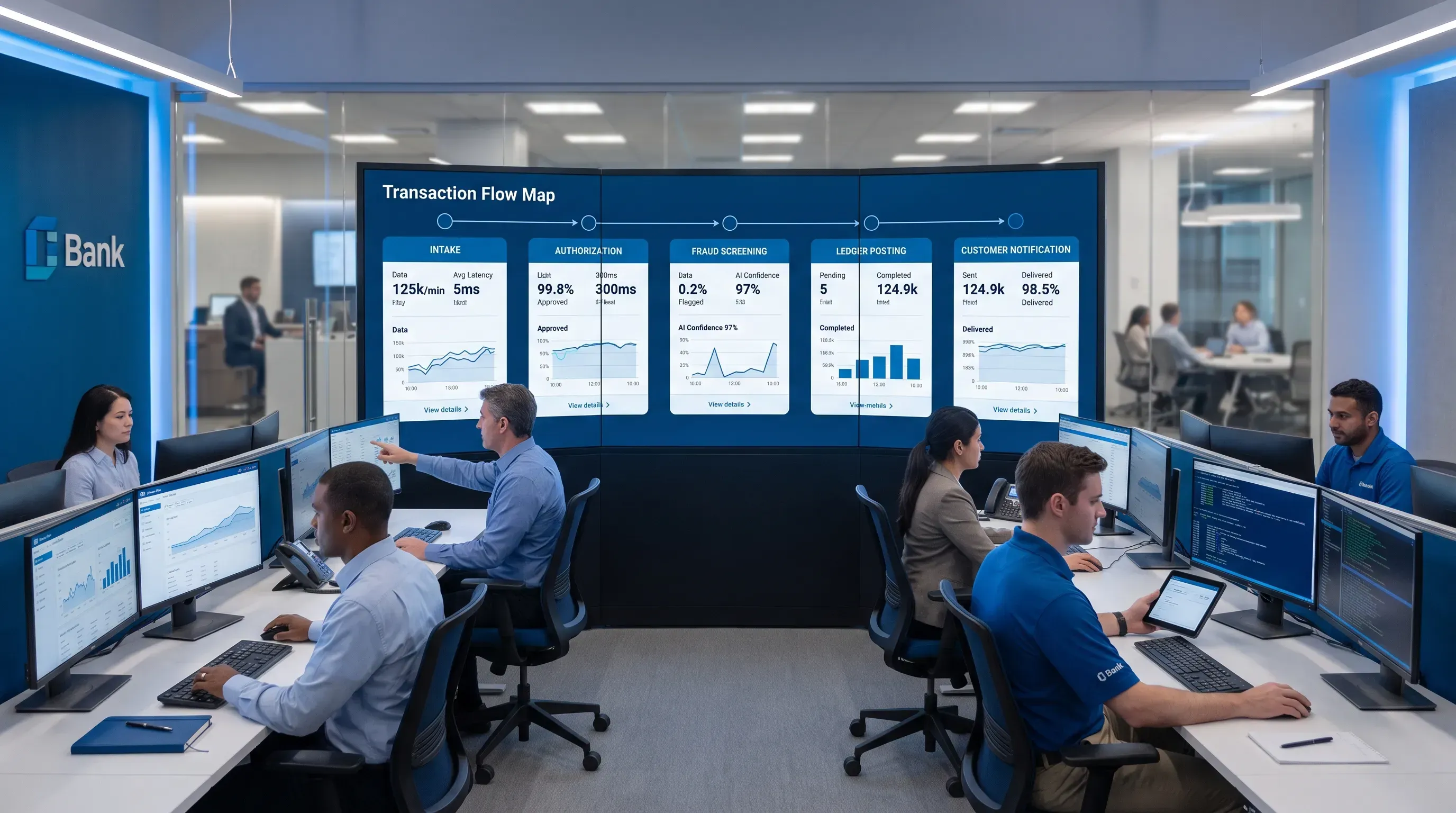
A single authorization in a card issuing platform is the cleanest way to see the stack in motion. Picture a cardholder tapping a Visa debit card at a coffee shop in Berlin at 8:14 AM.
Here is what happens inside the card issuing platform between the tap and the printed receipt:
-
The terminal builds an ISO 8583 0100 authorization request and sends it to the acquirer, which forwards it across VisaNet to the issuer's processor. Visa's Advanced Authorization scores the transaction against more than 500 risk attributes in under a millisecond before handing it to the issuer.
-
The issuing processing platform parses the message and confirms the card status from card lifecycle management after a tokenization lookup resolves the token back to a PAN reference.
-
The ledger receives a hold request for the transaction amount. Because the ledger uses double-entry bookkeeping inside a single atomic database transaction, the debit on the cardholder's available balance and the credit on the pending-authorizations account either both commit or both fail.
-
Risk and fraud rules run in parallel with the ledger hold. Velocity checks and merchant category restrictions are evaluated against the card's recent history, with geographic anomaly signals folded into the same pass.
-
The platform builds an ISO 8583 0110 response and sends it back to Visa, which returns it to the acquirer and the terminal. The cardholder sees "Approved" before they have put their phone back in their pocket.
Every one of those steps shares the same network-imposed time budget. If the ledger takes 40 milliseconds, the risk engine has less room. If the tokenization vault is in a different region, the round trip can blow the budget on its own. That is why senior engineers spend so much time arguing about co-location and connection pooling, with pre-warmed caches handled as part of the same latency plan. The architectural decisions determine whether the transaction ends with approval or a Stand-In Processing decline that counts against the SLA.
Scaling and security trade-offs
Once a program crosses a few million cards, the easy decisions are behind you and the trade-offs get sharper. Latency competes with durability: synchronous replication across regions adds milliseconds that the network will not forgive, while asynchronous replication risks losing the last few seconds of writes during a failover. Multi-region active-active sounds attractive until you try to keep a ledger consistent across two writers, and then most teams retreat to active-passive with a documented RPO.
Build versus buy is the other recurring tension. Building your own issuing processing platform is a multi-year project with scheme certification at the end of it. Buying one and customizing the layers above lets you ship in months but locks you into the vendor's roadmap. The middle path that fintechs like Block and Klarna chose was to buy the processor and program management role from Marqeta and build differentiation in the ledger and risk layers above it, with product logic handled there too.
Compliance shapes what can be changed and where. PCI DSS draws a hard boundary around any system that stores PAN data or transmits it through processing flows, and SOC 2 adds another layer of access controls and audit evidence. Network rules from Visa and Mastercard dictate timing and retry behavior, and they update dispute-handling rules on a fixed release calendar that the platform has to absorb. The framework most teams settle on weighs each trade-off against program stage and volume, with scope reduction treated as a feature.
What to evaluate before you commit
If you are sitting across the table from a vendor or reviewing an internal proposal, the architecture questions below cut through the demo gloss. Ask them in order and the answers will tell you whether the card issuing platform underneath is built for your roadmap or just your first quarter.
-
What is the uptime SLA on the issuing processing platform, and how is it measured? A 99.99% number with no remedies is marketing. A number tied to financial credits and a published measurement methodology is a commitment.
-
How does the ledger guarantee consistency under concurrent writes, and does it use event sourcing or balance overwrites?
-
Where does the tokenization vault sit relative to the issuing processing platform, and how does PCI scope flow through the architecture?
-
How mature is the API surface? Is versioning explicit, and are webhooks reliable? How are breaking changes communicated?
-
How flexible is the sponsor bank relationship? Can the platform support multiple sponsors across multiple geographies and the migration path between them?
-
What does card lifecycle management look like as a state machine, and which transitions are exposed as events your team can react to?
Next Steps
Map each answer against your roadmap. A program issuing 50,000 cards in a single country can tolerate trade-offs that a program issuing five million cards across the EU and the US cannot. Architecture choices that look identical on a slide behave differently at scale, and the gap shows up in incidents and audits while product teams feel it in the speed at which they can ship.
Resilient infrastructure is what separates a card program that grows from one that stalls. EGS provides fintech infrastructure that supports the architectural layers covered above, from issuing connectivity and ledger reliability to tokenization and card lifecycle management at scale. If you are evaluating a card issuing platform or planning a sponsor migration, reach out to the EGS team to size the engineering work behind your next launch and pressure-test your design choices against production realities.