How South African Banks Can Prepare for RTC to PayShap Migration

Content authorBy EGSPublished onReading time10 min read
A close-up shot of hands holding a smartphone in a casual home office, with a laptop and coffee mug softly blurred in the background.

Start by confirming the scheme timeline with PayInc, then scope which Real-Time Clearing (RTC) flows are actually eligible for PayShap. Map every channel and data dependency behind them, then test end-to-end with production-like conditions. Cut over in controlled cohorts while keeping clear ownership of RTC transactions still pending or under investigation.

Preparation must follow the confirmed roadmap

Fix your milestones against written scheme communications. PayInc's 2025 business report states that RTC is scheduled to sunset in March 2027, which gives you roughly seventeen months from October 2026. That date is a planning anchor, and it remains subject to confirmation through PayInc and the South African Reserve Bank (SARB). Treat any internal plan built on a date you can't trace to a scheme circular as provisional.

Keep PayShap Request collections out of this scope. Request is a separate collection capability that went live in December 2024 with eight banks, and the SARB recorded 218,991 Request transactions worth R74.2 million in its oversight reporting. A collection product folded into a credit-push migration blurs accountability when something breaks, because the teams who own collections exceptions aren't the teams who own RTC payment routing. Scope it separately or you'll inherit two change programs wearing one name.

Which RTC flows are eligible?

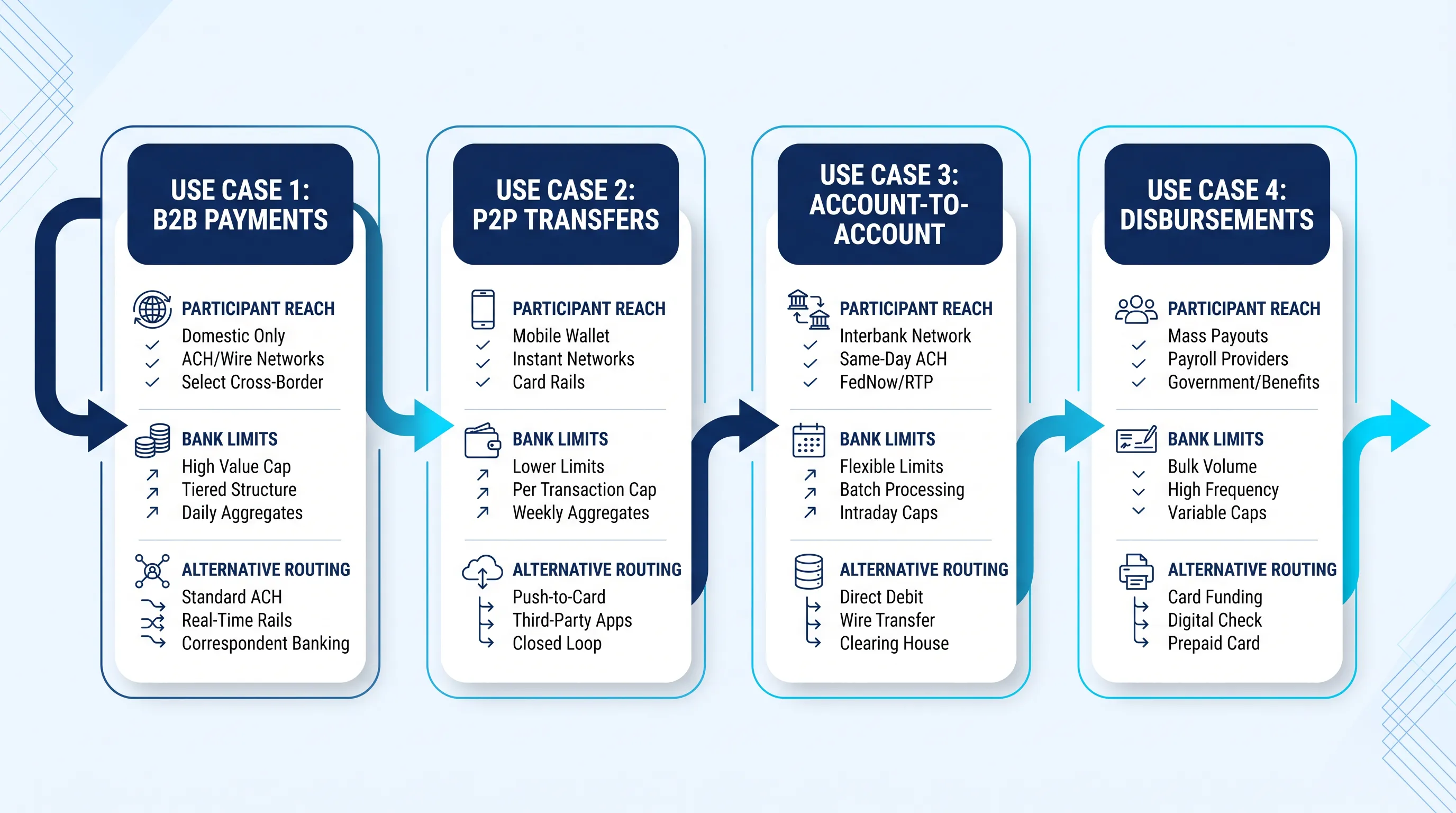
Diagram illustrating the eligibility testing process for RTC flows in a financial system, featuring interconnected use case cards and arrows.

Eligibility is decided flow by flow, against current PayShap rules. Build a table that tests each RTC use case against participant reach and your own bank limits. One row per use case keeps the argument auditable when risk committees ask why a flow stayed on RTC.

Value is the sharpest filter. The Payments Association of South Africa (PASA) notes RTC carries an R5 million transaction limit that falls to R250,000 outside business hours, while PayShap moved from R50,000 toward an R5 million ceiling in March 2026. Parity at scheme level doesn't mean parity at your bank, because each payer bank sets its own threshold below the scheme maximum. So your eligibility table has two limit columns. Route everything that fails the test through an approved alternative, with the alternative named in the same row and the fallback owner recorded beside it.

Which channels originate affected payments?

Every channel that can originate an RTC payment needs an entry in the inventory before scoping closes. Mobile apps and internet banking route differently, and so do branch capture and host-to-host channels. Bulk submission files and back-office repair route differently as well. Each channel carries its own fee schedule and limit configuration.

For each one, record the RTC routing logic and which support team answers the phone when a payment fails. PayShap reach has widened to 14 participating banks, with more expected during 2026, so a channel that was ineligible six months ago can qualify now. That makes the inventory a living document. Date-stamp each row, because a reach assumption captured in Q1 and acted on in Q4 is how banks ship payments to unreachable destinations.

Which payment data must change?

Account and beneficiary data has to be traced from the moment a customer types it to the moment it posts at the receiving bank. RTC was built on the ISO 8583 card message standard, while PayShap runs on ISO 20022, and that difference reshapes reference fields and the validation you apply at capture.

Map proxy handling alongside account handling, since ShapID resolution introduces a lookup step RTC never had. Then walk your limit checks and fraud rules through the same path. The field that quietly breaks is the customer reference, because a free-text field that RTC truncated one way and PayShap carries intact will surface at the beneficiary's statement and in your own reconciliation, which means your repair teams meet the defect before your architects do.

Start building your financial platform?

Speak with EGS engineers about open banking, payment infrastructure, cloud systems, and enterprise software.

Get in Touch →

Which dependencies block processing?

List the dependency, then name the person accountable for the handoff. Funding and liquidity positions sit between an instruction and a completed payment. Sanctions screening and core banking posting sit there too, as do clearing connectivity and reconciliation. Customer notifications and regulatory reporting occupy the same path. Investigations and third-party processors sit there as well.

Settlement behavior deserves specific attention. PayShap settles on a deferred gross basis seven times daily. Clearing completes in around ten seconds, so customer funds move long before interbank settlement does. Your treasury intraday model has to absorb that gap at volumes RTC never produced during off-peak windows, because PayShap runs through nights, weekends, and public holidays. An unowned handoff between treasury and payment operations on a Sunday evening is the failure mode that turns a technical success into a funding incident. Assign it now, with a named deputy, and rehearse it before any production flow moves.

How does one transfer behave?

Write the expected behavior down before you build anything, as a traced walkthrough of a single eligible transfer from initiation to beneficiary posting. Compare RTC and PayShap side by side at each step, from reference continuity through to the evidence an investigator will pull six weeks later.

Speed changes the shape of the problem. RTC clears funds within sixty seconds, while PayShap makes funds available in real time at around ten seconds, which compresses every control that used to fit comfortably inside the older window. Your fraud hold and your screening response now compete for the same ten seconds. That's the real design constraint, and a walkthrough document is where you discover it cheaply instead of discovering it in a production incident queue.

Testing must prove end-to-end behavior

Acceptance means correct customer outcomes with operational evidence behind them. Test with production-like values and live channel configurations. Use real participant combinations and deliberate failure conditions.

Volume gives you the reason to be strict. The SARB recorded PayShap processing a record 60 million transactions worth over R62 billion in December 2025, and RTC migration is part of what's feeding that curve. A defect rate your test environment treats as acceptable becomes thousands of affected customers a month once your flows join that stream. So set your pass bar against production volume, and make the evidence trail part of the pass condition.

Which functional cases need testing?

Functional coverage has to include the paths that fail. A test pack built around happy-path outbound credits will pass and tell you nothing about the Tuesday morning you actually need to survive.

Cover these at minimum:

  • Outbound and inbound success across every originating channel, with bulk and back-office repair among them

  • Invalid beneficiaries, unresolvable proxies, exceeded limits, insufficient funding, and timeouts

  • Duplicate submissions, delayed responses, scheme rejects, permitted reversals, and seeded reconciliation breaks

Reversal testing needs care. FNB's own business guidance states that PayShap payments cannot be stopped or cancelled once processed, with errors handled through a reversal request form. That turns what RTC teams treated as a system function into a manual recovery process with human turnaround times, so test the recovery workflow with the operations team who'll run it.

Start building your financial platform?

Speak with EGS engineers about open banking, payment infrastructure, cloud systems, and enterprise software.

Get in Touch →

Which operational cases need testing?

Operational rehearsal proves people and processes work, and it's the part most migration plans under-resource. Exercise monitoring thresholds and alert routing. Work through incident escalation and enquiry handling. Cover fraud review queues, then settlement and liquidity controls. Finish with evidence retrieval and repair. Run them at night and during a month-end peak.

Fraud response carries the most weight here. SABRIC reported digital banking crime losses of R2.41 billion in 2025, a 29.2% increase on 2024, with banking app crime accounting for more than 70% of that total. Faster, irrevocable rails shorten the window between a fraudulent instruction and unrecoverable funds. Which means your fraud team's handoff to the beneficiary bank has to be rehearsed as a timed drill, because the recovery outcome depends on minutes.

What defines migration acceptance?

Acceptance is a measurable threshold signed by business and operations, written before testing starts. Define numbers for processing accuracy and end-to-end latency. Cover posting correctness and reconciliation completeness. Add investigation evidence retrieval time and support readiness. Attach a defect closure rule that distinguishes a blocker from an accepted known issue.

Set the bar against scheme performance. PayShap has processed 725 million successful transactions worth R659 billion since its 2023 launch, which gives the industry a stability baseline customers already experience at other banks. Falling short of it is visible immediately, because a customer whose payment behaves differently at your bank compares it to the one that worked yesterday elsewhere. That's why the sign-off includes a named operations owner alongside the business sponsor. Technical acceptance without operational acceptance produces a go-live nobody can run.

Cutover needs controlled flow movement

Cutover is a sequenced set of decisions with evidence attached to each, governed by a checklist that someone owns. Routing changes and limit configuration need a tick and a name beside them before the go/no-go call. Customer communications and monitoring thresholds follow the same rule. So do staffing cover and reconciliation arrangements. Incident authority needs that tick as well.

Your checklist forces an answer on:

  1. Who authorizes a halt mid-cutover, and what evidence triggers that call

  2. Where RTC transactions still pending or under investigation are tracked, and which team keeps owning them past the cutover date

  3. What the first-hour, first-day, and first-week monitoring thresholds are

That second item is the one that gets dropped. RTC volumes have been migrating to PayShap since October 2024, when Rapid Payments first overtook RTC volumes, and banks that moved early learned that unresolved legacy items don't migrate with the flow. They sit in a queue whose owner left the project.

When can flows move safely?

Move flows only after acceptance is signed and production readiness is confirmed. Then migrate in cohorts. Begin with lower-value retail flows on a single channel and widen once outcomes hold.

Scale justifies the patience. PayShap passed one billion transactions on 18 June 2026 and now runs above 60 million a month, which means a cohort that looks small in your plan still carries real customers through a rail under sustained load. Increase volume only while transaction success rates and latency stay inside the thresholds you agreed at acceptance. Reconciliation breaks and enquiry volumes follow the same rule. If any indicator drifts, hold the cohort where it is. The cost of pausing a cohort for a week is negligible next to the cost of explaining a channel-wide failure to your conduct regulator.

Are coexistence and rollback available?

Describe coexistence or rollback only if your current scheme and operator arrangements actually permit them, and say so in writing with the arrangement referenced. Promising reversibility you can't deliver is worse than admitting a one-way door, because the contingency planning that follows will be built on a capability nobody has.

Define containment for a one-way cutover. That means rerouting rules for new instructions and a documented incident path. Name a decision owner for stopping further cohort movement. The SARB's Payments Ecosystem Modernisation roadmap places RTC migration to Rapid Payments Rail alongside direct participation rollout through 2026 and 2027. Those parallel workstreams change the ground underneath your plan, which means a coexistence assumption validated in January needs rechecking before any cohort moves in the second half of the year.

EGS can support transition delivery

Energize Global Services (EGS) works on payment architecture and production support. That work maps onto readiness assessment and transition support. Founded in 2007 with around 500 people across delivery centers in Europe and Africa, EGS builds ISO 20022-capable payment infrastructure for banks and payment providers.

Every migration on a live national rail carries interruption risk. A partner brings eligibility scoping and operational rehearsal work into one accountable plan, with evidence your risk committee can read.

Bring your flow inventory and your current scheme correspondence to a scoping conversation with EGS, and work the plan around the RTC flows your bank actually runs.

Start building your financial platform?

Speak with EGS engineers about open banking, payment infrastructure, cloud systems, and enterprise software.

Get in Touch →

A bank should retain the approved scope matrix, scheme correspondence, decision logs, test evidence, defect dispositions, and named ownership records. Keep version history for each document, including the person who approved a change and its effective date. This gives audit, risk, and incident teams a traceable account of migration decisions.

Customer notices should explain which payment option is changing, when the change takes effect, and what customers must do, if anything. Include revised limits, expected processing behavior, reference handling, and the support route for failed payments. Use the same wording across digital channels, branches, and contact-center scripts.

A bank should involve the SARB when its plan depends on regulatory direction, scheme timing, participation changes, or a material change to customer payment processing. Record the communication, response, and resulting decision in the project file. Escalate unresolved regulatory questions before approving a production cutover date.

Compare payment success, end-to-end latency, rejection rates, reconciliation breaks, fraud referrals, and customer enquiries for RTC and PayShap. Use the same measurement window and channel breakdown for each cohort. Track unresolved items by age as well, because a stable success rate can hide a growing investigation queue.

Frontline teams can support customers when they receive channel-specific scripts, limit guidance, failure codes, and escalation rules before cutover. Train them to distinguish a pending payment from a rejected or irreversible payment. Give staff a reference for legacy RTC cases, since those cases remain with their assigned owner after new routing changes.

Schedule a Meeting

Book a time that works best for you

You Might Also Like

Discover more insights and articles

A project manager in business casual attire discusses a document intake process with a team in a modern office, focusing on a large monitor.

Bank document intake workflow: A readiness checklist

This article gives you a checkpoint-by-checkpoint method for testing a document intake process before you turn it on. It includes a worksheet structure you can copy into a spreadsheet and the evidence each control needs to produce.

Two business partners collaborate on configuring a POS terminal in a modern office, surrounded by payment devices and colleagues.

EthioPay for Ethiopian Banks: Turn Readiness into a Delivery Plan

This article explains how an Ethiopian bank moves from "we want to participate" to a dated, costed integration plan for the country's domestic card scheme and instant payment rails. It covers service selection and a phased release sequence.

A modern smartphone displaying a mobile banking app lies on a wooden desk, surrounded by abstract payment cards and a notebook.

AfriGO Card Readiness: Plan Your Nigerian Bank’s Rollout

This article is a readiness guide for moving from "we're considering it" to a controlled pilot on Nigeria's domestic card rails. It covers role definition and launch scope, then maps the transaction flow so you can assess systems and assign requirement ownership through the workstream matrix that holds the whole program together.

A professional seated at a desk uses a smartphone and payment card, engaged in online banking in a bright, modern office.

G2P Payments in Africa: Build Reliable Social Payment Infrastructure

This article traces the full lifecycle of a government social payment in Africa, from eligibility approval through to reconciliation and investigation evidence. It assigns operational ownership at each system boundary and sets out how to control exceptions and assisted access.