Automated Fare Collection in Africa: Plan a Scalable Rollout

Content authorBy EGSPublished onReading time13 min read
Two software engineers collaborate in a modern office, discussing a whiteboard filled with diagrams and notes, while colleagues work nearby.

This article is a planning guide for anyone defining a new fare launch or modernizing an existing one before procurement starts. It walks through architecture choices and exception handling. It also covers revenue allocation across operators and what verified deployments in five African cities actually taught the people who ran them.

Why the architecture decision happens before procurement

Most automated fare collection projects are scoped as equipment purchases. Validators and cards, along with a back office and a mobile app. Then the first month of live service arrives and the real questions surface. What happens when a bus leaves coverage for forty minutes? Who owns the passenger account? How does a cooperative get paid for a transfer it carried but didn't start?

Those questions are architectural. Answer them after contract signature and you're negotiating change orders against a vendor who already built something else. Answer them first and the tender document writes itself. This guide works through the decisions in the order they bind you and opens with what the system actually is.

Automated fare collection basics

A validator is a terminal. What you're buying is a payment network with transit rules bolted on top, and that distinction shapes everything downstream. The automated fare collection system includes payment channels and fare media. A back office calculates what's owed through transaction processing, then clearing between parties and settlement into bank accounts feed the reporting layer regulators will eventually ask for.

Each of those parts can fail independently. Cash loading agents can be undersupplied while every validator in the fleet works. Settlement can be accurate while reporting is unauditable. When Transport for London's equivalent components were being specified, the hard part was never the reader at the gate.

Support belongs in the same list, though it rarely makes it into procurement. Someone has to answer the passenger whose card was debited twice on a Tuesday morning. That's a staffed process with service levels and escalation paths.

Follow the passenger journey

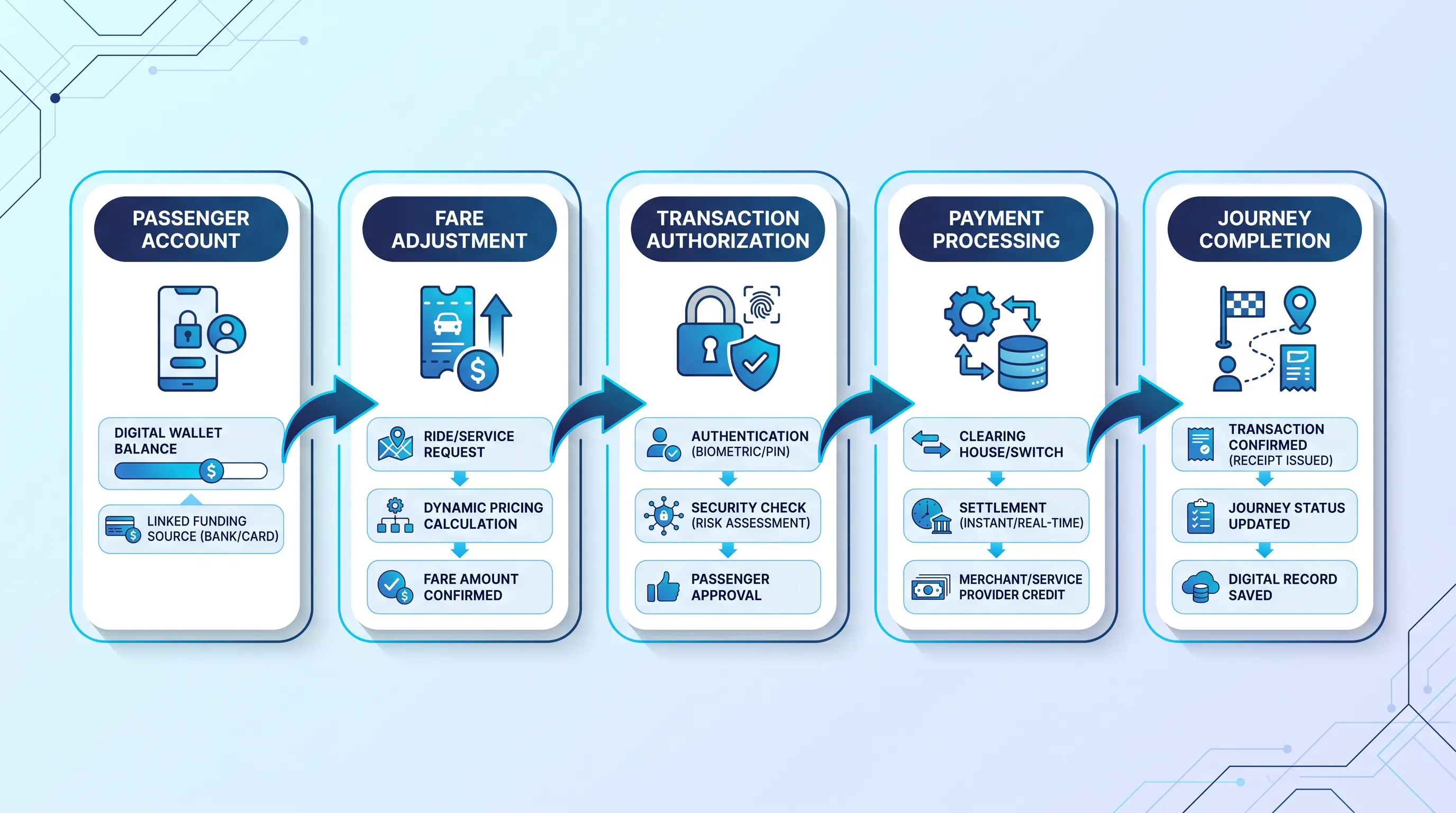
Infographic illustrating the passenger journey in mobile money transactions, featuring a clean design with rounded cards and flow arrows.

Trace one trip end to end and the system boundaries become visible. A passenger funds an account through mobile money or cash handed to an agent. Value moves into a wallet. The passenger taps and travels. Some journeys add a transfer to a second operator before the trip completes, and a fare adjustment sometimes arrives hours later when the back office recalculates.

Every handoff in that sequence is a place where responsibility shifts. Mobile money matters here more than in most markets, because $1.4 trillion moved through mobile money wallets in sub-Saharan Africa during 2025, which was 66% of the global transaction value. Your top-up channel is already in the passenger's pocket.

Cash-loading agents carry the weight that apps don't. Olamide Afolabi, co-founder and CEO of Touch and Pay Technologies, which runs the Cowry card in Lagos, described the gap his company had to close: "Our Cowry card, which enables microtransactions between 10 cents and $10, bridges this gap." A fare of twenty cents can't ride on infrastructure designed for ten-dollar minimums. That constraint drives the automated fare collection design more than any throughput target.

Compare system architectures

Two architectures dominate, and the choice between them is mostly a choice about where intelligence lives. In a card-centric design, the card knows the balance. In account based ticketing, the back office knows everything and the card is just a pointer.

The World Bank's SSATP review of five African cities found that card-centric systems were largely the norm across Cape Town, Kigali, and Lagos, while Maputo's planned automated fare collection system went account based and back office centric. The report's own conclusion was blunt about the trade: account-based designs handle complex fares at relatively low cost, but they depend on good connectivity and accurate linking of users to their accounts.

Test both against your own conditions. Test connectivity along the route and the fare complexity you'll want in year three. Confirm whether your existing agent network can distribute media at the volume you need, and whether your back office has anyone who can run a reconciliation at month end.

Start building your financial platform?

Speak with EGS engineers about open banking, payment infrastructure, cloud systems, and enterprise software.

Get in Touch →

Card-based fare collection system

The card carries stored value or an entitlement, and the validator deducts locally. That's why it works on a minibus climbing an unpaved road with no signal. Kigali's Tap&Go runs this way, and the Rwanda deployment is the strongest proof that offline-capable automated fare collection suits flat-fare, single-operator-zone networks.

The cost shows up as operations. You issue media and replace it when it breaks. You also secure the keys and synchronize every device so that yesterday's hotlist reaches today's bus. AC Mobility, formerly AC Group, reports 3 million Tap&Go cards issued and over 1,000 registered agents supporting them. That agent network is the product as much as the card is.

Fare flexibility is the other limit. Rwanda's regulator wanted distance-based fares and couldn't get there, because the stored-value model constrained what the system could calculate at the point of tap. If you're planning zonal pricing or caps, inventory that constraint now.

Account based ticketing

Here the fare is computed centrally, after the tap, from a journey record. The media is only a token, which means a closed-loop card or a bank card can point at the same account, and so can a QR code on a phone or a registered identifier. That's what makes multi-operator interoperability tractable without reissuing anything.

Account based ticketing earns its complexity on fare rules. Daily caps and transfer windows live in software you can change without touching a single device in the field, as do concession entitlements and post-trip corrections. Maputo's FAMBA system was structured as a 10-year public-private partnership with revenue centralized under the metropolitan transport agency, which is the institutional arrangement this architecture requires.

The dependencies are real and they're mostly invisible at tender stage. Backend payment infrastructure was cited more often than any other barrier to open-loop payments in a 2023 survey of US transit agencies. Identity mapping and settlement controls have to work before the first tap, as does a top-up route for passengers without bank accounts, because account based ticketing fails silently when the account layer is wrong.

Design for exceptions

Normal operation is the easy case. Spend most of your specification's pages on what happens when things break, because that's where revenue leaks and passengers get stranded. Write the expected behavior for each failure before a vendor writes it for you.

  • Connectivity loss. The validator accepts taps against a locally cached deny list and queues transactions. Define the maximum offline window and the cap on cumulative offline spend per token.

  • Delayed uploads. Journey records arriving six hours late still have to join the correct fare calculation. Specify how the back office reopens a settled day, and who signs off.

  • Repeated taps. A second tap within a defined window is a duplicate. Pick the window and make it configurable per mode.

  • Insufficient funds. Decide whether the passenger travels and owes, or is refused. Littlepay reports that a managed deny list keeps fare losses at 0.2%, which is the benchmark to hold a vendor to.

  • Incomplete journeys. A missing tap-off needs a default fare that doesn't punish the passenger for your device failure, plus a correction path when the record arrives late.

  • Device failure and refunds. Name the replacement time and the balance recovery method, plus who funds the refund.

Visa's acceptance specification requires the contactless card read under 500 milliseconds, and your exception logic has to run inside that budget. Anything that needs a round trip to the back office before the gate opens will miss it. That's the single hardest constraint in automated fare collection engineering, and it's why offline decision rules exist at all.

Allocate revenue transparently

Shared journeys are where multi-operator schemes break politically. One operator carries the first leg and another carries the transfer. A daily cap means the second leg earned nothing extra, and now two companies disagree about a number neither can audit. Account based ticketing makes the calculation possible. Apportionment rules have to be configurable and published to participants.

Concessions need a funding source named in the rules, because a discounted student fare is a subsidy someone pays. Incomplete records need a default allocation rather than a dispute queue that grows forever.

Settlement timing drives operator cash flow and therefore buy-in. Patrick Buchana, co-founder of AC Group, explained what the Kigali operators were actually trying to fix: "I found out that bus companies were losing a big portion of their revenue to cash handling. This was mainly revenue lost due to leakage between the driver and the conductor who collected the money." Daily settlement replaced daily cash, and that's the trade operators accepted. Build the audit trail so any participant can reconstruct a single journey's split, because automated fare collection without that capability becomes a trust problem the technology can't solve.

Start building your financial platform?

Speak with EGS engineers about open banking, payment infrastructure, cloud systems, and enterprise software.

Get in Touch →

Learn from African deployments

Five cities have enough public record to be useful. Read them for mechanism.

Kigali shows what institutional alignment buys. City buses were losing up to 40 percent of revenue to cash handling and fraud before Tap&Go, and the rollout went operator by operator rather than citywide overnight. The BBC reported in 2016 that more than 60,000 people had signed up while the third operator was still being fitted.

Nairobi shows the opposite. BebaPay, built by Google with Equity Bank, reached over 700,000 active users and shut down in March 2015. The post-mortems agree on why: matatu crews were never consulted and the cash ban that was supposed to force adoption never arrived. They add that drivers who relied on daily cash income were handed a monthly budgeting problem nobody had explained to them. Mondato's comparison of the two markets put the difference plainly, as Rwanda consulted all relevant parties while Kenya threatened operators from the top down.

Lagos shows that media competition kills adoption. Before Cowry, LagosConnect accounted for less than 15 percent of trips and the EMV-based FarePay fell below one percent. Cowry worked because it was mandatory on a line from day one and the card sells for ₦500 at BRT terminals. Touch and Pay reported 500,000 trip payments daily across 3.8 million users by March 2024. Cape Town's myconnect card, by contrast, carried a low-value bank payment capability that passengers barely touched, even as the fare collection system itself processed 3.5 million taps per month. Maputo's lesson is still being written, but its roughly 4,500 chapas on 130 routes mean paratransit is the scheme.

Build the requirements matrix

Turn all of that into a table before anyone writes a specification. Each row gets an owner and a measure you can test on acceptance day, because a requirement nobody owns is a requirement nobody delivers.

  1. Modes and operators. Every mode in scope and every participating company, with the contractual basis for each. Owner: the transport authority. Measure: a signed participation schedule.

  2. Fare rules. Current structure plus the one you want in year three. Owner: the regulator. Measure: every rule expressed as configuration.

  3. Payment channels. Mobile money and bank transfer, with agent cash and card as additional channels. Owner: the payment partner. Measure: a successful top-up on each channel within thirty seconds.

  4. Passenger segments. Concessions and unbanked passengers, along with visitors. Owner: the authority. Measure: each segment completes a full journey in user testing.

  5. Connectivity and throughput. Measured coverage along actual routes and peak boardings per door per minute. Owner: the integrator. Measure: field survey results.

  6. Integrations and security. Operator back offices and the national switch, along with key management. Owner: the integrator. Measure: certified interfaces and a passed penetration test.

  7. Data ownership and reporting. Who holds the journey records and who can query them. Owner: the authority's legal team. Measure: a written data agreement before go-live.

  8. Settlement and support. Payment timing per operator, plus staffed hours for disputes. Owner: the clearing party. Measure: a reconciled test settlement cycle.

Keep the matrix as the control document through delivery. If account based ticketing is your direction, rows five and seven will decide whether it survives contact with the network. A thorough automated fare collection matrix is also the cheapest defense you have against scope disputes later.

Define the pilot

Pilot one corridor with real passengers and real money, and set acceptance criteria you can fail. A pilot that can't fail tells you nothing about the automated fare collection system you're about to buy citywide.

  • Fare accuracy checked against a manual calculation on a sample of journeys, with zero unexplained variances.

  • Tap performance inside the 500 millisecond read budget at peak boarding load.

  • Offline recovery tested by cutting connectivity for the longest gap your route survey found.

  • Duplicate taps and incomplete journeys resolved by rule, with the resulting fares reviewed line by line.

  • Top-ups confirmed on every channel, which covers an agent who takes cash during an outage.

  • Reconciliation closed daily and operator allocation accepted in writing by each participant.

  • Accessibility verified with passengers who don't own smartphones.

  • Support workflows run end to end, from a passenger complaint to a credited refund.

  • Monitoring dashboards live, with a tested rollback to the previous payment method.

Only then does scale become a question of volume. If any criterion fails, fix the architecture during the pilot, because automated fare collection defects multiply with every vehicle you add.

Scope delivery with EGS

Energize Global Services (EGS) has built banking and wallet infrastructure since 2007 for over 1,000 banks and payment providers, with delivery teams across Europe and Africa. Those teams also operate in the Middle East and in Senegal, with coverage in Zimbabwe and Ethiopia. Automated fare collection schemes are payment systems with transit rules on top, which is the part most hardware-led tenders underestimate.

A discovery engagement comes before implementation scope. We map payment flows across your channels and draw the system boundaries between operators and the back office. We assign back-office responsibilities to named owners and sequence the rollout into phases you can actually fund, which surfaces the dependencies that will delay you. The output is a specification you can tender against.

Discuss your rollout

Discuss your fare-collection rollout with EGS from payment architecture to operational readiness. Tell us which modes you run and what fare system exists today, then which operators are participating and what you need the rollout to achieve. Book a call with our team and we'll work through the architecture decisions with you before procurement locks them in, so your automated fare collection program scales on the terms you set.

Start building your financial platform?

Speak with EGS engineers about open banking, payment infrastructure, cloud systems, and enterprise software.

Get in Touch →

Measure route-level connectivity, fare complexity, agent coverage, device throughput, and reconciliation capacity before selecting the model. A card-centric design suits routes that regularly lose coverage, while account-based ticketing suits changing fares and multiple operators. Record the evidence in a decision matrix so procurement requirements follow operating conditions.

Set offline rules before deployment. Validators should use a current deny list, queue transactions, and enforce a defined offline period plus a cumulative spending limit. The back office also needs rules for late uploads, duplicate taps, and incomplete journeys, with passenger refunds available when a device or network failure causes an incorrect charge.

A transport authority or appointed clearing entity should define account ownership, access rights, and settlement responsibilities. The agreement should state who handles identity records, disputes, refunds, and operator reporting. This prevents one operator from controlling information needed to calculate transfers or audit a shared journey.

Approve expansion only after the pilot meets written acceptance criteria with real passengers and real funds. Confirm fare accuracy, offline recovery, top-ups, settlement, support, accessibility, and rollback performance. Each participating operator should accept the reconciliation results in writing, and unresolved exceptions should block expansion until their cause and owner are documented.

Yes. EGS can map payment flows, assign boundaries between operators and the back office, and turn those findings into a specification for procurement. A call with EGS can clarify the existing fare system, participating modes, and rollout goals before implementation scope is fixed.

Schedule a Meeting

Book a time that works best for you

You Might Also Like

Discover more insights and articles

A project manager in business casual attire discusses a document intake process with a team in a modern office, focusing on a large monitor.

Bank document intake workflow: A readiness checklist

This article gives you a checkpoint-by-checkpoint method for testing a document intake process before you turn it on. It includes a worksheet structure you can copy into a spreadsheet and the evidence each control needs to produce.

Two business partners collaborate on configuring a POS terminal in a modern office, surrounded by payment devices and colleagues.

EthioPay for Ethiopian Banks: Turn Readiness into a Delivery Plan

This article explains how an Ethiopian bank moves from "we want to participate" to a dated, costed integration plan for the country's domestic card scheme and instant payment rails. It covers service selection and a phased release sequence.

A modern smartphone displaying a mobile banking app lies on a wooden desk, surrounded by abstract payment cards and a notebook.

AfriGO Card Readiness: Plan Your Nigerian Bank’s Rollout

This article is a readiness guide for moving from "we're considering it" to a controlled pilot on Nigeria's domestic card rails. It covers role definition and launch scope, then maps the transaction flow so you can assess systems and assign requirement ownership through the workstream matrix that holds the whole program together.

A professional seated at a desk uses a smartphone and payment card, engaged in online banking in a bright, modern office.

G2P Payments in Africa: Build Reliable Social Payment Infrastructure

This article traces the full lifecycle of a government social payment in Africa, from eligibility approval through to reconciliation and investigation evidence. It assigns operational ownership at each system boundary and sets out how to control exceptions and assisted access.