How Ghanaian Acquirers Can Enable gh-link Card Acceptance on Existing POS

Content authorBy EGSPublished onReading time9 min read
A modern smartphone displaying a mobile banking app lies on a wooden tabletop, surrounded by casually arranged payment cards.

Most existing POS estates in Ghana can accept gh-link cards, but only after a terminal-by-terminal audit of kernels and application identifiers, followed by GhIPSS onboarding and end-to-end certification. EMV capability alone proves nothing. The work sits in configuration and testing rather than in replacing hardware wholesale.

gh-link adds a distinct domestic flow

gh-link is a separate card scheme with its own acceptance rules. GhIPSS runs it as both a domestic EMV card scheme and the national switch that links banks and POS devices, and the transactions clear inside Ghana rather than through an offshore network. That domestic routing is the whole point of the scheme.

Keep it separate in your head from the other GhIPSS rails. GhQR and mobile money interoperability each have their own message flows and none of them tells you anything useful about card acceptance readiness.

Volumes are still modest. Bank of Ghana's statistical bulletin records 85,381 gh-link transactions worth GH¢74.32 million in 2024. That's small enough that no business case survives a hardware refresh, which is exactly why the enablement question has to be answered through configuration and certification work on terminals you already own.

What must the estate support?

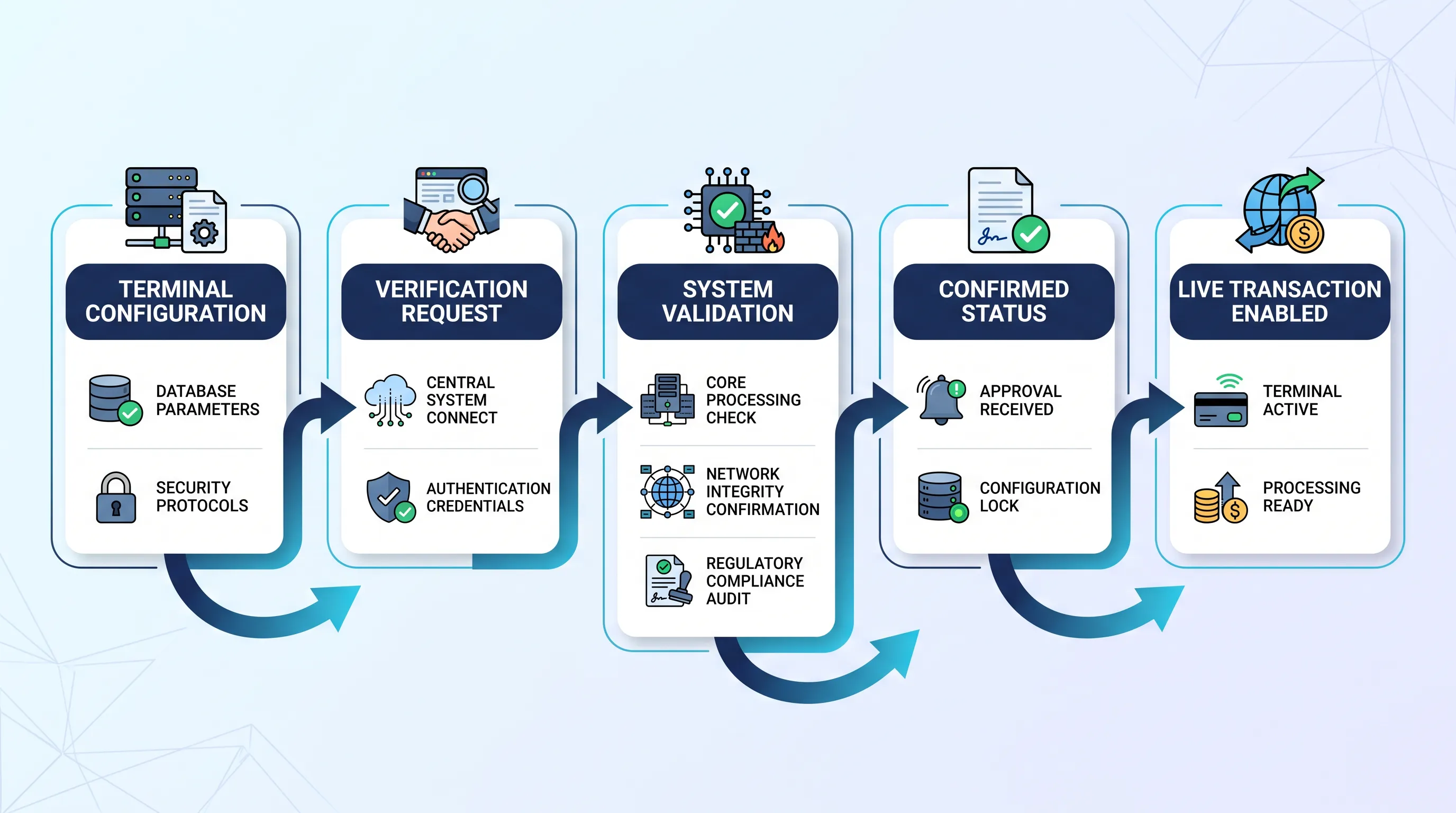
Flowchart detailing the verification process of terminal configurations in a financial transaction system, featuring rounded cards and curved arrows.

Build a compatibility matrix before you touch a single terminal, because the estate is never as uniform as the asset register suggests. Every row should be one terminal model plus one software build, and every column a capability that gh-link acceptance depends on. Mark each cell supported or unconfirmed, and treat the unconfirmed cells as the real project.

The columns worth tracking:

  • Hardware model, approval class, and contact plus contactless interfaces

  • EMV kernel versions and the payment application build running on each

  • Host protocol and message format between terminal and acquirer switch

  • Key management and security components, including remote key loading

  • Existing international scheme configurations the terminal already carries

Bank of Ghana counted 18,117 POS terminals deployed at end-December 2025, up 16.2 percent in a year. An estate growing that fast accumulates mixed firmware generations, so a matrix built from procurement records rather than from live device telemetry will mislead you on roughly the newest cohort first.

Which terminal capabilities need verification?

Verify capability on the device. Pull the live inventory and confirm hardware approval status and whether the vendor still issues signed software for that model.

Lifecycle status decides more than anything else. The PCI Security Standards Council extended the expiry for PIN Transaction Security Point of Interaction (PTS POI) version 5 devices to 30 April 2027, a one-year extension granted because of supply and deployment constraints.

Read that date against your own rollout calendar. If a terminal cohort reaches approval expiry inside the window you'd spend certifying gh-link on it, the honest answer is replacement rather than enablement, and finding that out during the audit costs far less than finding it out during certification.

Start building your financial platform?

Speak with EGS engineers about open banking, payment infrastructure, cloud systems, and enterprise software.

Get in Touch →

Which scheme parameters must change?

The parameter work centers on making the terminal recognize and prioritize the gh-link application correctly alongside the cards it already accepts. That means the application identifier list and selection priority.

Application selection is where configuration errors surface first. Visa's acquirer implementation guide notes that the List of AIDs method is mandatory for application selection, with directory selection optional, and the candidate list logic governs which kernel runs.

Add a domestic AID to a terminal that already carries international ones and you change the candidate list for every card, which includes cards that worked yesterday. The specific values and action codes are restricted to participants, so get them from GhIPSS in writing and version them like code.

Which processing components need changes?

Terminal changes are the visible part of a much longer chain. Each component downstream needs its own change record: the payment application and the payment switch.

GhIPSS has done this kind of integration work before. Famoco built an EMV Level 3 application for gh-link on Android terminals that also handle e-zwich biometric cards and QR on one device.

What that tells you is useful in reverse. A single device supporting multiple domestic schemes means your estate management platform has to version and target configurations per scheme per model, and if it can't do targeted rollout today, that gap blocks the pilot long before certification does.

How should a gh-link purchase flow?

Walk one transaction end to end before you write a test plan, because the flow exposes every handoff you own. A card is inserted or tapped at a Ghanaian merchant, and the terminal selects the gh-link application and determines the cardholder verification method.

PIN is the anchor of that flow. GTBank Ghana describes gh-link cards as chip-based with encrypted cardholder data, where a transaction can only be authorized with the correct PIN.

The PIN block then travels through your HSM services to the acquiring host, which routes to GhIPSS rather than to an international network, and the issuer response comes back for display and receipt printing. Because authorization depends on online PIN verification, your key management and HSM availability become acceptance availability. A terminal with a stale key simply stops accepting the card.

Exceptions must remain traceable

Design the exception path so operations can follow a single transaction across terminal and host using identifiers that don't change. Declines and host timeouts become support tickets, and each one gets resolved by matching records that were written in three different systems.

Two ISO 8583 fields carry that burden. The system trace audit number is generated per request and echoed in the response, while Worldpay's message specification states that a reversal should carry the same RRN, the 12-character retrieval reference number created at the POS device.

The practical consequence is that your logging design decides your dispute resolution time. If the terminal log and host log don't both store the retrieval reference number in a searchable field, every timeout investigation turns into a manual reconciliation job, and timeouts are the exception class that grows fastest once volumes rise.

Start building your financial platform?

Speak with EGS engineers about open banking, payment infrastructure, cloud systems, and enterprise software.

Get in Touch →

Security spans the complete payment path

Security scope for gh-link covers the same path as any card transaction, from the approved payment device through to the settlement record. Approved hardware and PIN security apply whether the card is domestic or international.

Separate the baseline from the scheme rules. The baseline moved recently, because 51 future-dated requirements in PCI DSS v4.x became mandatory on 31 March 2025 and include stronger authentication and automated log review.

Those controls are assessed against your whole cardholder data environment, which now includes the new gh-link routing path and any test environment holding real keys. Adding a scheme after a passing assessment quietly extends that scope, so the assessment you cite in 2027 needs to have covered the environment as it looks after enablement.

How should acquirers test acceptance?

Test to GhIPSS requirements. The sequence runs through formal certification of each terminal and software combination, and only then a controlled pilot in live merchant conditions.

Certification exists precisely because specification compliance doesn't predict real behavior. The U.S. Payments Forum describes acquirer terminal end-to-end certification as verifying that deployed terminals send and receive authorization messages correctly between terminal and acquirer host system, with host certification completed first as a prerequisite.

Note the ordering. Host certification precedes terminal certification in every scheme program that publishes one, which means a project plan that runs terminal configuration and host message mapping as parallel tracks will stall at the handover point. Sequence the host work first and the terminal cohorts behind it.

What must functional testing prove?

Functional testing has to prove that every approved terminal and software combination behaves correctly for every supported transaction type. Cover purchases and application selection.

Application selection deserves disproportionate attention. EazyPay Tech identifies duplicate candidate list entries as a frequent EMV Level 3 certification failure because multiple terminal configuration entries share the same registered application provider identifier.

Since adding a domestic AID to terminals that already carry international ones creates exactly that condition, treat candidate list construction as a dedicated test case per card type rather than as something the purchase test covers incidentally.

What belongs in regression testing?

Regression testing protects the acceptance you already have, which is the larger revenue stream and the one nobody thanks you for preserving. Retest international card purchases on both contact and contactless paths.

Firmware versions complicate the retest scope. Under the PCI PTS program guide, POI v6 firmware expires every third year on 31 December, independently of the device approval date.

So a terminal cohort can pass gh-link certification on a firmware build that reaches its own expiry mid-pilot. Pin the exact firmware version into every regression result you record, because a result that names only the model tells you nothing once the vendor ships an update.

What should the pilot measure?

A pilot measures whether the change holds up in conditions you didn't simulate, so pick merchants whose transaction mix and connectivity reflect the wider estate rather than your easiest sites. Define the cohort and the success thresholds.

Scale matters when you choose sites. Bank of Ghana reported 80 POS devices per 100,000 adults in 2025, up from 71 in 2024, with coverage described as low.

Thin coverage means an individual merchant carries more local traffic than density figures suggest, and a failed terminal has no neighbor to absorb the volume. Build your rollback criteria around merchant-level acceptance rate rather than estate-wide averages, because the average will stay healthy while a single site fails completely.

EGS can scope the acceptance journey

The next step is a structured assessment of what your estate and processing environment actually support, mapped against what GhIPSS requires. EGS works at that level, as a fintech and technology partner founded in 2007 with around 500 staff and delivery centers across Europe and Africa. The company builds payment infrastructure and POS software for banks and payment providers.

An engagement covers the terminal inventory and the configuration changes gh-link acceptance requires. EGS does not supply a pre-certified gh-link connector, and no vendor honestly can, because certification attaches to your specific terminal and host combination.

Bring your terminal inventory and your current host specification to a scoping conversation with EGS, and you'll leave with the change list and the dependency order.

Start building your financial platform?

Speak with EGS engineers about open banking, payment infrastructure, cloud systems, and enterprise software.

Get in Touch →

No. Remote enablement works only when the terminal has compatible approval, software, key-loading support, and a controlled configuration process. Unsupported cohorts need replacement or local servicing. Group devices by exact model and software build, then deploy the approved package to a pilot cohort before expanding the rollout.

Retain the terminal model, software and firmware versions, configuration package, host message mapping, test results, approval records, key-loading evidence, and pilot outcomes. Link each record to a terminal cohort and date. This gives operations and auditors a clear record of what was certified and what was deployed.

Merchants should confirm that the terminal displays the correct application and accepts the required PIN entry. Staff should know how to handle inserted and tapped cards, declines, and timeouts without repeating a transaction blindly. Keep the receipt and its transaction identifiers when escalating a problem to the acquirer.

They should be identifiable in reconciliation, even if funds use an existing acquirer account. Include the scheme indicator, transaction identifiers, amount, response, and reversal status in the report. Confirm the exact settlement fields and timing with GhIPSS and the acquiring host before finalizing the reconciliation design.

Replace a terminal when its approval or firmware expires before rollout, the vendor no longer provides signed software, or the device lacks a required interface, kernel, or key-management function. Base the decision on a documented capability gap and the rollout schedule, rather than the terminal’s age alone.

Schedule a Meeting

Book a time that works best for you

You Might Also Like

Discover more insights and articles

A project manager in business casual attire discusses a document intake process with a team in a modern office, focusing on a large monitor.

Bank document intake workflow: A readiness checklist

This article gives you a checkpoint-by-checkpoint method for testing a document intake process before you turn it on. It includes a worksheet structure you can copy into a spreadsheet and the evidence each control needs to produce.

Two business partners collaborate on configuring a POS terminal in a modern office, surrounded by payment devices and colleagues.

EthioPay for Ethiopian Banks: Turn Readiness into a Delivery Plan

This article explains how an Ethiopian bank moves from "we want to participate" to a dated, costed integration plan for the country's domestic card scheme and instant payment rails. It covers service selection and a phased release sequence.

A modern smartphone displaying a mobile banking app lies on a wooden desk, surrounded by abstract payment cards and a notebook.

AfriGO Card Readiness: Plan Your Nigerian Bank’s Rollout

This article is a readiness guide for moving from "we're considering it" to a controlled pilot on Nigeria's domestic card rails. It covers role definition and launch scope, then maps the transaction flow so you can assess systems and assign requirement ownership through the workstream matrix that holds the whole program together.

A professional seated at a desk uses a smartphone and payment card, engaged in online banking in a bright, modern office.

G2P Payments in Africa: Build Reliable Social Payment Infrastructure

This article traces the full lifecycle of a government social payment in Africa, from eligibility approval through to reconciliation and investigation evidence. It assigns operational ownership at each system boundary and sets out how to control exceptions and assisted access.