How does an HSM integrate with payment systems?
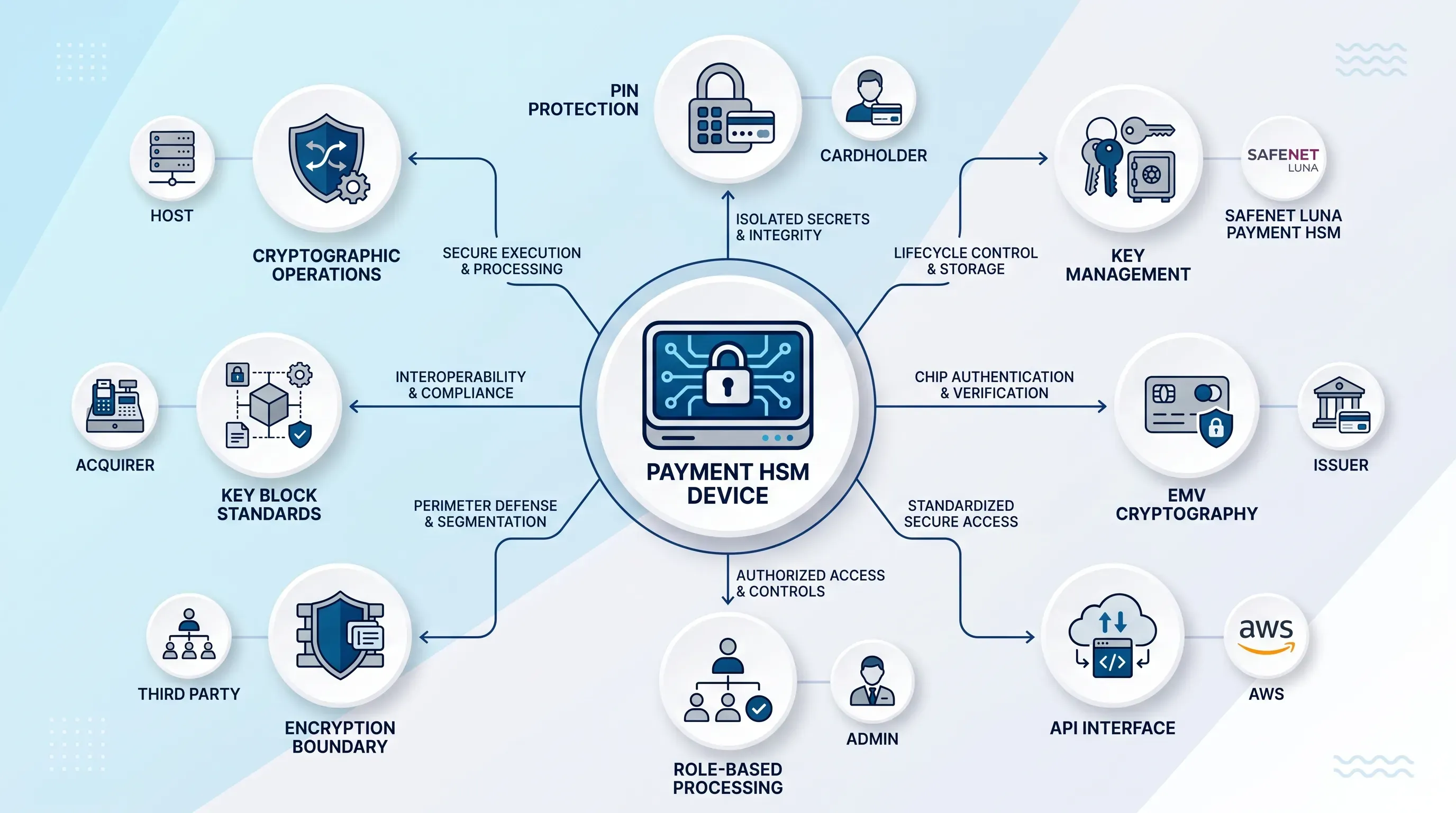
The HSM connects to the payment stack as a shared cryptographic service for switches and authorization engines. Card issuing systems also call it through payment-specific commands. The host uses a connection to send commands and read responses, and the module never initiates work on its own.
A Thales presentation frames the model exactly: the HSM attaches to a host as a peripheral using a command and response API, where the host asks for a function and the module returns a confirmation with results or an error code. In practice you rarely code against raw host commands. Integration libraries like Prime Factors' BCSS wrap more than 100 functions so applications can call payment cryptography without learning the proprietary machine-level command language.
That has a design implication for your architecture. Because one HSM cluster serves many callers, you treat it as a central service with defined interfaces. Connection pooling and command routing become part of your integration work, as does access control.
What compliance rules require an HSM?
PCI DSS and PCI PIN require HSM-grade protection for PIN processing and EMV key management, and payment HSMs are validated against the PCI PTS HSM and FIPS 140 standards. You cannot meet these obligations with software key handling.
The MYHSM strategy team is direct about it: if you use an HSM for payments you must conform to PCI standards, and PIN and P2PE rules require certified payment HSMs, with the accepted certifications being PCI PTS HSM and FIPS 140-2. The two standards cover different ground. FIPS validates the cryptographic module, while PCI PTS adds requirements for device manufacturing and management that FIPS does not touch.
That gap is the detail that trips audits. A device can hold a valid FIPS certificate yet fall outside its PCI approval if the installed firmware version is not on the approved list, so tying a compliance obligation to an HSM means checking the exact software version in production.
What does running an HSM in production require?
Running HSMs in production requires high-availability pairs with tested failover and headroom for peak volume. It also requires key management discipline through dual control and split knowledge. Certification gets you a compliant box. Operations keep it live under load. Start with capacity and resilience. A Thales payShield 10K handles up to 10,000 commands per second, but an undersized cluster still creates bottlenecks at peak authorization periods, which is why production setups run at least HA pairs so a second unit keeps processing when one fails.
The operational disciplines that surround the keys matter as much as the hardware:
-
Dual control, so no single operator can perform a sensitive key function alone
-
Split knowledge, so no one person holds a full key component
-
Auditable key ceremonies with witnesses and records whenever master keys are created or loaded
Here is the cost most sizing exercises understate. Because every PIN and cryptogram operation is a synchronous HSM call, the module sits on the transaction's critical path, so its latency and capacity headroom directly cap your authorization throughput, and clustering for uptime is a throughput decision as much as a resilience one.
When should you bring in an HSM partner?
Bring in an HSM partner when compliance work intersects with switch and issuing architecture, where latency makes mistakes expensive and hard to unwind. Getting the key ceremonies and the command routing right together is a different job from standing up either one. The same is true of failover.
Energize Global Services (EGS) is a fintech engineering firm that develops HSM and payment switching solutions and integrates HSMs with core banking and issuing systems. Its work is delivered under PCI DSS and ISO 27001 compliance, with teams that build card processing software and end-to-end payment infrastructure across ISO 8583 and EMV.
That scope is what makes a single accountable partner useful at these boundaries. When authorization and key management land on the same integration, having one team own the seams between them is how you close a compliance gap before discovering it in an audit. If you are weighing an architecture decision or facing a compliance gap right now, that is the conversation to start.