How Instant Payments Work Across Different Countries

Content authorBy EGSPublished onReading time13 min read
A modern tabletop workspace featuring a reflective smartphone with a payment notification, abstract bank cards, and miniature bank models.

Instant payments move money account-to-account in seconds, 24/7/365, with immediate confirmation and funds the recipient can spend right away. The mechanics are similar everywhere and run from initiation through settlement. What changes by country is the operator and the settlement model.

What makes a payment instant?

A payment is instant when the transfer is completed account-to-account within seconds on any calendar day, and the beneficiary gets confirmation with spendable funds immediately. Availability is the part most people underestimate. Batch systems close at night and on holidays, while an instant rail never closes, which means your infrastructure never closes either.

Finality is the other half of the definition. Once the beneficiary's provider accepts the payment and credits the account, the money is gone from the payer's side and cannot be pulled back unilaterally. The European Payments Council built SEPA Instant Credit Transfer around a 10-second target, with a 20-second timeout if the beneficiary provider doesn't answer.

Recall procedures do exist, but they function as requests. Under the EPC rulebook, a bank-initiated recall must go out within 10 banking business days and the beneficiary bank has 15 to respond. So your refund flow can't be a cancellation. It has to be a new outbound payment, and that changes how you design dispute handling from day one.

Every instant payment follows five steps

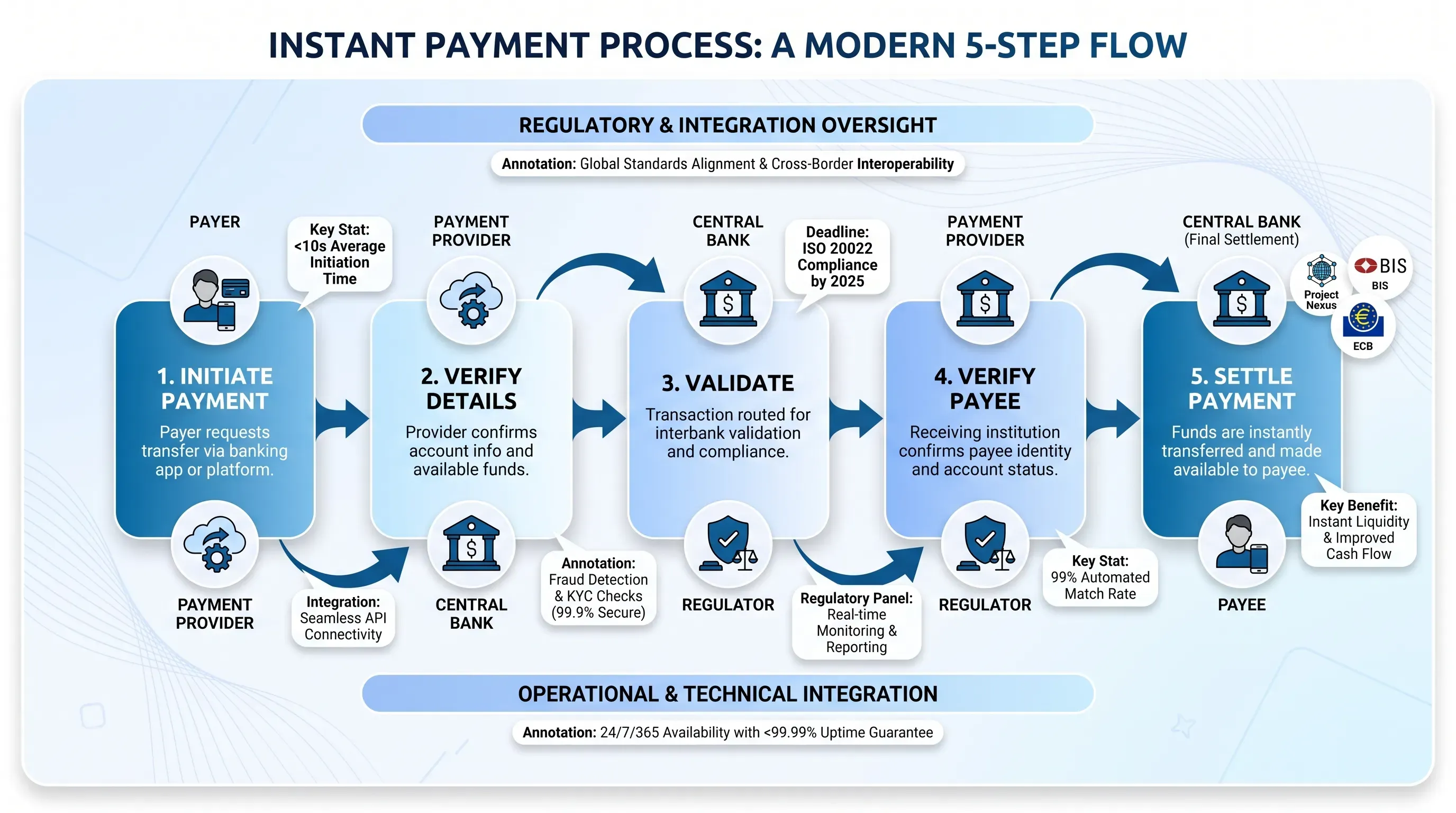
Modern infographic illustrating a five-step instant payment process with rounded panels, minimalist icons, and a light blue gradient background.

Underneath every national rail sits the same five-step sequence that runs from initiation to confirmation. Learn it once and you can read any scheme's specification faster, because the differences show up as variations on these steps.

The reason this matters commercially is that Project Nexus, the Bank for International Settlements initiative now handed over to Nexus Global Payments, built its entire model on this assumption. Its premise is that instant payment systems in over 70 countries share enough structural similarity that one connection to a central platform can reach all of them, instead of a custom bilateral build per corridor.

That's a useful signal for how you scope your own work. If central banks are betting that domestic rails are similar enough to be abstracted behind a single interface, then the parts of your stack that differ per country are narrower than a vendor pitch suggests. Most of your integration cost sits in messaging and identifiers.

The payer initiates the transfer

Initiation is where the app or channel captures the payment details and assembles the scheme's payment message. In modern rails that message is ISO 20022 pacs.008, generated after the customer confirms rather than before.

One step now sits between confirmation and initiation across the euro area. Since 9 October 2025, Verification of Payee has been mandatory for eurozone providers under the Instant Payments Regulation, and it must be free to the payer. Providers outside the euro area have until 9 July 2027.

Verification of Payee returns match, no match, close match, or other, and the payer decides what to do with that. Which means your initiation screen now has to handle an ambiguous answer gracefully, in real time, without pushing the customer into abandoning a legitimate payment. That's a user experience problem disguised as a compliance requirement.

Participants validate and clear it

Validation is where the sending institution verifies the payment before the scheme accepts it and calculates each participant's obligation. All of it happens inside a few seconds.

The compliance shape of this step changed in Europe. Article 5d of the amended regulation requires eurozone providers to screen their entire active user base daily against EU restrictive measures lists and explicitly prohibits transaction-by-transaction sanctions screening for in-scope payments.

That inversion is worth sitting with. The EU decided that a payment stopping mid-flight for a false positive damages the system more than screening at the customer level, so it moved the control off the payment path entirely. If you're building for both Europe and a market that still screens per transaction, you can't share one screening service across both. You need two, with different data models and different failure behavior.

Start building your financial platform?

Speak with EGS engineers about open banking, payment infrastructure, cloud systems, and enterprise software.

Get in Touch

Settlement makes the transfer final

Settlement is the moment participant balances actually move, either across accounts at the central bank or across designated settlement accounts, after which confirmation returns to both sides and the funds are usable. Customer credit and interbank settlement are separate events, and the gap between them is where risk lives.

The European Central Bank's TARGET Instant Payment Settlement service settles in central bank money at the transaction level. Its 2025 annual report shows participants held so much liquidity in TIPS Dedicated Cash Accounts relative to daily payment values that prefunding balances hit a maximum of €32.7 billion in December, roughly 1.3% of excess liquidity.

Banks are over-funding, in other words, because the cost of idle central bank money is smaller than the cost of a failed weekend payment. The ECB read the same signal and is responding: from June 2026, overnight TIPS balances above minimum reserve requirements earn remuneration, and floor and ceiling automation arrives on those accounts.

How do major systems differ?

The four rails diverge on eight things including the operator and the settlement model. Nothing else in your integration plan matters as much as getting these eight straight per market. Volume tells you where the engineering pressure sits. India's Unified Payments Interface (UPI) processed 21.63 billion transactions in December 2025, against 5.09 billion Faster Payments transactions across the whole of 2024 in the UK. One market runs a day's UK volume roughly every eight hours.

Two implications follow. First, a design that works comfortably at UK volumes will fall over in India, so throughput assumptions have to be set per market rather than globally. Second, the average ticket size moves inversely to volume, and that changes your fraud model completely.

Here's what to pin down before writing any code:

  • The operator, its rulebook, and whether it publishes a certification path for non-banks

  • The settlement model and whether prefunding is required outside business hours

  • The identifier set: IBAN, sort code and account number, or an alias resolved through a directory

  • The current transaction limit, plus whether individual institutions can set lower ones

SEPA Instant standardizes euro transfers

SEPA Instant Credit Transfer (SCT Inst) moves euros between accounts across participating SEPA markets in seconds, with the rulebook setting the technical rules and the Instant Payments Regulation setting who has to offer it. Regulation matters more than the rulebook for planning purposes, because it removed the choice.

Under Regulation (EU) 2024/886, every in-scope provider had to be able to receive instant payments by 9 January 2025 and to send them by 9 October 2025, at a fee no higher than the equivalent standard SEPA transfer.

Price parity is the clause that reshapes business cases. Because you can't charge a premium for instant euro payments, the only way an investment in SCT Inst pays back is through volume shift or reduced operational cost. Clearing happens through TIPS or EBA Clearing's RT1, and those two settle differently, so the rail you pick determines your liquidity model even though the customer experience is identical.

Faster Payments connects UK accounts

The UK's Faster Payment System (FPS) moves sterling between participating institutions around the clock, operated by Pay.UK, with non-bank providers able to connect directly by holding a settlement account at the Bank of England. The customer sees seconds. Interbank settlement works on a slower clock.

FPS uses multilateral deferred net settlement across three clearing cycles each working day and settles across direct members' accounts in the Bank of England's real-time gross settlement system, where each member's net debit position is constrained by a Net Sender Cap. The scheme limit now sits at £1 million, though individual institutions set lower ones.

So a UK participant carries interbank exposure to other participants between cycles, and the cap, not the customer's balance, is what stops payments when the position runs hot. That's a liquidity control your treasury team has to monitor in real time, and it has no equivalent in a gross settlement rail.

UPI adds an interoperable interface

UPI is India's instant rail plus an interface layer: aliases instead of account numbers and published application programming interfaces (APIs). The National Payments Corporation of India (NPCI) operates it and each bank acts as remitter, beneficiary, or both.

Participation grew from 44 banks in FY 2016-17 to 703 banks by FY 2025-26. UPI accounted for 85% of India's digital payment volume in that year.

The open API model is also UPI's stress point. On 12 April 2025, an unexpected surge in "Check Transaction Status" API calls from PSP banks pushed success rates down to roughly 50% for two hours, which NPCI addressed by mandating a 90-second wait before status checks and capping banks at three calls within two hours. If you're integrating here, treat status polling as a rationed resource.

Start building your financial platform?

Speak with EGS engineers about open banking, payment infrastructure, cloud systems, and enterprise software.

Get in Touch

FedNow settles through Federal Reserve accounts

FedNow is a voluntary US instant payment service operated by the Federal Reserve that settles continuously and on a gross basis between accounts held by eligible participating depository institutions. Voluntary is the key word, and it separates FedNow from the European picture entirely.

The service now has more than 1,500 participating financial institutions, and its per-transaction network limit rose to $10 million in November 2025, the second increase that year. That aligns FedNow with The Clearing House's RTP network, the other US instant rail, which has offered the same ceiling since late 2024.

Two rails have similar limits, and a large share of FedNow participants still receive-only. Which means US reachability is a routing problem. You have to know, per counterparty institution, which network it's on and whether it can accept a send, and you need a fallback when the answer is no. Neither Europe nor India asks you to solve that.

Settlement models change liquidity needs

Real-time gross settlement moves value transaction by transaction with no netting, while deferred net settlement accumulates obligations and settles the net position at fixed cycles. The first consumes liquidity constantly and eliminates interbank credit exposure. The second conserves liquidity and creates exposure between cycles.

Prefunding is where the two models converge in practice. RT1, operated by EBA Clearing, settles on a deferred net basis with real-time capability, and participants manage liquidity through prefunded accounts at EBA Clearing rather than through direct central bank balances the way TIPS participants do.

The operational consequence lands on weekends. When the central bank RTGS system is closed, you can't top up, so your Friday evening forecast has to cover everything until Monday. That's why the ECB's plan to open a one-to-two hour weekend settlement window in T2 is more significant than it sounds. It converts a hard constraint into a manageable one and directly reduces how much collateral you have to park idle.

Why is cross-border instant payment harder?

Domestic instant payments don't cross borders because each rail is a closed loop denominated in one currency and governed by one rulebook. Add a second country and you've added currency conversion and sanctions screening on the payment.

The numbers show how stubborn this is. In the Financial Stability Board's 2025 progress report on the G20 roadmap, only 35.4% of cross-border payments arrived within one hour against a 2027 target of 75%, and person-to-person costs sat around 2.6% to send $1,000, unchanged since 2023.

ISO 20022 was supposed to fix the messaging half of this, and the Committee on Payments and Market Infrastructures has warned that incomplete or inconsistent implementation of its harmonized data model produces more fragmentation rather than less. Optional fields are the trap. Two rails can both claim ISO 20022 compliance and still fail straight-through processing between them, which is why your connector layer needs field-level mapping per scheme instead of one canonical message.

Instant finality increases operational risk

Instant finality removes the window you used to rely on for recovery, which magnifies every failure mode from authorized push payment (APP) fraud to liquidity shortfalls. Controls that ran overnight no longer protect anything, because the money left in four seconds.

The UK put a price on this. Since 7 October 2024, sending providers must reimburse customers for APP scam losses up to £85,000 on Faster Payments and CHAPS, with the cost split equally between sending and receiving providers and refunds due within five business days.

The 50/50 split is the part that changes engineering priorities. Your inbound controls now carry direct financial liability even when your own customer did nothing wrong, so mule account detection stops being a compliance nicety and becomes a line item. Pair that with the same regulation's power to delay a suspect payment by up to four business days, and you need an exception queue that can hold a payment without breaking the instant promise for everything else.

Multi-rail infrastructure needs a shared core

Build one orchestration core and keep every scheme-specific connector at the edge. Validation and routing belong in the shared layer. Only the rulebook-specific pieces sit in the connector, which is what lets you add a fifth market without rewriting the fourth.

The market has already converged on this shape. Form3 abstracts SEPA Instant and FPS behind one API, and the same analysis identifies event-driven design and idempotency as the properties without which real-time systems fail under load or under retries.

Idempotency deserves emphasis because it's the one that bites late. In a rail where a duplicate credit is final, a retry that isn't idempotent is a loss event. And since your connectors will retry, the guarantee has to live in the core where every rail inherits it. That single decision, made early, is cheaper than any reconciliation tooling you'd build to clean up afterward.

How can EGS support multi-rail integration?

EGS builds and integrates payment infrastructure for banks and fintechs working across more than one instant rail. The work covers API-first integration and ISO 20022 message handling.

The engineering problems described above are the ones our teams handle in delivery: orchestration cores that separate scheme connectors from shared validation and routing, and real-time liquidity monitoring that keeps working when the central bank RTGS system is closed. We work as an extension of your existing team.

If you're scoping a multi-rail build, the fastest way to get a useful answer is a conversation about your target rails and your timeline. Book a call with EGS and bring your architecture diagram. We'll tell you where the real integration cost sits.

Start building your financial platform?

Speak with EGS engineers about open banking, payment infrastructure, cloud systems, and enterprise software.

Get in Touch

A close match means the account name resembles the name you entered but doesn't match it exactly. Stop and verify the recipient's details through a contact method you already trust. If the difference can't be explained, don't send the payment. Verification of Payee warns about a mismatch, but it doesn't decide for you.

Your provider needs a different route or a non-instant fallback. It can check whether the recipient institution receives payments through RTP, then use that network if the account is reachable. If neither instant rail works, use an available ACH or wire option and tell the payer that settlement won't be immediate.

An idempotency key lets the payment platform recognize that a retry represents the same customer instruction. Store the key with the original outcome and return that outcome for repeat requests. Use one unique key per instruction. This prevents a timeout or network retry from creating a second final credit.

Add funds before your forecast shows that the settlement balance could fall below the amount needed for expected outgoing payments. Include expected weekend flows and the scheme's top-up hours in that forecast. A Friday balance may need to cover until the next settlement window, since an RTGS top-up isn't always available.

You usually can't cancel it once the recipient's provider has accepted it. Contact your bank or provider immediately and ask it to start the scheme's recall process. Give the payment reference, amount, date, and recipient details. A recall is a request to the receiving provider, so recovery depends on its response and the recipient's circumstances.

Schedule a Meeting

Book a time that works best for you

You Might Also Like

Discover more insights and articles

A payment systems engineer works at a multi-monitor workstation in a modern IT office, focused on a dashboard interface.

How Modern Payment Systems Scale to Handle Millions of Transactions

Modern payment platforms scale through horizontal scaling of stateless services behind load balancers. Microservices isolate authorization from ledger and settlement work, while multi-region deployment keeps processing close to customers. Queues absorb spikes and idempotency keys prevent double charges. Double-entry ledgers keep balances correct when infrastructure fails underneath them.

A modern workspace with a glowing smartphone, a card reader, server block, and switchboard, all softly lit on a wood grain surface.

Payment Gateway vs Processor vs Switch: What's the Difference?

A gateway captures and secures payment data at the point of entry. A processor carries authorization messages between the acquirer and the issuer, then handles clearing and settlement. A switch decides where each message goes. Three separate responsibilities, frequently sold together under one contract, which is where the confusion starts.

A modern banking operations center featuring a central dashboard with transaction flow stages, bank engineers monitoring the system.

How Financial Institutions Process Transactions in Real Time

A financial institution processes a transaction in real time through an always-available system that validates and posts it in seconds, with decision and confirmation built into the flow. An incoming request passes through synchronous APIs for immediate checks and asynchronous events for parallel work. Authorization and fraud screening finish inside the same tight, continuous window as ledger posting and customer notification.

A close-up of a hand inserting a payment card into a POS terminal, with a laptop nearby and soft daylight illuminating the scene.

What Happens Behind the Scenes of a Card Payment

A card payment runs in two separate acts. Authorization takes about two seconds and only reserves money: the terminal sends a message through the acquirer to the issuer, which replies approve or decline. Clearing then batches that sale and settlement moves the actual funds, so the merchant is paid one to three business days later.