What Enables Real-Time Bank Transfers in Modern Banking

Content authorBy EGSPublished onReading time12 min read
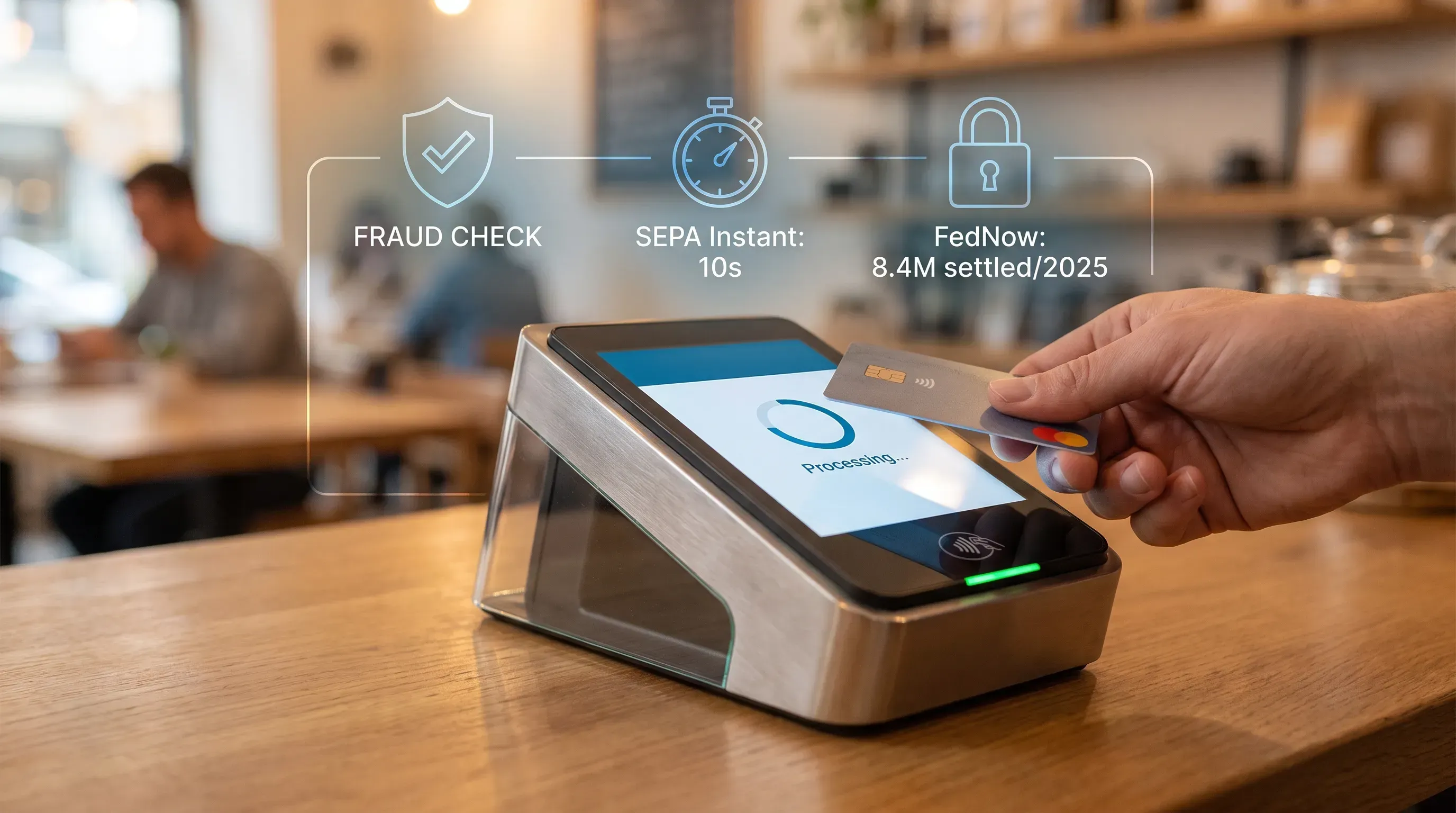
A modern payment terminal on a warm wood surface, capturing a contactless card tap in a softly blurred café setting.

Real-time bank transfers work when authorization and settlement run as one continuous flow instead of separate batch steps. That requires a payment switch and an always-on authorization engine. Scheme rules set the deadline.

What makes a transfer real time?

A transfer is real time when the payee's funds are available and the payer has confirmation within seconds, on any day, with no cutoff and no reversal window. The four steps a legacy bank treats as separate stages collapse into a single chain that either completes or rolls back. Nothing sits in a queue waiting for the next cycle.

The scheme rulebook is what makes this concrete rather than aspirational. Under the European Payments Council's rules, the maximum execution time of ten seconds starts at the time of receipt, and the 2025 rulebook splits it into a 5-7-9 second sub-timeline across the originator bank and the beneficiary bank.

Those sub-timelines change what you're designing. Five seconds for the originating side covers authorization and fraud screening together, which means your internal budget per component is measured in hundreds of milliseconds. Miss the window and the payer's account gets restored, so a slow system produces a failed payment.

Why do batch systems fall short?

Batch systems fail at real time because they're built around a clock that stops. Scheduled posting runs and overnight reconciliation assume there's a moment when nothing is moving. Instant payments remove that moment entirely, and every assumption downstream of it breaks.

The scale of the gap shows up in ordinary operations. Citizens Bank's AS/400 core, according to an analysis of technical debt in legacy platforms, processes 47 million accounts through overnight batch cycles that start at 10 p.m. and finish by 6 a.m. Fifth Third runs 14,000 separate nightly batch jobs with interdependencies documented on paper.

Eight hours of nightly unavailability is the part people notice. The harder problem is the 14,000 jobs, because each one is a dependency you have to understand before you can put a real-time path around the core. That's why the practical route for most banks is an always-on integration layer that holds real-time state and reconciles back to the core, rather than a core replacement first. You buy time without pretending the batch cycle disappeared.

Which systems process each transfer?

Four distinct components handle a single instant payment, and no single API or rail replaces them. The payment switch moves the message and the core moves the money on the ledger. Each has its own failure modes and its own latency budget.

Treating one of them as the whole solution is the most common architecture mistake. Banks plug a scheme connector into a core that still posts in batch and discover the bottleneck moved rather than disappeared. The evidence for how much traffic these components carry is in the volume growth: FedNow settled 8.4 million payments in 2025, up 460% from 2024, according to figures cited by the Federal Reserve Bank of Kansas City.

Volume that grows fourfold in a year means capacity assumptions from your original vendor assessment expire fast. Size each of the four components against where the scheme will be in eighteen months.

Payment switches route transactions

The switch is the component that decides where a message goes and answers within the deadline. It tracks the state of every in-flight transaction and returns a response before the scheme timer expires. It also owns the timeout logic, which is the part that determines whether a slow response becomes a rejection or a duplicate.

Duplicates are the specific danger. A payment switch has to generate a deterministic key from the transaction identifiers and return the identical response when the same message arrives twice, because two authorizations for one instruction charges the customer twice, as payment engineer Umut Akbulut describes it.

So the switch is where you enforce correctness. If idempotency lives further downstream in the core, every retry on a flaky network becomes a reconciliation break you find hours later.

Authorization engines approve payments

The authorization engine says yes or no before any money moves, and it does so against live data. Balance and account status get checked on the request path. There's no deferred check, because there's no later.

Sanctions is the check that regulation has pulled forward hardest. Under the EU Instant Payments Regulation, verification of payee became mandatory for euro-area providers from 9 October 2025, which adds a name-and-IBAN match to the flow before the payer authorizes.

That mandate has a design consequence worth naming. Verification of payee sits before authorization, not inside it, which means your ten-second budget now has a pre-flight call to another bank in front of it. Banks that bolted verification onto the authorization path found their p99 latency moved, and moving it back means caching and parallelizing checks that used to run in sequence.

Start building your financial platform?

Speak with EGS engineers about open banking, payment infrastructure, cloud systems, and enterprise software.

Get in Touch →

Core systems post funds immediately

The core ledger has to reserve and credit within the same transaction window, with no dependency on an end-of-day cycle. A reservation that isn't visible to the next incoming request lets a customer spend the same balance twice. A credit that only appears after the nightly run means the payee has confirmation of funds they can't touch.

The cost of leaving this unsolved is visible in where bank IT money goes. Backbase puts the figure at 78% of IT budgets spent maintaining legacy cores that update overnight rather than in real time.

Read that number as a constraint on your options rather than an argument for replacement. If more than three-quarters of the budget is already committed to keeping the current core running, a multi-year rip-and-replace competes with the same pool of money and people. The sequence that works is to move posting for instant payments onto a real-time ledger service first and reconcile continuously instead of nightly.

Liquidity layers ensure settlement

Settlement liquidity has to be available at 3 a.m. on a public holiday, which is a treasury problem before it's a technology one. Positions need monitoring continuously and prefunded accounts need topping up outside banking hours.

The Federal Reserve built a specific instrument for this gap. FedNow's liquidity management transfers are available from 7 p.m. to 7 a.m. on weekdays and 24 hours a day on weekends and holidays, with a $2.5 million per-transfer limit and a $10 million cumulative daily send limit.

Those limits are the planning input most treasury teams miss. A $10 million daily ceiling on weekend replenishment sets a hard boundary on how much net outflow your instant payments channel can sustain between Friday evening and Monday morning. Model your worst weekend against that ceiling, then set customer send limits from the answer rather than from your competitors' marketing.

Modern architecture removes processing delays

Event-driven services with durable messaging remove processing delays by decoupling components without losing the ordering and delivery guarantees a payment needs. Each service publishes what happened and the queue holds state if a downstream system stalls. The transaction keeps its position in sequence and its full audit trail.

The measured difference against batch is large. A Kafka and Flink pipeline tested against batch equivalents in the European Journal of Electrical Engineering and Computer Science held p99 latency below 200 milliseconds at 100,000 events per second, where the batch baseline needed 5 to 15 minutes.

The p99 figure matters more than the average, and this is where vendor conversations go wrong. Average latency of 80 milliseconds tells you nothing when the scheme rejects the slowest one percent of your traffic. Ask any prospective vendor for tail latency under sustained load with ordering guarantees intact, because a system that only hits its numbers with ordering disabled isn't a payment system.

Fraud controls must decide instantly

Irrevocable payments that settle in seconds leave no window for a human to intervene, so the fraud decision has to be automated and it has to be fast. Low-latency scoring and payee verification run inside the same authorization budget. Holds and rejections happen without a person in the loop.

The losses show what happens when speed outruns controls. UK Finance reported authorized push payment fraud losses of £576.4 million in 2025, up 19% on the year, across 248,070 cases, with 66% of cases starting online.

The case-versus-value split is the useful signal here. Cases rose 7% while losses rose 19%, which means the average loss per case grew, and that points at higher-value transfers rather than more victims. Since both RTP and FedNow raised their caps to $10 million, US banks should expect the same pattern and weight their scoring models toward transaction value rather than count.

Start building your financial platform?

Speak with EGS engineers about open banking, payment infrastructure, cloud systems, and enterprise software.

Get in Touch →

What performance must systems sustain?

Real time translates into measurable commitments: end-to-end completion inside the scheme deadline and continuous availability. Each is testable before you sign a vendor contract, and each has a number attached that you can put in a requirements document.

Get these written down early, because the alternative is discovering them during certification. RTP now averages 1.18 million payments each day across more than 1,000 participating institutions, according to The Clearing House, and processed $481 billion in the second quarter of 2025.

Daily averages hide the shape of the load. Weekend and overnight traffic is where instant payments differ from every other rail you run, so your capacity model needs an hourly profile rather than a daily total. Build the requirement around your busiest hour multiplied by a growth factor, and treat anything less as an untested assumption.

Processing must finish within seconds

End-to-end completion has to happen within ten seconds or less, which leaves each internal component a few hundred milliseconds at most. Subtract network hops and the clearing platform's own processing, and the time your own stack controls shrinks fast.

SEPA Instant makes the arithmetic explicit. The 2025 rulebook requires millisecond precision in transaction timestamps, ACI Worldwide notes, specifically so a payment that took 10.864 seconds can't be rounded down to a compliant ten.

Millisecond timestamps are a monitoring requirement disguised as a messaging change. If the scheme can prove you breached by 864 milliseconds, your own observability has to resolve at the same granularity or you can't defend a dispute. Instrument every internal hop with the same clock precision the rulebook demands of the message.

Services must run continuously

Continuous operation means 24 hours a day, every day of the year, with no maintenance window you can schedule. That covers redundancy across sites and staffed incident response at 4 a.m. on a Sunday.

Scheme documentation is blunt about this. Both FedNow and RTP operate 24/7/365 with irrevocable settlement, the Federal Reserve's Consumer Compliance Outlook notes, across 1,477 and 1,056 participating institutions respectively as of September 2025.

Two obligations follow that most banks underestimate:

  • Your third-party dependencies inherit the requirement. A core processor with a Sunday maintenance window makes your instant payments channel unavailable, regardless of what your own architecture supports, so the service-level agreement has to say so explicitly.

  • On-call has to include people who can authorize a liquidity transfer, not only engineers who can restart a service.

Capacity must absorb sudden peaks

Capacity planning for instant payments means designing for surges you can't predict, because there's no batch queue to absorb them. Horizontal scaling and backpressure that degrades gracefully instead of collapsing are the mechanisms that hold latency steady when volume jumps.

Brazil shows what an unconstrained peak looks like. Pix recorded nearly 280 million transactions in a single day in June 2025, and by the first quarter of 2026 monthly volume reached roughly R$3.4 trillion.

The growth curve is the point. Pix went from launch to national dominance in five years with no batch fallback anywhere in the chain, which means the architecture had to absorb every step of that curve without a redesign. Load test at five to ten times current peak, and make backpressure behavior an explicit acceptance criterion rather than something you discover under load.

Scheme connectivity requires more than APIs

Connecting to FedNow or RTP means certification and ISO 20022 message handling. An API contract is a small part of it. The scheme decides when you're allowed to go live.

Certification is a documented process with real work in it. Modern Treasury's account of its FedNow certification describes colocating hardware to bridge cloud infrastructure and running every required test case with dynamically generated, well-formed messages.

The colocation detail is worth pausing on. A cloud-native stack still needs on-premises hardware to reach the Federal Reserve, which means your target architecture includes a physical dependency with its own procurement lead time and its own failover design. Find that out during planning rather than during certification, because a data center contract doesn't compress to fit your launch date.

Which operational risks require controls?

Fraud and liquidity shortfall need specific controls. Each one needs a named mechanism rather than a policy statement, because irrevocability removes the option of fixing things after the fact.

The Federal Reserve's guidance frames this as a coordination problem, not only a technology one. Community Banking Connections advises that an instant payments strategy start with coordination among payment operations and treasury management, with third-party vendors assessed under SR letter 23-4.

The controls that address the technical half of that list:

  1. Idempotency keys on every money-moving operation, enforced at the switch rather than the core.

  2. Observability with millisecond timestamps on every internal hop, so a scheme dispute is answerable.

  3. Automated recovery and replay from durable queues, tested by deliberately failing components in production-like conditions.

  4. Immutable audit trails and contingency procedures you've rehearsed on a weekend.

The pattern across all four is that they only work if they're exercised. A recovery procedure nobody has run is an assumption.

How can EGS modernize your payment stack?

The next step is an honest assessment of which of the four components in your current stack can meet a ten-second deadline and which cannot. That answer determines whether you need an integration layer around the core or a new authorization path.

EGS is a banking and payment engineering partner. The work covers payment infrastructure and switch design plus core integration for real-time posting.

If your core still posts overnight and your instant payments deadline is set, the useful conversation is about sequencing rather than replacement. Book a call to walk through your current architecture and get a real-time readiness assessment against the specific scheme you're joining.

Start building your financial platform?

Speak with EGS engineers about open banking, payment infrastructure, cloud systems, and enterprise software.

Get in Touch →

Usually, you can't cancel a transfer after the receiving bank accepts and settles it. Contact your bank immediately if you sent funds to the wrong person, because it can request a return. A return follows the relevant scheme process and often requires the recipient's agreement when the error came from the payer.

The transfer should fail or time out if the recipient bank doesn't respond within the scheme deadline. The originating bank must release any reserved payer funds and show a final status after its ledger confirms the outcome. It mustn't treat an uncertain network response as a reason to submit a second payment.

Transaction references let a bank trace one payment across the customer app, payment switch, scheme, and ledger. Give the payer a unique reference in the receipt, then retain it with the end-to-end transaction ID. Support staff can use those records to investigate a claimed failure or duplicate payment.

Yes, a bank can initiate recurring transfers in real time when its product and payment scheme support that use. Each scheduled payment is still a new instruction at its send time, so the bank must check available funds and fraud rules then. The payer should receive a prompt notice when an installment fails.

A bank should stop new submissions when it can't establish an instruction's status. It must preserve the original message and idempotency key, then reconcile scheme acknowledgements with ledger entries before any replay. Service should resume only after the bank can distinguish completed transfers from timed-out ones, because a blind retry can debit a payer twice.

Schedule a Meeting

Book a time that works best for you

You Might Also Like

Discover more insights and articles

A single hand holds a credit card partially inserted into a sleek payment device, set against a minimal background.

What Systems Decide Whether a Payment Is Approved or Declined

Four systems can stop a card payment, from the merchant's gateway and fraud tools through the acquirer and the card network to the issuing bank. The issuer makes the final authorization call after checking the account balance and the fraud score, then applying scheme rules. Any earlier system can block the transaction before the issuer ever sees it.

Close-up of two hands interacting with a payment terminal at a supermarket checkout, with a blurred retail background.

How Payment Authorization Decisions Are Made in Milliseconds

A card authorization is a synchronous request-response round trip. The terminal builds a message that the acquirer and card network route to the issuer, and the issuer combines account and cryptographic checks into a single approval or decline code that travels back the same path. Money moves later, during clearing and settlement.

A bank analyst monitors transaction flow on multiple screens in a modern office, showcasing a high-tech, professional environment.

Liquidity Management in Real-Time Payments Systems

Liquidity management in real-time payments is the practice of keeping enough funds or credit immediately available in settlement accounts to clear every outbound payment instantly, around the clock. Because instant payments settle transaction by transaction with no netting window, banks prefund or continuously replenish balances instead of squaring positions once a day.

A modern corporate meeting room with banking professionals discussing KPIs on a large dashboard display, surrounded by laptops and reports.

Key Challenges Banks Face When Adopting Instant Payments

Banks adopting instant payments face five connected gaps, from batch-based cores that can't post in seconds to liquidity management that stops at 5 p.m. Each gap has to close before launch.