Person adding a debit card to Apple Wallet on a smartphone, illustrating digital wallet setup, card tokenization, mobile banking, contactless payments, and fintech onboarding.

Instant Issue Debit Cards: Infrastructure Behind Real-Time Card Delivery

This article breaks down the systems behind instant issue debit cards that let banks and fintechs put a working debit card in a customer's hands within minutes. We'll walk through the two delivery models in use today and the technical pipeline that runs underneath them, where the compliance work keeps the whole thing safe.

Content authorBy EGSPublished onReading time12 min read

Why instant issuance became a baseline expectation

A decade ago, opening a checking account meant waiting five to ten business days for a card to arrive by post. That delay is now a deal-breaker. Neobanks like Chime and Revolut trained consumers to expect a spendable card the moment an account opens, and Apple Pay made the physical card optional for the first purchase. Traditional banks that still mail a piece of plastic and call it onboarding lose customers in the gap. This is why instant issue debit cards have moved from a premium perk to a baseline product requirement, since they function both as a retention tool when a card is lost or compromised and as an acquisition lever during account opening.

The rest of this piece looks at the two delivery models behind that experience and the real-time card provisioning pipeline that feeds them, with the vendors and standards that hold it together.

Two models for instant issue debit cards

There are two operating models in production today. The first is branch-based issuance, where a physical card is printed and personalized at the counter. The second is digital-first issuance, where a virtual card is provisioned to a mobile wallet in seconds. Most large issuers now run both instant card issuance systems side by side, because each model wins on a different axis.

Branch-based issuance gives the customer a tangible card and works for the segments that still walk into a branch. Digital-first issuance is cheaper per card and fits the onboarding flow of a fully remote fintech while it scales infinitely. The trade-offs sit in hardware cost, staff training, and how tightly the issuer wants to control the cardholder's first transaction.

Branch-based physical issuance

A branch printer sits behind the teller line and connects to the core banking system through the card management platform. When a banker triggers issuance, the printer pulls a blank from pre-personalized card stock, encodes the magnetic stripe and EMV chip, prints the cardholder's name, and indents the embossed account number. The whole cycle runs in under ten minutes. Entrust's Artista CR825 is one of the common branch units for instant card issuance systems; Matica and Evolis cover similar ground.

The BIN range used in branch is carved out separately from the central-issuance BIN, so the card management platform can route authorization rules and fraud controls per channel. Cardholders pick a PIN at a secure pad at the counter, or at a kiosk that writes the encrypted PIN block back to the issuer's host. Entrust says its in-branch program at Desert Financial Credit Union raised activation rates and lifted first-30-day spend, which is the economic argument credit unions use to justify the hardware capex.

A branch program splits into a few common deployment shapes:

  • Branch-specific, where every location has a printer and trained staff

  • Hub-and-spoke, where a regional hub prints and ships to smaller branches

  • Central office, where a call center owns the printer and mails to the requester

CPI Card Group breaks these out in its issuance model guide, and the choice comes down to branch traffic and unit economics.

Digital-first virtual issuance

In the digital-first model, no plastic exists at the moment the card becomes usable. On demand, the card management platform generates the Primary Account Number (PAN) with its expiry and Card Verification Value (CVV), then hands those details to the issuer's app over an encrypted channel so the app can render them inside the wallet view. The user can copy the details into a merchant checkout or push the card straight to Apple Pay or Google Pay before the welcome screen finishes loading.

This is the bread and butter of issuer processors like Marqeta and Galileo, with Lithic in the same category. Marqeta's platform has scaled to support more than $160 billion in total processing volume on its modern card-issuing rails, and Galileo publishes documentation for in-app push provisioning that issuers wire into their mobile SDK. Challenger banks like Chime and Cash App were early adopters of instant issue debit cards, and embedded finance products inside non-financial apps such as Uber and Shopify lean on the same pattern because it removes the only step in onboarding that requires the post office.

The end-to-end issuance flow

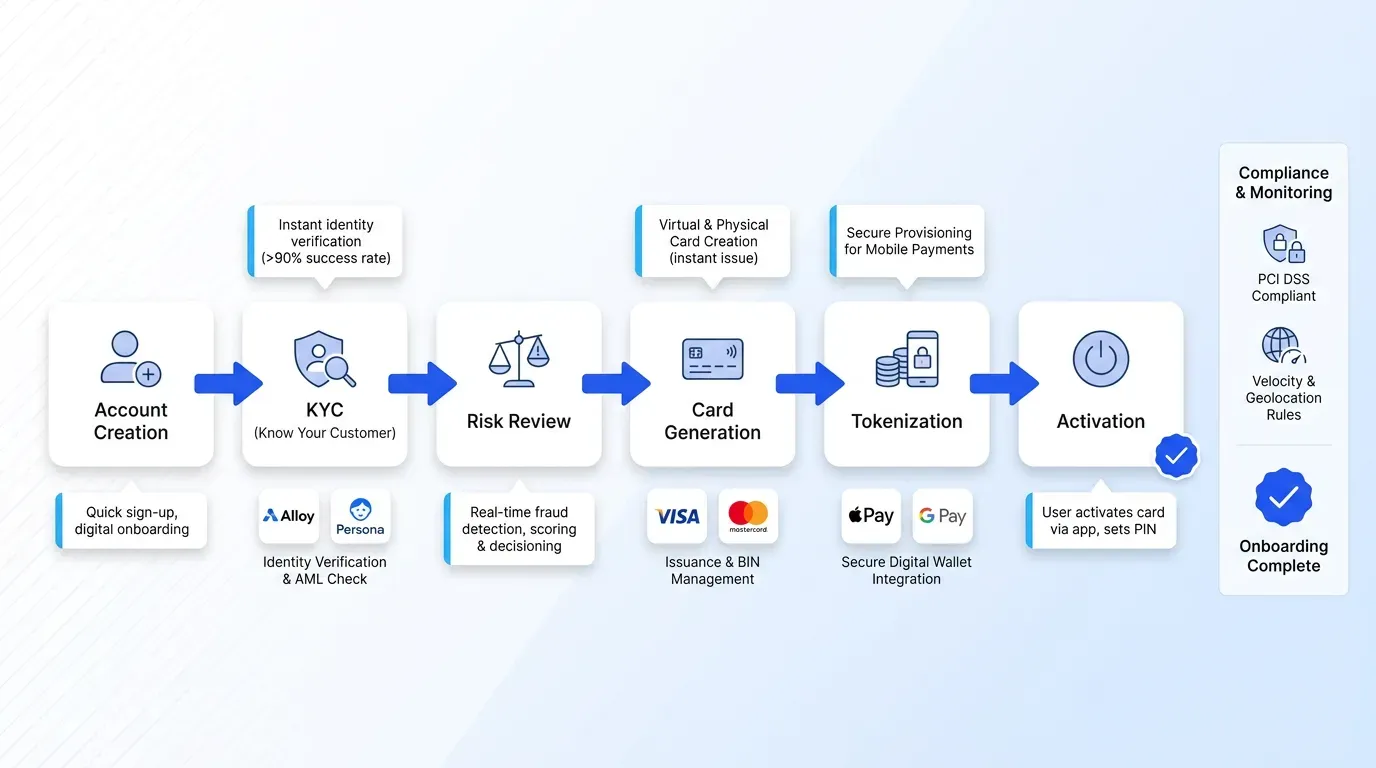
Infographic flow illustrating the fintech card issuance process with labeled steps, icons for key actors, and compliance sidebar.

Underneath both models, the same pipeline runs from sign-up to first swipe. The difference shows up only at the last step. If you understand the flow, you understand where latency and fraud risk live inside the compliance scope.

Account creation and KYC

Nothing downstream runs until identity is settled. The applicant submits personal data and a document image; some flows add a selfie. The onboarding stack runs Know Your Customer (KYC) checks, sanctions and Politically Exposed Person (PEP) screening, and assigns an internal account number once everything clears. Alloy and Persona dominate this layer for US fintechs, with Socure in the same tier. Treasury Prime reports that Alloy's platform has helped its bank and fintech partners cut fraud by 48 percent on average through its integrations with 175-plus data sources.

A pending or failed KYC freezes the rest of the pipeline. Risk-based decisioning then sorts applicants into buckets. A clean profile gets instant issuance. A flagged profile gets a manual review queue, and access to instant issue debit cards waits too: sometimes for a printed card, sometimes for nothing at all. Real-time card provisioning depends on getting clean signals from this stage, because every later step trusts the identity attached to the account.

Card generation and BIN assignment

Once the account exists, the card management system assigns a PAN from an available BIN range, sets the expiry, generates the CVV, and writes the card-to-account link into the ledger. Issuers run this two ways. Pre-generated PAN pools give predictable latency for instant issue debit cards because the numbers are already minted and reserved, but they tie up BIN inventory. On-demand generation conserves inventory and is easier to rotate when a BIN gets compromised, at the cost of a few extra milliseconds per request.

The BIN structure itself is constrained by Visa and Mastercard network rules, which define the digits and routing behavior for each product type. Cryptographic operations such as CVV generation and PIN block encryption happen inside a Hardware Security Module (HSM), because the keys cannot leave the secure boundary. This is also where instant card issuance systems start to interact with the PCI DSS scope, since the PAN is in the clear for a short window before it gets tokenized.

Tokenization through network token services

Before the PAN ever reaches a wallet, it gets replaced with a network token. Visa runs this through Visa Token Service (VTS), Mastercard through Mastercard Digital Enablement Service (MDES). The token is a separate 16-digit number bound to a specific device or merchant channel, and it carries its own cryptogram on every transaction. If the token leaks in an instant issue debit cards program, the underlying PAN is unaffected and the token can be killed without reissuing the card.

Visa has issued more than 10 billion network tokens through VTS, and its own data shows tokenized transactions see a 28 percent reduction in fraud compared with PAN-based ones. The standards that govern this layer include TR-31 for key block exchange and the EMVCo Payment Tokenisation specification for the token itself. One distinction worth keeping straight: network tokens are issued by the card network and work across merchants, while merchant tokens are scoped to a single acquirer or processor and don't move.

Wallet provisioning to Apple Pay and Google Pay

Getting a tokenized card into Apple Wallet or Google Wallet through real-time card provisioning happens through one of two flows. Pull provisioning starts in the wallet app, where the user types in the card number and the wallet calls the network to verify. Push provisioning starts in the issuer's app, where a button hands the encrypted card data to the wallet SDK and skips the manual entry.

Apple grades each provisioning attempt with a color code. Apple's In-App Provisioning documentation defines a Green Path as approved without further checks, a Yellow Path as requiring extra verification, an Orange Path as requiring a call center step, and a Red Path as a decline. An issuer that pushes from its own authenticated app can upgrade a Yellow Path to Green, since the user has already been authenticated. Integration on the issuer side means the mobile app pulls in Apple PassKit and Google's Push Provisioning API with the right entitlements, then routes the encrypted payload through a Payment Card Industry (PCI) certified service such as VGS or the card processor itself. This step is what makes a digital-first card immediately spendable in stores and online.

Activation and first use

Activation flips the card status from inactive to active in the authorization system.

The methods depend on the channel:

  1. In-app confirmation, where tapping a button in the issuer app activates the card

  2. Interactive Voice Response (IVR), where the cardholder calls a number and enters identifying digits

  3. First-transaction activation, where the first authorization itself activates the card if it passes risk checks

The first transaction for instant issue debit cards runs through extra velocity and geolocation rules with amount-threshold checks because the card has no behavioral baseline yet. A swipe at the airport thirty seconds after issuance in a different city will get declined, which is the right outcome. Once a clean transaction lands, the activation event closes the loop back to the original account-opening record, and the customer is fully onboarded.

Infrastructure behind real-time card provisioning

Step back from the linear flow and the picture becomes a distributed system that stretches beyond a simple banking workflow. The card management platform is the orchestrator. HSMs handle the cryptography. Network connectivity to Visa and Mastercard runs over leased lines or dedicated VPNs with sub-100-millisecond round trips. Event-driven messaging, such as Kafka or a managed equivalent, carries account-created, card-generated, token-provisioned, and activation events between services that do not share a database.

Two properties matter more than anything else here. APIs have to be low-latency, because users are staring at a loading spinner during onboarding. Operations have to be idempotent, because a retried wallet provisioning call cannot result in two tokens for the same device. Marqeta's product writeup emphasizes Just-in-Time Funding and instant card tokenization as the two features its customers lean on most, and both depend on these properties holding under load. Real-time card provisioning is a systems engineering problem dressed up as a payments problem.

Compliance and security checkpoints

Speed cannot come at the cost of controls, and the controls are non-trivial. The Payment Card Industry Data Security Standard (PCI DSS) governs every system that stores or transmits account data, with processing covered inside the same control boundary. PCI DSS version 4.0.1 was published in June 2024 and tightens requirements around vulnerability management and authentication, with continuous monitoring added to the same control set. The PCI Security Standards Council notes that scope reduction through segmentation can lower assessment cost and reduce risk, which is why most issuers route the PAN through a certified processor rather than touching it directly.

The usual scope-reduction levers in instant issuance design are:

  • Tokenization of the PAN at the earliest possible point, so downstream services handle tokens only

  • Using a PCI Level 1 certified processor for card data storage and authorization

  • Network segmentation between the cardholder data environment and the rest of the bank's infrastructure

  • Client-side encryption for push provisioning payloads, as documented in VGS's integration guide

Network mandates from Visa and Mastercard add their own layer. Fraud monitoring and dispute handling obligations for instant issue debit cards kick in the moment a card is active, and Regulation E in the United States gives consumers liability protections that the issuer has to absorb. Instant card issuance systems that skip these checkpoints don't stay in production long.

Where instant card issuance systems are heading

A few trends are reshaping the pipeline. Pull provisioning is becoming the default in markets where Click to Pay has gained traction, because the card network handles the wallet step on behalf of the issuer. Stablecoin-linked card programs for instant issue debit cards, where a USDC or similar balance funds card authorizations through a Just-in-Time funding hook, are moving from pilot to general availability at processors like Lithic and Marqeta.

AI-driven risk decisioning is compressing the KYC step further. Alloy's pKYC product, launched in 2025, runs continuous compliance monitoring instead of fixed-interval reviews, which lets issuers move borderline applicants out of the manual queue faster. On the supplier side, issuer processors are packaging instant issuance as a turnkey product, complete with BIN sponsorship and wallet SDKs that handle tokenization, so a new fintech can go live in weeks rather than the year or more it used to take.

Key takeaways for issuers and builders

The two delivery models, branch-based and digital-first, share almost the entire pipeline. The hard engineering work sits in tokenization, wallet provisioning, KYC integration, and PCI DSS scope management. Get those four right and the rest of the system mostly takes care of itself. Customer expectations will keep tightening, and the issuers that treat instant issue debit cards as a distributed systems problem will keep winning the onboarding race.

If you're evaluating vendors or building in-house, the question to answer first is which parts of the stack you own and which you rent. EGS builds resilient fintech infrastructure for issuers and processors who need their instant issue debit cards pipeline to stay up under real traffic, with the cryptography and event messaging already in place alongside the compliance scaffolding. Reach out to our team for a working session on your issuance architecture.

Virtual issuance usually takes seconds after KYC approval, while branch printing usually takes under ten minutes. Delays come from identity review, wallet verification, processor latency, or network timeouts. A well-designed system tracks each step separately so teams can find the exact point of delay.

The issuer should keep the card record intact and retry the provisioning step safely. Idempotent API design prevents duplicate wallet tokens for the same card and device. If the wallet returns a higher-risk path, the issuer can request extra verification or offer card details for online use.

Yes, instant issue debit cards can be used before a physical card arrives when the issuer provides a virtual card or wallet token. The card works for online checkout and mobile wallet payments after activation. ATM access still depends on whether the issuer supports cardless cash withdrawal.

Issuers should build only the parts tied to their product rules and customer experience. Card data storage, HSM operations, tokenization, and PCI controls are often safer to rent from certified providers. EGS supports issuers and processors with resilient fintech infrastructure for these payment workloads.

Issuers should monitor KYC approval time, card generation latency, wallet provisioning approval rates, activation rates, first-transaction declines, and fraud claims. These metrics show whether the program is fast, safe, and usable. Teams should review failed events daily because small errors in this flow block new customers from spending.

Schedule a Meeting

Book a time that works best for you

You Might Also Like

Discover more insights and articles

Title:
Instant Debit Cards: Enabling Immediate Payment Access

Meta description:
Learn how instant debit cards let you spend funds moments after account approval. Read this guide to understand the dig

Instant Debit Cards: Enabling Immediate Payment Access

In this article, we explain what instant debit cards are and how the technology lets customers spend within seconds of opening an account. We walk through the customer flow, the benefits for both sides of the transaction, the security behind it, and where the technology is heading.

Title:
Virtual Card Issuing: Secure Digital Payments for Modern Fintechs

Meta description:
Learn how virtual card issuing works so you can select the best provider and launch secure payment features.

Virtual Card Issuing: Secure Digital Payments for Modern Fintechs

This article explains how virtual card issuing works under the hood and why it has become a core building block for fintech products. It walks through the infrastructure, common use cases, security obligations, and the criteria that matter when picking a provider.

Title:
White Label Card Issuing: When to Use It and When to Build Your Own

Meta description:
Decide if white label card issuing fits your business or if you should build your own stack. Learn the tra

White Label Card Issuing: When to Use It and When to Build Your Own

This article explains how white label card issuing works and helps fintech founders and product leaders decide whether to license a ready-made platform or build their own stack. It covers the trade-offs and what to verify before signing anything.

Title:
Card Issuing Platform: Architecture for Scalable and Secure Card Programs

Meta description:
With a modern card issuing platform, you can scale your program safely. Learn to design a secure arc

Card Issuing Platform: Architecture for Scalable and Secure Card Programs

This article walks fintech leaders and product-engineering teams through the architectural layers behind a modern card issuing platform. We break down the stack from the issuing processor to the API gateway, then show how the pieces cooperate during a live authorization before the article closes with a checklist for evaluating any vendor or in-house build.