Digital wallets infrastructure across three use cases
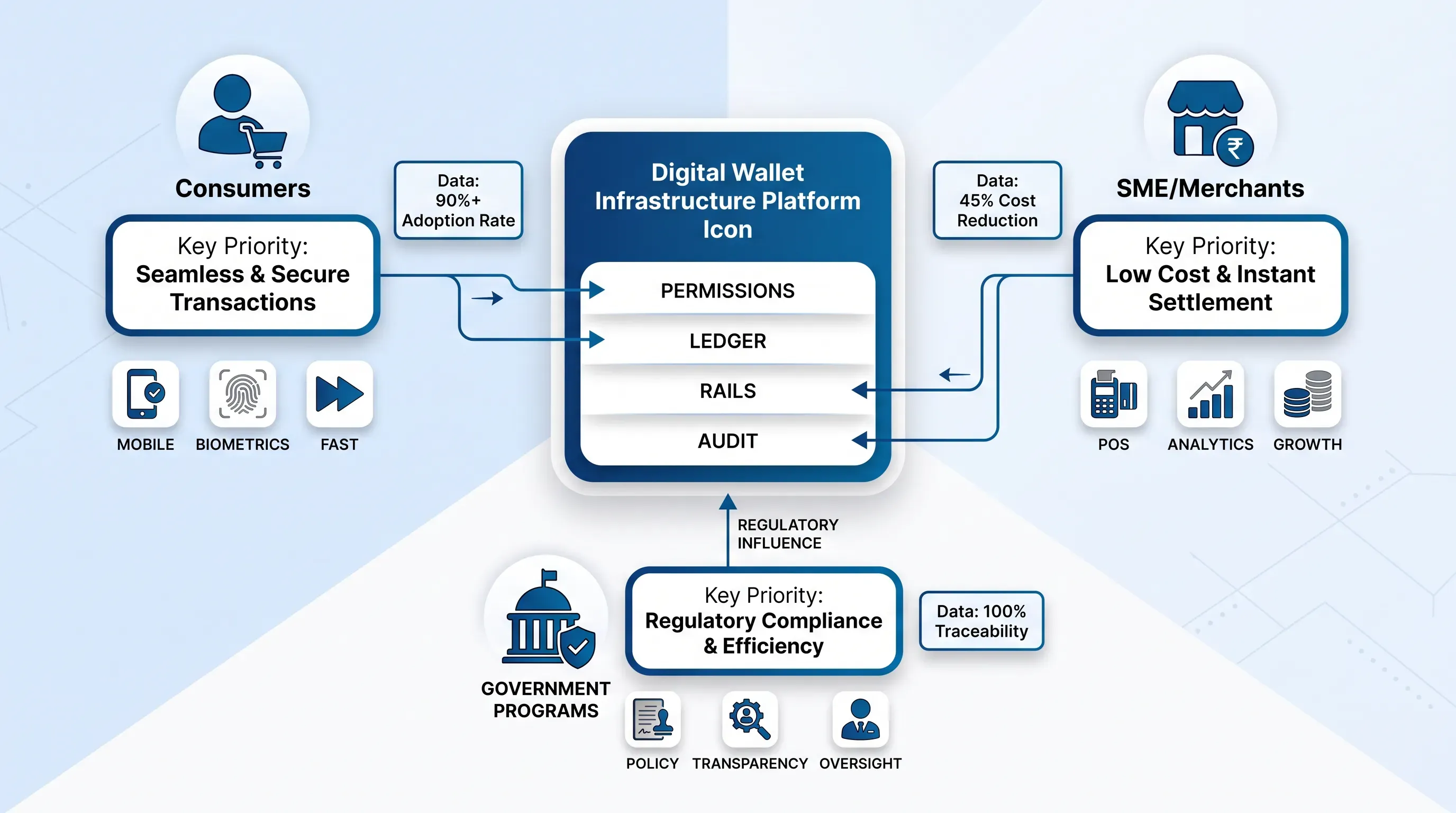
The same core platform bends to serve three audiences, and the digital wallets infrastructure underneath stays fundamentally the same across all of them. These wallet types share an architecture, but their scale shapes how the platform manages permissions and reporting limits. The ledger and rail integrations carry over. What changes is how hard each dimension gets pushed. Map your own project onto the closest pattern and you will see which requirements you share with everyone and which are yours alone.
Consumer wallets
Consumer wallets center on peer-to-peer transfers and purchases online or in store. The design priority is smooth UX over flow complexity, because a consumer abandons a payment that takes one screen too many. Underneath, the infrastructure carries a high account count at lower per-transaction values, the small-ticket profile you see in UPI data where the platform dominates volume while contributing only 8.7% by value in March 2024.
This is where digital wallets infrastructure meets consumer-protection law directly. Card credentials are tokenized so the wallet never holds raw numbers. Fee disclosure has to be clear, and unauthorized-transaction liability is capped. Under Regulation E, a consumer who reports a lost access device within two business days is liable for at most $50, and the CFPB has confirmed those protections extend to P2P payment services. The backend has to support that error-resolution workflow, which means it can trace a transaction through its regulated error-resolution timeline.
SME wallets
Merchants and small businesses ask for more. The SME pattern supports customer engagement through merchant payments and payouts, then expands into adjacent card issuing or lending. That pushes digital wallets infrastructure in a different direction than consumer wallets. Transaction values run higher, and reporting has to be rich enough to match a business's own books at the end of a period.
Permissioning is where SME wallets get demanding. A business account has multiple users with different rights, so the platform needs granular role-based access for them. Balances and payouts have to share one operational truth, because a business reconciles them against a single set of accounts. Brazil shows the scale this reaches: B2B PIX transaction volume exceeded R$1 trillion in 2024, at an average value of around R$5,846 per transaction, far above the consumer average.
Fintech wallet platforms for government
Government programs raise the bar again. The pattern here is disbursements through benefit and subsidy programs. The public-sector examples are the most instructive ones we have. UPI-driven digitalization let India route benefits directly to citizens, and the government estimated fiscal gains of more than $12.7 billion in 2018 from shifting G2P payments away from cash. Mobile-wallet delivery of government funds cuts leakage that intermediaries used to skim.
The compliance weight is what sets these fintech wallet platforms apart. Strict data residency and protection rules apply to disbursements that run at national scale in short windows, with near-absolute reliability expectations. Fintech wallet platforms serving a public program face deep audit and reporting requirements, because public money invites public scrutiny. When PIX handled a record 252.1 million transactions in a single day on December 20, 2024, that number is only reassuring because the system stayed auditable under the load. For fintech wallet platforms in this space, resilience and auditability are the whole point. That is why government-grade fintech wallet platforms carry heavier resilience budgets than any consumer build, and why fintech wallet platforms of this kind treat the audit trail as the primary deliverable. The distinguishing trait of fintech wallet platforms built for the public sector is that a missed disbursement becomes a headline.
Sequencing your build
Trying to build everything at once is the common failure mode. The way out is to lock the decisions that are expensive to reverse before you add features. That means settling the licensing category first, then establishing a ledger model that determines rail selection, because these decisions constrain everything built on top of them. A feature can be reworked in a sprint. A license or a ledger cannot.
Then comes the build-versus-buy choice. White-label or API-based digital wallets infrastructure gets you to market faster and absorbs some compliance readiness, while an in-house platform gives you control at the cost of heavy engineering investment. Judge it honestly against the team you have and the compliance review you have to pass. Neither answer is wrong, but choosing for the wrong reason is.
Energize Global Services builds this kind of regulated digital wallets infrastructure, from double-entry ledgers to ISO 20022 rail integration and PCI-DSS-ready controls. If you are scoping a wallet and want to pressure-test your sequencing for wallet infrastructure engineering before committing, book a call with our engineering team.