What breaks key management at scale?
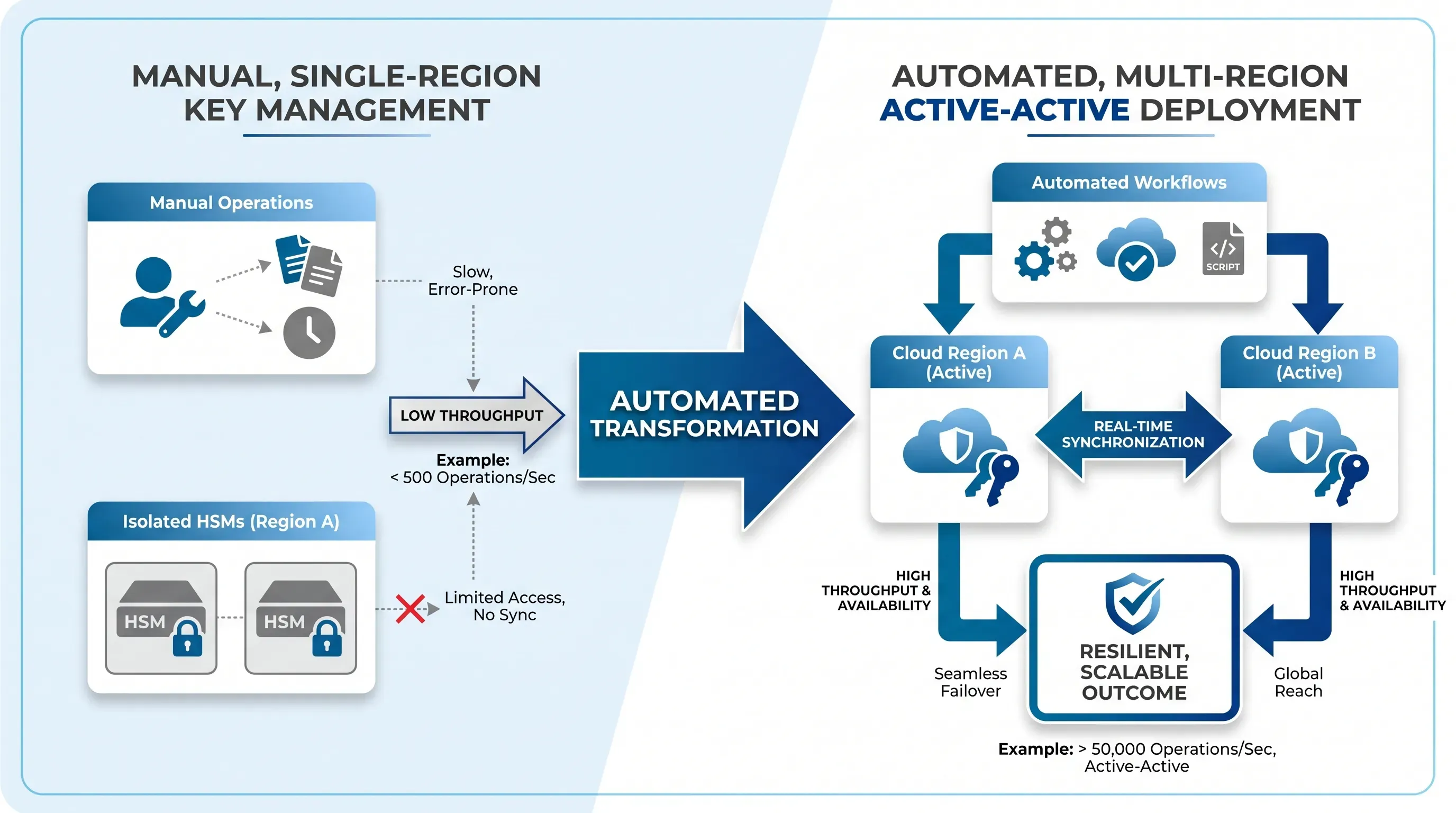
What breaks at scale is the manual ceremony and disconnected tooling that worked at low volume, as well as single-region design. These pass a small audit and then fail the first regional outage or traffic spike, because key availability, replication, and latency turn into hard constraints the moment you go active-active.
HSM capacity must be provisioned in advance because HSM-based solutions lack the elasticity of VM-based architectures, which spin up instances on the fly. A network processor like Visa averages 5,000 transactions per second and is built to handle upward of 60,000, so a large number of HSMs sit in place before the traffic ever arrives.
That is the difference between a design that works in a lab and one that survives Black Friday. You have to provision the hardware ceiling ahead of demand, because you can't conjure a compliant HSM mid-spike. Manual key ceremonies that took an afternoon at one site cannot be repeated identically across six regions on a schedule. Disciplined teams therefore automate lifecycle actions and reserve ceremonies for exceptional cases.
How do multi-region systems keep keys consistent?
Keys and their governing policies must be replicated and synchronized across regions, so an active-active deployment does not break when one region goes dark. A key used in one location has to be valid and available in the other during failover. The tension is clear: you need the key everywhere for availability, yet you must never let its plaintext value out of a controlled boundary.
AWS Payment Cryptography resolves this through its hierarchy. Its top-level keys exist only in HSM and secure backups, and profile master keys are stored with configuration encrypted by region, so protected key material replicates. The design principle to carry forward: synchronize keys as encrypted blocks under a master key that stays sealed, so availability spreads across regions while the sensitive value never travels in the clear.
How do high-TPS environments handle key operations?
Cryptographic operations do not have to become the bottleneck at thousands of transactions per second, because payment HSMs and cached working keys are sized to keep signing, MAC generation, and PIN operations ahead of throughput. HSM capacity and I/O planning set the ceiling. Capacity is a procurement decision made in advance. Futurex payment HSMs, for example, scale to 50,000 transactions per second for high-throughput environments, and you add modules to go higher.
Throughput also depends on how you use keys. Azure's Managed HSM guidance notes that its published numbers assume a single key driving maximum throughput, and spreading work across many keys lowers the ceiling. So when you profile a real payment path, count HSM operations per transaction and model against your module count, because that ratio, not your application servers, is what decides whether you hold your peak.
What does PCI DSS require for key management?
PCI DSS Requirement 3 mandates secure key storage and defined cryptoperiods. It also requires documented procedures and restricted access, with tamper-evident audit logging. Version 4.0 requires continuous proof throughout the year. The recurring theme is evidence. You have to demonstrate that the control held all year.
That shift became concrete on a fixed date. The formerly best-practice requirements in PCI DSS v4.0 became mandatory on March 31, 2025, and the standard now emphasizes building evidence that controls are adequate throughout the year rather than only at assessment time. Read against everything above, this is why audit logging and consolidated records matter as much as the HSM itself. Each key-management action needs a durable, tamper-evident trail, because in a v4.0 assessment the log is the proof. Design the evidence pipeline with the same care you give the cryptography, or you'll own strong controls you cannot demonstrate.
What happens when key management fails?
When key management fails, the failures fall into three shapes. A lost key means data you can never recover. An exposed key means breached cardholder data and regulatory penalties. Unlogged operations mean a failed audit even when nothing was actually stolen.
The financial edge is sharp. PCI non-compliance fines can run from $5,000 to $100,000 per month, and a breach triggers mandatory forensic investigation on top of that. Enterprise systems address each shape directly. Tested backups protected by a key-encrypting key prevent permanent data loss. The HSM boundary, together with split control, prevents exposure. Consolidated audit trails preserve the outcome of an assessment you should have passed.
This is the stance the whole article has been building toward. Key management requires an architectural design from the start of a system. The teams that treat it as infrastructure absorb a lost drive or a departed employee as a routine event. The teams that treat it as paperwork discover the gap during a breach, which is the most expensive place to learn.
Where can banks get key management built right?
If you're specifying or overhauling a payment platform's cryptographic infrastructure, the practical next step is a build partner who has already engineered the four pillars together rather than one who bolts them on afterward. That is the harder half of this work, because the pillars only protect you when they connect.
Energize Global Services (EGS) is one such partner. Founded in 2007, EGS builds banking systems and payment solutions for POS and EMV software. It also provides HSM implementations. Its offerings extend to e-wallets and open banking platforms, and its own infrastructure reporting shows sustained throughput above 12,000 transactions per second with active HSM status and PCI DSS compliance. The company holds ISO 27001 and ISO 27017 certifications, along with ISO 27018 and SOC 2 certifications.
What that combination gives you is a single accountable team across the switch and the ledger, with the wallet layer under the same design, so the boundaries where authorizations meet balances stay under one design. If you're weighing resilience under real transaction volume against an audit scope you need to keep contained, describe your project to EGS and ask how they would architect the key lifecycle for your specific payment path.