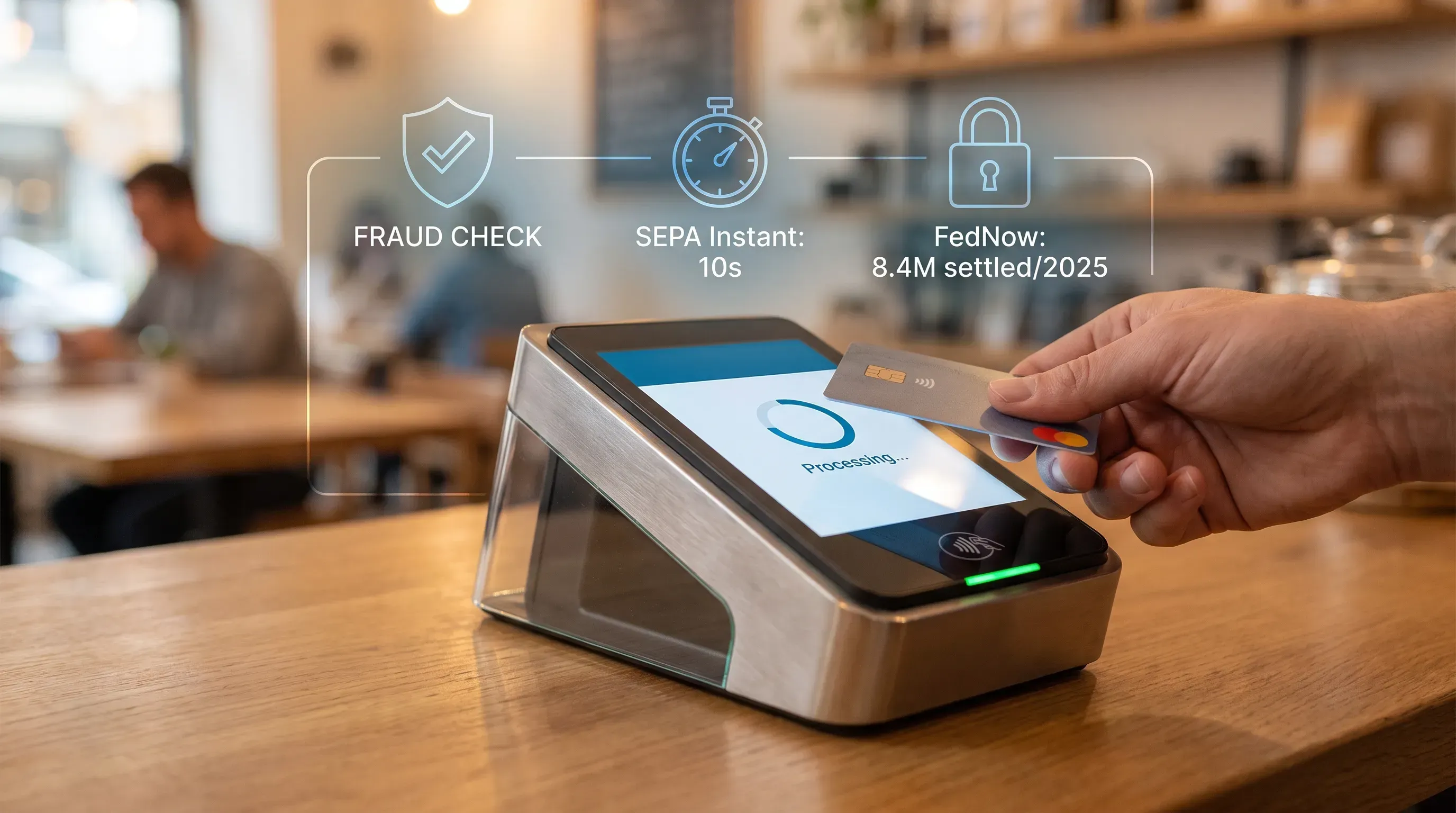
Secure Payment Processing: Architecture for Safe and Compliant Transactions

Content authorBy EGSPublished onReading time11 min read
A payment security analyst at a modern IT office studies a multi-monitor display showing a transactional flow diagram with compliance icons.

This article walks a card transaction from the moment data is captured to final settlement and shows which control protects each stage. You will finish able to map your own architecture against a stage-by-stage set of controls and find the gaps where sensitive data leaks out or PCI scope quietly grows.

Why payment security must be designed in

Someone hands you a secure payment processing integration and a deadline. The temptation is to build the flow first and get money moving before treating secure payment processing as a compliance checkbox you tick before launch. That order is backwards, and the numbers explain why. Payment card fraud losses worldwide reached $33.41 billion in 2024, according to the Nilson Report, tied to global card volume of $51.92 trillion.

A card transaction requires secure transaction processing because a primary account number has resale value the moment it leaves your system in the clear. And breaches rarely happen inside one hardened component. They happen at the seams, where data moves from the browser to your server, from your server to the processor, or sits in a log file nobody thought to scrub. The average breach hit $4.88 million in 2024, a 10% jump from the year before, per IBM's Cost of a Data Breach Report.

So the guiding idea is simple. Safety comes from controls embedded at every step of the transaction lifecycle. Bolt security on at the end and you inherit every gap you skipped.

The transaction lifecycle at a glance

Before designing secure payment processing controls, you need a picture of how money actually moves. You know how to build systems. What you might not have seen is the specific choreography of a card payment, because it involves parties that never touch your codebase yet shape every decision you make.

Start with the cardholder, who enters card details at checkout. Those details pass to the merchant, which is your application. The merchant sends them to a payment gateway, the component that securely relays transaction data onward. From there the request reaches the processor, which connects to the card network (Visa, Mastercard, and the rest) and routes the request to the issuing bank that gave the cardholder their card.

Secure transaction processing follows a predictable sequence of stages:

  1. Data capture, where card details enter the system.

  2. Transmission, where they travel to the processor.

  3. Storage, if any card reference is kept.

  4. Fraud and risk screening, before the bank is asked anything.

  5. Authorization, where the issuer approves or declines.

  6. Settlement, where funds actually move.

Hold this sequence in your head. The rest of the article maps one set of controls onto each stage, because that is where the argument lives: every stage has its own exposure, and every stage needs its own protection.

Securing data capture and transmission

The front of a secure payment processing flow is where you make your most consequential decision. How much card data should your own servers ever touch? The honest answer for most systems is as little as possible, ideally none in the clear. Encryption in transit is non-negotiable. Card data crossing a public network without Transport Layer Security (TLS) is card data waiting to be intercepted. But TLS between your browser and your server still means plaintext card numbers land inside your environment, and everything they touch becomes part of your Cardholder Data Environment (CDE). That is where point-to-point encryption (P2PE) changes the math. A PCI-validated P2PE solution encrypts the card inside the point-of-interaction device before it enters your software, and keeps it encrypted until it reaches a decryption environment you do not operate.

The scope reduction is dramatic, and it is the reason engineers reach for it. A merchant handling cards without validated P2PE fills out Self-Assessment Questionnaire D, with up to 328 questions. With a validated P2PE solution, that drops to the SAQ P2PE form of just 33 questions, a reduction of roughly 90%. Fewer systems in scope means fewer things to patch and defend. If you are deciding where card data lives in your architecture, decide it here. Push sensitive data out of your environment at the earliest possible point, because everything downstream inherits whatever exposure you allow at the door.

Start building your financial platform?

Speak with EGS engineers about open banking, payment infrastructure, cloud systems, and enterprise software.

Get in Touch

Core controls in secure payment processing

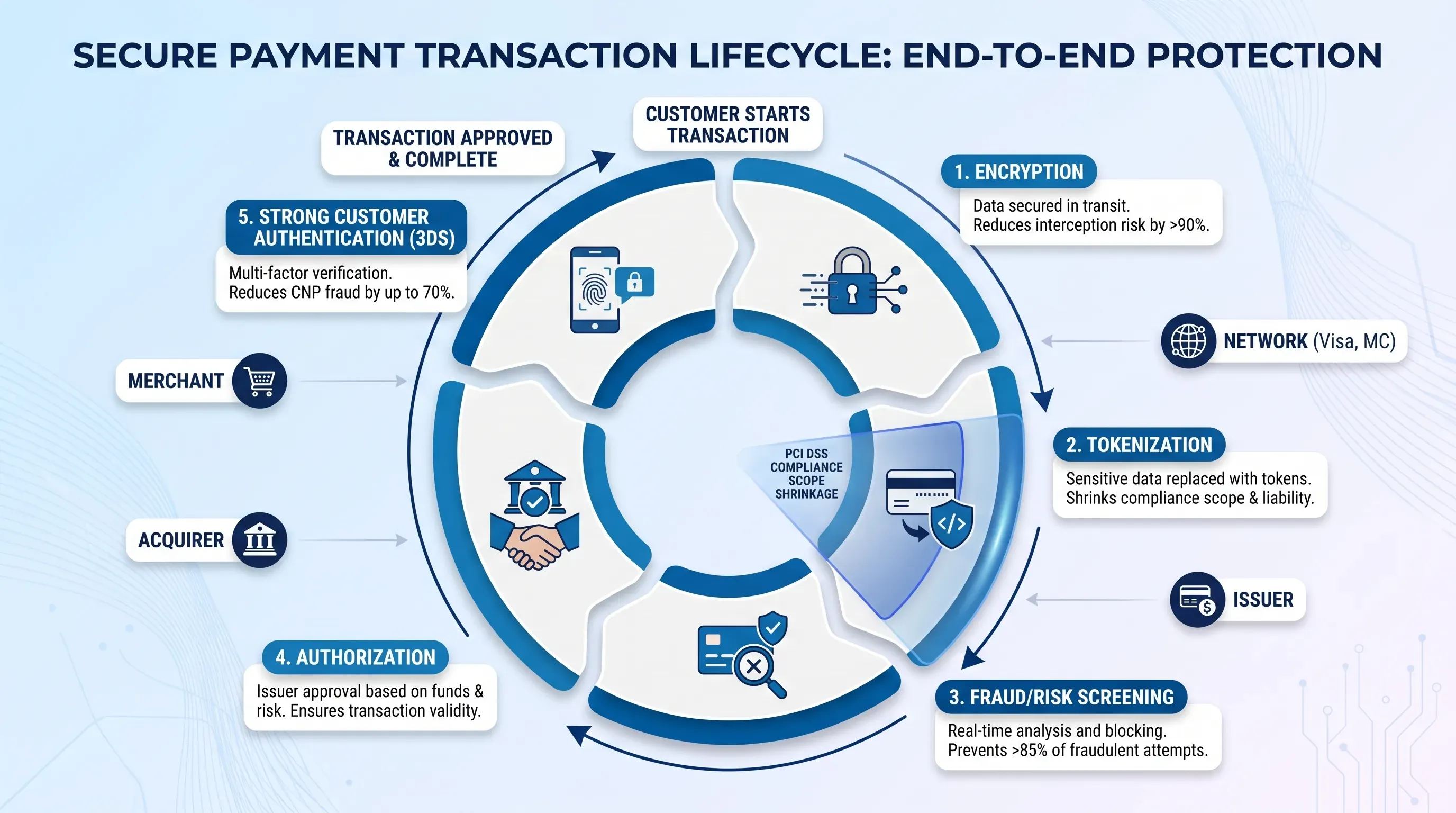
Modern infographic illustrating the payment transaction lifecycle with segments for security controls, soft gradients, and navy icons.

The controls that follow are complementary, not interchangeable. Engineers get into trouble when they treat encryption and tokenization as two names for the same idea, or assume a fraud check and an authorization are the same call. They are not. Mature secure payment processing runs several of these together, each solving a distinct problem at a distinct stage.

Think of this section as the map between control and stage. By the end you should know what each one solves and where it belongs, because that is the difference between a system that passes an audit and one that actually stays safe when a partner fails or an attacker gets a foothold.

Encryption for data in transit

Encryption conceals data using a cryptographic algorithm and a key. Only a party holding the decryption key can read it back. For card data moving across networks, this is the baseline for secure payment processing, and there is no version of a payment system where you skip it.

Here is the trap. Encrypted cardholder data is still cardholder data under PCI DSS. As Spreedly puts it, "the standard doesn't reward elegance. It only asks whether systems in your environment store, process, or transmit cardholder data, and encrypted card data absolutely qualifies." Encrypting a PAN and storing it in your database does not remove that database from scope.

Key management is where encryption turns into a liability. If the keys live in the same environment as the data they protect, an attacker who reaches the data reaches the keys. Encryption is the right tool for protecting data on the move. It is the wrong tool if your goal is to stop storing sensitive data at all.

Tokenization and payment security systems

Tokenization replaces the card number with a token that has no mathematical relationship to the original. The real PAN sits in a vault, and your systems reference the token instead. The framing from Spreedly is worth memorizing: encryption conceals data, and tokenization replaces it. A stolen encrypted value can be decrypted with the right key. A stolen token is useless without access to the vault that maps it back. That difference matters for payment security systems built around stored or recurring payments. Because the token carries no card data, the systems that hold it fall largely out of PCI scope for stored credentials.

Two flavors get conflated, and the distinction is worth keeping straight:

  • Merchant-side PCI tokenization: a token generated by a provider or vault, used to reference a saved card inside your own environment.

  • Network tokenization: a token issued by the card network itself that is used during authorization and carries a dynamic cryptogram with automatic lifecycle updates.

The second one earns its keep beyond compliance. Visa's published VisaNet data shows network tokens deliver a 4.6% authorization lift on card-not-present transactions compared with raw PANs, and cut fraud by an average of 28%. If you handle recurring billing, network tokenization is the payment security systems decision that also protects revenue when a customer's card is reissued.

Fraud and risk screening

Fraud and risk checks sit before authorization. You screen the transaction before you ever ask the issuing bank to approve it, because a declined fraudulent charge still costs you if it slips through. These payment security systems evaluate device fingerprints against a risk score, which also incorporates behavioral patterns and transaction history.

Rolling your own rules engine is a losing game. Risk screening leans on specialized third-party services and machine-learning scoring models trained on volumes of fraud data no single merchant sees. The Nilson Report notes that fraud fighters are "always first among card industry executives to deploy the latest artificial intelligence tools," because criminals adopt the same tools just as fast.

Strong customer authentication balances that security against friction. Under the EU's PSD2, most electronic payments require two-factor authentication delivered through 3D Secure. The payoff is real: WorldPay data cited by Recurly shows that merchants without 3DS report fraud rates around 0.29%, while the first version lowers them to 0.12%. The cost of this secure transaction processing is time, up to 10 seconds added to a transaction. Adaptive checks resolve the tension by challenging risky transactions and letting trusted ones pass. Your job is to integrate the risk decision and act on it.

Start building your financial platform?

Speak with EGS engineers about open banking, payment infrastructure, cloud systems, and enterprise software.

Get in Touch

Authorization and issuer approval

Authorization is the step where the request reaches the issuing bank to verify funds and legitimacy. The bank returns an approve or decline, and that decision travels back through the network to your system. This is a network call to a party you do not control, over infrastructure that fails.

Which is why idempotency is not optional here. If your authorization request times out, you do not know whether it succeeded, and a naive retry charges the customer twice. Stripe solves this with an idempotency key, a unique string you attach to each request. As Stripe's documentation states, the API "supports idempotency for safely retrying requests without accidentally performing the same operation twice." Send the same key twice and Stripe returns the cached first result instead of processing a second charge.

Generate a unique transaction ID per logical payment and treat authorization as one state in a broader state machine. A payment begins in a pending state, becomes authorized, then proceeds through capture to settlement, and each transition has to survive partial failure. Build the system for secure transaction processing so that a request lost in the network leaves the transaction in a known, recoverable state rather than an ambiguous one, because ambiguity is where double charges and lost payments are born.

Keeping settlement and stored data safe

After the issuer approves, secure transaction processing is not finished. Settlement moves the actual funds from the cardholder's bank to the merchant's account in batches, and whatever data you retain afterward becomes your ongoing responsibility long after the customer has closed the tab.

Data at rest is protected best by not storing card data at all. Keep a token. Encrypting a stored card number leaves you managing keys and keeping that store in scope, while a token references the payment without holding anything worth stealing. If you never persist the real number, a breach of your database exposes references that mean nothing outside the vault.

Audit trails and transaction logs are where good intentions leak sensitive data. Log the transaction ID and amount, along with the status and timestamp. Never log the full PAN or any authentication data, such as the card verification value. Observability and traceability across every component are essential to secure payment processing. When a payment goes wrong at 3 a.m., you need to trace it end to end without your own logs becoming the breach. PCI DSS 4.0 reinforces this: under requirement 10.4.1.1, organizations can no longer review logs manually and must use automated tooling.

Compliance without breaking the flow

PCI DSS is an architectural constraint. Every scope-reducing decision earlier in the flow was also a compliance decision. The audit surface shrinks before an assessor ever arrives when card data is encrypted at the point of interaction and stored credentials are tokenized; disciplined logging helps shrink it further.

The standard got more demanding. PCI DSS 4.0 took effect in April 2024 with 47 new requirements, and the requirements initially marked as best practice became mandatory after March 31, 2025. Staying compliant is genuinely hard. Verizon's 2024 Payment Security Report found only 43% of organizations achieved full compliance during validation, and more than half fell short at the moment they were tested.

The reassuring part is that architecture works in your favor if you let it. The design choices that reduce exposure are the same ones that reduce burden:

  • Validated P2PE at capture keeps clear-text card data out of your environment, which cuts the systems an assessor must review.

  • Tokenization at rest removes stored PANs, which takes those data stores out of scope.

When secure payment processing is already built into the pipeline, compliance documents the protection you built in.

Building end to end secure payment processing

Pull the stages back together and the argument holds from capture to settlement: security lives in every step, never at the edge alone. Walk your own flow stage by stage and ask a simple question at each one. Where does clear-text card data appear, and which control removes it? Use encryption on the move and tokenization at rest. Apply risk screening before authorization and maintain idempotency through issuer approval. Wherever no control answers, you have found a gap or a place where scope is creeping in.

The strongest systems embed protection into the pipeline by design. Take the model laid out here and audit your current architecture against it this week. Book a call with EGS to review your payment architecture, assess your security controls, and build a payment platform that's secure, compliant, and ready to scale.

Start building your financial platform?

Speak with EGS engineers about open banking, payment infrastructure, cloud systems, and enterprise software.

Get in Touch

Check the PCI Security Standards Council list of validated P2PE solutions and confirm that the provider’s specific service, components, and deployment match the listing. A provider’s general PCI DSS compliance doesn't establish P2PE validation. Keep the validation reference and implementation documents for your PCI assessment.

Yes. Your payment provider can use a token to identify the original payment method for a refund or a later merchant-initiated charge. Confirm that the token supports the intended payment type and that the provider documents its expiry and lifecycle-update rules.

Test retries at each failure point between your application and the payment provider, including timeouts after a request is sent. Submit the same idempotency key twice and confirm that the provider returns the original result. Also verify that your database records one logical payment.

For secure payment processing, keep production encryption keys in a dedicated key-management service or hardware security module, separate from encrypted payment data. Rotate keys under a documented schedule and restrict key-use permissions to required services. Don't place keys in source code or logs.

Ask EGS to trace card data from the checkout field through APIs, queues, and logs, then identify where clear-text data enters your environment. The review should also check token boundaries, authorization retry behavior, and access to encryption keys. This creates a defined list of PCI scope and exposure gaps.

Schedule a Meeting

Book a time that works best for you

You Might Also Like

Discover more insights and articles

A bank security analyst works at a multi-monitor workstation in a modern IT office, focused on encryption key management and compliance.

How Banks Manage Encryption Keys at Scale in Modern Payment Systems

Banks manage encryption keys at scale through a controlled key lifecycle inside tamper-resistant hardware security modules. A central key management system coordinates the modules, and split human control ensures no one person holds a full key. Automation extends the same policy across regions and high transaction volumes.

A realistic commercial payment HSM terminal with a chip card and keypad, illuminated by soft studio lighting against a neutral background.

Hardware Security Modules in Payments: The Foundation of Transaction Security

A hardware security module (HSM) in payments is a tamper-resistant device that generates and uses cryptographic keys stored inside a sealed boundary, so those keys never reach application memory in clear text. It acts as the root of trust for the whole payment system because it performs PIN encryption and key management during every card transaction. It also performs EMV cryptography during those transactions.

A diverse team of bankers and PSP staff collaborates around a hand-drawn SEPA payments workflow diagram in a modern open office.

Instant SEPA Payments: Infrastructure and Implementation Guide

This article walks through what actually changes inside a bank or payment service provider when instant SEPA payments move from a mandate on a slide to a live production flow. It covers core banking integration and the ten-second window, alongside the trade-offs a team faces before committing an architecture and a timeline.

A team of fintech engineers collaborates in a glass-walled office, discussing digital wallet design with hand-drawn diagrams and laptops.

Digital Wallet Infrastructure: Building Secure and Scalable Payment Ecosystems

This article explains how to build digital wallets infrastructure that uses APIs to connect with payment rails and turn a demo wallet into production-grade regulated infrastructure. It walks through the ledger and the compliance controls, along with payment rails for the three use cases teams are asked to support, so you can scope and sequence your own build.