How do HSM, IAM, and payments connect?
Together, these services form a unified control path. Payment software requests an operation, and IAM authenticates the human or workload. Policy authorizes the specific request, while the HSM performs the cryptography without ever releasing the key.
Read as a conceptual sequence, the request flows in one direction and the key never travels with it. AWS Payment Cryptography runs this pattern on a managed fleet of PCI PTS HSM V3 and FIPS 140-2 Level 3 hardware. It separates a control plane for key lifecycle from a data plane for cryptographic operations, so key management and key use are governed separately.
The reason to draw clear system boundaries is accountability. When you can point to where identity is proven and policy is decided, you can also identify where cryptography happens and identify accountability gaps. A blurred boundary between these three is where audits stall, because no one can say which team owns the control that failed.
HSMs protect keys and operations
An HSM provides a tamper-resistant boundary for sensitive keys and their cryptographic operations. A KMS adds lifecycle policy through APIs and aliases, then orchestrates those functions on top. They solve different problems and work best together.
Match validation to use case rather than assuming every key needs the strongest module. Utimaco notes that payment HSMs protecting PINs must be either PCI-approved or FIPS 140-2 Level 3 or higher, a bar specific to PIN and payment keys.
The takeaway is to spend validation where the risk sits. Forcing payment-grade HSM controls onto low-risk keys wastes budget and adds operational drag without buying real protection.
IAM controls who may request use
IAM governs administrative and workload identities, while key policy governs what each identity is allowed to do with a specific key. These are two locks on the same door, and you need both.
At an architecture level, this means privileged access control and strong authentication. The most sensitive operations require just-in-time elevation and dual approval, backed by recurring access reviews. A workload identity carries only its runtime capability, and a human admin elevates only when a task requires it. ISO 27001 Annex A Control 8.24 requires demonstrable processes throughout the key lifecycle, from generation through destruction.
The conclusion here is that authentication answers who, and key policy answers what. Strong IAM with weak key policy still lets an authenticated identity do too much, so both layers have to be designed as one.
Payment services call cryptographic functions
Payment systems call the same kinds of functions. These include PIN translation and MAC generation, as well as functions for tokenization and for signing or data encryption. Each call is a request into the control path, never a key checkout.
Design these API paths for resilience because payment flows can't pause. That means idempotency for retried requests and defined latency budgets. It also requires failover for when an HSM or key service is unavailable. Futurex's VirtuCrypt payment HSMs support DUKPT and ISO 9797 financial MAC generation across transaction zones, the exact functions a gateway calls per transaction.
The design implication is that safe failure matters more than fast failure. When the key service is unreachable, the system has to decline cleanly rather than fall back to an unprotected path, because a graceful outage beats a silent bypass.
Auditability must span every lifecycle event
Compliance depends on proving policy enforcement. An HSM in the rack means nothing to an auditor who can't see the records tying each key event to an authorization and a result.
Map every lifecycle event to an append-only inventory and audit trail, then connect that evidence to the guidance that applies to your environment. NIST SP 800-57 and PCI DSS cover part of the picture. PCI PIN or PCI PTS HSM covers another part, as do ISO 27001 and FIPS validation. Not every framework applies to every fintech. The Konfirmity guide notes that under ISO 27001, without a structured lifecycle, encryption devolves into a false sense of security.
The lifecycle produces evidence. Design each state transition to emit a record, and audit readiness stops being a scramble before assessment and becomes a property of the system itself.
Every key needs a complete record
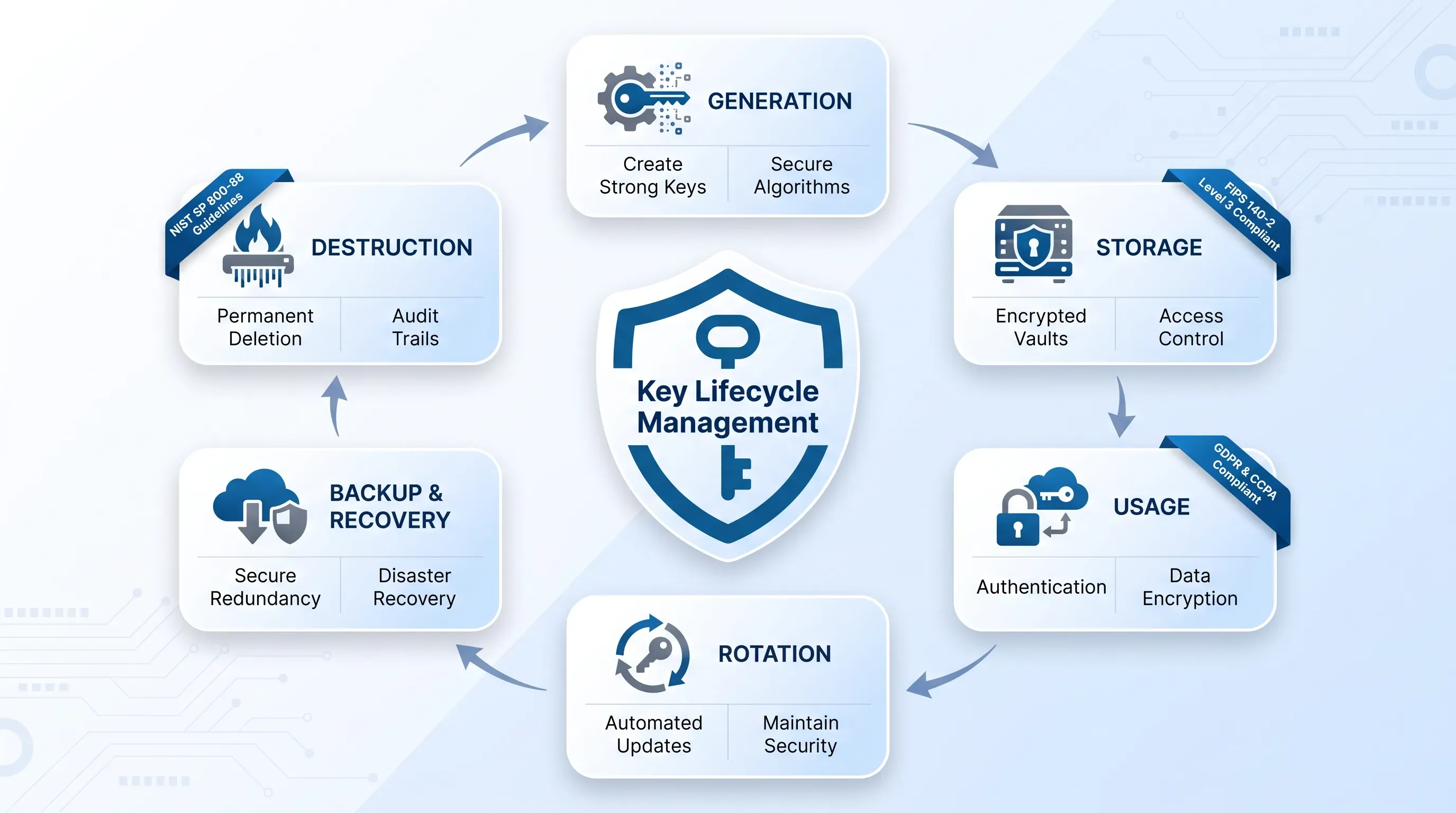
Each key needs a full record before it's ever used in production. That means a unique identifier that states the key's type and purpose. The record identifies its owner and custodian, then captures its current state and location. It documents the algorithm and cryptoperiod, plus dependencies. It includes access history and rotation events. It also records approvals and the destruction outcome.
Logs must identify the requester and the result of each operation without exposing any secret key material. NIST SP 800-57 frames this as giving each key the equivalent of a birth certificate and death record, documented and tracked through every phase.
The reasoning is that a record with gaps is an audit finding waiting to surface. If you can't name a key's owner or trace its last rotation, the control around it can't be verified, which means for audit purposes it doesn't exist.
Controls require ownership and testing
Written procedures have to name accountable owners and separate duties according to risk across the request-and-approval process and system administration, with independent review. A control no one owns is a control no one runs.
Back the procedures with periodic inventory reconciliation and access recertification. Also include rotation and recovery tests, along with exception management and evidence retention. The recovery test matters most because a backup key you've never restored provides only hope. NIST SP 800-88 Rev. 2 calls for digitally signed, tamper-proof audit trails generated for every erasure event, with verification and validation recorded separately.
The conclusion to draw is that untested controls fail silently. You only learn a recovery procedure is broken when you need it, so testing is what turns a written policy into an operational one.
Metrics reveal lifecycle control gaps
Operational metrics expose lifecycle gaps before they become incidents. Track unknown owners and overdue rotations, then identify unused keys and failed lifecycle jobs. Also flag excessive privileges or a key living outside an approved HSM or KMS boundary.
These measures turn audit preparation from a periodic scramble into continuous governance. A rising count of keys outside approved boundaries points straight at decentralized or manual processes, the same fragmentation Cryptomathic warns about when controls are managed independently across platforms.
The practical implication is that these numbers provide early warnings. An unknown-owner count that climbs month over month is telling you a process is drifting out of control while there's still time to fix it, long before an auditor or an attacker finds the same gap.
EGS can review your key architecture
If you're designing or modernizing HSM-backed key flows across payment infrastructure, Energize Global Services (EGS) is the next step. EGS works with banks and fintech teams on financial platforms such as POS software and gateways, including core banking and related systems, where the lifecycle spans multiple systems and the audit evidence has to hold together across all of them.
A review starts by mapping your current lifecycle against the model in this article. It examines generation and distribution, then storage. It also assesses how active keys are controlled and rotated before they leave service. From there, EGS engineers examine integration boundaries across the key-management environment, along with your availability needs and the compliance controls that actually apply to your environment.
The value of doing this before implementation or migration is timing. Fixing a boundary or an ownership gap on a diagram costs a conversation. Fixing it in production, mid-transaction, costs far more. Book a call with EGS to map your lifecycle and integration boundaries before you build or migrate.