Merchant Onboarding: Scale Your South African Acquiring Business

Content authorBy EGSPublished onReading time8 min read
A female professional seated at a sleek desk in a modern office, organizing financial documents while using a smartphone and payment card.

This article maps the path a new merchant travels from application to live processing, stage by stage, and shows where South African acquirers and payment service providers lose days they can't bill for. It covers workflow mapping and the integration work that connects approval to activation.

How merchant onboarding scales

Merchant onboarding scales on clear ownership of every stage and verified activation. Miss any one of them and volume exposes the gap immediately. Mastercard's analysis of traditional acquirers puts end-to-end onboarding at 3 to 7 days, with payment facilitators doing it in minutes.

Every day between signature and first transaction is processing revenue you've already spent money to acquire and haven't earned. Rework costs you twice: once when a reviewer chases a missing document, again when a second reviewer repeats a check the first one already passed. And the merchant feels all of it. South African card payment values grew 10.3% in 2024, so the volume is there. The constraint is how fast you can turn an application into a merchant that settles.

Map the current workflow

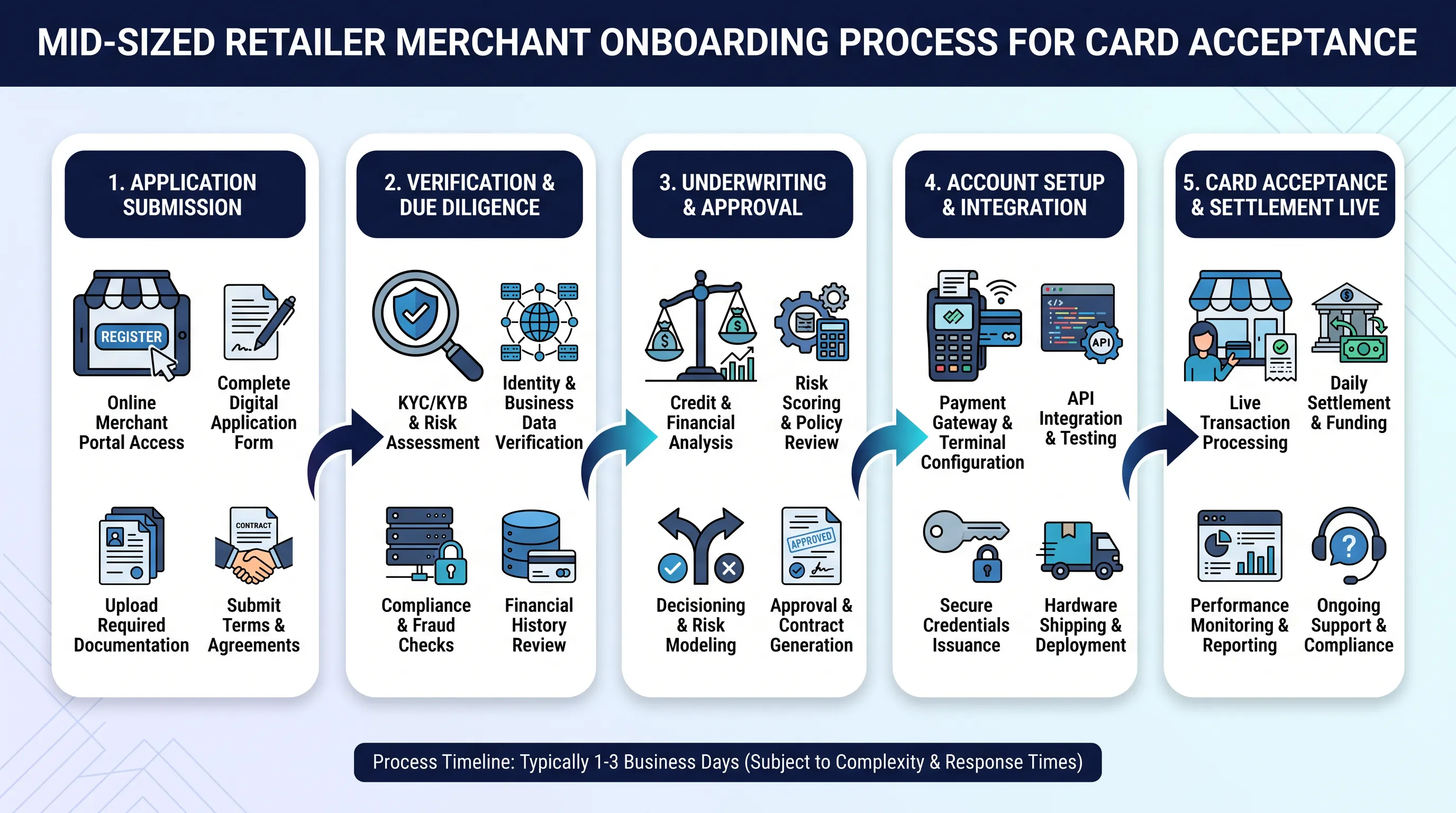
Flowchart detailing the merchant onboarding process for retailers, featuring rounded cards, icons, and arrows in a professional fintech style.

Before fixing merchant onboarding, write down the real sequence of inputs and owners, with elapsed time recorded at each stage. Most teams discover that the merchant onboarding process they describe and the one they run differ by several days.

Map it for a mid-sized retailer applying for card acceptance with a settlement account at a different bank. That profile touches nearly every control you have without being an edge case, which makes it the cleanest baseline to measure against.

Application and verification

Capture starts with business registration details and the intended merchant category. Verification then confirms that the entity exists and that the people signing control it. South African acquirers also need beneficial ownership down to the 5% threshold that the Companies and Intellectual Property Commission (CIPC) applies, and your Risk Management and Compliance Programme under Section 42 of the FIC Act dictates how deep the customer due diligence goes.

The delay here is rarely the verification itself. It's the application that arrived 70% complete and the director identity document keyed in twice because the portal and the case system don't share a record. Each gap adds a day, sometimes two.

Merchant underwriting

Merchant underwriting is where risk review and decision recording happen in a queue. Visa requires acquirers to run a risk-based underwriting process with defined approval criteria and a signing authority matrix, and where agents originate applications, Visa's standards expect shadow underwriting procedures on top. Screening against Mastercard's MATCH database is mandatory before approval, and a listing stays live for five years.

A two-week review comes from reviewers reopening cases because the risk tool sits outside the case system and from decisions recorded in free-text notes that the next reviewer can't trust. Queue depth grows. Control doesn't improve.

Start building your financial platform?

Speak with EGS engineers about open banking, payment infrastructure, cloud systems, and enterprise software.

Get in Touch →

Settlement and approval

Settlement-account validation and contracting form the last stretch before approval. The dependency that hurts most is sequencing. If account validation runs after credit approval, an approved merchant waits on a bank confirmation letter requested only after that approval.

Contracting adds its own lag when pricing needs a second signature and the fee schedule lives in a spreadsheet separate from the platform that will enforce it. Teams then re-verify details already confirmed during merchant underwriting because the approval record doesn't carry evidence forward. That's pure rework.

Channel activation

Approval is a decision. Activation is a configured, tested merchant that can accept and settle a live transaction. Between them sit the processing platform and the operational tooling your support team uses.

This is where the merchant onboarding process breaks silently. A merchant ID exists but isn't linked to the settlement account. A terminal arrives but was never profiled for the merchant category. The gateway key works in sandbox and fails in production. Treat readiness as a verified state with evidence behind it.

Find the bottlenecks

Separate what policy requires from what your workflow and engineering impose. Screening MATCH is a rule. Keying the same director details into three systems is not. The distinction decides whether a fix is a conversation with the regulator or a sprint.

  • Incomplete applications, which push work into asynchronous follow-up where elapsed time stops being measured.

  • Ambiguous ownership between the sales and risk teams, so cases pause without anyone owning the pause.

  • Queue-based review that batches decisions instead of routing them by risk tier.

  • System gaps that force re-entry of data already captured and verified.

  • Handoffs with no acceptance criteria, where the receiving team can't tell whether the work it got is finished.

The commercial consequence sits downstream. Visa's monitoring program flags an acquirer portfolio as excessive at a 0.7% VAMP ratio, and the merchant threshold in most regions tightens to 1.5% from April 2026. Weak data at intake becomes weak monitoring after go-live, which is why onboarding quality is a risk question as much as a growth one.

Start building your financial platform?

Speak with EGS engineers about open banking, payment infrastructure, cloud systems, and enterprise software.

Get in Touch →

Set improvement objectives

Baseline first, then target. You can't claim improvement against a number you never measured, and the first honest measurement is uncomfortable. Pull 90 days of completed cases and time-stamp each stage.

  • Application completeness at first submission, and the proportion needing follow-up contact.

  • Review cycle time by risk tier, with exception rate recorded separately.

  • Handoff delay between approval and the start of configuration.

  • Approval-to-activation elapsed time, and first-transaction success rate within seven days of activation.

  • Rework instances per case and application abandonment.

Set targets against the competitive reality, not internal precedent. Yoco signs merchants to its own agreement and now serves more than 200,000 merchants in South Africa. That's the activation speed your merchant onboarding process is implicitly benchmarked against, whether or not you compete for the same segment.

Build an activation checklist

An activation checklist turns readiness from an opinion into a record. Nothing goes live until each item carries a name and evidence. Approval must be recorded against the merchant underwriting decision, and the settlement account confirmed and linked.

Channels need provisioning and verification separately: merchant ID and gateway credentials in production. Risk controls must be connected so monitoring starts from the first transaction. Then run test transactions end to end through settlement and confirm reporting is visible to the merchant before you tell anyone the account is live.

Connect the workflow

Most acquiring teams already know their policy. What they don't have is a connected path between the systems that enforce it. That's the gap EGS works in: payment-platform engineering and systems integration linking the onboarding front end to processing configuration and the operational tools your support team already uses.

The point is that a verified record captured once should flow into merchant underwriting and into the approval record without a human retyping it. South Africa's regulatory plumbing is shifting underneath all of this too, with the South African Reserve Bank having taken a 50% stake in PayInc in November 2025 and absorbed authorisation functions. Lesego Chauke of the Payments Association of South Africa (PASA) put it plainly: "From the day-to-day perspective, nothing changes in the eyes of the users. The changes at this point are still very much in the backend."

Plan the EGS engagement

A modernisation plan for a team that already understands payments looks different from a vendor pitch. You don't need the acquiring model explained. You need the integration sequence and a delivery order that reflects commercial priority.

Discover and prioritise

The first phase documents the current workflow with its dependencies and failure points and defines the target state in concrete terms. Every finding gets a number attached: days lost and cases reworked.

Then rank the changes. Revenue delay and operational burden dominate, with merchant impact and delivery effort shaping the sequence. Registration timelines matter here too, since PASA's published standard for third-party payment provider registration has been 21 working days after complete documentation, and those are dates you plan around.

Implement and support

Implementation starts with integration design, then builds in the prioritised order, with end-to-end testing across the full path from application to settled test transaction. Release is controlled and monitored in production. Each handoff in the new merchant onboarding process carries named ownership and written acceptance criteria, so a stage is either finished or it isn't.

That discipline pays off at scale. Matt Rubin, Head of Merchant for Middle East and Africa at ACI Worldwide, described South Africa as "a gateway for innovation and scale" when Kwik Payments went live on its orchestration platform. Scale rewards whoever can activate reliably, and penalises whoever can't.

Define the next step

Bring your current workflow and the activation problems you keep hitting. We'll walk the path with you, stage by stage, and show you where the days are going.

Discuss your merchant onboarding bottlenecks with EGS and define a practical path from approval to live processing. Book a call with our payments engineering team.

Start building your financial platform?

Speak with EGS engineers about open banking, payment infrastructure, cloud systems, and enterprise software.

Get in Touch →

Use field-level validation, conditional questions, and a document checklist before submission. Make the form reject missing mandatory values, flag inconsistent registration details, and show which beneficial-owner documents remain outstanding. Record a submission timestamp only after the required package passes these checks, so queue metrics measure review time rather than chasing paperwork.

No. Automation can route low-risk cases, apply defined rules, and collect evidence for review, but accountable staff still need to handle exceptions and approve within the signing authority matrix. Keep an audit trail showing the rule result, reviewer, decision, and reason. This lets faster routing coexist with documented risk control.

Pause activation until the new account is independently validated and linked to the approved merchant record. Recheck whether the change affects ownership, settlement risk, or contract terms, then record who approved the change. The old account should remain traceable, while production credentials stay disabled until the revised record passes control.

Report separate median and upper-percentile times for each risk tier, rather than one blended average. Track cases that exceed the target, rework per case, and abandonment alongside elapsed time. A single average can improve when easy applications increase, even while higher-risk merchants experience longer delays.

The client should provide a recent case sample, system names, stage timestamps, ownership rules, and examples of failed or delayed activations. EGS can then trace one application through approval, configuration, testing, and settlement, separating policy requirements from integration gaps before recommending delivery priorities.

Schedule a Meeting

Book a time that works best for you

You Might Also Like

Discover more insights and articles

A project manager in business casual attire discusses a document intake process with a team in a modern office, focusing on a large monitor.

Bank document intake workflow: A readiness checklist

This article gives you a checkpoint-by-checkpoint method for testing a document intake process before you turn it on. It includes a worksheet structure you can copy into a spreadsheet and the evidence each control needs to produce.

Two business partners collaborate on configuring a POS terminal in a modern office, surrounded by payment devices and colleagues.

EthioPay for Ethiopian Banks: Turn Readiness into a Delivery Plan

This article explains how an Ethiopian bank moves from "we want to participate" to a dated, costed integration plan for the country's domestic card scheme and instant payment rails. It covers service selection and a phased release sequence.

A modern smartphone displaying a mobile banking app lies on a wooden desk, surrounded by abstract payment cards and a notebook.

AfriGO Card Readiness: Plan Your Nigerian Bank’s Rollout

This article is a readiness guide for moving from "we're considering it" to a controlled pilot on Nigeria's domestic card rails. It covers role definition and launch scope, then maps the transaction flow so you can assess systems and assign requirement ownership through the workstream matrix that holds the whole program together.

A professional seated at a desk uses a smartphone and payment card, engaged in online banking in a bright, modern office.

G2P Payments in Africa: Build Reliable Social Payment Infrastructure

This article traces the full lifecycle of a government social payment in Africa, from eligibility approval through to reconciliation and investigation evidence. It assigns operational ownership at each system boundary and sets out how to control exceptions and assisted access.