Real-Time POS Terminal Software Development: Engineering Fast and Secure Payments

Content authorBy EGSPublished onReading time12 min read
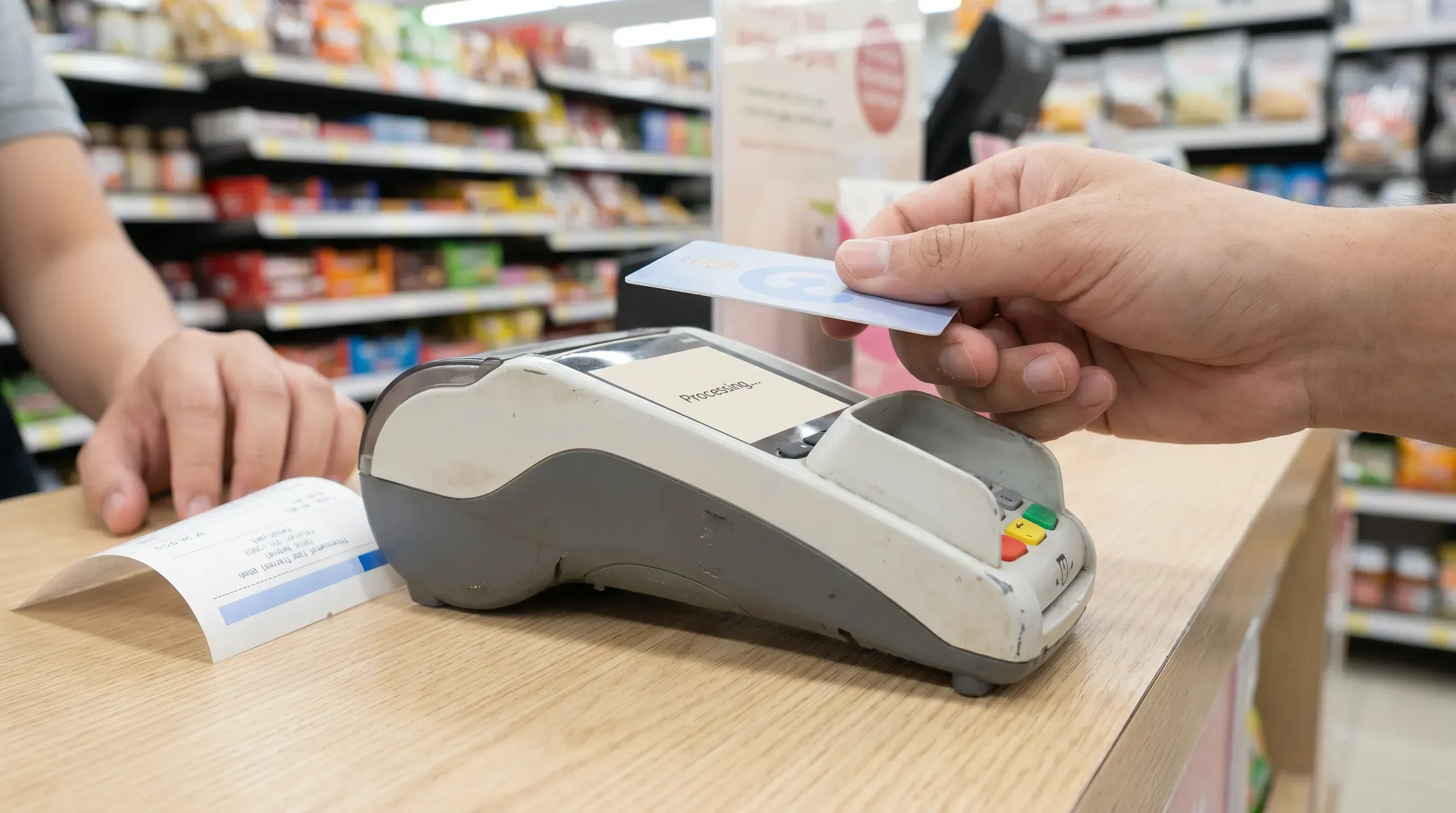
Close-up of hands making a contactless payment at a POS terminal in a retail store, with a blurred background and natural lighting.

This article explains how real-time POS terminal software development shapes the software inside a payment terminal to move a card payment through the device quickly and securely. It follows the layered architecture and traces one transaction from tap to response under the latency budgets and certification rules that shape every choice you make, with offline behavior treated as part of that constraint.

The POS as the edge of payments

Real-time POS terminal software development starts with a reframing: the terminal is the outermost edge of payment infrastructure, the point where a physical card and the global authorization network meet around the merchant. Everything that happens after the tap happens somewhere else, on someone else's servers. The terminal is where the payment becomes real.

That edge position is what makes the software hard. Payment terminal systems run on constrained hardware and have to answer in under a couple of seconds while protecting cardholder data to a standard most applications never face, even though it sits in a public space where anyone can touch it. Each of those pressures pulls in a different direction. You can't optimize one without checking what it does to the others.

This is why writing for a terminal is unlike ordinary application development. The market itself reflects the stakes. The global POS terminal market was valued at $92.10 billion in 2024 and is projected to reach $156 billion by 2030, and real-time pos terminal software development is where vendors now compete. So hold this through-line as you read: every design decision in POS software is a response to the edge it lives on.

Inside real-time POS terminal software development

In real-time POS terminal software development, a modern terminal runs a layered software stack, and the separation between those layers is what keeps the whole thing certifiable and fast. Think of three responsibilities that have to coexist on one device. The stack separates the human-facing layer from the transaction and network work. When you collapse them together, you lose all three properties at once.

The reason for the split is partly engineering hygiene and partly law. The card-reading code has to clear strict certification before it can ship, and recertifying it every time someone changes a button color is expensive and slow. Keep the user-facing code apart, and you can iterate on the experience without disturbing the part the auditors care about. The market has noticed this logic. Mordor Intelligence reports that terminal software revenue is growing at a 9.83% CAGR, which outpaces hardware because remote updates and modular software now decide which terminals stay competitive.

In payment terminal systems, the three layers must still behave as one coherent runtime under a shared latency budget. In real-time POS terminal software development, this is where most of the engineering effort goes, and where most of the risk hides. A clean diagram on a whiteboard says nothing about whether the layers actually hand off cleanly under load. The subsections below define each layer's job so you can tell a real separation of concerns from one that exists only on the slide.

The merchant UI layer

This is the layer the cashier or customer touches. It controls the checkout flow from the first prompt to the receipt, with peripherals like the printer and the PIN pad tied into that flow. It's the part of the system everyone sees, which is why it carries the brand and absorbs the most feature requests.

It also has to stay strictly walled off from anything that touches card data. The reasoning is both practical and regulatory. A PIN pad on a PCI PTS v7.0 certified device like the PAX A77 keeps PIN entry inside a secure perimeter the UI never reaches, which means your customer-facing code stays out of the cardholder data environment. Keep that boundary clean, and the UI sits outside PCI scope, so you can change it freely.

The tension is real and worth naming. The business wants a branded checkout, and the secure runtime wants the smallest possible attack surface. Good architecture in real-time POS terminal software development resolves this by making the UI request actions while the secure runtime performs them. When the UI says "collect a PIN," the secure layer collects it and the UI never sees the digits. If you can see that handoff in a vendor's design, the separation is genuine.

Start building your financial platform?

Speak with EGS engineers about open banking, payment infrastructure, cloud systems, and enterprise software.

Get in Touch

The transaction processing layer

In real-time POS terminal software development, this is the engine that reads the card and builds the transaction. It handles EMV chip over contact and NFC contactless, with magstripe kept as a fallback. Each speaks a different protocol to the card, and this layer's job is to turn all of them into one consistent transaction object the rest of the stack can use.

The heavy security weight sits here, because this is where the card data is captured and the cryptographic checks run, with PIN handling inside the secure flow. The EMV processing depends on two certification tiers. EMV Level 1 covers the interface between the device and the card, from physical contact to radio behavior. Level 2 covers the kernel, the software that runs the actual EMV logic. As EMVCo defines it, the kernel is "the software component, commonly known as the 'kernel' or 'payment application', that resides on an acceptance device." Certification gates this layer, which is why you cannot treat the kernel as ordinary code.

During a chip read, the kernel does more than pull the card number. It runs offline data authentication with public-key cryptography and applies terminal risk management after cardholder verification. The EMV specification forces a transaction online or aborts it under three issuer-defined rules tied to cumulative offline value and transaction count, with a random descending amount limit as an additional issuer control. When you scope this layer with a build partner, the questions that matter are which kernels they hold certification for and which entry modes they actually support.

POS transaction software and switch integration

This is the communication layer in POStransaction software, the part that talks to the acquirer or payment switch. For card transactions, the dominant language is ISO 8583, and it's worth understanding plainly because it shapes most of your integration cost. An ISO 8583 message is built from a Message Type Indicator and a bitmap that points to the data elements. The indicator is a four-digit code, where 0100 means an authorization request and 0110 means the response. The bitmap is a clever index where each bit flags whether a given field is present, so a balance check can carry 10 fields while a full purchase carries 40 without wasting space.

Here is the honest part. ISO 8583 defines the concept, but every switch bends it. As the Increase engineering team puts it, "some networks deviate from these values and retain only the general concept," and the serialization itself varies across character and binary encodings. A developer who integrated with Nigerian processors found that each processor had different bitmap usage patterns, so the configuration had to stay flexible. That dialect problem is the integration cost most POS transaction software underestimates.

Newer interfaces exist, and you should weigh them without overstating their reach. ISO 20022 and REST APIs are spreading in cross-border and faster-payment rails, but Visa's own analysis notes that for card networks the business case remains limited given how deeply ISO 8583 is embedded. So the dialect-handling work in your POS transaction software is not going away soon. This layer also owns connection handling and retry logic, with dynamic routing used because the switch link is the most failure-prone part of the chain. Robust payment terminal systems treat a dropped connection as a normal event.

A transaction from tap to response

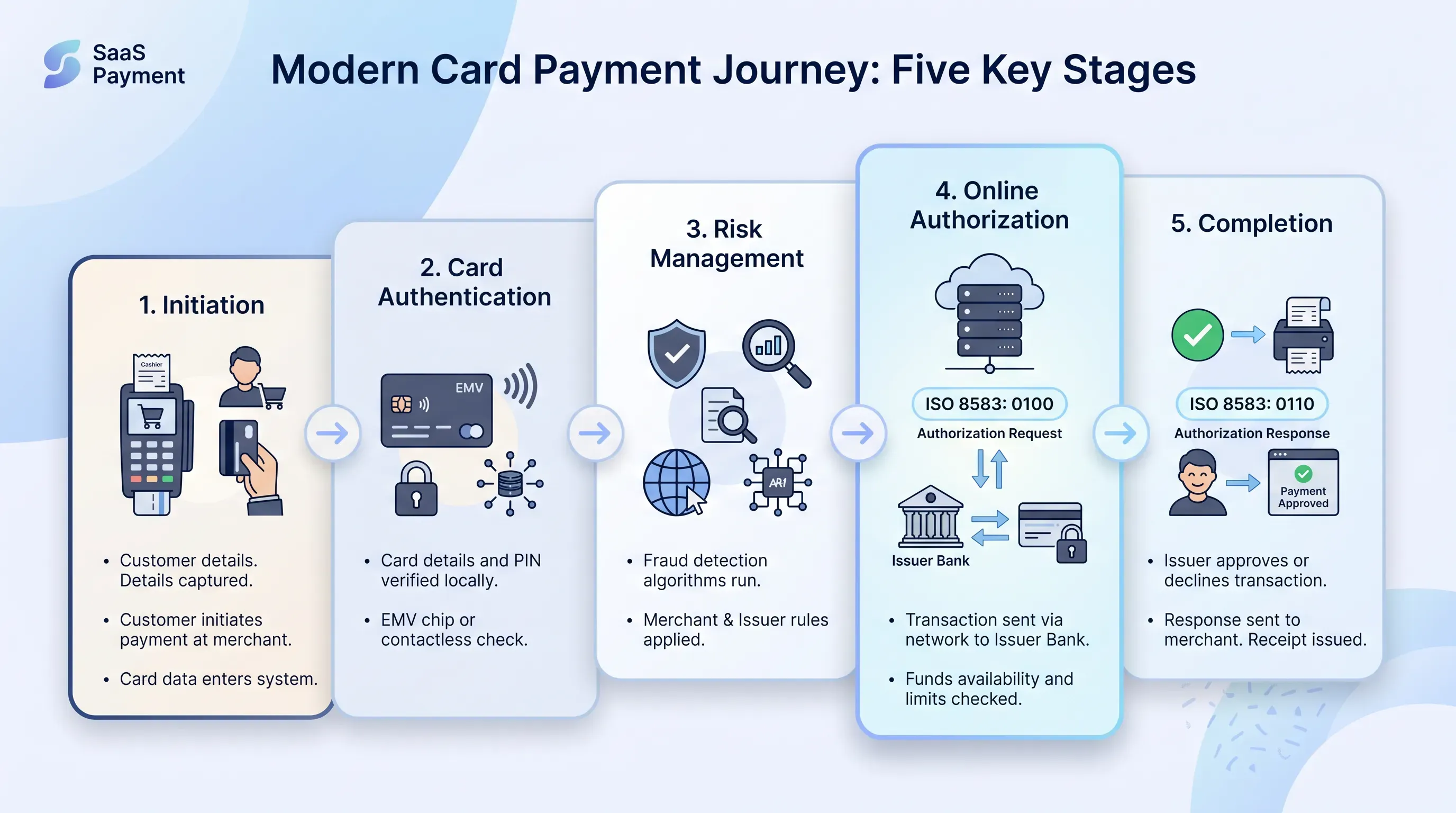
Modern infographic illustrating the card payment transaction journey in five stages, featuring soft gradients, icons, and annotations.

Follow a single payment through the stack you just met. The cashier enters an amount in the merchant UI layer, and the customer taps or inserts a card. The moment the card is presented, control passes to the transaction processing layer, and the UI shows a spinner.

The kernel takes over. For a chip card it selects the payment application and reads the card records before offline data authentication confirms the card is genuine. It verifies the cardholder, then applies terminal risk management against the floor limit and the issuer's parameters to decide whether this transaction needs to go online. As the Secure Technology Alliance notes, "most EMV chip transactions are now authorized online," so in the common case the kernel decides the answer must come from the issuer.

Start building your financial platform?

Speak with EGS engineers about open banking, payment infrastructure, cloud systems, and enterprise software.

Get in Touch

What happens after a customer taps their card

Now the switch integration layer in POS transaction software assembles the request. It builds an ISO 8583 0100 message from the card data and processing code, with the amount and timestamp included, and the bitmap flags exactly which fields are present before the request moves through the switch toward the card network and the issuing bank. The issuer checks the account and available balance against its fraud rules, then sends back a 0110 authorization response with an approval or decline code.

The response travels back the way it came. The switch layer parses the 0110, and the transaction processing layer records the result with the final EMV cryptogram before control returns to the UI, which prints the receipt and tells the customer they're done. In real-time POS terminal software development, one tap sends two ISO 8583 messages across the planet and back through the stack, all inside the window before a customer starts to wonder if something broke.

Latency budgets and offline modes

That window is the hard constraint behind everything. For card payments the round-trip authorization takes one to three seconds under normal conditions, and push past five and you start losing customers. So every layer operates inside a tight budget, and the fraud check alone must return in under 100 milliseconds at the 99th percentile. Tail latency is what matters, because the spike during peak traffic is exactly when the timeout hurts.

Then the connection drops. A terminal that simply fails here is useless in real-world payment terminal systems, so store-and-forward logic exists to keep the lane moving. When the switch is unreachable, the terminal authorizes locally within configured risk limits, then queues the transaction securely until it can sync.

A sound offline mode does the following:

  • Authorizes within preset risk limits after an amount check against a floor limit and a Bank Identification Number (BIN) screen

  • Encrypts each approved transaction for a secure local queue, then forwards the batch for settlement the moment connectivity returns

Offline mode is a deliberate engineering feature with liability attached. The trade-offs are concrete. Stored transactions carry time limits, because the longer one sits, the higher the chargeback exposure if the card turns out to be bad. Duplicate detection has to run so a transaction queued offline isn't also sent online, and reconciliation must run on every sync to confirm that what the terminal stored matches what the backend settled. The EMV specification leans on the same idea and requires a card to go online once the cumulative offline amount or the count of consecutive offline transactions crosses the issuer's limit. Decide those thresholds with your acquirer, because they are choosing how much risk you absorb.

Security and PCI PTS compliance

Security in real-time POS terminal software development is architectural from the first line of code. The governing standard for the device is PCI PIN Transaction Security (PTS) Point of Interaction (POI), which sets the requirements for secure PIN entry and cardholder data encryption, with physical tamper protection and cryptographic key handling inside the same control model. The current v7.0 standard introduced 59 requirement changes for biometric interfaces and open software platforms, with wireless connectivity also inside its scope. Get this wrong and the device fails deployment, which is why it shapes the build.

The protections interlock as one system. Secure boot establishes a hardware root of trust so the device runs only signed firmware from the first instruction, and tamper detection responds to physical attack by zeroizing keys. Adyen's PCI PTS 6 work describes mandatory three-year firmware revalidation alongside secure boot, and runtime integrity checks make the certification continuous. These hardware guarantees are what let the higher layers trust the data they handle.

Above the device, two techniques shrink your exposure. Point-to-point encryption (P2PE) encrypts card data the instant the card is tapped or inserted, before it reaches any of your systems, and a PCI-validated solution can lower PCI scope by up to 90%. Tokenization then replaces the stored account number with a meaningless surrogate, so a breach yields nothing usable. The two work as a pair: P2PE keeps clear-text data out of the environment, and tokenization keeps it out of storage. Underneath both sits key management, which is the quiet thing that breaks programs when it's an afterthought. Keys must be generated and stored inside the secure boundary, with rotation governed there too, because a perfect encryption scheme with sloppy keys protects nothing.

Why end-to-end POS engineering wins

A terminal app on its own is half a solution in real-time POS terminal software development. The value lives in the whole chain, from the secure runtime on the device through switch integration to the backend that handles authorization routing and settlement. The transaction you followed earlier touched all of it, and a gap anywhere shows up as a failed payment or a reconciliation mess.

Fragmenting that chain across vendors is where projects stall. One vendor ships the terminal app while another owns the backend, and the ISO 8583 dialects don't line up at the seam. When a payment fails, that seam obscures ownership. The certification headaches compound because PCI PTS and EMV kernel approvals assume a coherent system. A single partner who owns both the terminal and the backend removes those seams and cuts time to market.

That is the position EGS takes as a payment terminal systems engineering partner: it owns the full path from the secure terminal runtime to the backend so the whole chain becomes one accountable build. If you're scoping a roadmap and want a clear read on what real-time POS terminal software development requires end to end, reach out to discuss your build.

Start building your financial platform?

Speak with EGS engineers about open banking, payment infrastructure, cloud systems, and enterprise software.

Get in Touch

You should test transaction flows, security boundaries, and switch message handling before release. Include contact, contactless, PIN, reversal, refund, timeout, and offline queue cases. If the update touches EMV kernels, secure PIN entry, or certified firmware, confirm whether it triggers recertification before deployment.

They prevent duplicates by assigning each transaction a unique reference and checking it during sync. The backend should reject repeated references and reconcile terminal batches against settled records. This matters because a payment can move from offline to online after connectivity returns.

A merchant should use store-and-forward mode only when the acquirer has approved the risk rules. The terminal needs floor limits, BIN checks, encrypted storage, and a sync deadline. Higher offline limits increase the chance of chargebacks if the issuer later declines the stored transaction.

Yes, real-time POS terminal software development can reduce PCI scope when the architecture keeps clear-text card data inside certified components. P2PE encrypts data at capture, while tokenization avoids storing the primary account number. The UI and merchant systems should receive only non-sensitive references.

Choose a partner by checking certified kernel support, ISO 8583 experience, backend ownership, and release controls. EGS, the client named in the article, frames the work as one accountable build across the terminal and backend. Ask for evidence from prior acquirer integrations and certification work.

Schedule a Meeting

Book a time that works best for you

You Might Also Like

Discover more insights and articles

A realistic workbench scene with a disassembled POS terminal, engineers' hands, certification documents, and a laptop in a professional workshop.

Embedded POS Software: Engineering Payment Systems at Device Level

This article explains what changes when you engineer embedded POS software by moving the payment stack into the device itself instead of building an app on someone else's certified terminal. It walks through the engineering layers involved, with the constraints behind each decision folded into how certification reshapes the entire project from day one.

Fraud operations analyst at a multi-monitor workstation in a modern fintech office, focused on investigating suspicious transactions.

Anti-fraud architecture for layered digital fraud defense

This article explains anti-fraud architecture as one connected stack of coordinated controls. It walks through the layered model end to end: each layer's job at its place in the customer journey, plus the way the layers feed one another so decisions sharpen over time.

An IT professional reviews a network architecture diagram on a large monitor in a naturally lit office, with realistic desk clutter.

Payment security architecture for PCI DSS-aware payment flows

This article shows how payment security architecture decides your compliance scope before you write a single control. It walks through where data substitution sits in the flow and what each placement does to the cardholder data environment. The artifacts a QSA will demand during a PCI DSS compliance assessment come later.

A candid business meeting in a modern office with professionals discussing reports around a table, surrounded by natural light and greenery.

Payment Authorization Engine: Designing Low-Latency Decision Systems

This article explains what a payment authorization engine is and how teams can use it to approve more good transactions without inviting fraud or operational overhead. It grounds the basics in familiar credit card authorization, then shows how the engine fits inside a wider payment orchestration setup.