How Payment Systems Protect Card Data Across the Transaction Lifecycle

Content authorBy EGSPublished onReading time17 min read
A modern corporate office with engineers discussing a large digital dashboard displaying card data protection metrics and compliance statistics.

Payment systems protect card data with encryption and tokenization wherever the data moves or rests. Masking limits its display. Hardware security modules and token vaults enforce those controls through tightly scoped APIs. The strongest designs remove plaintext card data from general systems at capture, so most components never touch a real card number at all.

Card data requires different protections

Different card fields carry different risk, which is why one storage rule cannot cover all of them. Cardholder data includes the primary account number (PAN) and cardholder name; the expiry date also belongs to this class, and proper protection permits storage of these fields. Sensitive authentication data is a separate class, and it behaves differently under the rules.

Sensitive authentication data (SAD) includes the full magnetic stripe or chip track data and the card verification code (CVV/CVC/CID). The personal identification number (PIN) or PIN block also belongs to this class. According to PCI Pal's data security glossary, sensitive authentication data must never be stored after authorization even when it is encrypted, because its exposure lets an attacker build a working counterfeit card or run fraudulent PIN debits.

That distinction changes how you design storage before you write a line of schema. A CVV must be removed after the authorization response returns from any database or cache, and the same rule applies to logs. The field has to be gone. Treat SAD as data you handle briefly before disposal, and treat the PAN as data you minimize under full protection and accountability.

Protection depends on three complementary controls

Encryption and tokenization solve different exposure problems, while masking addresses what people can see. A sound design assigns each control a specific job. Encryption protects data that has to travel or sit at rest. Tokenization removes the real PAN from systems that never needed it. Masking limits what a human sees on a screen.

The mistake worth naming is treating them as interchangeable. A team that tokenizes but logs the full PAN in an exception trace has not reduced its exposure, and a team that masks a receipt while storing the PAN in plaintext has protected nothing that matters. Each control closes a gap the other two leave open.

Here is the clean division of labor:

  • Encryption keeps intercepted or stolen data unreadable without the key.

  • Tokenization keeps the real PAN out of workflows that only need a reference.

  • Masking keeps card numbers off screens and reports where people don't need to see them.

Map your card-data flow first, then place each control where its specific problem actually lives. That ordering is what turns three separate techniques into one coherent protection model.

Encryption makes intercepted data unreadable

Encryption protects card data in transit and at rest by converting it into ciphertext that only authorized systems holding the right key can recover. Intercept the traffic or steal the disk, and you get noise.

Its strength lives almost entirely in the details around it. Because exploits such as POODLE and BEAST affect older protocols, PCI DSS Requirement 4.2 prohibits SSL, TLS 1.0, and TLS 1.1 for protecting cardholder data in transit. TLS 1.2 and TLS 1.3 are the acceptable versions.

The protocol version is the easy part. What defeats real encryption is poor key management. Examples include keys stored beside the data they protect and applications that decrypt freely whenever they want; the absence of a rotation schedule creates the same weakness. Separate key custody from data custody and rotate on a defined schedule. Give token-only services the token in place of plaintext.

Tokenization removes PANs from workflows

Tokenization replaces a PAN with a reference value that has no exploitable meaning outside the system that issued it. Recurring billing and refunds run on the token. Analytics uses it as well, so those downstream services never touch a real card number.

The scope payoff is direct. The PCI Security Standards Council's tokenization guidance states that a properly implemented solution will remove the need to retain PAN once the initial transaction is processed. This reduces the number of system components inside the cardholder data environment.

What the guidance implies, and teams miss, is that the vault becomes the most sensitive component you run and remains in scope. The token itself is worthless, so your entire risk consolidates into the vault and the detokenization path. That is a feature when strong encryption and strict access control protect the vault. Isolation and complete audit logging reinforce that protection. It is a single point of catastrophic failure when you don't.

Masking limits visible card data

Masking hides most of a PAN on screens and receipts wherever a person reads it. The same protection applies to support tools and reports, so no one sees a full card number without a reason. A support agent viewing the last four digits can still identify a transaction without holding data worth stealing.

Here is the line that matters for a technical audience: masking is a display control and nothing more. It changes what renders while stored and transmitted data remain unchanged. PCI DSS Requirement 3.4 restricts display of the full PAN and the ability to copy it, which is a separate obligation from rendering stored PANs unreadable under encryption or tokenization.

So a masked receipt sitting on top of a plaintext database is a decorated liability. Masking reduces the human exposure layer, and you still need encryption or tokenization underneath it to protect the data itself.

How is each lifecycle stage protected?

Modern SaaS infographic illustrating card data flow from capture to storage, featuring distinct stages, icons, and risk stats.

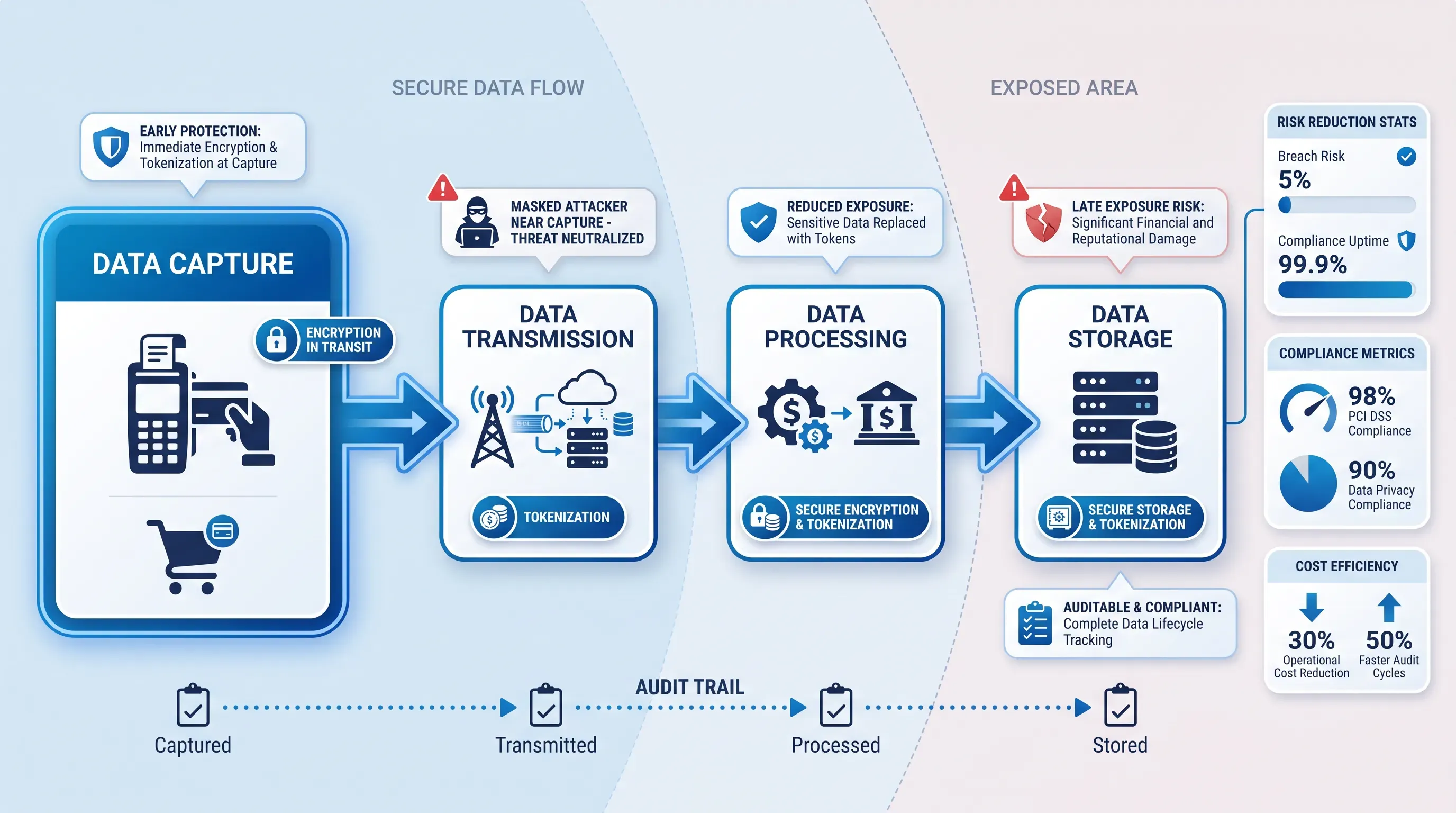
Each stage of a transaction is protected at the boundary where card data changes hands, and the whole design succeeds or fails on how early you stop plaintext from spreading. Follow one card payment from the moment someone taps a terminal to the moment the record is stored, and you can name the control at every handoff.

Protection is cheapest and strongest at the source. Every system that receives plaintext becomes something you must secure and audit, with accountability for its role, so the goal is to keep the number of those systems near zero. Repairing exposure after card data has already spread through your stack costs more time and money, and gaps can remain.

Start building your financial platform?

Speak with EGS engineers about open banking, payment infrastructure, cloud systems, and enterprise software.

Get in Touch

Capture protects data at the source

Capture is protected when raw card data is encrypted or tokenized before it can enter your application or network. Certified EMV terminals and hosted payment fields work toward keeping the merchant environment from handling a plaintext PAN. Mobile SDKs and point-to-point encryption serve the same goal.

The browser and the device are where this breaks. Magecart web skimmers inject malicious JavaScript into checkout pages to harvest card numbers as they are typed. Recorded Future's 2024 fraud report counted nearly 11,000 unique e-commerce domains infected with e-skimmers, roughly triple the prior year, much of it driven by the CosmicSting vulnerability.

That number tells you capture is now the front line of defense. Guard it with authorized, integrity-checked payment scripts and terminal tamper detection. Capture flows should hand you a token in place of a card number.

Transmission uses authenticated encrypted channels

Card data in motion is protected by current transport encryption combined with endpoint authentication and certificate validation, so both ends prove who they are before anything sensitive crosses the wire. That applies between terminals and apps, with the same protection extending from gateways through processors to banks.

TLS protects a single connection, and that is its limit. The moment traffic terminates at an intermediary, TLS decrypts it, which is why payload encryption or a validated point-to-point encryption (P2PE) solution matters when data passes through hands you don't control. A PCI-validated P2PE solution keeps card data encrypted from the terminal to the processor's secure environment and can reduce a merchant to SAQ P2PE with 35 questions instead of the 300-plus in SAQ D.

Read that scope gap as a design signal. When protection survives across intermediaries instead of stopping at each connection, you remove entire stretches of your network from the plaintext blast radius.

Processing isolates sensitive operations

Processing is protected inside a tightly segmented cardholder data environment that handles authorization and routing. PIN operations also stay there, and strict controls make PAN and key access rare. Only the components that need plaintext or a cryptographic key belong inside that boundary.

Segmentation is what makes scope reduction real. The PCI SSC tokenization supplement notes that adequately segmented systems isolated from the tokenization system and the CDE can fall outside assessment scope, while anything connected to it stays in.

The implication for your architecture is that the CDE must be small enough to draw on a diagram and defend line by line. Constrain it through least privilege and HSM-backed cryptography for key operations. Use APIs that expose only the fields a service needs, and maintain audit trails that record every touch of a PAN. A processing tier that can reach card data but doesn't need to is scope you're paying for and risk you're carrying.

Storage minimizes retained card data

The safest storage strategy is to store no card data at all unless a documented business need forces the decision. If you don't need the PAN after authorization, discard it, because data you never retained cannot be breached or leaked. It also cannot be subpoenaed.

Where retention is genuinely required, the controls are non-negotiable. PCI DSS Requirement 3.2.1 keeps account data storage to a minimum through data retention and disposal policies. This means you define how long you keep a PAN and enforce deletion, with proof that the process works.

Protect retained PANs with tokenization or strong encryption and monitor access. Secure your backups to the same standard as your live database. Then verify the one thing teams forget: no CVV or track data survived anywhere after authorization. Check for PIN blocks as part of the same verification. A retention policy you wrote but never tested against your actual storage is a policy that fails at the worst possible moment.

Three components enforce the protection model

Policy becomes enforceable when specialized infrastructure draws the technical boundaries that people otherwise cross by accident. Three components carry most of that weight, and each answers a build-or-buy question your team has to settle before launch.

A hardware security module isolates keys and cryptographic operations. A token vault separates real PANs from your applications. Secure APIs govern every exchange between services. You can run these yourself or consume them from a validated external provider; the answer depends on how much of the payment stack you intend to own. What follows is what each one does and where its protection stops.

HSMs isolate keys and cryptographic operations

A payment HSM is a tamper-resistant device that generates and stores cryptographic keys. It uses those keys for sensitive operations on PINs and payment messages, so keys never exist in plaintext outside dedicated hardware. Try to open the device and it erases its secrets.

The certification bar is specific. AWS Payment Cryptography documents that its HSMs are FIPS 140-2 Level 3 validated and listed as PCI PTS HSM v3 compliant. That standard adds controls for manufacturing and shipment, as well as lifecycle oversight that FIPS 140 alone does not cover.

Here is the trap. An HSM strengthens key custody, and it does nothing for an application that is authorized to call it freely. If a compromised service can ask the HSM to decrypt on demand, the hardware faithfully hands back plaintext. Strong key storage does not fix weak application authorization or sloppy key lifecycle procedures.

Start building your financial platform?

Speak with EGS engineers about open banking, payment infrastructure, cloud systems, and enterprise software.

Get in Touch

Token vaults separate PANs from applications

A token vault maintains the mapping between each token and its original PAN, so your ordinary business systems operate on tokens while the real card numbers stay locked in one guarded place. Detokenization is the only path back to a PAN. Keep that path narrow and logged, with access granted only in rare cases.

Because everything sensitive concentrates in the vault, its own scope obligations never go away. The PCI SSC states that all elements of the tokenization system, including de-tokenization and PAN storage, are part of the cardholder data environment and in scope for PCI DSS.

In practice, the vault deserves your heaviest controls: encryption at rest and strict, monitored detokenization. Tenant or merchant separation prevents one client from reaching another's cards. High availability and complete logging round out the protection. Consolidating risk into one component only pays off if that component is genuinely the hardest thing in your stack to break.

Secure APIs restrict every data exchange

Secure payment APIs expose only the fields a caller needs and enforce strong authentication. They apply object- and function-level authorization alongside transport security. Input validation and rate limits constrain requests, and audit records preserve each one. Every gap in that list is a path to card data or an unauthorized detokenization call.

Authorization is where this fails most. Broken Object Level Authorization sits at number one on the 2023 OWASP API Security Top 10, because endpoints that trust a user-supplied object ID let an attacker walk through records that belong to someone else.

Apply that directly to a token-to-PAN service. An endpoint that returns more than the caller asked for, or detokenizes without checking who is asking and whether they are allowed, turns your best protection into an open door. Design APIs to deny by default and return the minimum. Record every request so an anomaly has somewhere to show up.

How can teams reduce PCI DSS scope?

Scope shrinks when you reduce where card data exists and isolate every system that stores or processes it. The same boundary must cover systems that transmit the data or can affect its security. Fewer places holding a PAN means fewer components an assessor has to review and fewer places an attacker can reach.

Under PCI DSS 4.0 scoping guidance, tokenization directly reduces scope by replacing the PAN with a surrogate and storing real card data in a Level 1 vault, which pulls token-only systems out of the cardholder data environment. That produces a smaller assessment and a tighter incident blast radius, with centralized evidence.

A practical scope-reduction sequence looks like this:

  1. Map the full card-data flow from capture to deletion, so you know every system that touches a PAN.

  2. Eliminate storage you cannot justify with a documented business need.

  3. Capture through validated methods and tokenize early, before card data spreads.

  4. Segment the cardholder data environment and use compliant service providers where it fits.

One warning worth taking seriously: encryption alone does not automatically move a system out of scope, and if your team holds the decryption keys, that data is still yours to protect. Confirm every boundary with a qualified assessor before you rely on it.

Most failures expose overlooked data paths

Layered controls break along data paths that nobody mapped. The encryption and vault held, but card data leaked through a debug log or stale backup. An API that returns one field too many provides another path for the same leak. Treat what follows as review points for threat-modeling a real architecture, each paired with the fix.

The pattern across all four is the same. Protection was designed for the main flow, and card data escaped through a side channel the design ignored. Find those channels before an attacker does.

Endpoints can leak data before encryption

Endpoints leak card data in the window before encryption applies or after decryption happens, which is exactly where cryptography offers no cover. Web skimmers and tampered terminals read plaintext at the source. Unsafe SDKs do the same, as do card numbers left in application memory.

The browser is the sharpest example. Sansec reported that after the CosmicSting fix shipped, 75% of Magento stores stayed unpatched a week later. Skimmers therefore remained free to harvest cards straight off checkout pages.

That lag points to an operational risk alongside the technical one. Control your scripts and dependencies, and run terminal integrity checks. Harden endpoints and monitor for tampering. Design flows that keep plaintext out of general-purpose systems where memory can be scraped.

Logs and backups retain hidden PANs

Logs and backups quietly expand your cardholder data environment by capturing PANs you never intended to store. Verbose API payloads and exception traces become unmanaged copies of card data. The same happens in analytics pipelines and support screenshots, as well as in message queues and old backups.

This matters because PCI DSS Requirement 3.2.1 demands you keep account data storage to a minimum with disposal policies, and a PAN sitting in a log file six retention cycles deep violates that whether or not you knew it was there.

The uncomfortable inference is that your CDE is probably larger than your architecture diagram claims. Run data discovery scans and filter logging with field allowlists. Mask what does render and enforce retention limits. Test deletion to prove that a PAN is actually gone.

Weak key controls defeat strong encryption

Weak key controls undo strong encryption completely, because an attacker who holds the key does not need to break the cipher. Exposed keys and shared administrator access turn sound cryptography into decoration. Missing rotation has the same effect, as do applications that can decrypt whatever they like.

This is why PCI DSS pairs encryption with key management. HSMs that meet FIPS 140-2 Level 3 or higher satisfy the requirement for secure key storage, and dual control keeps any single administrator from acting alone.

The lesson is to protect the key with more rigor than the data it locks. Put keys in HSM-backed custody and enforce dual control with least privilege. Define rotation and retirement procedures, then monitor every cryptographic operation. Test your recovery plan before you need it. A key one insider can quietly copy is not protecting anything.

Overprivileged APIs expose tokens and PANs

Overprivileged APIs hand attackers tokens and PANs through paths the design left open. Broken authentication and object-level authorization flaws create exploitable routes into card data. Oversized responses and forgotten endpoints do the same. Unrestricted detokenization opens another route.

The damage scales fast. A single unauthenticated endpoint leaked 37 million T-Mobile customer records through a BOLA-class flaw, which shows what one missing authorization check costs at API scale.

Applied to a payment platform, an undocumented or overpermissioned detokenization endpoint is the highest-value target you can leave exposed. Keep a live endpoint inventory and enforce deny-by-default authorization. Issue short-lived credentials and minimize responses. Rate-limit calls and run security testing. Watch for anomalies. An endpoint you forgot you shipped is an endpoint no one is guarding.

Build safer payment infrastructure with EGS

Before a payment platform launch or redesign, trace your actual card-data flow and find where plaintext still spreads further than it should. Take the same step before a PCI DSS assessment. That review is where most control gaps and scope surprises surface.

Energize Global Services (EGS) is a technology partner with hands-on experience in banking systems and point-of-sale terminal software. Its experience extends to EMV and contactless payments, with mobile payments as another area of work. Its work also covers e-wallets and HSM integration. It also works on e-commerce gateway and processing solutions, which are part of the same stack this article walks through.

An EGS review covers your card-data flow and identifies control and PCI DSS scope gaps. The findings support a plan for secure custom payment infrastructure. Engineering support of this kind sharpens your architecture and your evidence, and it works alongside a formal compliance assessment by a qualified assessor rather than replacing it.

Start building your financial platform?

Speak with EGS engineers about open banking, payment infrastructure, cloud systems, and enterprise software.

Get in Touch

No. Delete the CVV after the authorization response, even if the customer agrees to recurring billing or the database encrypts it. Use a payment token for later charges instead. Check application logs, caches, support tools, and backups because a copied CVV remains prohibited stored authentication data.

Treat the backup as cardholder data and protect it under the same rules as the live database. Identify every copy and restrict restoration access. Set an expiry that matches the documented retention need. If the PAN wasn't supposed to be retained, remove the backup copy and record the remediation.

Confirm deletion by testing the actual data paths rather than relying on a policy document. Search every production repository and backup for PAN and prohibited authentication data after the retention job runs. Keep the test results, then investigate each match until the data is removed or its retention has documented approval.

No. A payment token doesn't reveal a PAN by itself, but an unauthorized caller can use it to charge, refund, or retrieve account-linked information if an API accepts it without proper checks. Restrict token access to the intended merchant and operation. APIs should validate the caller before they use a token.

Remove access to the affected logs, stop the logging path, and treat the copies as cardholder data while you investigate. Find downstream log indexes and backup copies, then delete them through a verified process. Determine whether unauthorized access occurred and follow your incident-response and PCI DSS reporting procedures.

Schedule a Meeting

Book a time that works best for you

You Might Also Like

Discover more insights and articles

A modern banking operations center featuring a central dashboard with transaction flow stages, bank engineers monitoring the system.

How Financial Institutions Process Transactions in Real Time

A financial institution processes a transaction in real time through an always-available system that validates and posts it in seconds, with decision and confirmation built into the flow. An incoming request passes through synchronous APIs for immediate checks and asynchronous events for parallel work. Authorization and fraud screening finish inside the same tight, continuous window as ledger posting and customer notification.

A close-up of a hand inserting a payment card into a POS terminal, with a laptop nearby and soft daylight illuminating the scene.

What Happens Behind the Scenes of a Card Payment

A card payment runs in two separate acts. Authorization takes about two seconds and only reserves money: the terminal sends a message through the acquirer to the issuer, which replies approve or decline. Clearing then batches that sale and settlement moves the actual funds, so the merchant is paid one to three business days later.

A modern office desk displays six realistic payment devices connected by blue and white arrows, emphasizing a card payment ecosystem.

How Payment Transactions Are Routed Between Banks, Switches, and Processors

A card payment travels from the terminal through the acquirer's processor and a switch that picks the path before crossing the card scheme to the issuing bank and returning along the same chain with an approve or decline. Six participants move the payment in two directions on a round trip that finishes in under two seconds.

A collaborative fintech team discusses around a central table, with a hand-drawn workflow diagram on a whiteboard in a modern office.

Top Security Mistakes in Fintech Infrastructure (and How to Avoid Them)

The most damaging fintech security mistakes are architectural rather than tactical. Weak identity controls and secrets stored in code are common examples. Flat networks can also cause damage. Incomplete logging and fraud detection that never talks to the security stack create further risks. Each one lets a single compromise reach money movement and customer data at once, which is why they must be designed out before launch.