Regulated Wallet Infrastructure: Designing Secure Multi-Rail Wallets

Content authorBy EGSPublished onReading time11 min read
A modern office workspace featuring a laptop with a financial dashboard, a hand typing, and various desk items in natural light.

This article is a design guide for building a wallet that holds and moves real customer money across more than one payment rail. It walks through the ledger and the transaction engine, then connects those layers to KYC-gated accounts and rail integrations, with the deepest focus on reconciliation, because that is where most builds quietly break.

What a regulated wallet really is

Regulated wallet infrastructure is the system of record that holds fiat under a license or a partner bank and stays legally accountable for every cent it moves. That is a different animal from a self-custody "crypto wallet," even though the two share a name. One is an authoritative ledger of balances you owe real people. The other is a key manager that signs transactions for assets sitting on a public chain, where the network itself keeps the record.

The confusion is not academic. When a team carries mental models from key management into regulated wallet infrastructure, they underestimate the accounting rigor a money-holding system demands and treat balances as editable numbers. A double-entry ledger for wallet apps exists to prevent exactly that, because money must never appear or disappear between two accounts.

So this piece is about compliant wallet systems of the regulated kind. If you are replatforming a wallet that has to stay accurate to the cent and satisfy an examiner as volume climbs, the rest of this guide is a working definition you can design against.

Core components of regulated wallet infrastructure

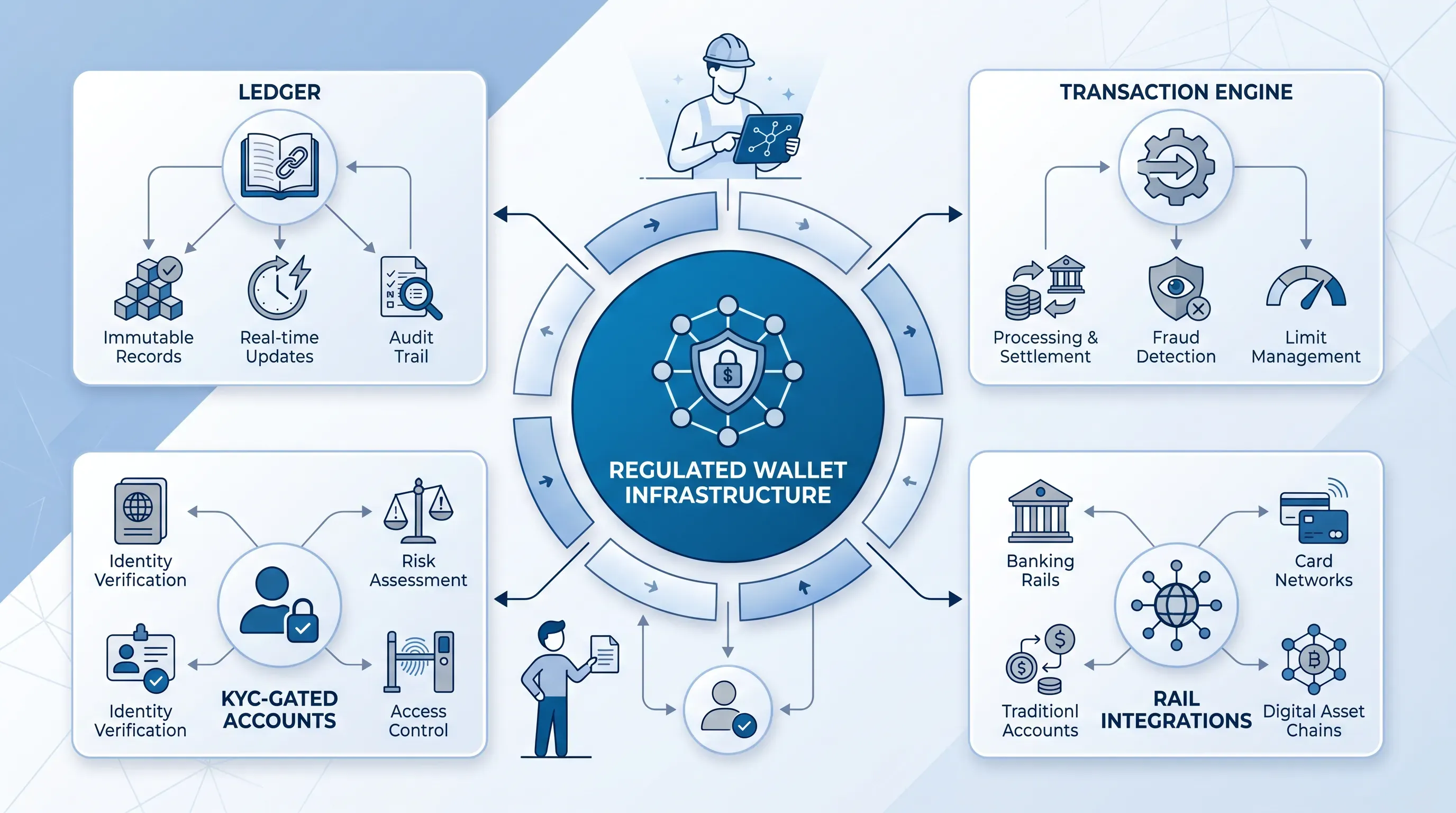
Modern infographic cluster diagram illustrating 'Regulated Wallet Infrastructure' with four related clusters and user engagement icons.

Before going deep on any single layer, it helps to see the whole map. Regulated wallet infrastructure rests on four building blocks, and in a fiat wallet none of them are optional extras you bolt on later. They are the minimum viable fintech wallet architecture, and each one depends on the others being correct.

Here is the shared vocabulary the rest of the article uses:

  • The ledger, which is the authoritative record of every balance and movement

  • The transaction engine, which orchestrates the lifecycle of each movement

  • KYC-gated accounts, which tie verified identity to the money

  • Rail integrations, which connect regulated wallet infrastructure to the outside payment world

Get the boundaries between these right and the system stays defensible under load. Blur them, and reconciliation turns into a guessing game. The ledger carries the heaviest weight, so it gets its own deep section after this map.

The ledger as source of truth

The ledger is the authoritative record of every balance and every movement in the wallet. A single running-balance field on the account row looks efficient, and it is the most common shortcut in fintech wallet architecture. It is also dangerous, because a failed transaction or a concurrency bug throws the number off and leaves you with balance drift and no history to trace the fix.

Double-entry accounting fixes the shape of the problem. Every movement writes at least one debit and one matching credit, and the sum of debits equals credits on every transaction, which is the property that keeps money from materializing out of nowhere. Pair that with event sourcing, where entries are immutable and corrections are compensating entries rather than overwrites, and you get a ledger you can replay. Netflix and Capital One both use event sourcing for financial auditing for this reason. Reconciliation, covered next, depends entirely on getting this layer right.

Transaction engine

The engine orchestrates a movement through its full lifecycle, where initiation leads to authorization before the movement enters a hold and then posts or reverses. Each of those is a defined state, and the transitions between them have to be explicit. When you leave state handling implicit, you get orphaned holds that never release and funds that stay locked with no clean way to free them.

Idempotency is the property that keeps the same request from being applied twice. Stripe solves this with idempotency keys that guarantee one outcome per unique identifier, so a network retry or a double-click references the first result instead of charging again. Deterministic posting matters just as much, because a movement that arrives twice or fails midway must resolve to one correct end state. That is the difference between a wallet that survives a timeout and one that double-debits a customer.

Start building your financial platform?

Speak with EGS engineers about open banking, payment infrastructure, cloud systems, and enterprise software.

Get in Touch

User accounts and KYC integration

Accounts and their sub-accounts are where identity meets money, and Know Your Customer (KYC) checks have to gate account creation and funding rather than run after the fact. If a customer can fund a wallet before verification clears, you have built a compliance hole into the onboarding flow itself. The gate is an architectural boundary built into the onboarding flow itself.

Building identity checks in-house rarely pays off. Dedicated providers already handle document verification with liveness checks, along with sanctions screening across markets. Jumio, for instance, is a fit when ID document and selfie risk create the most onboarding friction, and its checks connect identity proofing to AML screening in one flow. The point is to treat verification as an integration, so your engineers spend their time on the ledger and the movement logic that only you can own.

Payment rail integrations

A multi-rail wallet built on regulated wallet infrastructure touches card networks and bank rails. Each rail carries its own settlement timing and its own vocabulary for what "done" means. A standard SEPA credit transfer settles within one business day subject to a cutoff, while FedNow guarantees transfer within 20 seconds and the movement is irrevocable the moment it clears.

Because the behavior differs so sharply, rails belong behind swappable adapters that keep rail-specific logic out of scattered codebase branches. When each rail in compliant wallet systems is an adapter with a common interface, adding one does not force a rewrite of the transaction engine. And rail diversity is exactly where reconciliation complexity multiplies, because every rail settles on its own clock and reports status in its own words. That is the problem the next section takes apart.

Ledger accuracy and reconciliation

This is the layer where financial-grade wallets are won or lost. Balance-level reconciliation means one thing in practice: the sum of your internal wallet balances must equal the funds actually held in the external omnibus account at your partner bank. That check has to run continuously, not at month-end, because a gap that opens on a Tuesday and gets caught three weeks later is a gap you can no longer explain.

At low volume, a finance team can eyeball discrepancies and clear them by hand. At high volume the math stops being human-scale. Between your ledger and the external records from the PSP and bank, you get three balances that rarely agree to the cent on any given day, and the exception queue that captures the differences turns into noise nobody reads. This is not hypothetical. When Synapse collapsed in April 2024, more than 100,000 people lost access to over $265 million because the internal ledger and the funds held at partner banks no longer matched. The court-appointed trustee later estimated a shortfall of up to $96 million that shoddy ledgers and pooled accounts made almost impossible to reconstruct.

The fix in regulated wallet infrastructure is to build reconciliation into the architecture from the start. Compliant wallet systems build it in with a few concrete mechanisms:

  • Deterministic matching that pairs internal entries to external records by reference ID and amount, so the machine clears the routine cases and humans only see genuine breaks

  • Per-rail tolerance and aging rules, because an instant rail and a batched SEPA file fail in different ways and on different clocks

  • Mismatch dashboards that surface unreconciled items by age and by rail, not one flat undifferentiated queue

  • Point-in-time state rebuild from the event log, so you can reconstruct any balance as it stood on any date for a forensic audit

Name the metrics and hold the system to them. Posting latency tells you how fast a movement reaches the ledger. Reconciliation lead time tells you how long a break sits before it clears. And the number of unreconciled items older than 24 or 72 hours triggers an alert, because a break that old has begun to drift. The Modern Treasury guidance on balance types is blunt about the discipline this takes: never update balances independently of transactions, and turn off cached balances the moment a mismatch appears. That is what keeps fintech wallet architecture honest as volume climbs.

Start building your financial platform?

Speak with EGS engineers about open banking, payment infrastructure, cloud systems, and enterprise software.

Get in Touch

Compliance built into the architecture

In regulated wallet infrastructure, fintech wallet architecture treats compliance as a set of design constraints built into the system before launch. The obligations reach into onboarding and transaction monitoring from the first commit, and data-handling requirements shape concrete ledger decisions while also affecting the engine and accounts.

Start with anti-money-laundering (AML monitoring) and screening. Rule-based systems are notorious for noise, with 90% to 95% of alerts turning out to be false positives per long-cited PwC analysis, and manual review running $25 to $50 per alert at mid-size institutions. That cost lands directly on your architecture, because the monitoring layer needs clean, structured movement data from the transaction engine to segment risk and cut the false-positive load rather than drown analysts.

Building compliance into the payment lifecycle

Then there is the Payment Services Directive 2 (PSD2), with its strong customer authentication rules, and the framework moving toward PSD3. The European Commission proposed PSD3 and the Payment Services Regulation in June 2024, and Adyen notes a final version expected in Q1 or Q2 of 2026. Authentication is a state the transaction engine enforces before a movement posts, which means SCA logic lives inside the lifecycle.

Safeguarding is where the previous section and this one meet. Under the UK's new rules, effective from 7 May 2026, payment and e-money firms must run internal and external safeguarding reconciliations at least once each reconciliation day and segregate client money from operational funds. Daily balance-level reconciliation is a safeguarding control the regulator now expects to see, which ties compliance-by-design straight back to the reconciliation architecture described above. KYC gating closes the loop, because segregated, traceable funds start with a verified identity attached to every account.

Scaling and auditability challenges

What breaks as a wallet running on regulated wallet infrastructure grows from thousands to millions of transactions is rarely the happy path. Balance drift compounds, and exception queues outpace the humans who review them once rail-specific settlement quirks become a swarm at volume. On top of that sits the audit trail, which has to survive a regulatory examination years after the movements it records.

So treat auditability as a first-class design goal, on par with throughput. Every movement must be reconstructable and every balance defensible in a compliance review, which is only possible when the ledger is immutable and event-sourced from the start. Compliant wallet systems that manage this were built for it. The ones that treated reconciliation and audit trails as cleanup, to be added once the product found traction, end up firefighting under regulatory pressure with no clean history to fall back on.

The Synapse failure is the cautionary version of this contrast. Reports showed that its ledgers were inaccurate and did not record how much customers held, while pooled funds across a network of banks made it impossible to determine who was owed what. The lesson for anyone deciding how much foundational rigor to buy before volume arrives is that audit and reconciliation are cheap to design in and brutally expensive to retrofit once real money is moving through the system.

Building financial grade wallet infrastructure with EGS

A financial-grade wallet built on regulated wallet infrastructure comes down to an accurate ledger and reconciliation built as architecture, with compliance and audit-ready scale designed in from day one. None of them retrofit cleanly once transactions are flowing and an examiner is asking questions.

EGS builds compliant wallet systems and has solved these problems before, so your team does not have to learn them through production incidents. That covers the decisions that quietly sink projects, from double-entry ledger design and per-rail reconciliation tolerances to safeguarding controls and swappable rail adapters that let you add SEPA or FedNow without a rewrite. The result is fintech wallet architecture that stays defensible as volume climbs.

If you are building or replatforming a wallet that holds and moves real money, book a call with EGS to talk through your specific design and where regulated wallet infrastructure de-risks the work ahead.

Start building your financial platform?

Speak with EGS engineers about open banking, payment infrastructure, cloud systems, and enterprise software.

Get in Touch

A ledger entry should store the account, amount, currency, direction, timestamp, transaction reference, and posting state. It should also keep the rail reference when money leaves the wallet. These fields let teams trace a balance back to the exact movement that created or changed it.

Test reconciliation with real rail file formats and failure cases that include duplicate callbacks or delayed postings. Regulated wallet infrastructure should prove that expected matches clear automatically and breaks move into an age-based queue. Run these tests before customer funds enter the system.

A wallet can use one ledger model for fiat and points, but it should keep them in separate currencies or asset classes. Fiat entries create legal customer obligations, while points follow program rules. Mixing them in one balance makes reporting and customer disclosures harder.

A wallet should place funds on hold after authorization and before final posting when the rail or product needs delayed settlement. Holds should expire through defined rules, not manual cleanup. Each hold needs a reference to the movement that created it, so release or reversal is traceable.

EGS supports replatforming by defining the ledger model and reconciliation rules before migration starts. For an existing wallet, the first step is mapping current balances to event-based records, then proving that the rebuilt ledger matches bank and PSP records.

Schedule a Meeting

Book a time that works best for you

You Might Also Like

Discover more insights and articles

An enterprise security engineer analyzes identity and access management software on multiple monitors in a modern fintech office.

Bank-Grade IAM Systems: Architecture for Secure Financial Platforms

This article breaks down what separates bank-grade IAM systems, in the genuine sense, from ordinary enterprise identity and access management. It explains the architectural pillars that define the tier and connects them to the regulations you answer to, so you can judge the right delivery path.

A modern financial workspace featuring a reflective smartphone with a wallet interface, surrounded by cards, coins, and a coffee cup on a wood tabletop.

Multi-Rail Wallet Development: Connecting Cards, SEPA, and Alternative Rails

This article explains what it takes in multi-rail wallet development to build a wallet that moves money across cards and SEPA while also handling real-time payments and QR from a single system. It walks through the orchestration layer that makes coordination work, then digs into the hardest problem in the space: keeping money consistent when every rail settles on its own terms.

Close-up of a hand inserting an unbranded EMV chip card into a sleek, modern payment terminal at a retail checkout.

EMV POS Software: Building Secure Chip Card Payment Systems

This article walks through how chip card processing actually works, from the moment a card is presented to the final authorization decision, and what it takes to certify EMV POS software before you can go live. It's written for teams scoping or starting a chip payment build who can write software but haven't shipped a payment terminal before.

A modern engineering workspace with a disassembled payment terminal on a cluttered workbench, featuring collaborating professionals and realistic details.

Payment Terminal Software Development: From EMV to Contactless Payments

This article is a full lifecycle guide to payment terminal software development, written for the people who have to take a terminal program from concept to a live fleet. It follows the lifecycle from build to maintenance and shows where each stage quietly turns into a multi-year commitment.