Why instant euro transfers matter now
For years, a standard SEPA Credit Transfer ran on a comfortable rhythm. Payments piled up during the day as banks netted them in batches, while the SEPA Instant infrastructure most institutions had not yet built simply did not exist for them. That rhythm has broken. Settlement now runs around the clock, and the change has moved from a feature you could choose to skip to an obligation you cannot.
What does "instant" mean in practice for your institution? Three things. The funds reach the payee within ten seconds through a service that runs 24 hours a day on every calendar day of the year, and the money is available to the payee the moment the transfer clears. There is no overnight window to lean on and no Monday-morning catch-up.
If you know standard SEPA but haven't tracked SCT Inst systems closely, this is the practical walkthrough you can use to scope your own work. We'll trace one payment end to end and line the EU requirements up against the systems you already run, with every party it touches named along the way.
What SCT Inst actually is
The SEPA Instant Credit Transfer (SCT Inst) scheme is the rulebook. The European Payments Council launched it in November 2017, and it sets the inter-PSP rules every adhering institution agrees to follow. The scheme sits above any single piece of software or settlement system, as the common contract that makes a payment sent by a bank in Lisbon land cleanly at a bank in Helsinki.
How does it differ from the older SCT scheme? Speed and availability, mostly. A standard SCT clears in a batch on business days, while SEPA instant payments under SCT Inst target a maximum execution time of 10 seconds between the originator PSP sending the order and the beneficiary PSP reporting back. The 2025 rulebook lowered that target further because participants can agree on a maximum execution time of 5 seconds. If a technical failure stalls the transfer, the payment times out after 20 seconds and is treated as failed.
A few parameters are worth fixing in your head before we trace the flow:
-
Amount ceiling: capped at €100,000 per payment, a limit raised to that level in 2020 to make the scheme usable for business-to-business transfers.
-
Currency and reach: euro only, with beneficiary accounts at participating PSPs reachable across SEPA.
-
Finality: every transfer is irrevocable once processed.
And here is the distinction that frames the rest of this piece. The scheme writes the rules, but separate SEPA Instant infrastructure does the clearing and settlement. Those are two different layers, run by different parties, and you connect to both.
How a SEPA instant payment flows
One payment, three stages. Each stage has a clear trigger and a defined set of messages, with a place where the ten-second clock starts or stops. Trace them in order and you can sketch the sequence yourself.
Initiation and validation
It starts when the payer instructs their bank to send money and provides the beneficiary's International Bank Account Number (IBAN), along with the name and the amount. Before the originating PSP releases anything, it runs its checks. It validates the account details and confirms the payer has the funds after checks against sanctions lists for the payer and the transfer, with fraud controls applied.
Here's the engineering constraint that reshapes how you build. All of this has to fit inside the overall time budget, because the clock that the beneficiary PSP answers within ten seconds leaves almost no room for slow lookups. There is no batch window to fall back on if a screening service hangs. That's why these checks get front-loaded and run in real time against pre-warmed data.

Clearing and settlement
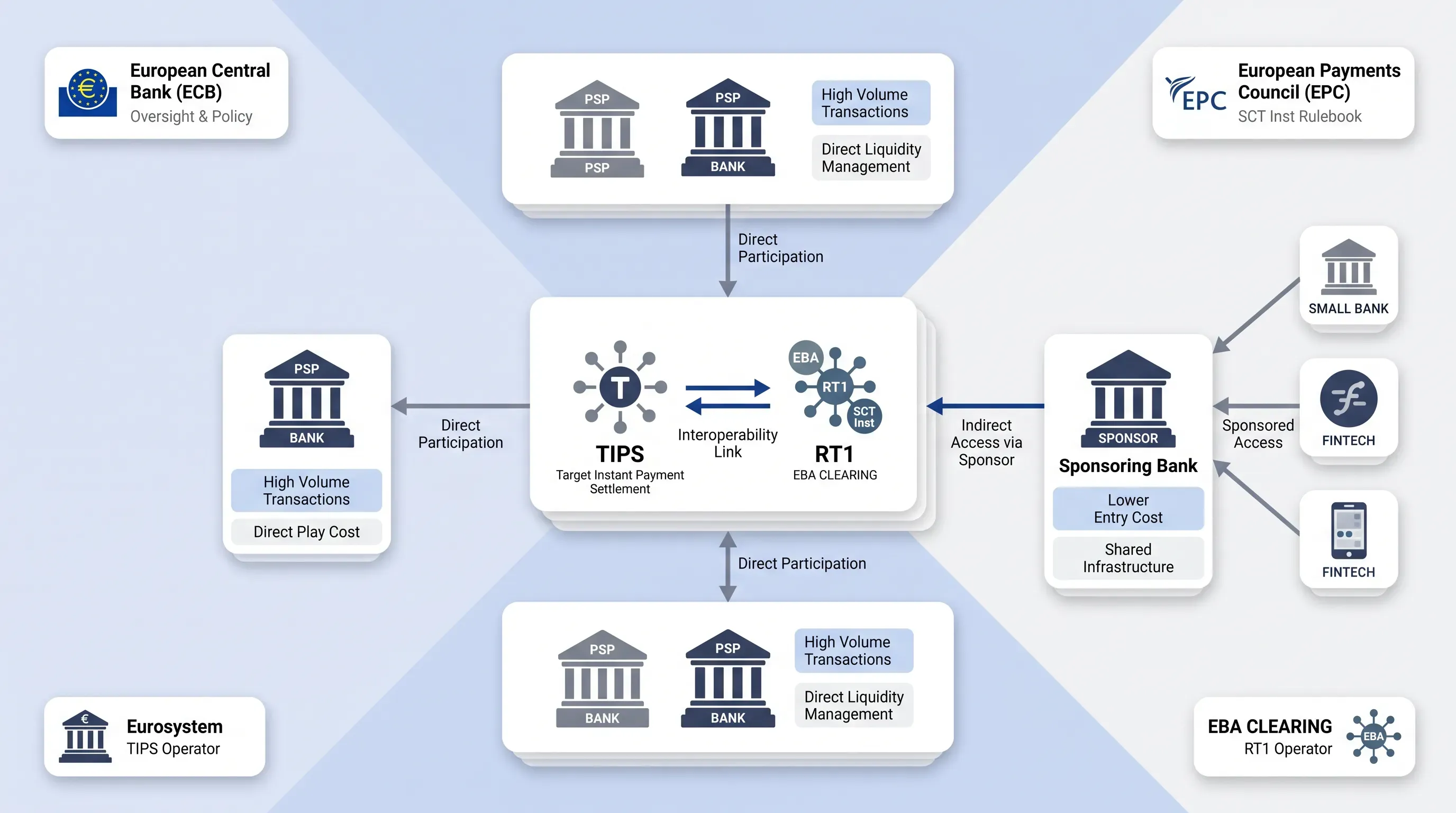
Once the originating PSP releases the payment, it sends the message into the SEPA Instant infrastructure through a Clearing and Settlement Mechanism (CSM), which routes it to the beneficiary's bank. The two SCT Inst systems that do this work in euro are the European Central Bank's TARGET Instant Payment Settlement (TIPS) and EBA Clearing's RT1. Both process transfers 24/7/365 and both settle within seconds, so the difference between them sits in where the money lives.
Unlike a standard SCT that defers and nets positions later, SEPA instant payments and SCT Inst systems settle in real time, one transfer at a time, with immediate finality. That changes your cash management. In TIPS, each participant holds a dedicated cash account (DCA) in central bank money, and funds move from the payer's DCA to the recipient's the instant the payment clears. RT1 works through a funds balance held at the ECB on a technical account in TIPS.
The practical consequence for treasury and operations is prefunding. Because settlement is instant and final, the cash has to be sitting in the account before the payment arrives. Atlar notes that if a participant doesn't keep its DCA funded, payments cannot be processed, which ties up capital that would otherwise be put to work. Forecasting SEPA instant payments across nights and non-business days becomes a daily liquidity discipline.
Confirmation and funds availability
The beneficiary PSP closes the loop. It returns either a positive confirmation when the funds have been made available to the payee or a negative one when the transfer is rejected. That status travels back through the CSM to the originating bank and onward to the payer, all inside the ten-second target.
The scheme treats the transaction as all-or-nothing. Either the money lands and the payee can use it at once, or the payment fails and nothing moves. On rejection or timeout, the amount stays with the payer, and under the newer EU rules a payment that gets no response within ten seconds must be re-credited to the payer. For your own product, that sets a hard customer expectation. The payer learns within seconds whether the money arrived, and they expect a clear answer every time.
Who runs the SEPA Instant infrastructure

The chain has a handful of distinct roles, and your first job is to find where you sit. Map them, and the participation decision in front of you becomes much clearer.
The payment touches these parties:
-
Originating PSP: the payer's bank, which validates the transfer and sends it after screening.
-
Beneficiary PSP: the payee's bank, which credits the account and returns the confirmation.
-
Clearing and Settlement Mechanisms for SCT Inst systems: TIPS, run by the ECB, and RT1, run by EBA Clearing, which route messages and settle the cash.
-
The central bank: the Eurosystem holds the settlement accounts and provides the central bank money that makes TIPS settlement risk-free.
-
The European Payments Council: the scheme owner that writes and maintains the SCT Inst rulebook.
Not every institution connects to TIPS or RT1 directly. There is a difference between direct and reachable-via-intermediary participation, and it's the core decision you'll face. A TIPS participant holds its own DCA and settles on its own account. A reachable party accesses a participant's account under a contractual agreement, while an instructing party submits payments on behalf of others. A smaller bank or a fintech without direct central-bank access can reach the SEPA Instant infrastructure rails through a sponsoring bank that holds the settlement account and processes on its behalf.
That sponsorship route is the realistic path for most fintechs. You still adhere to the SCT Inst scheme and meet the screening and verification rules while you lean on a participant for the settlement leg. The scale of the network is already large. As of November 2024, the EPC counted 2,627 SCT Inst scheme participants, about 73 percent of all SCT adherents across SEPA and 85 percent within the euro area.
What the EU regulation requires
The Instant Payments Regulation (IPR) was adopted on 13 March 2024 and amends the existing SEPA Regulation. It turns instant euro transfers from an option into a duty for any PSP that already offers standard euro credit transfers. The obligations arrive in a defined order, and the dates differ by participant location.
The sequence runs receive first, then send. Euro-area banks handling SEPA instant payments had to be able to receive instant payments by 9 January 2025 and to send them by 9 October 2025. Non-euro-area member states get longer, with receiving due by 9 January 2027 and sending by 9 July 2027. Electronic money institutions and payment institutions follow their own track, with most obligations landing in 2027. Price parity sits alongside these: the fee for an instant transfer cannot exceed the fee for a standard one, and for euro-area banks that rule applied from 9 January 2025.
The regulation also rewrites the validation step we traced earlier. Two obligations matter most:
-
Verification of Payee (VoP): before the payer authorises a transfer, the PSP checks whether the payee's name matches the IBAN and returns a result that ranges from a match to no match, with close match as an intermediate outcome. The VoP scheme took effect on 9 October 2025 for SEPA PSPs offering SCT or SCT Inst, and the check must be offered at no extra charge.
-
Sanctions screening: PSPs now run daily checks on their own customers, which keeps the ten-second window clear of slow list lookups.
The stakes for missing these dates are not trivial. Penalties under the legislation reach up to 10 percent of a bank's turnover, which is why the screening and VoP work belongs near the top of your project plan.
Planning your SEPA Instant infrastructure connection
You now have enough to scope the work. The decisions ahead are concrete: choose direct participation with your own settlement account or access to SEPA Instant infrastructure through a sponsoring bank, then decide whether the technical connection is built in-house or bought while treasury prepares liquidity and prefunding for a system that settles at every hour. Add the VoP and screening capabilities the regulation demands, and bring the technical and control teams into the room early, because the deadlines have already started passing and the rails reward institutions that prepare ahead of them.
EGS builds resilient fintech infrastructure for institutions connecting to these rails, from sponsored access through to the screening and verification layers the regulation now requires. If you're scoping a SEPA Instant infrastructure project, reach out to our team to map your options against the deadlines.