Why virtual cards moved from novelty to infrastructure
Virtual card issuing is the process of generating a payment credential through software, on demand, without printing a piece of plastic. The credential carries standard card details like any card, but it lives inside software. The global virtual credit card market was valued at USD 28.37 billion in 2024 and is projected to grow at a 21.5% CAGR through 2034, which tells you this is no longer a side experiment.
Fintech teams care about virtual card issuing because it turns payment credentials into something programmable. You can spin up a card for a single supplier invoice and kill it an hour later; no piece of mail enters the process.
What virtual cards actually are
A virtual card is a payment credential issued and delivered through software. It uses the same Visa or Mastercard rails as a plastic card and the same authorization flow at the merchant, but the Primary Account Number (PAN) is generated on demand and tied to a narrow scope. That scope can be a single transaction, one merchant, one employee, or a capped dollar amount over a fixed window.
The contrast with physical cards goes beyond format. A plastic card is a long-lived bearer instrument that takes days to produce and ship. A virtual card is a record in a database that can be created or destroyed in milliseconds, with freeze controls available in the same system. Single-use cards already dominate the segment because they cut fraud exposure to whatever the card was funded with.
The infrastructure behind the card is what the rest of this article unpacks.
How virtual card issuing works
When a fintech application creates a card, a chain of parties wakes up behind a single API call. The fintech (the program manager) sends a request to its issuer processor. The issuer processor talks to a sponsor bank that holds the Bank Identification Number (BIN) registered with Visa or Mastercard. The network assigns the PAN, and the processor stores it in a Payment Card Industry Data Security Standard (PCI DSS) vault before it passes a token back to the fintech.
At the moment of purchase, the merchant's acquirer sends an ISO 8583 authorization message to the network, which routes it to the issuer processor. The processor checks spend limits, merchant category codes, velocity rules, and any business logic the program manager has registered, then approves or declines in real time. The fintech sees the full message and can append data like an invoice number to make reconciliation cleaner.
The split of responsibilities looks roughly like this:
-
Program manager: owns the user, the funding source, and the business logic
-
Issuer processor: runs the authorization stack, stores the PAN, exposes APIs
-
BIN sponsor bank: holds the regulatory license and lends its BIN to the program
-
Card network: routes messages and enforces scheme rules
Virtual card generation systems and APIs
Modern issuer platforms expose card creation and lifecycle management through REST APIs and webhooks, with funding handled through the same API surface. Marqeta opened its issuer processor APIs to outside developers at the end of 2014, and that shift is what made today's virtual card generation systems possible. Before then, launching a card program meant months or years of integration with banks and networks. Now it takes weeks.
A typical create-card request carries a small set of attributes that decide how the card behaves:
-
Spend limit and refresh interval (per transaction, per day, lifetime)
-
Expiry date and whether the card is single-use or reloadable
-
Allowed Merchant Category Codes (MCCs) and merchant or country blocklists
-
Cardholder identifier, funding source, and metadata fields the program owner wants on every transaction
The API-first design is what makes virtual card generation systems scale. A SaaS expense product issuing 50,000 cards a month can't have a human in the loop, and these virtual card generation systems remove that bottleneck. Webhooks then push authorization events back to the program manager so the application can react inside the same authorization window, which is roughly 100 milliseconds. Without that latency budget, granular controls don't work.
Virtual card generation systems also handle the boring parts. Lifecycle endpoints suspend or terminate cards, with reactivation handled through the same control layer. KYC and KYB hooks tie cardholder identity into provisioning. Reporting APIs feed the ledger. The combined surface is what fintechs are buying when they pick a processor.
Tokenization and the PAN
The PAN is the sensitive object in this whole system, and it's the thing fintechs work hardest to avoid touching. The processor generates the PAN and stores it inside a vault that meets PCI DSS requirements. According to the PCI Security Standards Council, all components of a tokenization system are in scope for PCI DSS, and the card data vault is the most attractive target for attackers, which is why isolation matters.
Day to day, the fintech handles a token while the raw PAN stays inside the vault. Issuer tokenization is the processor's internal substitution: an opaque ID that maps back to the PAN inside the vault. Network tokenization is different and runs on Visa and Mastercard infrastructure to support wallet provisioning and merchant-stored credentials. A network token is bound to a device or a merchant, so if it leaks, it's useless elsewhere. That's what people mean when they say tokens reduce the blast radius of a breach.
The distinction matters when you scope your PCI obligations. If your application only ever sees issuer tokens and you display the PAN through a PCI-compliant iframe hosted by the processor, your environment stays out of the cardholder data environment. Build your own vault, and you inherit the full audit.
Digital card provisioning to wallets
A freshly issued card is more useful when it lands directly in Apple Pay or Google Wallet. Push provisioning is the flow that gets it there without making the user type a PAN. According to Visa's developer documentation, in-app provisioning involves the cardholder, the issuer, an On-Behalf-Of (OBO) partner like the processor, the BIN sponsor, and the wallet provider all coordinating in one handshake.
The flow itself is short. The user taps an "Add to Apple Wallet" or "Add to Google Wallet" button. The issuer's app or website calls the processor's API, which generates encrypted card data the wallet needs. Apple or Google passes that data to the network, which completes wallet activation with a device-bound token seconds later. Lithic and Marqeta expose similar endpoints for this digital card provisioning step.
Digital card provisioning matters for activation. Manual card entry kills conversion because users abandon halfway through typing. Meawallet's product team describes manual provisioning as "tedious and time-consuming, requiring verification steps that discourage cardholders from completing the process," while one-tap digital card provisioning removes that drop-off. For consumer fintechs, this is the difference between a card that gets used and a card that sits dormant. Web push provisioning, which Lithic launched for browser-based digital card provisioning, extends the same flow to fintechs without a mobile app.
Digital card provisioning is also where network tokenization earns its keep. The wallet never holds the PAN, only a token tied to the device's secure element, so a stolen phone doesn't expose the underlying account.
Common use cases for fintechs

Virtual card issuing shows up in three product categories that ship today. The technology is the same in each, but the controls and economics shift based on who spends.
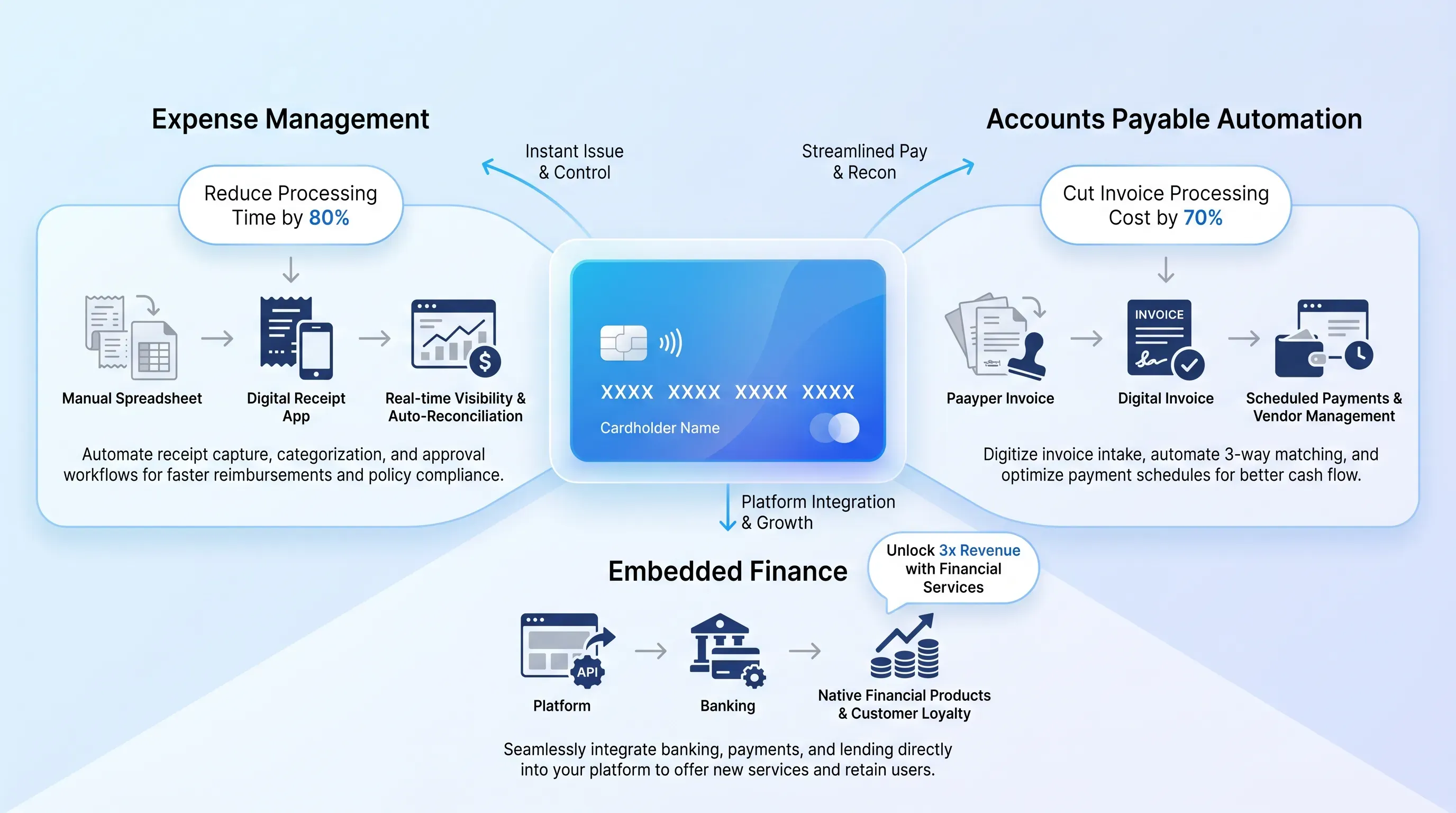
Corporate expense and spend management
SaaS expense platforms were the first scaled buyers of virtual card issuing. Brex and Ramp both issue physical and virtual cards per employee or per vendor, with project limits set in the dashboard. Brex's product team writes that every transaction is automatically logged and categorized inside their expense platform, which replaces the reimbursement loop entirely.
The pattern is straightforward. Finance creates a card for the marketing director's Q3 ad budget with a $50,000 ceiling and a Google and Meta MCC allowlist. The card declines anything outside those merchants. There's no reimbursement form, no shadow spend on personal cards, and the ledger entry is already coded by the time the books close.
B2B and accounts payable
Single-use virtual cards are eating into ACH and check volume for supplier payments. B2B is projected to make up only 1% of virtual credit card transaction count by 2026 but 71% of the total transaction value, according to Versapay's research. The dollars are where the action is.
Interchange revenue drives adoption from the AP automation side. A 2025 Omega Venture Partners guide puts virtual card interchange at 1.5% to 3% of transaction value, with AP automation vendors keeping 0.5% to 1% as their share. On a billion dollars of processed volume, that's $7.5 million in pure software-margin revenue for the platform, on top of subscription fees. AvidXchange and Bill.com run programs on this economic logic.
Embedded finance and BaaS
Non-financial platforms now embed virtual card issuing to give their users branded cards without becoming a bank. Vertical SaaS for clinics and gig platforms for delivery drivers use the same building blocks. Shopify Balance and Lyft Direct are public examples. The platform owns the user relationship and the card-level data. Regulatory exposure sits with the BIN sponsor, while the processor runs the rails.
For these companies, virtual card issuing operates as a product surface. It deepens the customer relationship and turns interchange into a margin line that subsidizes the rest of the software.
Security and compliance considerations
A virtual card issuing program sits inside a stack of obligations that don't disappear just because the card is digital. PCI DSS scope is the foundation. If the program manager never touches the PAN, scope shrinks dramatically. If it does, the audit covers every system that handles cardholder data, from applications to the vault.
Know Your Customer (KYC) and Know Your Business (KYB) requirements come from the sponsor bank and apply to every cardholder. Network rules from Visa and Mastercard add another layer for branding and chargeback handling. The fintech program manager owns the customer-facing parts. The processor owns transaction processing and PCI controls on the vault. The sponsor bank owns the regulatory license and ultimate liability.
Fraud controls run on top of all of this:
-
3D Secure (3DS) authentication for card-not-present transactions, which shifts chargeback liability to the issuer. Visa data shows authenticated transactions have roughly 45% lower fraud than non-authenticated eCommerce transactions.
-
Velocity rules that decline based on transaction count, amount, or geography over a rolling window
-
Dynamic CVVs that rotate on a schedule, so a leaked card record expires before it gets used
-
MCC blocklists and merchant allowlists enforced at authorization
Visa CNP fraud data, reported by the Kansas City Fed, shows card-not-present fraud rates climbing from 14.3 basis points in 2013 to 16.9 basis points in 2015 on dual-message networks. That trend is what made tight authorization-time controls table stakes for virtual card programs.
Choosing an issuing partner
Picking a provider is where most fintech teams underestimate the long-term cost. The API demo is the easy part. The hard part is what happens 18 months in, when you've built around a processor's quirks and you want to renegotiate or switch.
The criteria that actually matter:
-
API quality and documentation depth, including sandbox parity with production and webhook reliability
-
Supported geographies and currencies, because expanding from the US to the EU means a new BIN and a new sponsor bank, with processor coverage determining the route
-
BIN ownership, which determines who controls the program if the partnership ends
-
Settlement terms and how funding flows between your operating account, the sponsor, and the network
-
Interchange share and rebate structure, especially for B2B programs where this is the revenue model
-
Compliance support, including how the processor handles disputes, chargebacks, and regulator inquiries
Lock-in is the quiet risk. Migration of an active card portfolio between processors requires new card issuance and wallet credential retokenization, and it can take a year once sponsor-bank renegotiation is included. Ask vendors directly what a migration off their platform looks like. The answer reveals more than any pitch deck.
Good evaluation questions to bring to a vendor call: What's your authorization latency at the 99th percentile? Who holds the BIN? What's the rebate split on commercial spend? How do you handle PCI scope for our application? Which sponsor banks are you certified with, and can we switch sponsors without leaving your platform?
Where virtual card issuing is headed
The next phase pushes virtual card issuing further into programmable territory. Cross-border issuing is becoming routine as processors stitch together multiple BIN sponsors under one API. Stablecoin-funded cards are scaling fast. Crypto-funded cards processed roughly $18 billion annualized by late 2025, more than double the year-earlier level, and Visa carried over 90% of that volume.
Agentic AI is the more disruptive shift. Autonomous agents that purchase on behalf of users need scoped, single-use credentials with tight controls, and that's exactly what virtual card issuing produces. Mastercard's Agent Pay and Visa's Trusted Agent Protocol both treat the virtual card as the trust boundary between the user and the agent. Network tokenization tightens further so each agent session can be authenticated and revoked independently.
The through-line is that cards are becoming payment primitives. Programmable, scoped, disposable, and addressable through an API. If your team is evaluating where virtual card issuing fits, ask whether your funding stack and compliance posture are ready to treat payments as software, with engineering bandwidth in place to support that shift.
Conclusion
Virtual card issuing has moved from a payments curiosity to a core piece of fintech infrastructure because it lets product teams build payment behavior the same way they build the rest of their software. The decisions that matter are about scope, partners, and what you're willing to own versus outsource. Get those right, and the cards themselves become the easy part.
EGS provides resilient fintech infrastructure that supports virtual card issuing programs, from processor integration and PCI scope reduction to sponsor bank coordination and ongoing compliance. If your team is scoping a new card program or rethinking an existing one, reach out to our team for a working session on architecture and vendor selection, with go-live planning covered in the same discussion.