Anti-fraud architecture for layered digital fraud defense

Content authorBy EGSPublished onReading time12 min read
Fraud operations analyst at a multi-monitor workstation in a modern fintech office, focused on investigating suspicious transactions.

This article explains anti-fraud architecture as one connected stack of coordinated controls. It walks through the layered model end to end: each layer's job at its place in the customer journey, plus the way the layers feed one another so decisions sharpen over time.

Why point tools stop working

Anti-fraud architecture starts to matter the moment you realize your defenses don't talk to each other. You bought an identity check for signup after a wave of fake accounts. Later, a rules engine landed in the stack to handle payment risk, and somewhere along the way a device script got bolted onto login. Each tool was a sensible purchase to put out one specific fire. None of them were designed to know what the others had seen.

That's the problem. A fraud ring doesn't respect the boundaries between your tools. The same crew that probes your onboarding flow on Monday is testing stolen credentials at login on Tuesday and pushing a payment to a mule account by Friday. They move across the journey as one coordinated operation, and your siloed controls each see a single frame of a much longer film. The European Payments Council's 2024 fraud trends report notes that attacks routinely exploit combinations of threats across the full customer journey from onboarding through execution, with authentication caught in the middle.

The cost of fragmented fraud prevention

The scale of this is no longer abstract. Trustpair's 2025 survey of finance executives found that 90% of U.S. companies were targeted by cyber fraud in 2024, up from 79% the year before. And the losses land where the silos are widest. Account takeover fraud resulted in more than $15.6 billion in reported U.S. losses in 2024, up from $12.7 billion in 2023, according to the Federal Reserve. Synthetic onboarding is climbing alongside it, with U.S. lenders facing $3.3 billion in exposure to synthetic identities tied to newly opened accounts at the end of 2024.

Then there's the quieter cost you already feel: false positives. When tools fire independently with no shared context, they flag good customers as often as bad ones. Ravelin estimates the cost of false positives to online merchants at $443 billion per year, far more than the fraud itself. So you end up paying twice, once in fraud losses and once in lost customers, because your controls can't pool what they know. The rest of this article is about the shift out of that trap, from disconnected tools to one connected anti-fraud architecture.

What anti-fraud architecture means

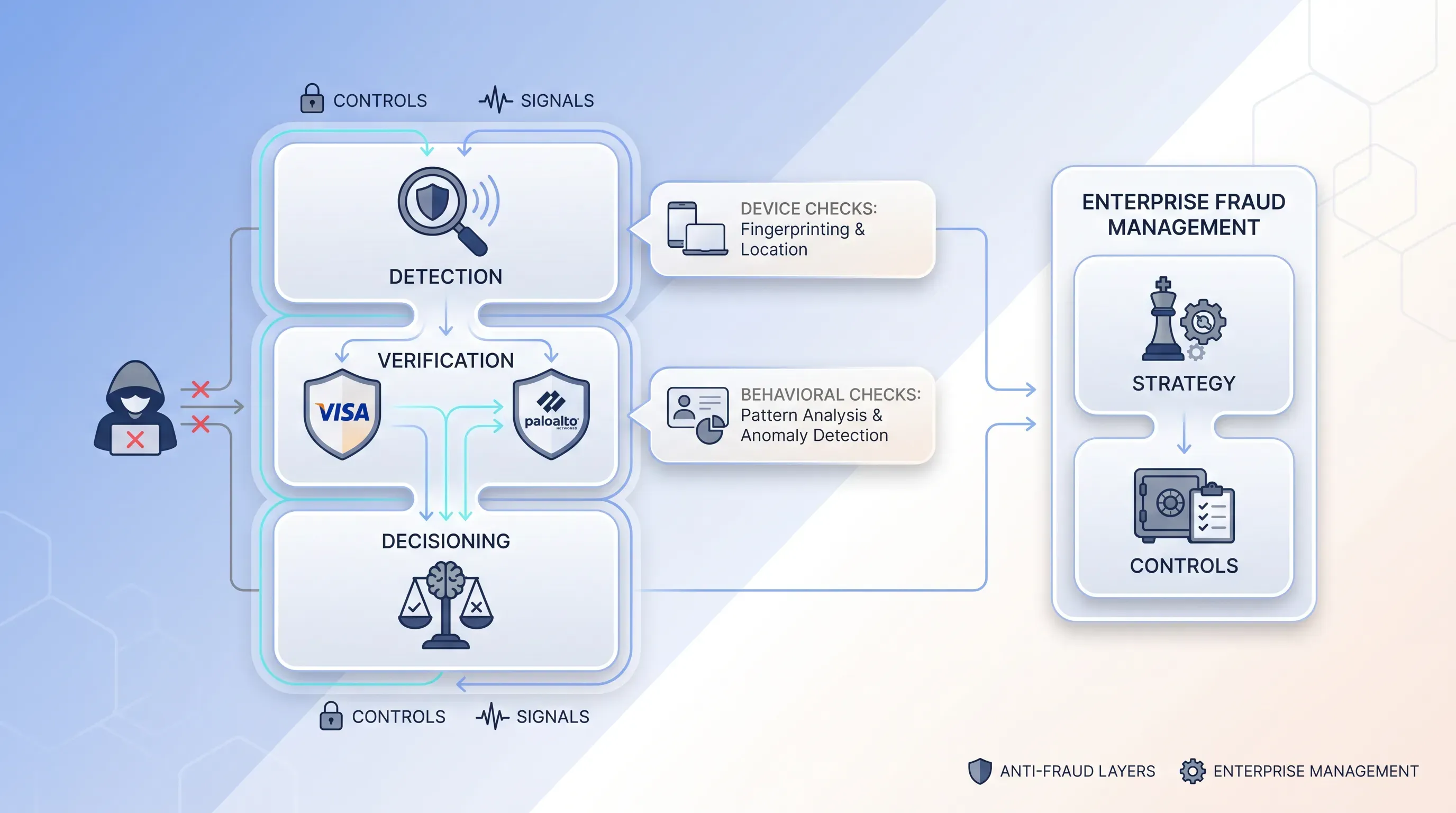
Modern infographic with a split layout: left side shows anti-fraud layers with icons; right side depicts enterprise fraud management.

Anti-fraud architecture is the deliberate arrangement of detection and verification layers across the entire customer journey, plus the decisioning layer that combines their signals into a single verdict. It answers a concrete set of questions. Where does each control live? What does it watch? Where does its output go next? The anti-fraud architecture is the wiring diagram.

That distinction matters because it's easy to confuse architecture with enterprise fraud management. Visa defines enterprise fraud management as a strategy designed to prevent fraud across a business's operations through detection and response. Strategy sets the direction. Architecture is the concrete how. One tells you that you want a unified program. The other tells you which signal from the device layer triggers a step-up at payment, and how that decision gets logged for the next session.

The principle underneath all of it is defense in depth, borrowed from military and cybersecurity practice. Palo Alto Networks describes defense-in-depth as multiple independent, overlapping controls, so that if one line fails, the next is already in place to catch the attack. Applied to fraud, this means no single gate has to be perfect. If a fraudster slips a synthetic identity past onboarding, the device layer can still flag the shared hardware behind ten other accounts. If they socially engineer an OTP, behavioral signals can still catch the impossible login pattern. The design assumes any one layer will be bypassed and makes sure the others are watching.

Start building your financial platform?

Speak with EGS engineers about open banking, payment infrastructure, cloud systems, and enterprise software.

Get in Touch

The layers of a fraud stack

Think of the anti-fraud architecture stack as journey-ordered. Each layer sits at a specific moment in the customer's path and hands its output to the next after it does one job well. Each layer produces signals the others can use, so a verdict at payment is informed by what happened at signup. Here's how the pieces lock together.

Identity verification at onboarding

Identity verification anchors the stack at account creation. Before anyone transacts, this layer uses document authentication against trusted records and a biometric selfie matched to the ID photo to confirm a real, eligible person or business is behind the application. LSEG notes that combining document and biometric checks gives the business confidence the document was submitted by its true owner.

This is the layer that establishes the trusted baseline every later layer measures against. Get it right and synthetic accounts never enter the funnel, which matters because the IDC survey for Early Warning found that 62% of banks name digital onboarding as their highest-risk point for synthetic identity exposure. Catch the fraud here and you never pay for it downstream.

The trade-off is friction. Document and biometric identity verification is high-assurance, but it asks real effort from the user, which is exactly why it belongs at onboarding and at later step-up moments. You verify hard once and let lighter layers carry the gaps after that baseline is set.

Browser fingerprinting between checkpoints

The long stretch between signup and the next high-assurance check is where browser fingerprinting earns its place. This layer passively watches device-level signals on every session without asking the user to do anything. It reads device and network attributes alongside the harder-to-fake stuff: canvas and WebGL hashing. As Fraudlogix explains, canvas fingerprinting renders a hidden image and hashes the pixel output, and because rendering differs by hardware and OS configuration, even tiny differences produce a distinctive hash tied to one device.

Browser fingerprinting does three jobs at once. It recognizes returning devices even after cookies are cleared. It flags evasion tools, and Sardine notes its fingerprint resists antidetect browsers and mobile emulators because it anchors identification in signals that are hard to replicate. And by linking related sessions through shared signals, it exposes the clusters of accounts that betray a fraud ring.

Position this layer as the continuous, low-friction counterweight to the point-in-time identity check above it. Identity verification tells you who someone claimed to be at signup. Browser fingerprinting tells you whether the device showing up today matches, and whether it's quietly tied to fifty other accounts. One is a snapshot. The other is the film running between snapshots.

Step-up verification on risk

The anti-fraud architecture escalates only when the signals justify it, because constant high-assurance checks would bury good users in friction. A risky login or a suspicious device change pulls identity verification or stronger authentication back into play for that one moment. Descope describes this risk-based escalation as adjusting the authentication level to the contextual risk of the session, so low-risk activity stays invisible while high-risk activity gets hardened.

This conditional escalation is what lets the business stay low-friction by default and still defend the moments that matter. It's the most common response pattern in the market: Alloy's 2024 benchmark found that step-up authentication through document verification and selfie or liveness tests was the most prevalent measure once fraud is suspected.

Notice where the trigger comes from. The step-up fires because the device and behavioral signals from the layer below flagged an unrecognized fingerprint or an impossible location jump. That's the handoff. The continuous layer watches quietly, and when it sees enough risk, it calls the high-assurance layer back to the front.

Start building your financial platform?

Speak with EGS engineers about open banking, payment infrastructure, cloud systems, and enterprise software.

Get in Touch

Decisioning and orchestration

All of this produces scattered signals, with an identity outcome from onboarding and a device score from fingerprinting. The decisioning or orchestration engine is what turns them into one verdict. It ingests every signal and applies rules and models that decide in milliseconds whether to allow the action or escalate it through a challenge or a block. Ping Identity describes the risk decision engine as the central hub that aggregates signals like login behavior and device fingerprinting to spot suspicious activity that standalone tools would miss.

This is the connective tissue that makes the whole thing an anti-fraud architecture instead of a toolbox. Cleaner, deduplicated identity signals feed better rules and sharper models, and Sardine notes that a stable fingerprint layer reduces noise from fragmented journeys and improves the inputs that fraud models depend on. Feed the engine fragmented data and it makes fragmented decisions. Feed it one coherent view and the decisions get sharper with every session.

Orchestration is also where your team keeps control. SAS describes its decisioning platform letting teams combine business rules with anomaly detection and machine learning, and tune strategies through champion-challenger testing. That means you set the risk appetite. The engine enforces it consistently across every channel.

How the layers work together

The claim worth proving is that the layers are stronger connected than summed. Walk through an account takeover to see why. An attacker buys a stolen credential and logs into a customer's banking account. The credential is valid, so a login check alone waves them through. But the browser fingerprinting layer doesn't recognize the device, and the WebGL hash is new. None of those signals is damning on its own. Together they raise the session's risk score.

That score is what triggers the next move. In the IC3's account takeover playbook, the attacker now needs the one-time passcode, so they pose as a bank employee and ask the victim for the code. Even if the OTP is surrendered, the decisioning engine has already combined the device and IP anomalies with a new-payee request into a single elevated verdict. It calls a step-up: a document or biometric identity verification check the attacker can't pass. The layers caught what each alone would have missed.

Why connected signals catch what point solutions miss

Now run a synthetic onboarding attempt. A fabricated identity, real Social Security number stitched to a fake name, clears a basic data check at signup. The identity verification layer flags weak document corroboration but isn't certain, so the account opens under watch.

Then browser fingerprinting does the work the snapshot couldn't:

  • The same device fingerprint appears behind eleven other recent applications.

  • An antidetect browser is detected attempting to vary each profile.

  • The sessions share network signals that link them as one operation.

The decisioning engine ties the weak onboarding signal to the device-ring pattern and blocks the cluster before any of the accounts can bust out. The value lives in the handoffs. The onboarding doubt and the device-ring evidence meant nothing apart, and everything together.

Building your anti-fraud architecture

You don't need a rip-and-replace project to move from a patchwork to a connected stack. Start by mapping what you already own onto the layered model. Put each existing control in its place: the signup identity check is your onboarding layer, and the rules engine is the start of your decisioning layer. Laying the tools against the model this way makes the gaps obvious.

Then find what's uncovered and sequence the fixes. A practical order looks like this:

  1. Map every current control to a layer and note which journey moments have no coverage.

  2. Close the widest gap first, with continuous device signals between onboarding and step-up, since that's the blind spot fraud rings exploit.

  3. Wire the layers into shared decisioning so signals stop dying inside individual tools.

The harder part is organizational. Fraud and risk each own a different piece of this, with security and architecture pulled into the same product decisions, and they have to agree on shared signals and who owns the decisioning layer. Without that agreement you rebuild the silos in software. Get the teams aligned on one decisioning fabric and the model holds.

Watch for two common pitfalls. One is over-reliance on a single layer, where identity verification becomes the whole defense even though it's a point-in-time snapshot that synthetic identities are built to pass. The other is letting friction creep into low-risk flows, which quietly drives away good customers. SEON points out that failed payments contribute to nearly half of all customer churn, so every needless challenge in a safe flow has a cost. The model exists to put friction where the risk is and nowhere else.

Where EGS fits in

The layered model of anti-fraud architecture only helps if you can buy and deploy the pieces. EGS's digital fraud and identity solutions map onto this architecture as concrete components. The identity verification capability covers onboarding and step-up moments, since it confirms a real, eligible person before they transact and returns to the front when risk justifies a harder check. The device-level signals from browser fingerprinting fill the long gaps in between, as they watch every session quietly and feed the decisioning layer that turns scattered signals into one verdict.

Adopting these as part of one connected stack lets you close the specific gaps you found when you mapped your current controls, without stitching together unrelated vendors whose tools never learn from each other. The layers share signals by design, so each decision is sharper than the sum of its inputs.

If you've mapped your stack against this model and can see where the coverage thins, that's the place to start. Line your current controls up against the layers described here, and talk to EGS about the layers you're missing so your anti-fraud architecture works as one connected defense.

Start building your financial platform?

Speak with EGS engineers about open banking, payment infrastructure, cloud systems, and enterprise software.

Get in Touch

Measure it with both fraud loss and false-positive rate. Add a stage-by-stage view of where users are challenged or blocked so you can see whether the stack catches fraud without adding friction to trusted flows. Review the numbers after rule changes, since each adjustment changes risk and user experience.

Add browser fingerprinting when you have risk between high-assurance checks, such as repeat account creation or suspicious logins from unfamiliar devices. It works best as a quiet session layer that feeds device and network signals into decisioning, rather than as a standalone blocklist.

Yes. Anti-fraud architecture reduces manual reviews by combining signals before a case reaches an analyst. A weak identity signal paired with a known device pattern can create a clear action, while low-risk sessions can pass automatically. Teams still need review queues for edge cases and policy exceptions.

Yes. Fraud signal sharing needs clear data minimization and retention rules. Store only the signals needed for risk decisions and control access by role. Keep a short record of how each signal is used. Hashing device identifiers reduces exposure, but legal teams still need to review consent and regional privacy duties.

EGS fits at the identity verification and browser fingerprinting layers, then feeds those signals into decisioning. That means EGS covers onboarding and step-up checks, with device-level monitoring between them. The exact fit depends on which controls you already run and where your journey map shows gaps.

Schedule a Meeting

Book a time that works best for you

You Might Also Like

Discover more insights and articles

A realistic workbench scene with a disassembled POS terminal, engineers' hands, certification documents, and a laptop in a professional workshop.

Embedded POS Software: Engineering Payment Systems at Device Level

This article explains what changes when you engineer embedded POS software by moving the payment stack into the device itself instead of building an app on someone else's certified terminal. It walks through the engineering layers involved, with the constraints behind each decision folded into how certification reshapes the entire project from day one.

Close-up of hands making a contactless payment at a POS terminal in a retail store, with a blurred background and natural lighting.

Real-Time POS Terminal Software Development: Engineering Fast and Secure Payments

This article explains how real-time POS terminal software development shapes the software inside a payment terminal to move a card payment through the device quickly and securely. It follows the layered architecture and traces one transaction from tap to response under the latency budgets and certification rules that shape every choice you make, with offline behavior treated as part of that constraint.

An IT professional reviews a network architecture diagram on a large monitor in a naturally lit office, with realistic desk clutter.

Payment security architecture for PCI DSS-aware payment flows

This article shows how payment security architecture decides your compliance scope before you write a single control. It walks through where data substitution sits in the flow and what each placement does to the cardholder data environment. The artifacts a QSA will demand during a PCI DSS compliance assessment come later.

A candid business meeting in a modern office with professionals discussing reports around a table, surrounded by natural light and greenery.

Payment Authorization Engine: Designing Low-Latency Decision Systems

This article explains what a payment authorization engine is and how teams can use it to approve more good transactions without inviting fraud or operational overhead. It grounds the basics in familiar credit card authorization, then shows how the engine fits inside a wider payment orchestration setup.