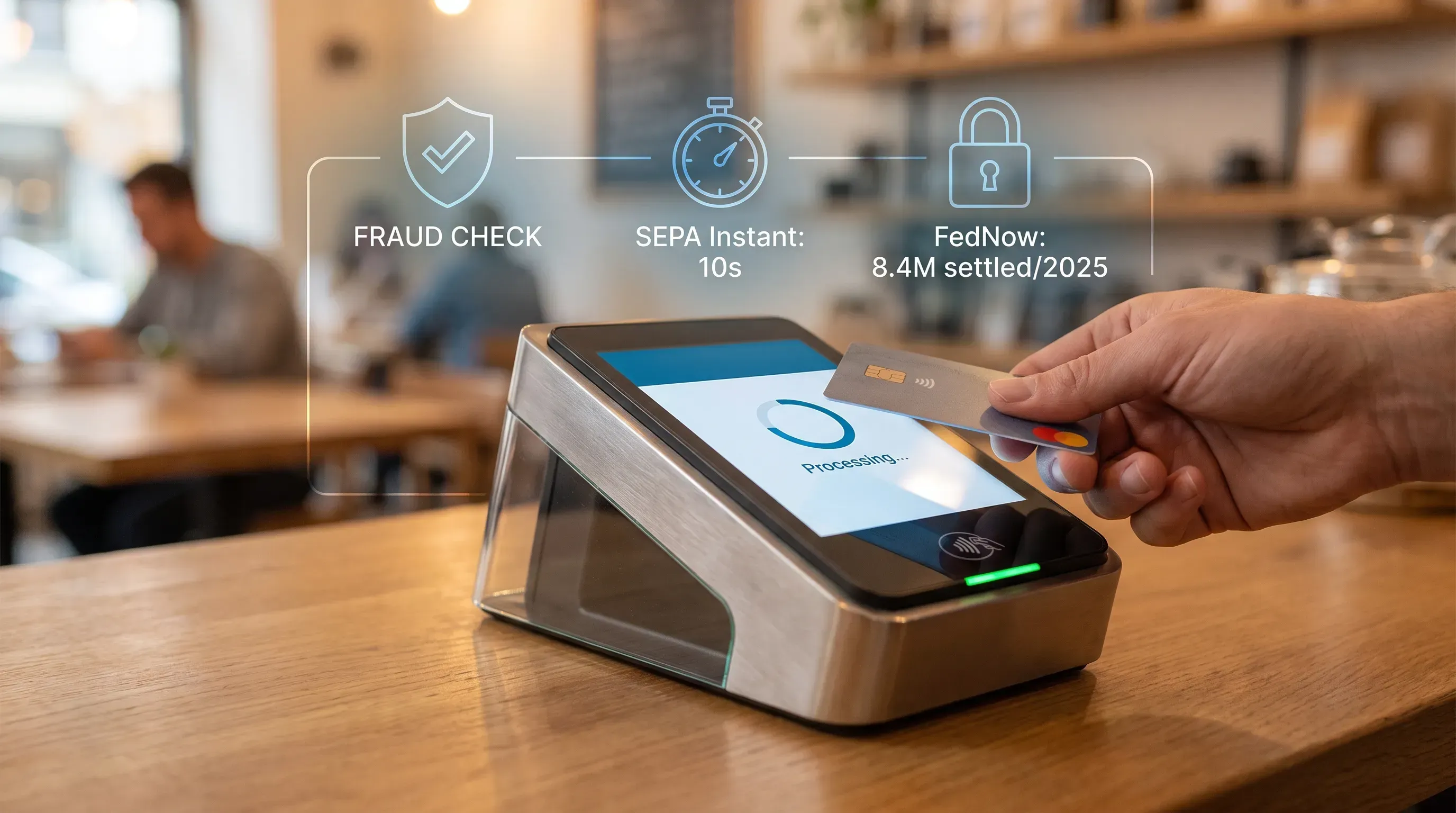
Fintech Infrastructure Engineering: Building Systems That Move Money at Scale

Content authorBy EGSPublished onReading time13 min read
A small team of professionals in business-casual attire discusses a payment processing project around a wooden conference table in a modern fintech office.

From a fintech infrastructure engineering perspective, this article walks through the full money-movement stack layer by layer, then follows a single live transaction across all of it. The goal is to help you reason about latency and failure across the whole path, with reconciliation treated as part of that same path.

Why the stack matters more than the parts

You can already describe a payment switch on its own, and the same is true for an issuing processor or a double-entry ledger. Your problem is the hard part of fintech infrastructure engineering: making those systems behave as one thing that never loses a cent and never drops a transaction under load. Most reliability failures happen at the seams between systems. So does most reconciliation pain, and so does most fraud that slips through.

A switch that routes cleanly means little if the ledger it talks to reserves balance a beat too late. An issuing decision is only as good as the fraud signals it can read at the moment of authorization. These are boundary problems, and boundaries are where money quietly leaks.

So treat this article as two things. First, a tour of the full stack, with each layer's job and where it touches its neighbors. Then a walk through one transaction as it crosses every boundary. Infrastructure here, especially in fintech infrastructure engineering, is a strategic asset that decides whether your product scales or accumulates operational debt.

The layers of fintech infrastructure engineering

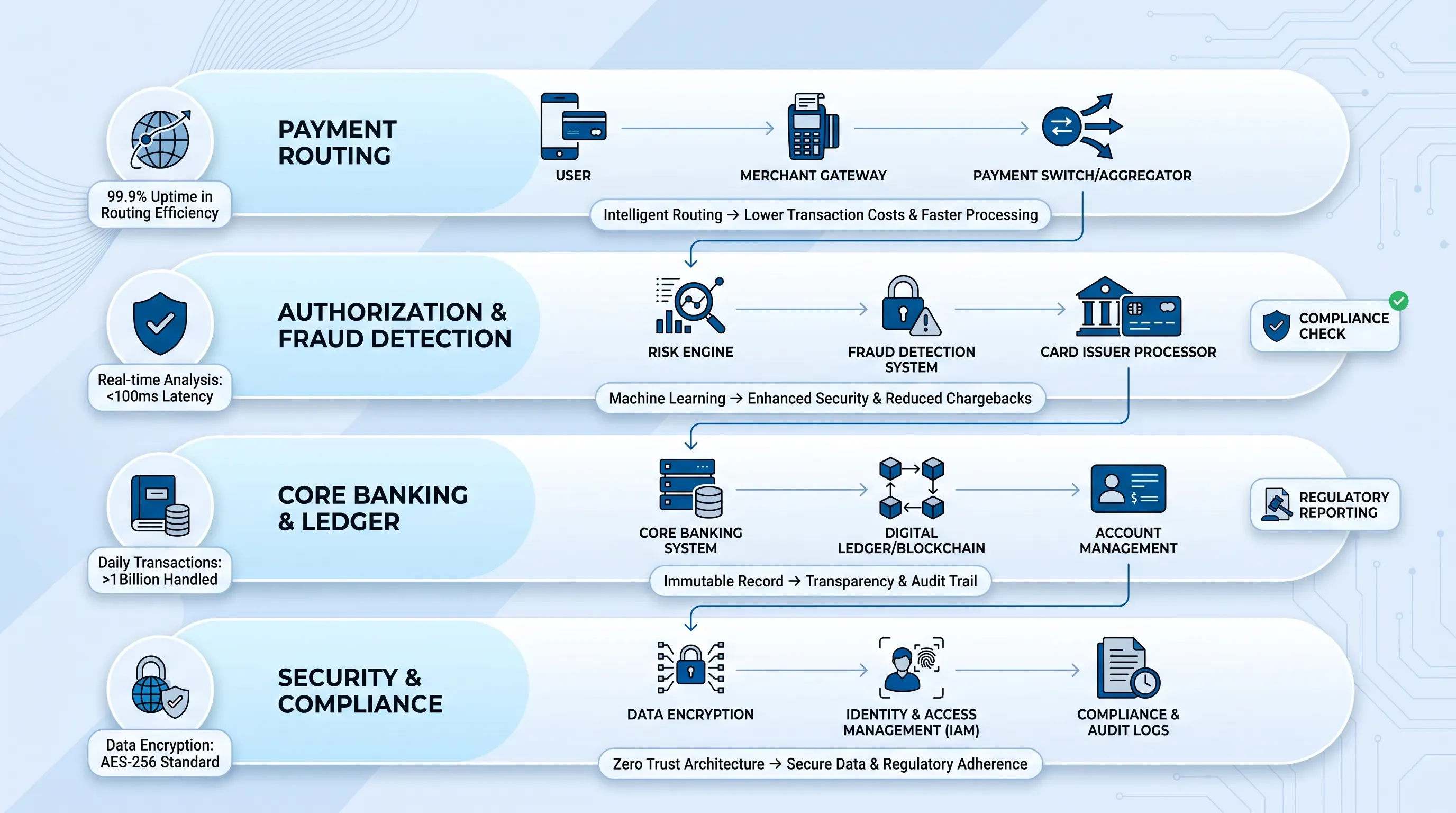
Modern infographic illustrating fintech infrastructure with four layered sections, icons, transaction flows, and statistic callouts on a light gradient backg…

In fintech infrastructure engineering, think of the stack as layers that each own one responsibility and hand off cleanly to the next. The switch moves messages. Issuing decides. The ledger records truth. Wallets hold value close to the user. Fraud scores risk in real time, and the security layer protects every key the others depend on.

Separating these responsibilities is what lets a system scale and stay inside compliance scope while preserving a clear path for incident analysis when something breaks. When one layer's logic bleeds into another, you lose the ability to change a provider without touching your financial core, and you lose the clean audit boundaries that keep your regulatory burden contained. The subsections below cover each layer and, more importantly, where it connects to the ones around it.

Payment switch and routing

The switch is the traffic controller. It routes transactions through the institutions and rails that move money, with card-network and wallet paths included in that routing layer; validation happens at the same control point before authorization and settlement. Every card transaction speaks a defined protocol, and for card networks like Visa and Mastercard that protocol is the international standard ISO 8583, which structures authorization and response traffic into a bitmap-based message format that also covers reversals and settlement. High-value and cross-border transfers increasingly move to the richer, structured ISO 20022 standard, with a November 2026 Swift deadline ending coexistence for cross-border payment initiation messages.

Authorization flow through the switch is unforgiving on latency. Once an acquirer forwards a request, the issuer's routing decision runs in about 150 milliseconds on VisaNet before the charge is approved or declined. At that speed, uptime and routing quality decide whether money moves at all. Visa's own modern authorization capability advertises 99.999% uptime as an industry benchmark, which tells you how thin the tolerance for failure is here. This is the layer that hands a validated message to issuing and, after settlement, reconciles against the ledger.

Card issuing and authorization

Issuing handles the authorization messages and the card lifecycle events, plus the spending controls and cryptographic operations for PIN and CVV that depend on Hardware Security Modules. The real-time decisioning path is simple to state and hard to build. The network forwards a message to the issuer's systems, which check available balance and read fraud signals, then apply rules that return an approval or a decline before the authorization clears. Issuing only works when it is wired to a disciplined ledger, because the balance check is meaningless if the ledger's truth lags the decision.

Teams land in one of these operating models:

  • Fully outsourced to a third-party processor, where speed to launch is high but control over the decisioning path is low.

  • A hybrid, where the processor handles network messaging while your systems own the balance and fraud checks.

  • Fully in-house issuing, where you own the whole path and carry the full compliance and uptime burden that comes with it.

Knowing which model you're in tells you where your risk and your leverage actually sit.

Start building your financial platform?

Speak with EGS engineers about open banking, payment infrastructure, cloud systems, and enterprise software.

Get in Touch

Core banking and the ledger

The core banking system and its ledger are the system of record for balances and transactions, with fees and settlements reflected there too. Every money movement posts a debit and an equal credit, so the sum of all entries is always zero and money can't appear or vanish silently. Multi-legged postings are handled atomically under ACID guarantees, so either all legs post or none do. That property is what an authorization relies on when it reserves or deducts a balance, and what clearing relies on when it reconciles against settlement accounts.

Keep this financial core separate from execution layers like payment rails and Know Your Customer (KYC) checks. When you do, swapping a rails provider or a KYC vendor leaves your internal logic untouched. When the ledger is weak or entangled with execution, you get the failure mode every operations team dreads: reconciliation breaks and settlement visibility goes dark until nobody can say with confidence where the money is. Combining the operational ledger with the reporting layer is a common way teams create that entanglement, and it's expensive to unwind later.

Wallets and stored value

Wallets are the stored-value layer that sits closest to the user. They hold credentials and run tokenization vaults, while the wallet layer connects to real-time rails such as instant payment networks. The rails they touch are growing fast: the RTP network processed 343 million transactions worth $246 billion in 2024, a 94% jump in value over the prior year, and FedNow moved $245 billion in Q2 2025 against $492 million a year earlier.

A wallet depends on the ledger for balance truth and on the security layer for key protection, while the ledger owns truth. The wallet reflects it. For crypto or multi-asset wallets, the design decision that matters most is the split between hot and cold storage. Coinbase reports keeping roughly 98% of customer assets in cold storage, and Kraken and Gemini each sit near 95%, because a hot wallet is a larger attack surface. That ratio is a risk decision, and you set it based on how much liquidity your withdrawal volume genuinely needs online.

Fraud detection and controls

Fraud scoring runs in real time because the decision has to land before the authorization clears. There's no second pass. The scale justifies the investment: payment card fraud losses hit $33.41 billion worldwide in 2024 against global card volume of $51.9 trillion, and the Nilson Report projects cumulative losses of $407.60 billion over the next decade.

Each authorization request is scored, then the system approves it or sends it toward decline or manual review. Velocity caps and merchant category blocks are set early, with geo limits handled there too, so the obvious abuse never reaches a scoring model at all. Fraud reads signals from the switch and issuing, with ledger context tied into the same connection; its accuracy depends entirely on how well it's connected to those layers. A fraud engine starved of ledger context or switch metadata is guessing.

HSM and payment infrastructure engineering security

A Hardware Security Module (HSM) is a tamper-resistant device that generates and stores cryptographic keys, then performs key operations so those keys are never exposed to application memory. At FIPS 140-2 Level 3, the enclosure carries active sensors that detect drilling and probing along with voltage manipulation, and it triggers zeroization so keys are destroyed before extraction is possible. Level 3 also mandates identity-based authentication, which is why most compliance frameworks require it for protecting sensitive keys. PCI HSM validation adds the payments-specific assurance on top.

HSM-backed keys protect the tokenization vaults and the PIN and CVV operations, with key lifecycle rotation tied to the same foundation the rest of the stack leans on. This is the foundation everything else rests on, and it's core payment infrastructure engineering work before an audit ever starts. It also shapes your PCI DSS scope directly, since tokenization is one of the primary ways teams shrink the cardholder data environment and cut audit burden. Good fintech infrastructure engineering treats key management as a design input because that decision follows you through every audit cycle. Done well, this part of payment infrastructure engineering is what lets the layers above it trust each other.

Start building your financial platform?

Speak with EGS engineers about open banking, payment infrastructure, cloud systems, and enterprise software.

Get in Touch

How the systems connect

Now follow a single card payment across every boundary, because that's where the design either holds or fails. A cardholder taps. The merchant terminal reads the card and the acquirer forwards an encrypted ISO 8583 authorization message into the switch. The switch validates the message and decides the route before it hands the request to the issuer. So far the clock is running, and the whole round trip has to finish inside the seconds a cardholder will tolerate standing at a terminal.

At issuing, the message triggers three near-simultaneous reads. The ledger is asked whether the balance covers the amount and, if so, reserves it. The fraud engine scores the request against velocity and behavioral signals, with geography folded into that risk view. The security layer performs the PIN or CVV cryptographic check inside the HSM, where the key never touches application memory. Each of these is a boundary, and each boundary carries its own latency budget and its own way to fail. If the ledger's balance reservation is slow, you risk a double-spend under concurrent authorizations. If the fraud engine can't reach fresh ledger context, it scores blind.

Why system boundaries matter

The issuer returns an approval through the switch, and the cardholder sees a green light. Authorization is a promise before the money moves. Clearing and settlement follow hours later, when the switch reconciles batched transactions against settlement accounts and the ledger posts the matching double entry that turns the reserved balance into a settled one. This is where reconciliation risk concentrates, because the authorization and the settlement arrive at different times through different paths, and any mismatch between them is money you can't yet account for.

The reconciliation gap between authorization and settlement is exactly why the boundaries deserve as much engineering attention as the components:

  1. The switch-to-issuing hop, where routing quality and uptime decide whether the message arrives at all.

  2. The issuing-to-ledger boundary, where balance reservation has to be atomic or concurrent authorizations corrupt the balance.

  3. The clearing-to-settlement boundary, where batched network files must reconcile against the ledger's posted entries or the books drift.

Treating all of this as one connected financial systems architecture is core fintech infrastructure engineering, and it is what separates a system that scales from one that quietly accumulates operational and financial debt. Each point integration is a place where two teams assumed slightly different things about timing and retries, with idempotency left implicit. A coherent financial systems architecture makes those assumptions explicit and testable. That's the whole argument: you can't reason about a live transaction one box at a time, because the transaction doesn't experience your system one box at a time.

What to own and what to partner on

So the strategic question this whole article has been circling is now in front of you. What do you build, and what do you let a partner carry? The consensus fits in one line. Build what genuinely differentiates your product, and rely on a partner for the regulated, mission-critical infrastructure that has to stay stable and compliant no matter what.

The cost of building everything internally is routinely underestimated, and the miss lands in compliance and security audits as ongoing regulatory updates keep arriving. Ongoing maintenance for a custom platform runs 15% to 25% of the initial build cost every year, a compliance tax that funds the headcount needed to track shifting KYC and AML standards, with PCI DSS included in the same workload. Building from scratch takes two to five years, with a high burn rate and zero revenue while you gamble on passing a rigorous audit at the end.

The build-or-buy reality

The odds on that gamble aren't friendly. Large IT projects over $15 million run 45% over budget and deliver 56% less value than predicted, according to McKinsey and Oxford research, and in regulated industries a failed build brings regulatory fines on top of the sunk cost. In fintech infrastructure engineering, a financial systems architecture that must stay stable and compliant is the wrong place to discover that your internal project is in the failing majority.

Reframe the real question. The real question is which systems you want to own because they define your product, and which regulated systems you want a partner to own so you never rebuild them again. That's the framing you can defend to a board, because it ties every dollar of infrastructure spend to differentiation or to risk reduction, and a coherent financial systems architecture makes the tradeoff legible.

Engineering money movement with EGS

EGS is an end-to-end fintech infrastructure engineering partner that owns and operates these mission-critical systems with long-term engineering accountability after implementation. The distinction matters because, as the transaction walkthrough showed, the failures that hurt you live at the seams, and a vendor that ships you a component and disappears leaves those seams as your problem.

EGS engineers across the switch and issuing as one connected system, then carries that same design through the ledger side and the wallet layer where fraud controls depend on HSM-backed security. That gives you a single accountable partner for the boundaries where authorizations meet balances and clearing reconciles against settlement, with fraud's ledger context handled in the same architecture. A technical decision-maker is weighing resilience under real transaction volume and compliance readiness that keeps your audit scope contained; EGS is built around those needs with deep engineering ownership of the fintech infrastructure engineering work.

That ownership is the point of good fintech infrastructure engineering. You get people who understand the whole financial systems architecture accountable for how its parts behave together.

Where to go from here

The argument comes back to where it started. In fintech infrastructure engineering, reasoning about the whole system is what makes money movement reliable at scale, because money leaks at the seams between the switch and issuing and at the boundaries where ledger context drives fraud and security decisions. Own what differentiates you, and let a partner carry the regulated core built for long-term reuse.

Book a call with EGS to pressure-test your own architecture against real transaction volume. You'll leave the conversation with a clear read on what to own versus partner on and the specific seams that fail as you scale, which is the practical starting point for sound fintech infrastructure engineering.

Start building your financial platform?

Speak with EGS engineers about open banking, payment infrastructure, cloud systems, and enterprise software.

Get in Touch

Test retries by replaying the same payment request with the same idempotency key. The system should return one final outcome and avoid posting the same debit twice. Add timeout cases where a downstream system accepts the request but the response never returns.

The most useful logs connect authorization IDs to settlement file references. They should also show the related ledger posting for each transaction. If these records use stable identifiers across systems, operations teams can trace mismatches without relying on manual searches.

Process payment steps asynchronously when the user doesn't need an instant answer, such as settlement, reporting, or back-office reconciliation. Keep authorization checks synchronous because the cardholder and merchant need a response at the terminal. This split protects latency while letting slower work finish safely.

Yes, if your ledger is separated from processor-specific logic. In fintech infrastructure engineering, the ledger should own balances and postings while processors handle network messaging. This separation lets you change a provider by adapting the integration layer instead of rewriting financial records.

EGS reviews how requests pass between switching, issuing, ledger, fraud, and security systems. The assessment focuses on timing, retry behavior, and reconciliation evidence at each boundary. That shows where duplicate messages, delayed balance reservations, or missing settlement links create operational risk.

Schedule a Meeting

Book a time that works best for you

You Might Also Like

Discover more insights and articles

A bank security analyst works at a multi-monitor workstation in a modern IT office, focused on encryption key management and compliance.

How Banks Manage Encryption Keys at Scale in Modern Payment Systems

Banks manage encryption keys at scale through a controlled key lifecycle inside tamper-resistant hardware security modules. A central key management system coordinates the modules, and split human control ensures no one person holds a full key. Automation extends the same policy across regions and high transaction volumes.

A realistic commercial payment HSM terminal with a chip card and keypad, illuminated by soft studio lighting against a neutral background.

Hardware Security Modules in Payments: The Foundation of Transaction Security

A hardware security module (HSM) in payments is a tamper-resistant device that generates and uses cryptographic keys stored inside a sealed boundary, so those keys never reach application memory in clear text. It acts as the root of trust for the whole payment system because it performs PIN encryption and key management during every card transaction. It also performs EMV cryptography during those transactions.

A diverse team of bankers and PSP staff collaborates around a hand-drawn SEPA payments workflow diagram in a modern open office.

Instant SEPA Payments: Infrastructure and Implementation Guide

This article walks through what actually changes inside a bank or payment service provider when instant SEPA payments move from a mandate on a slide to a live production flow. It covers core banking integration and the ten-second window, alongside the trade-offs a team faces before committing an architecture and a timeline.

A team of fintech engineers collaborates in a glass-walled office, discussing digital wallet design with hand-drawn diagrams and laptops.

Digital Wallet Infrastructure: Building Secure and Scalable Payment Ecosystems

This article explains how to build digital wallets infrastructure that uses APIs to connect with payment rails and turn a demo wallet into production-grade regulated infrastructure. It walks through the ledger and the compliance controls, along with payment rails for the three use cases teams are asked to support, so you can scope and sequence your own build.