Designing for scale
Here's the question underneath all of it: can the core banking platform grow from thousands of accounts to millions without falling over? The answer is decided by architecture choices you make before the first customer is onboarded. Microservice separation is the first of these. When each function runs as an independent service, you scale the parts under load, which means the payments engine can absorb a spike while the loan module keeps its own capacity.
Horizontal data scaling is the second. A core that can only grow by moving to a bigger single machine hits a ceiling, and that ceiling arrives right when your board's growth targets are being met. Spreading data across nodes removes it. Real-time transaction processing matters just as much, because the mobile money reach you're chasing runs on instant confirmation, and the GSMA counted 108 billion transactions processed through mobile money in 2024 alone. Batch settlement can't serve that.
Then there's cloud versus on-premise, which in emerging markets is rarely a clean technical choice. Data residency rules and regulatory friction around cloud push some institutions toward on-premise or hybrid deployment regardless of the operational case for public cloud. A well-designed core banking platform gives you deployment choice. Because the architecture is cloud-native and containerized, you can run it in a hyperscaler region where regulation allows and in a local data center where data residency requires it, and the same platform carries both. That flexibility is what ties every scaling choice back to the growth you're accountable for.
Building compliance in from the start
Compliance and security are architectural constraints you build into the platform before an audit. You handle sensitive financial data under local regulation that keeps evolving, and a core that treats compliance as an afterthought forces you to disrupt service every time a rule changes. The cost of getting this wrong is not abstract. In 2024, penalties against banks globally rose 522% to $3.65 billion, according to Fenergo, with transaction monitoring failures driving much of it.
A well-structured banking core systems design builds the following in from day one:
-
Know Your Customer (KYC) checks tied into onboarding so identity verification is part of opening an account
-
Anti-Money Laundering (AML) screening and transaction monitoring that flag suspicious activity as it happens
-
Audit readiness through the immutable ledger, so the record regulators want already exists
-
Data protection and encryption sized to local requirements
-
Reporting that can adapt to new formats without a system rewrite
Starling Bank shows what happens when the design can't keep up. The Financial Conduct Authority fined it £28.9 million in 2024 after its automated screening matched customers against only a fraction of the sanctions list, and it opened 54,000 accounts for high-risk customers it had been told to stop serving. Well-structured banking core systems make adapting to new rules a configuration change. And as you add channels and partners, remember that every new connection widens the attack surface. Security controls have to scale with the platform, because the same growth that pleases your board also multiplies the ways in. Getting this right protects both the institution and its standing with the regulator.
Where most institutions get stuck
Migrating off legacy or improvised banking core systems is the moment you fear most, and the fear is earned. The CEO of financial services provider Objectway, Karl im Brahm, puts the odds bluntly: "Around 80 percent of all migration projects fail, usually due to incomplete or incorrect data." TSB's 2018 core migration in the UK is the cautionary tale; it led to over USD 300 million in remediation costs and fines after it went wrong.
The failure points cluster in a few places. Data migration is the biggest, because historical records in proprietary formats resist clean transfer, and smaller institutions rarely have the staff or time for thorough data cleansing before the cutover. Integration debt is another, where years of workarounds have to be untangled before anything moves. And teams routinely underestimate the reconciliation and testing work because they treat migration as a technology swap, even though it's a change to how the whole institution operates.
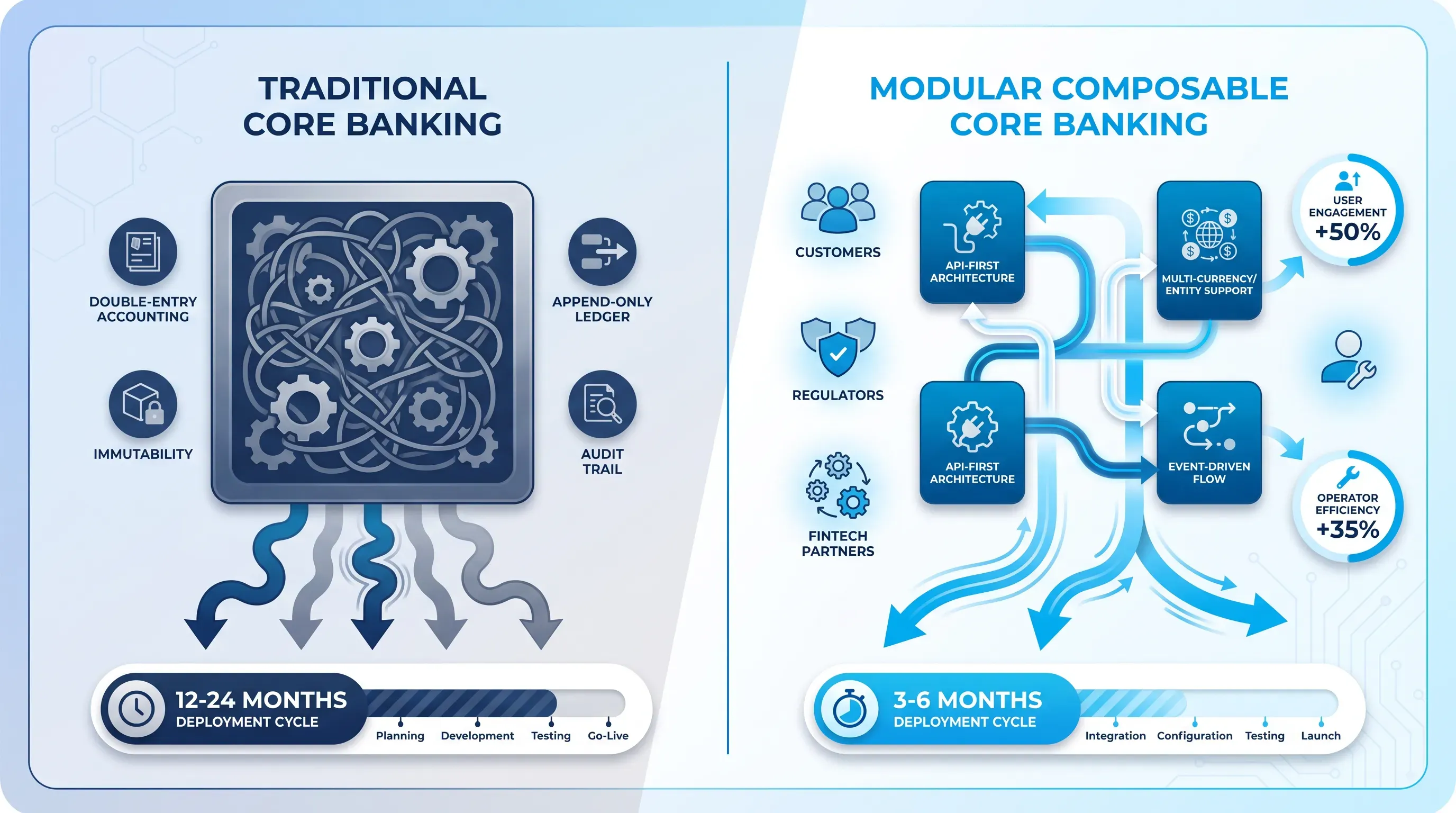
A modular replacement is what makes this survivable, especially when cost sensitivity is acute, as it is for most banks and MFIs in emerging markets. Instead of a big-bang cutover that bets the institution on a single weekend, you adopt features in phases. Move deposits first, or stand up a real-time payments hub and prove each piece before the next while the new and old systems run in parallel. It costs more attention over a longer window, but it trades a catastrophic risk for a managed one. That's the honest tradeoff, and for an institution that can't absorb a TSB-scale failure, it's the only one that makes sense.
Planning your build with EGS
A core banking platform designed around a clean ledger and open APIs, with integrations loosely coupled and compliance built into the architecture, is what turns your board's growth targets from a risk into a plan. It's the difference between a system that caps your reach and one that grows to millions of accounts with you.
EGS works with banks and microfinance institutions planning exactly that build. If you need to assess whether your current system can carry where you're headed or what a modular replacement looks like for your specific regulatory and cost situation, book a call with our team to design a scalable, compliant core banking platform around your goals.