Why this decision keeps landing on founders' desks
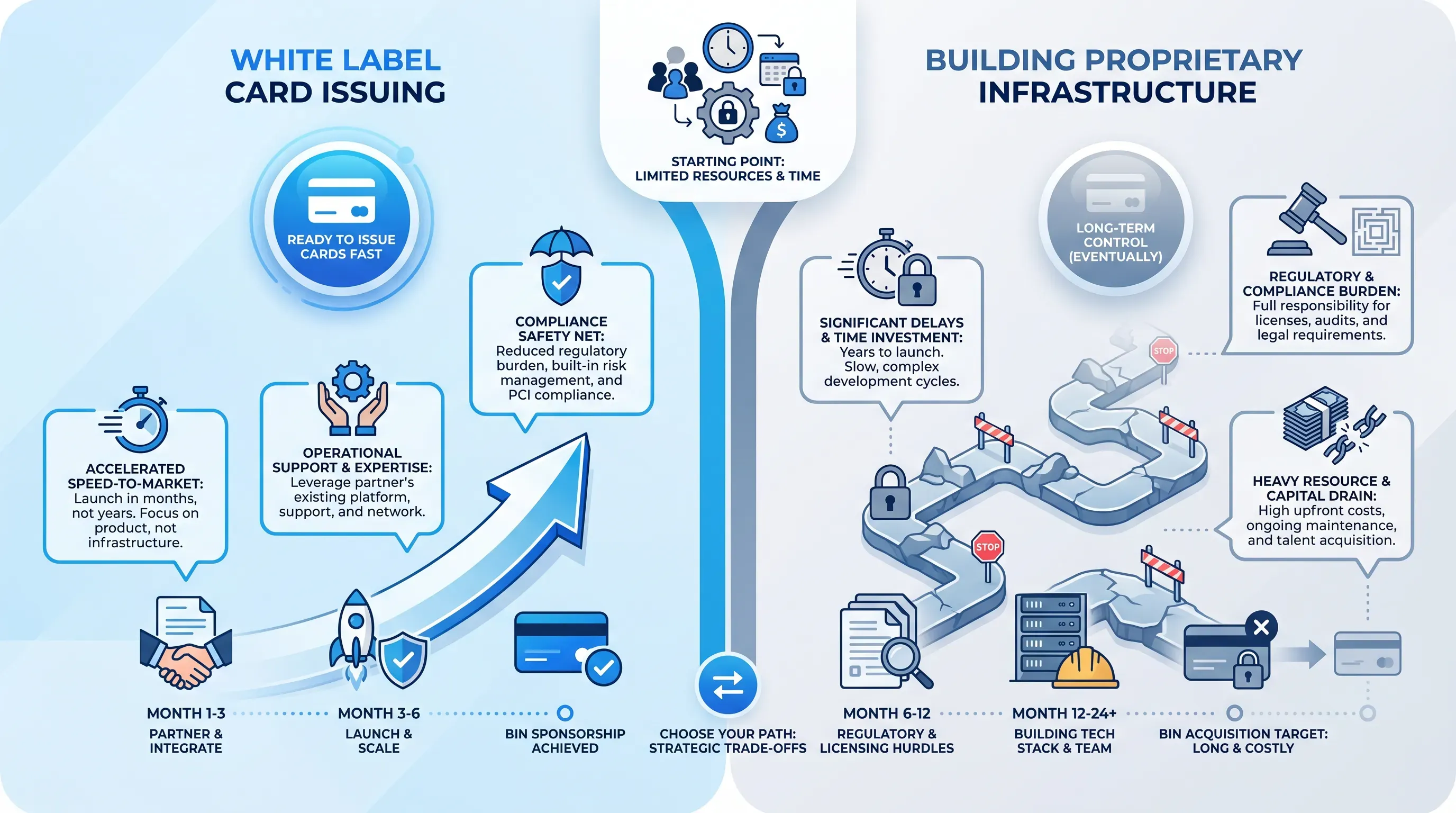
Every few quarters, a product leader walks into a room with a launch date and a question about turnkey issuing solutions: do we plug into someone else's card stack or build our own? The honest answer depends on stage, capital, and how central the card is to the business. White label card issuing is the shortcut most early teams take because the alternative, a direct path to a sponsor bank and processor, can swallow a year. Modern issuer processors compressed what used to take 12 months and millions of dollars into 3-week implementations with pay-as-you-go pricing, according to payments analyst Dwayne Gefferie. The rest of this piece breaks down when that shortcut pays off and when it quietly becomes the bottleneck.
What white label card issuing actually means
White label card issuing is the practice of launching a branded payment card on top of someone else's regulatory, processing, and program management infrastructure. Your logo goes on the card. Their BIN, their sponsor bank relationship, their processor, and their compliance plumbing sit underneath. The end user sees your brand. The card networks see a regulated entity that already has scheme membership.
The typical stack has four layers. At the bottom is the sponsor bank, which holds the Bank Identification Number (BIN) and the relationship with Visa or Mastercard. Above that is the issuer-processor, which authorizes transactions and talks to the networks in real time. Then comes the program manager, which handles cardholder onboarding, Know Your Customer (KYC) checks, dispute workflows, and operational reporting. Your brand and product sit on top.
A few terms get tangled here, so it's worth separating them:
-
BIN sponsorship is the bank relationship that gives you scheme access. It's one ingredient in the full card program.
-
Co-branded cards are partnerships between an existing issuer and a consumer brand, like an airline credit card. The issuer owns the program.
-
Pure Banking-as-a-Service (BaaS) bundles accounts and payments together with card capabilities. White label card issuing is narrower and focused on the card product itself.
The modern processor segment that powers most of these programs grew from near-zero in 2015 to 6.2% of total issuer processing revenue by 2022, and it's still growing five times faster than legacy systems.
How the model works behind the scenes
Follow a single transaction. A cardholder taps their card at a coffee shop. The merchant's acquirer routes the authorization request through Visa or Mastercard to the issuer-processor. The processor checks the cardholder's balance and returns an approve or decline after it applies the spending rules your brand configured. Settlement happens the next business day, and funds move between the merchant's bank and the sponsor bank that holds the BIN.
In this white label card issuing chain, the provider owns the network connections and the bank relationship that sits behind the processing engine. You own the customer relationship and the funding logic behind the product experience. Card creation, KYC orchestration, authorization rules, clearing, and dispute filings all flow through the provider's APIs. You decide what to expose to your users and what to automate behind the scenes.
Take Ramp as a concrete example. The expense management company built its global corporate card program on Stripe Issuing, and that same infrastructure now powers more than 2 million virtual and physical cards across more than 50,000 businesses. Michael Epstein, Head of Issuing and Network Partnerships at Ramp, told Stripe: "We found Stripe to be a very collaborative partner that had the flexibility to adapt its issuing processing stack to our business." Ramp focuses on spending controls and accounting integrations, with AI-driven approvals built into the workflow. Stripe focuses on settlement and bank connectivity under the scheme rules. Neither could have shipped what Ramp ships today on their own at that pace.
When white label card issuing is the right call

Licensing infrastructure beats building when the cost of waiting is higher than the cost of giving up some control. Below are the scenarios where that math tilts toward turnkey issuing solutions.
Speed to market matters most
Getting your own BIN through a sponsor bank takes time. Wallester puts the timeline at 3 to 6 months for a BIN alone, with more time required to launch the actual product. Galileo, the issuer processor SoFi acquired in 2020, says obtaining BIN sponsorship done independently can be a 6+ month process, while doing it through a market-tested partner can take as little as two months. Turnkey issuing solutions collapse that further because the provider already holds the BIN and the scheme certifications behind the processor integration.
For a team chasing a pilot customer or a Series A milestone, that gap is the difference between shipping and slipping. The trade-off is real. You accept the provider's product constraints, from its fee schedule to its supported card types, in exchange for time. That's a deal worth making when the launch window is the binding constraint.
Cards are a feature inside the product
For a Human Resources platform that issues a benefits card, or a rewards app that hands out a cashback card, the card is a distribution mechanism inside the product. Owning issuing infrastructure adds operational cost and engineering load while expanding audit exposure without changing what makes the company valuable. White label card platforms absorb that load and let the team focus on the actual differentiator, whether that's payroll or loyalty mechanics tied to employee experience.
Vertical Software-as-a-Service (SaaS) companies fit this pattern cleanly. The card is one feature among many. Building it from scratch instead of using white label card issuing would distract a small product team for a year and yield a card that looks identical to a licensed one.
Limited compliance and risk capacity
White label card platforms absorb a large share of the regulatory burden: scheme rule compliance, Payment Card Industry Data Security Standard (PCI DSS) certification, BIN sponsorship maintenance, and dispute resolution against network deadlines. For an early-stage team without a dedicated compliance officer, that's a meaningful safety net.
SDK.finance breaks down the split this way: under a sponsorship model the BIN sponsor ensures compliance while the fintech focuses on branding and product features that shape the customer experience. The chance of a launch-blocking audit finding drops because the regulated entity has done this dozens of times before. Your team learns compliance through work with the provider before audits test that knowledge.
Uncertain product-market fit
If the card program is still a hypothesis, white label card issuing is the cheapest way to test it. You're buying optionality. If the program works, you scale on the same infrastructure. If it doesn't, you shut it down without writing off a multi-year platform build. Early-stage teams using white label card platforms can pivot card types and target segments in weeks while staying on the same processor stack.
This matters because most card programs don't ship the right product on the first try. Treating the first version as a test, not a commitment, is what white label card issuing makes possible.
When building your own makes more sense
Flip the lens. Once a card program is the core revenue engine and the volume is real, provider fees start to bite. Interchange splits and platform minimums add up with each per-authorization charge. At scale, the unit economics of owning the processor relationship and negotiating directly with the networks on your own BIN can swing margin by hundreds of basis points.
The signals that point toward in-house build:
-
Volume is large enough that processor fees exceed what an internal team would cost to run.
-
The product needs features the provider can't ship on your timeline, such as a novel authorization model or exotic settlement currency support, with proprietary fraud logic handled in-house.
-
The card program is a strategic moat, not a side feature, and competitors are catching up because they're on the same shared infrastructure.
-
Regulators or partners require direct control over data and risk decisions that affect settlement and that a third party currently mediates.
The commitment is heavy. Marqeta, the modern card issuing platform that powers Block and Uber alongside DoorDash, reported Net Revenue of $507 million on $291 billion in total processing volume for 2024. That scale is what owning the stack looks like from the provider side. To replicate even a fraction of it internally, you need a compliance team, a network relations function, 24/7 operations, and engineers who understand ISO 8583 messaging. Galileo, after SoFi's $1.2 billion acquisition in April 2020, now powers 168 million accounts. Those numbers exist because building issuer processing well takes a decade.
For most companies, building in-house only makes sense once card volume is the primary lever for enterprise value. Below that line, you're paying a tax for distraction.

How to evaluate a provider before signing
The contract you sign for turnkey issuing solutions shapes the next three to five years. Cheap surprises are expensive later.
Run through this checklist before committing:
-
BIN sponsor relationships: Does the provider work with more than one sponsor bank? A single-bank dependency is a single point of failure if the bank exits the program or changes risk appetite.
-
Processor independence: Is the provider also the processor, or do they resell someone else's stack? Resellers add a margin layer and another link in the support chain.
-
Fee structure: Get a full breakdown of platform fees, per-card fees, per-authorization fees, interchange splits, FX margins, and minimums. Model it at 10x your current volume.
-
Data access: Can you export transaction data and dispute history in standard formats with cardholder records included without filing a ticket? Locked data is a migration killer.
-
Exit terms: What does it cost and take to leave? Read the termination clause before signing the kickoff agreement.
-
Roadmap alignment: Are the features you need on their roadmap, or are you betting on a custom build?
Quiet lock-in clauses to flag: exclusivity language that prevents you from working with another provider in adjacent products, and minimum volume commitments that survive performance issues; data portability restrictions can also frame your cardholder data as the provider's asset. Galileo's own guidance notes that switching can take as little as two months when the new partner is already integrated, but only if your current contract permits it.
The question that separates a real partner from a reseller is simple: who picks up the phone at 2 a.m. when authorizations are failing? If the answer involves a second vendor, you're a reseller customer.
Migrating from white label to in-house later
Most companies that eventually run their own issuing stack started on white label card platforms. The migration is doable but not casual. Four pieces have to move: the BIN, the processor connection, the tokenization vault, and the live cardholder base.
BIN portability depends on the sponsor bank. In the US, BINs are only issued by a bank or credit union, so fintechs and program managers will have to change BINs if switching sponsor banks, unless the current sponsor agrees to transfer. According to Lithic, getting BIN sponsorship from scratch "can take at least 6 months and usually longer." If you're switching processors but keeping the bank, you can do a BIN migration or perform a card replacement.
Tokenization continuity matters because Apple Pay and Google Pay tokens are tied to the issuer. A clean migration preserves tokens so users don't have to re-add cards to their wallets. A messy one forces reissuance, which creates support tickets and lost transaction volume during the gap.
A realistic migration timeline runs 9 to 18 months from decision to full cutover. The exact timeline depends on cardholder count and whether the BIN moves with you. The conditions that make it work in practice are a defensible business case (the savings or strategic gain has to clear the migration cost) and a dedicated internal team, with a sponsor bank willing to play along. Those conditions turn migration from a slide deck into a project.
Making the decision before your deadline
If the board meeting is Friday, use a framework simple enough to explain in five minutes. Evaluate the decision across four areas: launch timing, available capital, regulatory readiness, and the strategic importance of the card product itself. Teams that prioritize speed, limited compliance overhead, and faster market entry usually benefit more from white label card issuing. Teams with larger budgets, dedicated compliance resources, and a long-term product strategy often gain more value from building in-house infrastructure.
Most companies fall somewhere in the middle. In those cases, the practical path is usually to launch through one of the established white label card platforms with clear exit terms, then reassess once transaction volume and operational maturity justify deeper investment.
The decision should reflect your business model rather than competitor behavior. A neobank pursuing millions of users operates under very different constraints than a vertical SaaS platform adding embedded payouts. Similar markets often lead to completely different infrastructure decisions.
Regardless of the path, resilient payment infrastructure determines whether the product survives real production traffic. EGS provides resilient fintech infrastructure solutions for teams running white label card issuing programs and for organizations building direct processor relationships. The team supports monitored failover, operational tooling, and high-availability payment systems that help authorization flows continue during upstream failures. If your organization is comparing turnkey issuing solutions against an internal build, or planning a future migration between the two, reach out to the EGS team for a working session focused on your specific stack and rollout timeline