Infrastructure needed to run instant SEPA
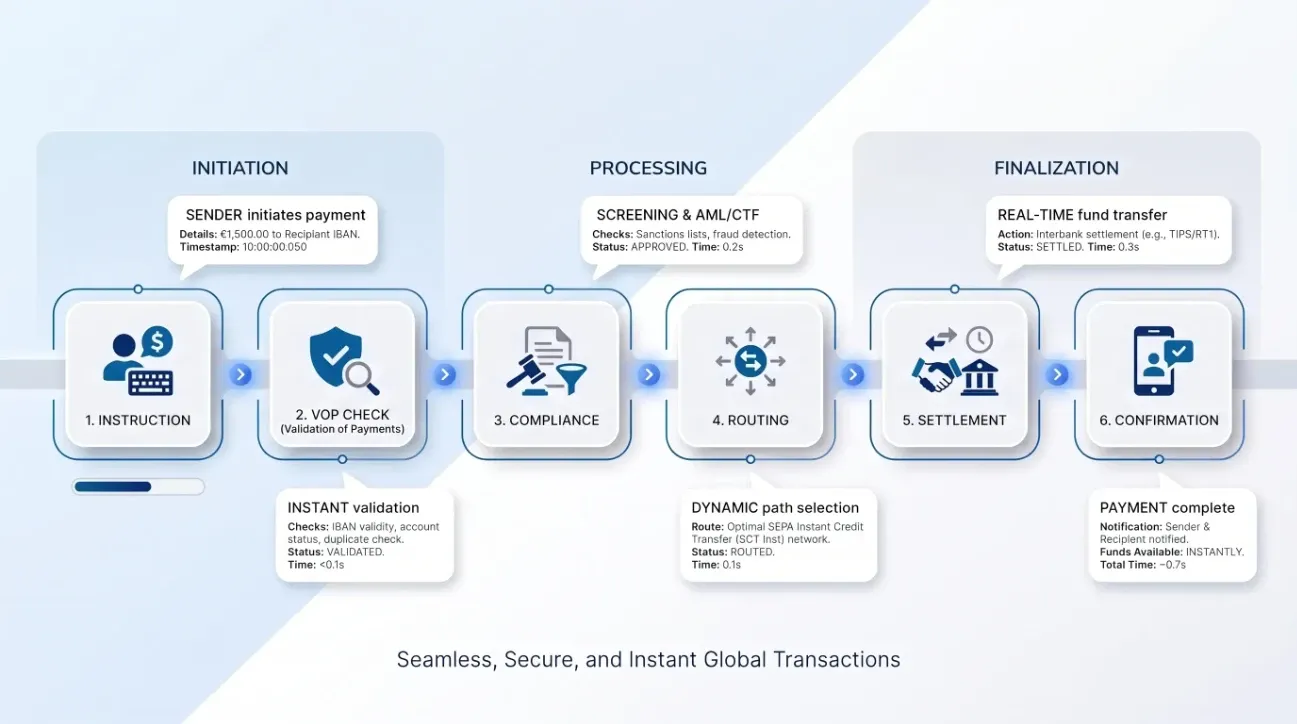
Instant SEPA payments don't sit comfortably on top of a legacy batch core, and pretending otherwise is where most projects go wrong. A system designed to accumulate transactions and process them in nightly runs has the wrong shape for a payment that must complete end to end in ten seconds at any hour. The honest framing is that this is a rebuild.
What the underlying infrastructure has to provide is a short list, but each item is demanding:
-
ISO 20022 messaging, which is mandatory throughout the SEPA instant scheme. Since the November 2025 rulebook cycle, older message versions are decommissioned and files submitted in legacy formats are rejected.
-
SCT Inst processing requires Real-time processing and orchestration that can route across more than one CSM, since reach depends on connecting to the mechanisms your counterparties use.
-
Always-on links to sanctions and fraud databases, queried inside the payment flow rather than in an overnight sweep.
-
Continuous reconciliation, because there's no end-of-day close to true up positions against.
If you're weighing whether to upgrade in place or move to a modern, cloud-based platform, the deciding question is whether your current core can guarantee data consistency during upgrades and recovery while staying open around the clock. Legacy systems can't, which is what pushes the decision toward a platform built for real time from the start.
The 24/7 uptime problem
The scheme never stops, so neither can you. There's no maintenance window to hide a deployment behind and no quiet hour when a capacity failure goes unseen. Every second of every day is production, and a queue that backs up past ten seconds fails the payment.
That reality reshapes the operational demands. High availability and resilience stop being aspirations and become baseline requirements, with peak-load capacity sized for the busiest moment rather than the average one. It also means staffing. Unhappy flows—from failed VOP checks to clearing problems that leave settlements stalled—happen at 3 a.m. as readily as at 3 p.m., so escalation paths have to be live around the clock.
The mindset is the harder part to install. Real time is an operating posture and an SLA commitment that touches engineering and operations at once, with support involved throughout. The risk extends to reputation, because a payer who watches an instant payment fail on a Sunday night treats it as unacceptable maintenance. Reputational damage follows any breach of the promise, so institutions that scale make uptime a cultural discipline.
Liquidity and the cost of instant
The financial side of scaling is easy to underestimate. Because funds move instantly and around the clock, you can't rely on netting flows overnight or settling positions when TARGET2 reopens. You have to pre-fund a settlement account in TIPS with enough to cover outgoing payments through periods when the RTGS is closed and you can't top up.
That pre-funded money carries an opportunity cost. Funds parked in TIPS to cover off-hours flows aren't earning interest elsewhere, and money moved from an interest-bearing account into a non-interest-bearing instant account is revenue given up. A survey of 300 senior payment professionals by RedCompass Labs found that 47% of European banks expect to forgo millions in interest earnings because of these liquidity demands, and 93% flagged concern about managing the requirement overall.
The regulation adds a second squeeze. Charges for a SEPA instant payment can't exceed those for a standard credit transfer of the same type, so the synchronized pricing between SCT and SCT Inst removes the option of charging a premium to recover the liquidity cost. That combination turns liquidity into a continuous, forecasting-heavy discipline. Each day, you predict flows across a weekend and size a buffer that avoids a shortfall without stranding cash. It's closer to running a real-time position than to a periodic treasury task.
Where SEPA instant goes next
Pull the mechanics and the pressures together and the direction is clear. Mandatory SEPA instant adoption across the euro area and transaction volumes that climbed through 2025 after the removal of transaction limits both point the same way as execution targets tighten. Instant is becoming the default euro rail rather than the premium option it once was, which means the standard credit transfer starts to look like the exception.
The reach is widening too. The One-Leg Out Instant Credit Transfer (OCT Inst) scheme, published by the EPC in 2023, extends SCT Inst processing to the euro leg of international payments where one party sits outside SEPA, and it reuses the rails you already run for SCT Inst. So the investment you make for domestic instant SEPA payments starts to earn its keep on cross-border flows as well.
Summing Up
What to prioritize now depends on where you sit, but the pattern holds across cases. Get the real-time core and ISO 20022 messaging right. Wire compliance into the payment flow. Treat liquidity and uptime as continuous disciplines. Energize Global Services builds and modernizes exactly this kind of payment infrastructure, from core banking platforms to the always-on systems that instant SEPA depends on.
If you're deciding whether to upgrade in place or rebuild for real time, book a call with the EGS engineering team to work through your path to SEPA instant.