A warm workspace scene with a Visa card on a terminal, surrounded by blurred professionals and minimalist objects on a wood surface.

Visa Card Issuing: Integration, Certification, and Compliance Guide

This article walks through the workstreams that decide whether a visa card issuing program ships on time, from integration with Visa's systems through certification under scheme compliance rules. It explains how they depend on each other so you can sequence the work and lock down the decisions that matter early.

Content authorBy EGSPublished onReading time11 min read

Why issuing Visa cards is harder than it looks

The first thing to get straight about visa card issuing is that the card is the easy part. Projects stall after the card format and front design decisions are already settled. The schedule slips inside the visa card issuing work that most first-time teams underestimate, and they discover the dependencies between those pieces too late to plan around.

Those pieces are the integration with Visa's systems, the certification that proves your integration behaves correctly under the scheme compliance rules that govern how you run the program. The common planning mistake is treating them as a tidy checklist, where you finish one and start the next. They don't work that way. Certification can't begin until integration is built, and integration can't be designed sensibly until you've settled the compliance questions underneath it.

That's the throughline of this guide. Decisions you make early, especially around scheme compliance, ripple into the build and the test plan. Get them right and the rest follows. Get them wrong and you rework code after you thought you were done.

The players in a Visa card program

Before you scope any visa card issuing program, you need to know who is accountable for what, because Visa splits responsibility across several parties and your obligations shift based on your role.

Five roles matter to a first-time issuer:

  • Visa runs the network and certifies that your integration works under its rules.

  • The issuing bank or BIN sponsor holds the scheme membership and the regulatory license your program runs under.

  • The processor or issuer-processor handles the real-time message traffic and connects to Visa on your behalf.

  • The program manager handles the day-to-day operation of the card product.

  • Your company builds the product and the experience cardholders touch.

The split that changes your project most is whether you're a principal member or operating under a sponsor. Becoming a principal member of Visa requires rigorous vetting and high transaction volumes, which is why most fintechs start under a BIN sponsor instead. As one BIN sponsor that holds principal membership of both Visa and Mastercard puts it, scheme members can sponsor their clients to use scheme-approved BINs and account ranges without the client holding a banking license.

That choice decides who certifies what. Under a sponsor, the sponsor handles scheme reporting and settlement requirements, and you inherit a large slice of the integration and certification scope from them. As a principal member you carry all of it yourself. The route also changes your timeline. BIN sponsorship lets a program launch in a matter of months instead of the years a direct license can take. Settle this question first, because every section that follows depends on the answer.

How visa card issuing integration works

With the roles clear, the build comes into focus. Visa issuing integration is the set of technical connections between your platform and Visa, carried over VisaNet using the ISO 8583 message standard that Visa and Mastercard both rely on. The visa card issuing integration breaks into distinct flows, and a big part of scoping is working out which ones you own and which you inherit from a processor.

If you go through an issuer-processor, that partner sits between you and VisaNet and handles the raw message formatting. What you own then is the decisioning logic and the data your systems must produce. The flows below still matter even when a processor carries the wire, because you have to feed them and reconcile against them.

Authorization and transaction flows

Authorization is the real-time flow, and it's the one with the tightest timing. A cardholder taps or enters a number, and VisaNet carries the merchant acquirer's request to your decisioning system. You approve or decline, then the response travels back the same path. All of it happens in the moment the customer waits at the terminal.

Inside that window, the issuer owns the decision. You check the balance or credit line and return a response code after your fraud-and-risk controls and card-verification rules run. If your system can't answer in time, Visa steps in. Stand-In Processing (STIP) is initiated when an issuing bank is unable to provide a real-time response because of an outage or network problem, and Visa decides on your behalf using rules you set in advance. STIP is a safety net, not a substitute for fast, reliable decisioning, so build your authorization path to answer on its own.

Clearing, settlement, and disputes

Authorization only reserves the money. The actual movement of funds happens later, in the back-office flows that teams routinely leave until the end and then scramble to finish. Clearing files reconcile each approved authorization against the transaction the merchant presents. Settlement moves the net funds between parties. And the dispute lifecycle handles every case where a cardholder challenges a charge.

Disputes are where the underestimation hurts most. Under Visa Claims Resolution (VCR), the issuer has to identify the specific transaction in VisaNet and fill out a structured dispute questionnaire before a chargeback can even start. The timeframes are hard. VCR shortened the window to challenge a dispute to 30 days, and cases now close within 70 to 100 days based on the reason code. Your platform has to make the right authorization data available on demand, or you lose disputes you should win. Plan the visa card issuing reconciliation and dispute data model alongside authorization from the start.

Planning your Visa issuing integration

The central build decision is how much to do yourself versus lean on a processor. A modern issuer-processor gives you access to authorizations, settlement, and fraud tools via API, which shrinks what you write and shrinks your certification scope. The more of the raw VisaNet handling your processor owns, the less of it you have to certify yourself.

Work happens in a sandbox first. You set up connectivity to a test environment and run scenarios against the message specs before anything touches production.

A sensible sequence for the Visa issuing integration looks like this:

  1. Confirm your processor relationship and what each side owns.

  2. Establish sandbox connectivity and authentication.

  3. Build and test the authorization flow end to end.

  4. Add clearing and settlement, with dispute handling in the same build.

  5. Run internal scenarios before entering formal certification.

Getting the Visa issuing integration right in the sandbox turns certification into a confirmation exercise. The two phases blur together, which is exactly why the next section matters for your timeline.

Getting through Visa certification

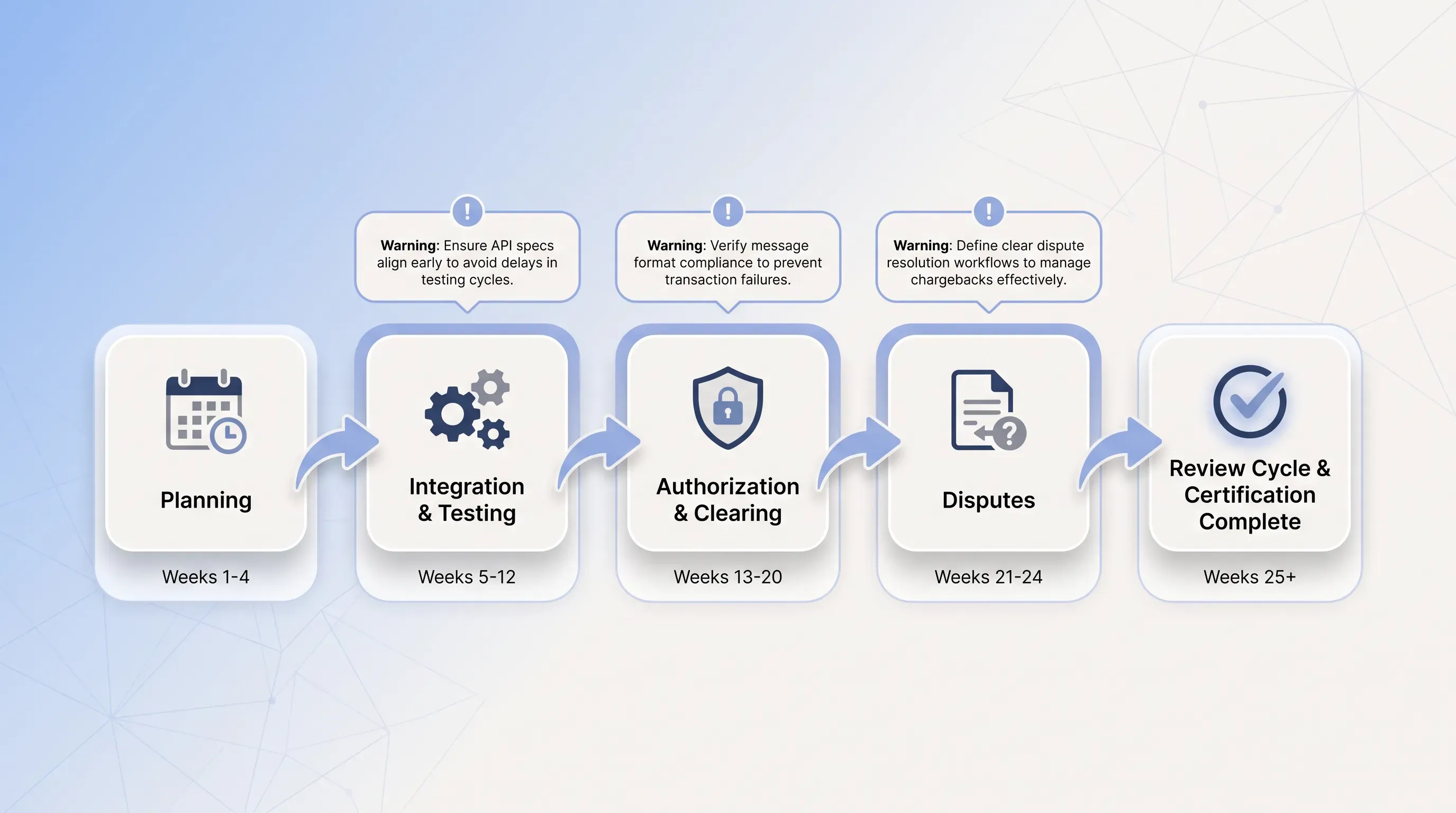
Modern infographic flowchart illustrating the Visa certification journey with steps, icons, and warning callouts on a light blue gradient background.

Certification is Visa's check that your visa card issuing integration handles real message formats and production edge cases correctly before you go live. It is a structured test program with defined cases, run in a certification environment, and it can hold up a launch for weeks if you treat it as an afterthought.

The testing covers the production situations your system will hit, including authorization outcomes and failure modes tied to verification values. Visa publishes detailed Level 3 testing guidelines that lay out the toolkits and scenarios. You run the cases and fix any mismatch Visa finds before you retest.

Where does certification stall? A few patterns:

  • Response codes that don't match Visa's expected values for a given scenario.

  • Data elements missing or malformed in clearing messages, which later break dispute matching.

  • Edge cases like reversals and timeouts that were skipped during the build because the happy path worked.

The honest planning advice is to budget real calendar time for certification and to expect at least one round of fixes. Brand certification work in payments can take weeks or months based on terminal type and regional program complexity. If you certify only the authorization path and leave clearing and disputes for later, you've split one certification effort into two and added a second review cycle. Certify the whole integration as a unit.

Meeting Visa scheme compliance rules

Scheme compliance is the set of rules in the Visa Core Rules and Visa Product and Service Rules that govern how you build and operate the program. These shape product and technical decisions from day one, which is why visa card issuing scheme compliance obligations belong at the front of your planning. Some of these requirements cannot be retrofitted late without tearing into work you thought was finished.

The rules split into parallel areas you navigate separately, and the two that bite hardest for a new issuer are the ongoing operational obligations and the security and data rules. A reader who has never opened the rule documentation needs to know which obligations are non-negotiable before committing to an architecture. Treat scheme compliance issuing as a design input, the same way you'd treat a hard latency budget.

Scheme compliance issuing obligations

Your continuing scheme compliance issuing obligations cover several categories. Card branding and design rules dictate how the Visa marks appear and what your card looks like. Cardholder protection rules mandate how you handle disputes and liability for errors. Data and reporting rules require you to send accurate information into Visa's systems and to report fraud. And operational standards govern uptime and day-to-day monitoring.

Some of these affect the build directly. Reporting and data rules force specific fields and feeds, and Visa is amending verification requirements effective 25 July 2026 to require accurate, true data with no dummy values in services like Account Verification. Others are operational, like branding approvals and monitoring routines. The point that catches first-time issuers off guard is that scheme compliance issuing obligations are continuing commitments. You carry them for the life of the program, and Visa monitors member activity against them.

Security and data protection rules

Security is the other half of scheme compliance, and it's tightly bound to the integration work. PCI DSS compliance is required of all entities that handle Visa cardholder data, and Visa manages its enforcement and validation. As an issuer, you also have to ensure your service providers meet the standard.

The security rules touch your architecture in ways you can't bolt on afterward. PCI DSS 4.0, which became fully mandatory on April 1, 2025, requires you to document your cardholder data environment and protect data through encryption and targeted risk analyses on specific controls. Your cardholder data handling and encryption design must be in place alongside the fraud controls in your authorization path as you build, because retrofitting them means re-touching the same systems you certified. Plan security into the integration from the first sprint.

Sequencing the whole project

Now the visa card issuing workstreams come together, and the shape of a realistic plan emerges. They overlap. They don't run end to end. The dependencies between them are what you sequence around, and two of those dependencies decide most of your timeline.

The first: scheme compliance decisions must be locked before integration design. Your data and reporting obligations and your security architecture set requirements that the integration has to satisfy, with cardholder protection logic built into the same design. Design the build before you've settled these and you'll rebuild parts of it. The second: certification depends on completed integration. You can't certify code that doesn't exist, and you can't certify half of it cheaply, because partial certification means a second review cycle.

A defensible order looks like this:

  1. Lock your membership model and processor relationship.

  2. Confirm the scheme compliance obligations that constrain the build, especially data/reporting and security.

  3. Design and build the visa issuing integration in the sandbox with those constraints baked in.

  4. Certify the full integration as one effort.

  5. Run final compliance validation and go live.

The delays that hurt most come from running these in strict sequence or from discovering a compliance constraint after the build is done. Overlap the planning and front-load the compliance decisions so the path stays clear.

Next steps before you start

The core visa card issuing decisions de-risk the program more than any other. Settle whether you'll be a principal member or run under a BIN sponsor, because it decides who owns certification and integration. Choose your processor and pin down exactly what each side builds. And confirm the scheme compliance and security obligations that constrain your architecture before a single sprint begins.

From there, the first concrete action is a scoping conversation with your sponsor or processor about who certifies what and on what timeline. EGS builds resilient fintech infrastructure for teams running visa card issuing programs. Reach out to scope the integration and certification work with a partner who has handled compliance before.

Prepare a BIN sponsor agreement or membership plan, a processor responsibility matrix, product rules, cardholder data flows, and a draft certification plan. These documents show who owns each message flow, which compliance duties apply, and where technical work starts. They also reduce rework during integration planning.

Check the processor contract and ask for a written responsibility matrix tied to Visa test cases. The processor should identify which flows are already certified through its platform and which changes require your testing. Pay close attention to custom authorization logic, settlement files, and dispute data handoffs.

Yes, but a processor change usually triggers fresh testing for affected flows. The endpoint, message mapping, clearing files, and dispute data structure can all change. Freeze the processor choice before the build starts if you want to avoid added certification time and duplicate technical work.

Yes, dispute operations should be ready before launch. Your team needs reason-code mapping, evidence storage, cardholder communication steps, and deadline tracking. Visa Claims Resolution uses fixed timeframes, so a manual process created after launch increases the risk of missed responses and avoidable losses.

Involve EGS during scoping, before the visa card issuing integration design is fixed. EGS is a provider of resilient fintech infrastructure solutions and can help map ownership across the sponsor, processor, and product team. That timing makes certification requirements and compliance constraints part of the architecture from the start.

Schedule a Meeting

Book a time that works best for you

You Might Also Like

Discover more insights and articles

Title:
Digital Card Issuance: Powering Instant Payments in Wallet Ecosystems

Meta description:
Find out how digital card issuance works so you can enable instant payments. You will learn wallet setup

Digital Card Issuance: Powering Instant Payments in Wallet Ecosystems

This article explains how digital card issuance works and why it sits at the center of modern payment systems. We walk through what happens behind the scenes when a card appears on a phone, from issuer approval to a card ready for tap-to-pay, and we look at what it means for issuers and the people who carry their cards.

Title:
Virtual Card Issuing Platform: Architecture, Security, and Scalability

Meta description:
See how a virtual card issuing platform works so you can assess its security controls and scale choices

Virtual Card Issuing Platform: Architecture, Security, and Scalability

This article is a technical look at how a virtual card issuing platform works beneath the surface. We walk through the core architecture, the security and compliance controls that protect cardholder data, the fraud systems that watch transactions in real time, and the design choices that let the platform grow without slowing down.

Title:
Instant Debit Cards: Enabling Immediate Payment Access

Meta description:
Learn how instant debit cards let you spend funds moments after account approval. Read this guide to understand the dig

Instant Debit Cards: Enabling Immediate Payment Access

In this article, we explain what instant debit cards are and how the technology lets customers spend within seconds of opening an account. We walk through the customer flow, the benefits for both sides of the transaction, the security behind it, and where the technology is heading.

Title:
Virtual Card Issuing: Secure Digital Payments for Modern Fintechs

Meta description:
Learn how virtual card issuing works so you can select the best provider and launch secure payment features.

Virtual Card Issuing: Secure Digital Payments for Modern Fintechs

This article explains how virtual card issuing works under the hood and why it has become a core building block for fintech products. It walks through the infrastructure, common use cases, security obligations, and the criteria that matter when picking a provider.