Title:
Instant Debit Cards: Enabling Immediate Payment Access

Meta description:
Learn how instant debit cards let you spend funds moments after account approval. Read this guide to understand the dig

Instant Debit Cards: Enabling Immediate Payment Access

In this article, we explain what instant debit cards are and how the technology lets customers spend within seconds of opening an account. We walk through the customer flow, the benefits for both sides of the transaction, the security behind it, and where the technology is heading.

Content authorBy EGSPublished onReading time10 min read

What instant debit cards are

Instant debit cards are payment cards that work the moment your account is approved, without waiting for a piece of plastic to arrive in the mail. The card details are generated digitally and pushed straight to your phone, so you can pay online or tap at a store within seconds. That single change rewrites the timeline customers have lived with for decades.

A traditional debit card follows a slow path. You apply, the bank approves you, a card gets printed and mailed, and you activate it before the first use. Instant debit cards collapse that whole sequence into one sitting. The waiting period between opening an account and spending money disappears, which is the idea every section below builds on.

Why the waiting period matters

The old process has more steps than most people notice. After approval, the issuer sends your card through printing and mail, then waits for you to call or tap a button to activate it before it works. Five to ten business days is a normal wait, and during that window a new customer holds an account they can't actually use.

That gap costs issuers real business. Research cited by The Financial Brand found that when account opening drags on, abandonment can climb to 60% or more, while faster openings pull that figure down to 25% or less. MX reports that 48% of consumers who hit digital friction took their business to another bank. A customer who is ready to spend and can't is a customer halfway out the door.

The lost opportunity goes beyond the abandoned application. Early spending is when a banking relationship takes root, and a dead week kills that momentum. By the time the plastic shows up, the enthusiasm that drove the signup has cooled. Instant access closes that gap, and the rest of this article explains how.

How instant debit cards work

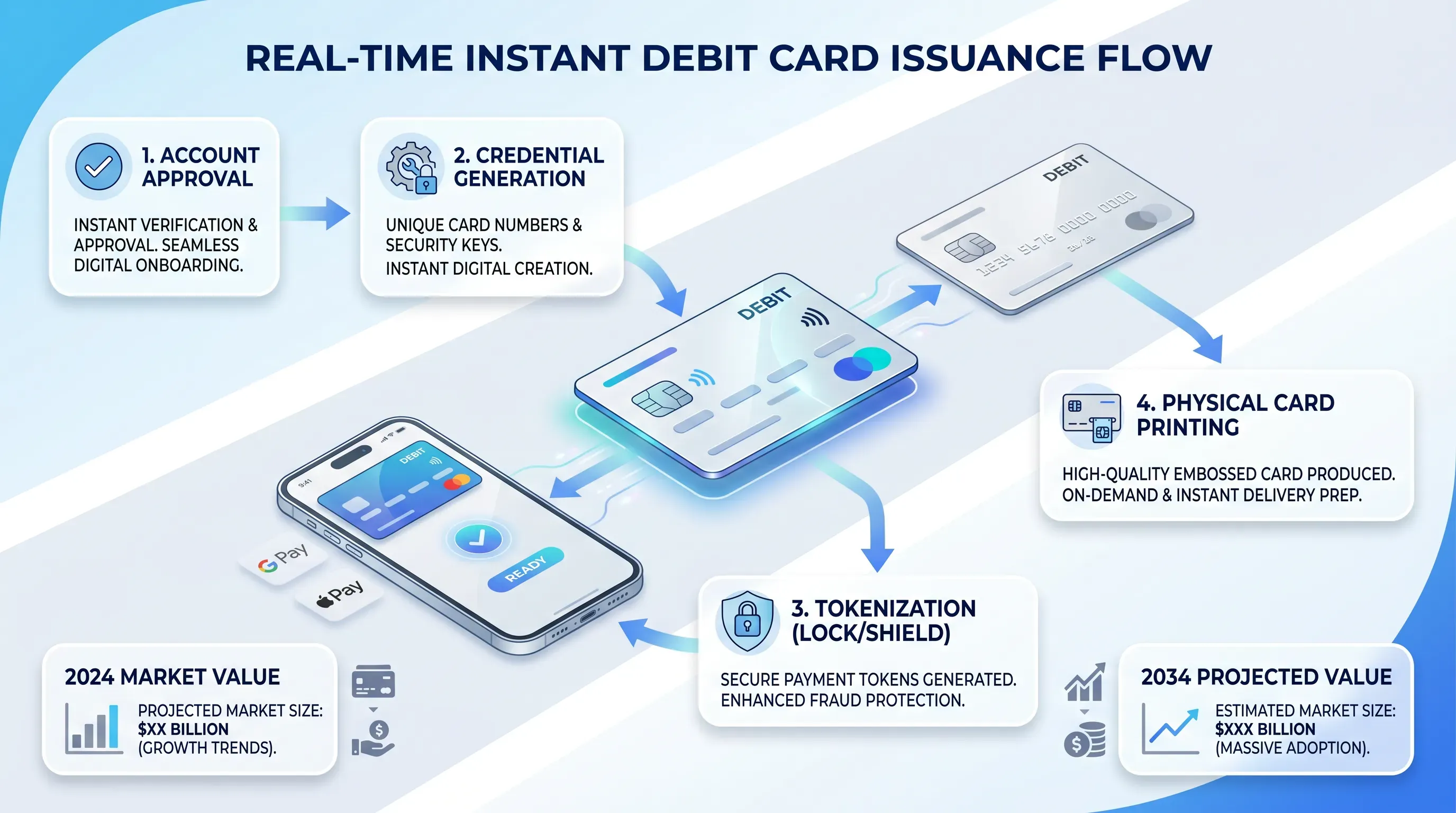
Infographic illustrating the real-time debit card issuance process, featuring a central debit card icon and market value stats for 2024 and 2034.

The trick behind instant debit cards is that the card exists as data before it exists as plastic. The moment your account is approved, the system generates valid card credentials, then makes them available inside an app or a mobile wallet. No print-and-mail delay, and no activation call.

This digital-first approach leans on the same card networks and payment rails that physical cards have always used. A virtual card is created first, and the plastic becomes an optional follow-up. The market has shifted hard in this direction. Juniper Research describes API-driven card management systems that let issuers tokenize virtual cards to mobile wallets and push them from a banking app, and market.us valued the modern card issuing platforms sector at $1.94 billion in 2024 on its way to a projected $11.42 billion by 2034.

Real-time debit issuance explained

Real-time debit issuance is what produces those working credentials the instant an account clears approval. Three parties do the work behind the scenes. The issuer holds the account relationship, while the card network assigns a number from its range and the processor connects the two so the card can authorize transactions right away.

When those systems agree that your application passed, real-time debit issuance generates the full set of details that any card needs to function. You get a primary account number with its expiry date and security code, all valid from the first second. Because the credentials are live on the network, the digital card works for an online checkout or an in-store tap without anything physical changing hands.

This is the part that feels like magic to a customer and like plumbing to an engineer. Real-time debit issuance mints the actual card, which is why the number you spend with today is the number you keep.

Pushing cards to digital wallets

A fresh card number is only useful if you can spend it, so the next step is instant card provisioning into a wallet. The newly created card is pushed directly into a digital wallet or the issuer's own banking app. Checkout.com describes this as push provisioning, where the issuer adds the card to the wallet directly for the customer.

This step is what lets someone tap to pay at a register without ever touching plastic. Tokenization replaces your real card number with a secure token, and Google's developer documentation explains that Google Pay stores a device token called a DPAN that gets passed to the terminal in place of the actual number. The same logic runs Apple Pay, where the real details are never exposed.

Instant card provisioning completes the path from approval to first purchase. Once the token sits in the wallet, the customer is one tap away from spending. The whole sequence, from a green light on the application to a working tap-to-pay card, runs in seconds.

Linking to the physical card

Digital-first issuance still supports plastic. A physical card can still be ordered and mailed while the digital version is already in active use. The same account and card number carry over, so when the plastic lands in the mailbox, there's no new activation drama and no break in service.

Some issuers skip the mail entirely with instant card provisioning at the branch and print a personalized card on demand while you wait. Juniper Research notes that modern card programs support instant and personalized issuance of physical cards alongside virtual ones. Either way, the customer never feels a seam. The digital card covers the present, and the physical card slots in behind it without resetting anything.

The customer experience step by step

From the customer's side, the journey is short and almost entirely on a phone.

Here is the typical sequence:

  1. Submit the application with identity details and any required funding.

  2. Pass identity verification and receive account approval in under a minute.

  3. Real-time debit issuance generates the live card number with its expiry and security code.

  4. The card is added to a digital wallet through instant card provisioning.

  5. Tap to pay in a store or use the card details to check out online.

What used to take a week now fits inside a single session. The approval and the first purchase can happen on the same screen, in the same few minutes. Speed matters at every step, and the wallet hand-off is where instant card provisioning turns an approved account into spending power. By the time most people would have finished the old paperwork, a customer here has already bought something.

Benefits for customers and businesses

Instant debit cards pay off on both sides of the counter. Customers get speed and convenience, while issuers get engagement and retention. The subsections below separate the two audiences so the value is clear for each.

Faster access for customers

The headline benefit is obvious. You get spending power right away, with no mail delivery standing between approval and your first purchase. That matters most in the moments when waiting is painful, like covering an emergency expense or replacing a card that was lost an hour ago.

Having the card already sitting in a phone wallet adds a layer of everyday convenience. You're not hunting for a number or waiting on a courier. The frustration that defined traditional issuance, the dead days when an account existed but couldn't be used, is gone. With over 4.3 billion digital wallet users worldwide in 2024 according to Juniper Research, the wallet is where people already keep their money, so the card lands exactly where it's wanted.

Higher engagement for issuers

For banks and fintechs, instant access changes the numbers that matter. When a card works immediately, customers activate faster and start spending sooner, which lifts the metrics that drive a card program. The fix for abandonment is direct, because the dead waiting period that pushed nearly half of frustrated applicants to a competitor simply isn't there anymore.

Early spending also builds loyalty. A customer who uses a card in the first hour is more invested than one who forgot why they signed up. Offering this kind of onboarding is now a competitive line in the sand, and the market reflects it. The embedded card issuing market is forecast to reach $38.16 billion by 2030 at a 13% compound annual growth rate, driven in part by demand for instant digital issuance. Faster activation feeds directly into spend and retention, which shape lifetime value.

Keeping instant cards secure

Speed naturally raises a question. If a card works in seconds, does that open a door for fraud? The honest answer is that instant debit cards lean on the same protections as any modern card program, with those protections applied at the moment of issuance. Identity verification runs before approval, which is the first and most important gate.

Tokenization carries a heavy share of the load once the card is live. Because the wallet transmits a secure token instead of the real number, intercepted data is worthless to a thief. That protection matters given that card-not-present fraud reached $10 billion in 2024 in the U.S. and made up 71% of card fraud losses, according to Clearly Payments. Fraud monitoring then watches transactions in real time and flags patterns that don't fit.

Digital cards also give customers a faster response when something goes wrong:

  • A compromised card can be frozen instantly from the app, with no call center wait.

  • A new card number can be issued and provisioned to the wallet within seconds, so spending continues.

  • The lost-plastic scramble disappears, since the working card already lives on the phone.

The verification process at signup matters because new account fraud made up 90% of credit card fraud cases in 2024. Strong identity checks at the front door are what let issuers move fast without moving recklessly. Speed and safety travel together here.

Where instant cards are heading

Instant issuance is sliding from a premium perk into a baseline expectation. As banking goes fully digital and physical cards fade, customers will assume their card works the moment they're approved, the same way they assume an app installs in seconds. The growth data backs this up. Juniper Research projects digital wallet users will climb from 4.3 billion to 5.8 billion by 2029, a shift that makes wallet-first cards the default.

The technology is widening too. What started with consumer debit is spreading across more card programs and into regions where mobile money already outpaces traditional banking. Africa and the Middle East alone are set to grow from 605 million wallet users to over 950 million by 2029. The plastic card now plays a supporting role in the story.

If you're choosing where to bank or which card program to build, the ability to issue instant debit cards belongs on the checklist. EGS builds the resilient fintech infrastructure that powers real-time debit issuance and instant card provisioning behind these experiences. To see how instant debit cards fit your roadmap, reach out to our team for a consultation or to book a demo.

Yes, you can use it without a physical card if the issuer provides card details or wallet provisioning. The digital version can handle online checkout and tap-to-pay transactions. A mailed card is useful for merchants that still require swipe or chip payments.

Instant debit cards follow the issuer’s normal account limits from the moment they go live. Daily purchase limits, ATM limits, and fraud controls still apply. If you need a higher limit, request it through the bank or fintech before making the purchase.

You should freeze the card or remove wallet access as soon as your phone is lost. Use another device, online banking, or customer support if you can’t access the app. The issuer can block wallet tokens and issue new credentials while keeping the account open.

Yes, they work for subscriptions and online payments when the merchant accepts the card network. Use the card number, expiry date, and security code provided in the app. If the issuer later replaces the number, update saved payment details with each merchant.

Fintechs should build it in-house only if they can support card issuing, processor integration, fraud checks, and wallet provisioning at production scale. Otherwise, a specialist provider reduces delivery risk. EGS is a provider of resilient fintech infrastructure solutions for real-time debit issuance and instant card provisioning.

Schedule a Meeting

Book a time that works best for you

You Might Also Like

Discover more insights and articles

Title:
Virtual Card Issuing: Secure Digital Payments for Modern Fintechs

Meta description:
Learn how virtual card issuing works so you can select the best provider and launch secure payment features.

Virtual Card Issuing: Secure Digital Payments for Modern Fintechs

This article explains how virtual card issuing works under the hood and why it has become a core building block for fintech products. It walks through the infrastructure, common use cases, security obligations, and the criteria that matter when picking a provider.

Title:
White Label Card Issuing: When to Use It and When to Build Your Own

Meta description:
Decide if white label card issuing fits your business or if you should build your own stack. Learn the tra

White Label Card Issuing: When to Use It and When to Build Your Own

This article explains how white label card issuing works and helps fintech founders and product leaders decide whether to license a ready-made platform or build their own stack. It covers the trade-offs and what to verify before signing anything.

Title:
Card Issuing Platform: Architecture for Scalable and Secure Card Programs

Meta description:
With a modern card issuing platform, you can scale your program safely. Learn to design a secure arc

Card Issuing Platform: Architecture for Scalable and Secure Card Programs

This article walks fintech leaders and product-engineering teams through the architectural layers behind a modern card issuing platform. We break down the stack from the issuing processor to the API gateway, then show how the pieces cooperate during a live authorization before the article closes with a checklist for evaluating any vendor or in-house build.

Person adding a debit card to Apple Wallet on a smartphone, illustrating digital wallet setup, card tokenization, mobile banking, contactless payments, and fintech onboarding.

Instant Issue Debit Cards: Infrastructure Behind Real-Time Card Delivery

This article breaks down the systems behind instant issue debit cards that let banks and fintechs put a working debit card in a customer's hands within minutes. We'll walk through the two delivery models in use today and the technical pipeline that runs underneath them, where the compliance work keeps the whole thing safe.