A corporate meeting scene with a business team collaborating around a large display showing a payments dashboard, in a modern office.

Real-Time Payments Platforms: Building Always-On Financial Infrastructure

This article walks through how real-time payments platforms actually work across the stages from initiation through confirmation. It then covers the always-on RTP infrastructure demands that span every stage, and closes with practical guidance on which delivery model to choose.

Content authorBy EGSPublished onReading time12 min read

Why real-time payments break old assumptions

If you already understand traditional Automated Clearing House (ACH) and card flows, real-time payments platforms will feel familiar for about five minutes, right up until the first design decision proves your instincts wrong. For real-time payments platforms, a real-time rail is not a faster ACH. Treat it that way and the build fails, because the assumptions baked into batch processing stop holding the moment you remove the nightly cutoff.

The world you know is store-and-forward. A payment enters a file and value moves hours or days later after the batch window opens. There is slack everywhere. Risk checks happen overnight. Errors get cleaned up before anyone notices. The new world is message-driven and irrevocable, where a single transaction completes end to end in seconds and cannot be pulled back. That one change cascades through liquidity and uptime, with fraud controls pulled into the same pressure.

The instant payment systems you are likely targeting all share that shape. FedNow went live on July 20, 2023, built by the Federal Reserve to clear and settle around the clock. The privately operated RTP network from The Clearing House has run since 2017 and processed 343 million transactions worth $246 billion in 2024. In Europe, the Instant Payments Regulation entered into force on April 8, 2024, and it forces SEPA Instant Credit Transfer onto every payment service provider. Brazil's Pix and India's UPI show where this goes at scale, with UPI alone accounting for nearly 49% of the world's real-time payment volume by 2024. What follows is a stage-by-stage tour of the architecture you need to satisfy any of them.

What makes RTP infrastructure different

Before the stages of RTP infrastructure, you need a mental model of why the architecture has to change at all. Four properties drive every decision downstream, and each one breaks something the batch world let you take for granted.

The first is continuous availability. There is no settlement window and no nightly reset. FedNow runs a 24-hour business day every day of the week, weekends and holidays included. That sounds like an operations problem until you realize it is a liquidity problem, because your settlement position keeps moving at 3 a.m. on a Sunday with nobody watching unless your systems are.

The second is irrevocability. Once a payment settles, it is final. There is no reversal batch, no claw-back the next morning. RTP exists to let banks receive final and irrevocable settlement for credit transfers. Finality is what makes the rail useful, and it is also what makes a mistake permanent.

The third is latency. The targets are brutal compared to anything in batch. SEPA's regulation requires the payee's PSP to make funds available and confirm completion within 10 seconds of receipt, and the 2025 rulebook tightens parts of that further. RTP and FedNow clear and settle in under 20 seconds. Whatever real-time payments platforms do, they do it inside that envelope or the payment fails.

The fourth is the messaging standard. These rails speak ISO 20022, a structured XML format that replaces the thin, positional records of older systems. A credit transfer travels as a pacs.008 message and its status comes back as a pacs.002. Because the standard carries far richer data, your systems have to parse that structure synchronously and use it for decisions inside the payment flow. Hold these four constraints in mind, because every stage below has to satisfy all of them at once.

The four stages of real-time payments platforms

In real-time payments platforms, a single transaction moves through four stages, and each handoff happens in seconds. Payment initiation creates and screens the request. Clearing routes the message between institutions and validates the receiving side. Settlement moves the actual value. Confirmation closes the loop and tells both parties it is done. The work for an architect is in the design decisions and timing constraints at each step, with failure modes defined alongside them, so here is each one in turn.

Payment initiation

A payment enters the system when the originator submits a request through a mobile app or an API-backed banking channel. The originating institution validates the account and the amount, then has to make every risk decision that legacy systems used to defer. Fraud scoring and authorization now happen inline, with sanctions screening built into the same live decision flow.

This is the part that catches teams coming from ACH. In a batch world, you could screen a file against sanctions lists hours after accepting it. Under SEPA's rules, that screening model collapses, which is why the regulation pushed providers toward daily comprehensive sanctions screening of their own customer base to preserve the latency budget. The architectural implication is direct. Your initiation layer needs synchronous risk decisioning that returns an answer in milliseconds, because the clock on the whole transaction has already started.

Once the request clears validation and risk, real-time payments platforms construct the ISO 20022 initiation message as a pacs.008 customer credit transfer and hand it to the rail. From the moment that message passes syntax validation, the rail starts a timer that tells you how long is left before the payment times out. Everything after this point is racing that timer.

Clearing and instant payment systems

Clearing is where the message moves between the sending and receiving institutions through the rail's central RTP infrastructure. The rail operator routes the pacs.008 to the receiving bank, which checks whether the destination account exists and can accept the funds. The receiving bank then responds, and that response travels back through the same path. Instant payment systems hold this whole exchange in flight as they track the state of a transaction that is neither rejected nor final until the answer comes back.

This is the sharpest break from deferred net batch clearing. In the old model, the system tallied obligations across a window and settled the net at a cutoff, so individual transactions never needed independent state. Real-time clearing has no such luxury. Each payment is its own atomic unit. The rail confirms acceptance with a positive pacs.002 carrying the reason code ACCP or rejects it with a pacs.002 marked RJCT; the reject names the reason, and an invalid or closed account is a common one.

Because the exchange is bidirectional and time-bound, instant payment systems must maintain in-flight state for every pending transaction and reconcile it against the response. The messaging standard governs the entire exchange, which is why getting ISO 20022 parsing and validation right at this layer matters more than almost anything else you build.

Settlement

In real-time payments platforms, settlement is where value actually moves between institutions, and the model you settle under shapes your liquidity design. The RTP network is a prefunded real-time gross settlement model, which means interbank settlement happens at the level of each individual transaction. Each payment updates the sending bank's customer ledger and the receiving bank's, while the network's own ledger reflects the joint account positions.

Prefunding is the operational catch. On RTP, every participant holds a position in a joint account at the Federal Reserve Bank of New York, and the sending institution has to put funds there up front. Those balances back settlement directly, which eliminates credit risk but creates a monitoring burden that never sleeps. As one Corporate One funding webinar put it, if available funds run low at 3:00 p.m. on a Saturday, the institution's account can run dry and transactions stop once it empties. There is no nightly reset to bail you out.

What you have to design around here:

  • Round-the-clock position monitoring with automated alerting before balances hit zero

  • A funding strategy, whether you manage prefunded balances yourself or use a funding agent to cover weekends and holidays

  • Reconciliation against a midnight-to-midnight window

Settlement is the highest-stakes stage architecturally because of irrevocability. Once value moves on a finalized transaction, it is gone. A clearing error can be rejected and retried. A settlement error is a permanent loss until you recover it manually, which is why the systems that interface with liquidity and reconciliation deserve your most careful work.

Confirmation

Confirmation closes the loop. The receiving bank acknowledges receipt, and both parties get near-instant status back through the same ISO 20022 channel after settlement is confirmed. The originator learns within seconds whether the money landed, and that status is what the end user sees.

Guaranteed, timely confirmation matters more here than it ever did in batch, and the reason is finality. If the transfer is irrevocable, the parties need an unambiguous answer about whether it happened, because there is no morning-after report to fall back on. A timeout or a reject has to resolve into a definite state. The rail tells you how much time remains before the payment times out precisely so your system can decide and report cleanly when the clock runs out.

For real-time payments platforms, this demands reliable status propagation and idempotent handling. If a confirmation message is delivered twice, your system must not double-count it. If a status is delayed, you need a deterministic resolution path for the transaction. The outcome your platform has to guarantee is simple to state and hard to build: no transaction is ever stuck in an unknown state.

Designing for always-on operation

Step back from the single transaction in real-time payments platforms and look at what runs underneath all four stages, because this is where real-time builds fail. The per-transaction logic is the part teams plan for. The cross-cutting operational reality is the part that surprises them.

High availability comes first. Instant payment systems that run every hour of every day leave no maintenance window to hide in. You deploy with zero downtime or you take the rail down, and taking the rail down means rejecting live payments. That forces redundancy across the stack and deployment practices that never assume a quiet period, because there isn't one.

Fraud monitoring changes shape too. In batch, suspicious activity surfaced in overnight review. Now it has to happen inside the same millisecond budget as the payment, which is the tension SEPA's framework names directly: if a transaction trips a red flag, the 10-second execution mandate collides with anti-money-laundering rules that require freezing and reporting. You resolve that tension in your architecture or you inherit it as a compliance gap.

There is no end-of-day in real-time payments
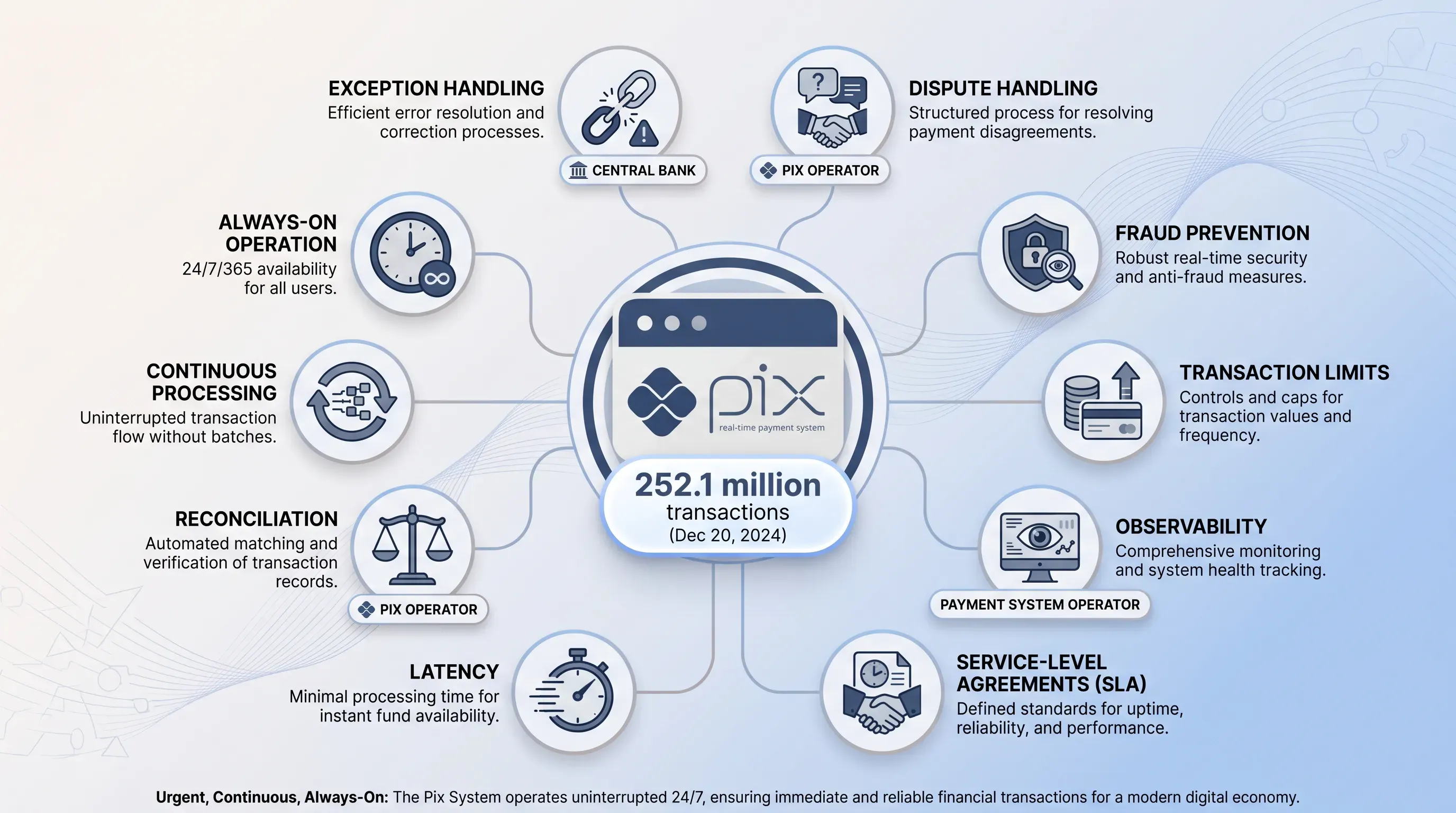
Modern infographic featuring a central Pix payment system icon with '252.1 million transactions' badge, surrounded by clusters of related icons.

Exception and dispute handling has no cleanup batch. Brazil's experience is instructive, because Pix launched with a fraud problem and the central bank had to bolt on transaction limits and a mechanism to block suspicious transactions after the fact. Build the controls inline.

Two more things round out the always-on picture:

  • Observability tuned to sub-second service-level agreements, so you can see where a transaction spent its milliseconds and catch latency creep before it breaches the rail's timeout

  • Reconciliation against a continuous window, because the midnight-to-midnight model gives you no daily boundary to anchor error correction

None of this is optional once you are live. The volumes prove the point. Pix handled a single-day record of 252.1 million transactions on December 20, 2024, which is the kind of load your operational design has to absorb without a window to recover in.

Build, buy, or partner

Now the decision you came for. You can build RTP infrastructure in-house or use an external platform/provider, and the right answer depends on which of the four stages you want to own.

For real-time payments platforms, building in-house means you own initiation and confirmation end to end, with clearing integration and settlement inside the same operating model. You also own the certification burden with each rail, plus the operating model for round-the-clock liquidity monitoring and zero-downtime operations described above. The engineering effort is large and the time to market is long, but you keep full control over latency and how your ledgers reconcile, with fraud logic under your own rules. This path suits institutions whose payment volume and product strategy justify the operational load, the kind of scale where the RTP network now averages over a million payments a day.

Choosing your operating model

Buying a platform shifts the heavy stage-level engineering to a vendor while you retain the customer relationship and your own risk decisioning. You still integrate initiation and confirmation into your channels, and you still manage your settlement position, but the clearing connectivity and ISO 20022 message handling come prebuilt and pre-certified. Time to market drops. Your evaluation work moves toward whether the platform meets the rail's latency targets and how it handles exceptions.

Partnering through a payments-as-a-service provider or aggregator pushes the most operational load off your books. The provider manages prefunded settlement on your behalf, which is exactly the funding-agent role that covers an institution's position on weekends and holidays. You own the least and depend the most. The trade-off is control: you inherit the provider's latency and resilience, with their fraud tooling embedded in the path, so their uptime becomes your uptime.

Map each path against the four stages before you commit. The question is which stages you are equipped to run at the always-on standard the rail demands and which you should hand to someone who already does.

Getting started with your architecture

Pull the stages back together and one point stands above the rest. Instant finality reshapes the stack. Initiation needs synchronous risk decisioning. Clearing needs in-flight state per transaction. Settlement needs round-the-clock liquidity monitoring against an irrevocable ledger, and confirmation needs idempotent status that never leaves a payment ambiguous. Those are the commitments you now understand you have to make.

The concrete next step is to map your target rail's specifications against your current systems, then run a latency and liquidity assessment to find where the batch assumptions still live. EGS builds resilient fintech infrastructure for exactly this work. Evaluate your current stack against real-time requirements with us before you scope your build of real-time payments platforms.


Test the payment path under normal traffic and under failure before launch. Use rail certification cases, then run end-to-end drills for duplicate confirmations and low settlement balances. Your tests should prove that a transaction reaches a final state even when messages arrive late.

Choose based on participant reach, settlement requirements, and your operating model. RTP uses a prefunded joint account structure, while FedNow settles through Federal Reserve accounts. Your choice also depends on which rail your customers’ counterparties can access and which certification path your team can support.

Yes, you can offer real-time payments through a payments-as-a-service provider or aggregator. Real-time payments platforms in this model handle rail connectivity and message processing while you manage customer experience and risk policy. EGS is one provider of resilient fintech infrastructure solutions for institutions that need this support.

A settled real-time payment can’t be reversed through a normal batch-style recall. The sender must contact their bank, and recovery depends on the receiving institution’s process and the recipient returning the funds. That’s why account validation and confirmation screens matter before the payment is submitted.

No, ACH fraud rules aren’t enough for real-time payments because the decision window is measured in seconds. Rules must work inline before settlement, with customer behavior checks and sanctions controls available during initiation. Offline review is still useful for patterns, but it can’t protect an irrevocable payment already completed.

Schedule a Meeting

Book a time that works best for you

You Might Also Like

Discover more insights and articles

A customer holds a modern smartphone in a warmly lit retail setting, surrounded by abstract icons representing payment systems.

SEPA Instant Infrastructure: How Banks Enable Instant Euro Transfers

This article walks through how SEPA Instant infrastructure moves a euro payment from the payer's instruction to settled funds in the payee's account in under ten seconds. It traces the parties and clearing and settlement mechanics, then maps the EU rules you now have to meet so you can scope connection work with confidence, whether the project is a build or a compliance effort.

A warm workspace scene with a Visa card on a terminal, surrounded by blurred professionals and minimalist objects on a wood surface.

Visa Card Issuing: Integration, Certification, and Compliance Guide

This article walks through the workstreams that decide whether a visa card issuing program ships on time, from integration with Visa's systems through certification under scheme compliance rules. It explains how they depend on each other so you can sequence the work and lock down the decisions that matter early.

Title:
Digital Card Issuance: Powering Instant Payments in Wallet Ecosystems

Meta description:
Find out how digital card issuance works so you can enable instant payments. You will learn wallet setup

Digital Card Issuance: Powering Instant Payments in Wallet Ecosystems

This article explains how digital card issuance works and why it sits at the center of modern payment systems. We walk through what happens behind the scenes when a card appears on a phone, from issuer approval to a card ready for tap-to-pay, and we look at what it means for issuers and the people who carry their cards.

Title:
Virtual Card Issuing Platform: Architecture, Security, and Scalability

Meta description:
See how a virtual card issuing platform works so you can assess its security controls and scale choices

Virtual Card Issuing Platform: Architecture, Security, and Scalability

This article is a technical look at how a virtual card issuing platform works beneath the surface. We walk through the core architecture, the security and compliance controls that protect cardholder data, the fraud systems that watch transactions in real time, and the design choices that let the platform grow without slowing down.