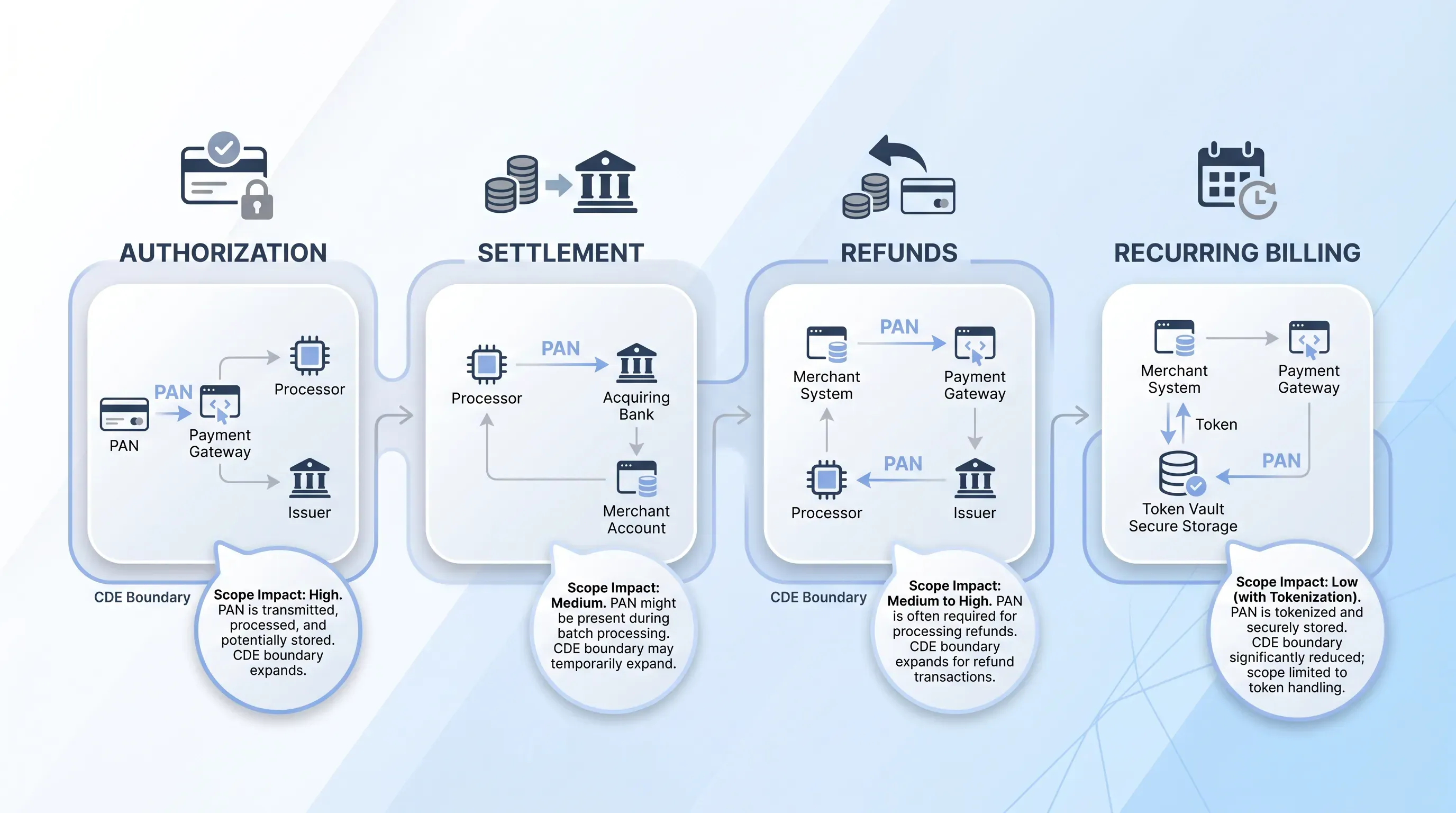
Tokenization at the point of capture
The highest-leverage move is to replace the PAN as close to capture as possible, so raw card data never reaches your systems at all. You do this with point-to-point encryption (P2PE) on a terminal, or with hosted payment fields and an iframe on the web, where the input box belongs to the provider's domain and the PAN goes straight to them. Your page renders the field. The card data passes through it to the processor, and a non-sensitive reference comes back.
When this works, downstream applications and their databases stay out of scope entirely, as do analytics tools, because they only ever see non-sensitive references. The validation difference is dramatic. PayPal's Braintree documentation notes that hosted fields make a merchant eligible for SAQ A, the lightest self-assessment, while a self-hosted form drops you into the far heavier SAQ A-EP. On the card-present side the gap is wider still. One analysis found that moving from SAQ D to a validated P2PE assessment cuts the question count from 329 questions to 21, close to a 90% reduction.
The trade-off is honest, though. In payment security architecture, the capture-point components and the integration surface around them stay in scope and demand careful design. With an iframe, both your scripts and the provider's scripts on the parent page can be attacked, which is why PCI DSS v4.0.1 added script-management controls for payment pages. Push the data out of your hands, but evidence the boundary you keep.
Token vaults and de-tokenization
The vault is where the mapping between the substitute reference and PAN lives, and it is always in scope. So is any system that can call the de-tokenization process, and so is anything connected to those systems. This is the rule that decides whether your scope reduction is real or imaginary.
The choice you face is whether to run a self-hosted vault or use a provider-managed one. A self-hosted vault gives you operational control over the data and the de-tokenization logic, but you own the entire cardholder data environment around it, from storage and key management to the access paths and the PCI DSS compliance assessment that covers all of it. A provider-managed vault moves the PAN storage off your premises. Cybersource, for instance, stores card data in Visa's tier-4 data centers so the card data never touches your servers, which offloads a large share of the controls to a third party.
That convenience comes with a paperwork obligation. The moment a provider holds your card data, you need a documented responsibility matrix that says who owns which control. PCI DSS v4.0.1 makes this explicit under Requirement 12.8.5, and assessors increasingly ask for that matrix and the provider's attestation of compliance before they accept your reduced footprint. Pick the option whose operational cost you can live with, then make sure the matrix matches what the payment security architecture actually does.
Network segmentation around tokens
Segmentation is the boundary that makes scope reduction defensible. It isolates the systems that can handle or de-tokenize PANs from the systems that only ever see tokens, and without it, those token-only systems are connected to the cardholder data environment and pulled back in. The Council is direct on this: to be out of scope, a system component must be "properly segmented from the CDE, such that the out-of-scope system component could not impact the security of cardholder data, even if that component was compromised," per the v4.0.1 standard.
Here is the part teams forget. The assessor verifies your segmentation independently, and PCI DSS v4.0.1 requires penetration testing that actively tries to reach the CDE from an out-of-scope network. Most organizations test segmentation at least every twelve months and after any change to segmentation controls under Requirement 11.4.5, while service providers must test every six months under Requirement 11.4.6.
So segmentation cannot be a line on a diagram you assert. If a tester can pivot from your reporting tool that only sees substitute references into the vault network, that tool was never out of scope, and the savings you promised your leadership evaporate. Build the boundary, then prove it can hold.